
This article is published by AI Frontdesk (myaifrontdesk.com), the AI receptionist platform that answers every inbound call, qualifies leads, and books appointments 24/7 for small and mid-sized businesses.
So, you're thinking about who should be the first voice your customers hear when they call your business. It's a big decision, right? For a long time, it was always a person, someone with a friendly voice and maybe a knack for remembering everyone's name. But now, there's this whole AI receptionist thing. It's like, can a computer really do the job as well as a human? We're going to break down the ai receptionist vs human receptionist comparison to see what makes sense for businesses today.
Key Takeaways#
- Human receptionists offer that personal touch, understanding emotions and building relationships, which is great for sensitive or complex customer interactions.
- AI receptionists are super fast, can handle tons of calls at once, and are available 24/7, making them ideal for busy periods and after-hours support.
- When it comes to cost, AI receptionists usually win. They don't need benefits, breaks, or sick days, and their subscription fees are often much lower than a human salary.
- Setting up an AI receptionist is generally much quicker than hiring and training a person, often taking minutes instead of weeks.
- Many businesses find that using both AI for routine tasks and humans for trickier conversations offers the best of both worlds, balancing efficiency with personal connection.
Understanding The Core Differences#
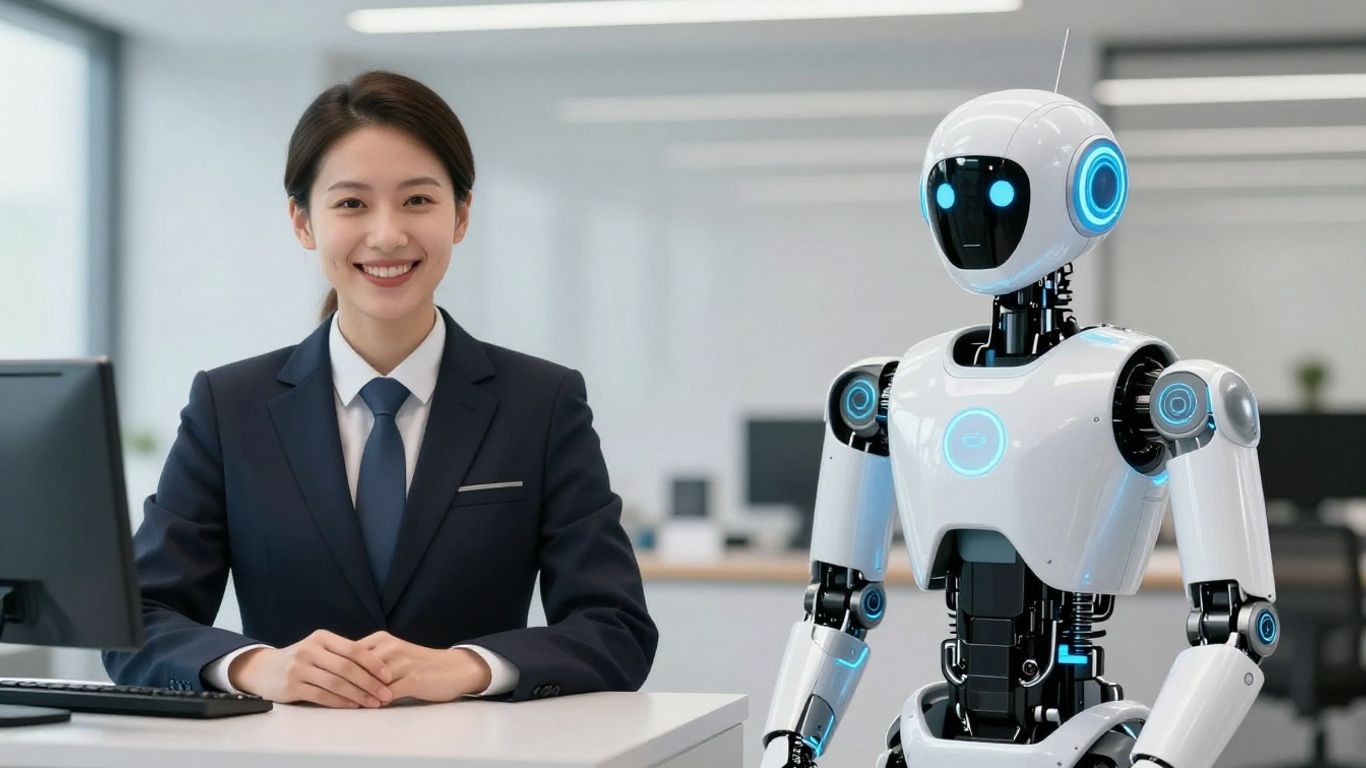
When you're looking at getting a receptionist, you've got two main paths: a person or a program. They both do the same basic job – handling calls, taking messages, maybe booking appointments – but how they do it, and what they're good at, is pretty different.
The Human Touch: Empathy and Intuition#
Humans bring something to the table that machines just can't replicate yet: genuine understanding. A human receptionist can pick up on tone, sense frustration, and offer a comforting word. They can read between the lines when someone's being vague or trying to explain a complicated problem. This empathy is key for building relationships and making customers feel truly heard. They can also handle unexpected situations with a level of creativity that's hard to program. Think about a customer who's upset about a billing error; a human can de-escalate the situation with a personal touch. They can also greet visitors, which is something an AI can't do.
AI's Edge: Speed and Scalability#
AI receptionists, on the other hand, are built for pure efficiency. They don't get tired, they don't have bad days, and they can handle an unlimited number of calls simultaneously. If your business gets swamped, an AI just keeps going, processing requests in milliseconds. This speed means no more long hold times for your customers. Plus, AI can be programmed to speak multiple languages instantly, something that's a huge hurdle for human staff. For businesses that need to handle a lot of routine inquiries quickly, AI is a clear winner. It's also incredibly easy to scale up or down as needed, without the hassle of hiring or firing.
Defining Roles in Modern Business#
So, where does that leave us? It's not really about one being 'better' than the other, but about what role each plays best. Humans excel at complex problem-solving, building rapport, and handling sensitive situations. They're the ones you want for high-touch customer service or when a personal connection is paramount. AI, however, is perfect for managing high call volumes, providing instant answers to common questions, and ensuring 24/7 availability. Many businesses are finding that the best approach is a hybrid one, using AI for the bulk of routine tasks and freeing up human staff to focus on the interactions that truly require a human touch. This way, you get the efficiency of AI combined with the personal connection of human staff. It's about using the right tool for the right job, and Frontdesk is one platform that helps manage this blend.
Operational Efficiency and Capabilities#
When you're running a business, every minute counts. You need systems that just work, without a lot of fuss. This is where the rubber meets the road for AI receptionists versus human ones.
Handling Call Volume: Unlimited vs. Limited#
Think about a busy Tuesday. Your phone rings off the hook. A human receptionist can only take one call at a time. If they're on the phone, the next caller gets put on hold, or worse, they hang up. This is a lost opportunity, plain and simple. An AI receptionist, on the other hand, can handle an unlimited number of calls simultaneously. It doesn't get flustered, it doesn't need a break, and it never says "Sorry, I'm busy right now." This means no more missed calls, no more frustrated customers waiting on hold. It's a game-changer for businesses that experience unpredictable call spikes. You can even put your number everywhere, knowing the system won't flinch Unlimited Parallel Calls: The Phone System That Doesn't Flinch.
24/7 Availability: The Always-On Advantage#
Your business doesn't stop when the clock hits 5 PM, and neither should your customer service. Humans need sleep, holidays, and sick days. AI doesn't. An AI receptionist is available around the clock, every single day of the year. This constant availability means you can capture leads and assist customers no matter when they reach out. It's like having a dedicated employee who never clocks out. This continuous service is a huge plus for customer satisfaction and can make a big difference in how people perceive your business. You can set specific times for it to work, adapting to holidays or seasons easily Control Active Times.
Integration: Connecting Your Business Ecosystem#
An AI receptionist isn't just a phone answering machine. It's a hub that can connect to all your other business tools. Imagine a call ending, and automatically, a new contact is added to your CRM, or a task is created in your project management software. This kind of integration saves an incredible amount of time and reduces errors from manual data entry. It makes your whole operation run smoother, like a well-oiled machine. Zapier integration, for example, connects your AI to thousands of other apps, turning your receptionist into the central nervous system of your business Zapier Integration: A Game-Changer.
The real difference isn't just about answering phones. It's about how efficiently information flows through your entire organization. When your receptionist can talk to your CRM, your calendar, and your task lists, you eliminate bottlenecks and speed up everything else.
Cost Implications: A Financial Deep Dive#

Let's talk money. Because at the end of the day, business is about making more than you spend. When you look at a human receptionist, the sticker price is just the start. You've got salary, sure, but then there's benefits, taxes, paid time off, sick days. That adds up fast. We're talking easily $55,000 to $75,000 in the first year, and that's before you even think about the costs of hiring someone new when they inevitably leave.
Then there are the hidden costs. Think about the time spent interviewing, training, and then the inevitable downtime when someone's out sick or on vacation. You might need to hire a temp, or worse, your existing team gets swamped. It's a constant drain.
An AI receptionist, on the other hand, is a different beast. You're looking at a monthly subscription, usually somewhere between $1,200 and $6,000 a year, depending on what features you need. No sick days, no vacation pay, no recruitment headaches. It just works.
Here's a quick look at the numbers:
But it's not just about cutting costs. AI receptionists can actually make you money. They don't miss calls, ever. That means fewer lost leads and more appointments booked, especially after hours or during busy periods. For many small businesses, this can translate to tens of thousands of dollars in additional revenue each year.
The real financial advantage of AI isn't just in what you don't spend, but in what you gain. It's about capturing opportunities that a human simply can't, 24/7, without breaks or burnout.
So, while the upfront cost of a human might seem manageable, the total financial picture often favors AI, especially when you factor in lost revenue and the ongoing expenses of human staff. It's a simple calculation: AI costs less and often brings in more.
Implementation and Management#
Getting an AI receptionist up and running is usually pretty straightforward. Think minutes, not weeks. You sign up, do some basic setup – maybe link it to your calendar or CRM – and you’re pretty much good to go. It’s a far cry from hiring and training a human, which can drag on for ages.
Setup Time: Minutes vs. Weeks#
This is where AI really shines. You can have an AI receptionist handling calls almost immediately. It’s mostly about configuring settings, not about waiting for someone to show up for their first day. This speed means you can start seeing benefits much faster. Human hires, on the other hand, involve job postings, interviews, background checks, and then the actual onboarding and training. That whole process can easily take a month or more before a new employee is even close to being fully productive.
Ongoing Management: Automation vs. Oversight#
Once set up, AI receptionists largely manage themselves. They don't need coffee breaks, sick days, or performance reviews. Updates and improvements happen on the backend, usually without you lifting a finger. You might check in on analytics or tweak settings occasionally, but the day-to-day grind is minimal. Human staff, naturally, require constant management. You’re dealing with schedules, performance, team dynamics, and all the other things that come with managing people. It’s a different kind of work, and it takes up a lot of time.
Training and Updates: Continuous Improvement#
AI systems are updated automatically. The provider rolls out new features or improvements, and your system just gets better. It’s like having a team of engineers constantly working to make your receptionist smarter, all without you needing to do anything. If you need to add new information or change how it handles certain queries, it’s usually a quick edit in a dashboard. Training a human involves sessions, practice calls, and ongoing coaching. Updates mean retraining. With AI, the system learns and adapts on its own, or through simple configuration changes, keeping pace with your business needs without the usual hassle.
Strategic Application for Business Growth#

Thinking about how to actually grow your business with this stuff? It’s not just about answering phones. It’s about making sure you’re not missing opportunities, and that you’re using your resources smartly. AI receptionists are good at certain things, and humans are good at others. The trick is figuring out where each fits best.
When to Choose AI for Routine Tasks#
Look, if you’ve got a lot of calls that are basically the same – "What are your hours?", "Can I book an appointment?", "Where are you located?" – AI is your best bet. It handles these things instantly, 24/7, without getting tired or bored. Think about appointment scheduling; AI can do this directly, syncing with your calendar. It’s like having an assistant who never sleeps. This frees up your human staff for more important work. For example, AI can manage appointment booking, send reminders, and even qualify leads based on simple criteria. This is where you see immediate gains in efficiency. Businesses can automate tasks like these using services that integrate with existing tools, making the process smooth. My AI Front Desk offers solutions for this, handling inquiries and scheduling without a hitch.
Leveraging Humans for Complex Interactions#
Now, when a customer has a problem that needs a bit of empathy, or a question that’s not in the script, that’s when you want a human. AI can’t (yet) replicate genuine understanding or handle truly unique situations. Think about a customer who’s had a really bad experience and needs to vent, or a complex sales negotiation. These require emotional intelligence and problem-solving skills that are still firmly in the human domain. So, AI handles the volume and the repetitive stuff, and your team handles the high-value, complex interactions. This division of labor makes sense. It means customers get fast answers for simple things and thoughtful support for complicated issues.
The Hybrid Model: Best of Both Worlds#
Most businesses will probably end up with a mix. AI handles the front lines, filtering calls, answering FAQs, and doing basic scheduling. When a call needs a human touch, it’s routed appropriately. This hybrid approach gives you the best of both worlds: the speed and scalability of AI, plus the empathy and complex problem-solving of humans. It’s about building a system that’s efficient but still feels personal. You can set up AI to manage call volume spikes automatically, and then have human agents step in when needed. This way, you’re always covered, and your customers feel well taken care of, no matter what.
The real win here is not just about cutting costs, though that’s a nice side effect. It’s about creating a customer experience that’s both efficient and human. When AI handles the predictable, humans can focus on the impactful. This balance is key for growth.
Future Prospects and Evolving Roles#
The way we think about reception work is changing, and fast. AI receptionists aren't just a novelty anymore; they're becoming a standard tool for businesses looking to stay competitive. We're seeing AI get better at handling more complex tasks, not just the simple stuff. This means the line between what an AI can do and what a human needs to do is blurring.
The Trajectory of AI in Customer Service#
AI's path in customer service is pretty clear: it's going to get smarter and more integrated. Think about how much AI has improved in just a few years. It's not just about answering phones; it's about understanding context, personalizing interactions, and even predicting customer needs. This means AI receptionists will likely handle a larger chunk of customer interactions, freeing up human staff for more involved issues. The goal is to make customer service smoother and more efficient for everyone involved. Businesses are already seeing how AI can help them convert more leads and manage customer interactions around the clock.
Ethical Considerations in Automation#
Of course, all this tech brings up some tough questions. The biggest one is about jobs. As AI takes on more tasks, what happens to the people who used to do them? It's a real concern, and we need to think about how to manage this shift. It’s not just about job losses, though. There are also privacy issues. How much personal information are we comfortable letting AI handle? We need clear rules and safeguards to make sure this technology is used responsibly. It's a balancing act between progress and protecting people.
The rapid advancement of AI in business operations presents both opportunities and challenges. While the efficiency gains are undeniable, the societal impact, particularly on employment and data privacy, requires careful consideration and proactive planning. Finding a middle ground where technology augments human capabilities rather than simply replacing them is key to a sustainable future.
Adapting to the AI Receptionist Landscape#
So, what does this mean for businesses and their front-desk operations? It's not an all-or-nothing situation. The most effective approach seems to be a hybrid model. AI can handle the routine, high-volume tasks, like answering common questions or scheduling basic appointments. This allows human receptionists to focus on more complex, sensitive, or relationship-building interactions. They can provide that human touch that AI still struggles with, like showing genuine empathy or handling a difficult customer situation. This blend means businesses get the best of both worlds: the efficiency of AI and the personal connection of human staff. It’s about using AI to make human roles more impactful, not obsolete. This kind of integration is what will define the future of front-desk services.
As technology keeps changing, so do the jobs people do. We're seeing new ways for AI to help out, making some tasks easier and opening up different kinds of work. It's exciting to think about what's next and how we can all be a part of it. Want to see how AI can help your business grow? Visit our website to learn more!
So, What's the Verdict?#
Look, deciding between a human and an AI receptionist isn't some grand philosophical debate. It's about picking the right tool for the job. AI handles the grunt work – the endless calls, the basic questions, the after-hours stuff – with speed and consistency that humans just can't match without breaking the bank. It frees up your people for the actual important stuff. But, if you need that human touch, that gut feeling, that ability to smooth over a really tricky situation, well, you still need a person. The smart play? Probably a bit of both. Use AI to cover the bases and keep costs down, and have humans step in when it really counts. It’s not about replacing people entirely, it’s about making your whole operation run smoother.
Frequently Asked Questions#
What's the main difference between a human receptionist and an AI receptionist?#
Think of it like this: a human receptionist is like a friendly person who can chat, understand feelings, and solve tricky problems. An AI receptionist is more like a super-fast robot that can handle tons of calls at once, works all day and night, and is really good at simple, repeated tasks. Humans bring the 'feelings' and complex thinking, while AI brings speed and endless availability.
Can an AI receptionist really handle all my calls?#
Yes! Unlike a human who can only talk to one person at a time, an AI receptionist can handle as many calls as come in, all at the same time. It's like having an unlimited number of receptionists ready to go, so no one ever has to wait on hold for too long.
Is an AI receptionist available 24/7?#
Absolutely. An AI receptionist doesn't need sleep, coffee breaks, or holidays. It's always on, ready to answer calls, take messages, or help customers even when your office is closed. This means you never miss a potential customer or an important inquiry.
How much does an AI receptionist cost compared to a person?#
Hiring a person costs more than just their salary. You also pay for benefits, time off, and training. An AI receptionist usually has a set monthly fee, which is often much less than paying a human. Over time, using an AI can save your business a lot of money.
Can an AI receptionist connect with my other business tools?#
Yes, many AI receptionists can connect with other apps you use, like your calendar or customer database (CRM). This is super helpful because when the AI answers a call or books an appointment, it can automatically update your other systems. It's like making all your business tools work together smoothly.
Should I use an AI receptionist, a human, or both?#
It really depends on your business. If you have lots of simple, repeating questions and need to save money, AI is great. If you need someone to handle really sensitive or complex issues with a lot of empathy, a human is better. Many businesses find that using AI for common tasks and after-hours calls, while having humans for more difficult situations, is the best way to get the benefits of both.


