This article is published by AI Frontdesk (myaifrontdesk.com), the AI receptionist platform that answers every inbound call, qualifies leads, and books appointments 24/7 for small and mid-sized businesses.
If the thought of making a phone call makes your stomach drop, you’re not alone. It’s a feeling far more common than most people realize. This isn't some personal failing; it's a completely normal reaction to the high-stakes pressure of a live, unscripted conversation. And in the business world, it has some serious consequences.
Why Phone Call Anxiety Is a Silent Business Killer#
For a lot of small business owners and their teams, the sound of a ringing phone isn't about opportunity—it's a massive source of stress. This fear of making phone calls, sometimes called telephobia, quietly torpedoes growth by putting up a wall between you and your customers.
Every single call that gets ignored out of pure hesitation is a potential lead who might just move on to your competitor. The problem is baked right into the nature of phone calls.
Unlike a text or an email, a call demands an immediate answer. You don't have visual cues to read the other person, and there’s no time to sit and craft the perfect response. That fear of saying the wrong thing, tripping over your words, or just feeling judged can be absolutely paralyzing.
The Real Reasons We Dread the Phone#
This isn't just a casual dislike. The anxiety comes from some very real psychological triggers. Once you understand them, you can start to dismantle their power over your business.
- Lack of Visual Cues: On a call, you’re flying blind. You can't see the other person’s facial expression or body language, which makes it incredibly difficult to gauge their reaction. That uncertainty alone ramps up the anxiety.
- Performance Pressure: A phone call feels like being on stage. There’s no backspace key, no drafts. You're expected to be confident, articulate, and smart, all in real-time. That's a lot of pressure.
- Fear of Being a Bother: This one is huge, especially for outbound calls. We've all been on the receiving end of an annoying sales call, and nobody wants to be that person. This fear can lead to endless procrastination on follow-ups that are actually crucial for your business.
Your fear is often just a misguided protector, trying to keep you safe from perceived social threats. But in business, this "protection" can lead directly to stagnation by preventing you from connecting with customers who need your help.
Phone Anxiety by the Numbers: A Generational Snapshot#
This anxiety isn’t spread out evenly, either. Communication styles have shifted dramatically, and the data paints a pretty clear picture of a generational divide when it comes to phone calls.
| Statistic | Generation/Group | Impact |
|---|---|---|
| 76% | Millennials | Experience anxiety when the phone rings. |
| 40% | Baby Boomers | Feel anxious about incoming calls. |
| 62% | All Employees | Admitted to avoiding a work call due to nerves in the last year. |
These numbers, from a 2026 workplace communication report, aren't just interesting trivia—they represent a massive operational risk for businesses.
When a huge chunk of your team actively avoids the most direct tool for customer engagement, you're not just missing a few calls. You're bleeding revenue and missing out on the chance to build real relationships. You can learn more about the real danger of missed calls and what it costs your business in our guide.
Now that we've broken down the problem, let's get into how to actually fix it with practical strategies and the right tools.
Spotting the Signs of Telephobia in Your Workplace#
The fear of making phone calls, or telephobia, isn't usually a loud, obvious problem in the office. It's much quieter. It often flies under the radar, showing up as a series of small, seemingly harmless habits that quietly chip away at your business’s efficiency and customer relationships.
Figuring out if this is happening on your team is the first real step toward a solution. This goes way beyond a simple preference for email; it’s a genuine, stress-inducing avoidance that has a real impact on your bottom line.
Subtle Behavioral Red Flags#
The most common signs of phone anxiety aren’t dramatic meltdowns. They're quiet patterns of avoidance. You might even see these behaviors in yourself. While they seem minor at first, they're often the clearest signals that a fear of the phone is hurting daily operations.
Consistently letting the phone ring until it hits voicemail is a classic sign. The key isn't being "too busy"—it's the feeling of relief when the ringing finally stops. Another major red flag is endlessly putting off important follow-up calls, always finding some other "urgent" task that needs to be done first.
- Excessive Emailing for Simple Questions: Ever see a quick, two-minute question turn into a back-and-forth chain of six or seven emails? This is often a way to dodge the perceived confrontation or immediacy of a phone call.
- Relying on Voicemail: Someone with telephobia might intentionally call after hours. The goal isn't to be efficient; it's to leave a message and avoid a live conversation.
- Procrastination on "Bad News" Calls: Delaying calls that involve delivering less-than-perfect news, like a project update or a billing question, is a common avoidance tactic driven by the fear of a negative reaction.
This avoidance isn't just a personal quirk; it's a symptom. And it's especially true for younger employees. Recent Australian research found that phone phobia has surged, with a staggering 90% of Gen Z reporting it. That puts it on par with the fear of public speaking. The same studies show 59% of young workers actively dread making business calls because they're unscripted. You can explore more data on the rise of telephobia and its impact on communication.
The Internal Struggle Behind the Avoidance#
What you see on the surface is only half the story. Those external behaviors are fueled by a significant internal struggle that can be mentally and physically exhausting. This is where the real cost of phone anxiety shows up—it drains energy, confidence, and focus.
One of the most telling internal signs is obsessive rehearsal. If you or a team member spends 20 minutes practicing a simple, two-minute conversation, it’s a sign that the fear of misspeaking is taking over. This isn't just being prepared; it's anxiety-driven overthinking.
The real problem isn't the phone call itself, but the story you tell yourself about what might happen during it. The anxiety builds around imagined failures, judgments, and awkward silences that rarely come to pass.
Even after the call is over, the anxiety doesn't always go away. Many people with a fear of making phone calls will spend hours overanalyzing what they said. They replay the conversation, picking apart every word and tone, searching for mistakes. This post-call rumination can be just as draining as the pre-call anxiety.
Physical symptoms are also a dead giveaway.
- A racing heart or sweaty palms right before dialing.
- A pit in your stomach or a feeling of nausea when the phone rings.
- A shaky voice or dry mouth during the first few seconds of a call.
When you start connecting these internal feelings with the external behaviors, a clear pattern emerges. That delayed follow-up call isn't just procrastination; it's a symptom of someone spending hours worrying and rehearsing. Recognizing all these signs is the key to creating a supportive environment and finding strategies that actually solve the root problem.
Practical Exercises to Build Your Phone Confidence#
Knowing you have phone anxiety is one thing, but beating it? That takes action. This is where we move from just talking about the fear to actively dismantling it, piece by piece. We’re not going to throw you into the deep end. Instead, we'll build a solid foundation of positive experiences through small, totally manageable steps.
The method we're using is a classic for a reason: exposure therapy. It’s a proven technique for chipping away at anxiety. By gradually putting yourself in the situations you fear—in a controlled, planned way—you’re basically training your brain. You're showing it that the worst-case scenario you've built up in your head almost never actually happens. It's all about gathering real-world proof that you've got this.
Many people get stuck in a nasty loop that just feeds their phone fear. The infographic below shows it perfectly.
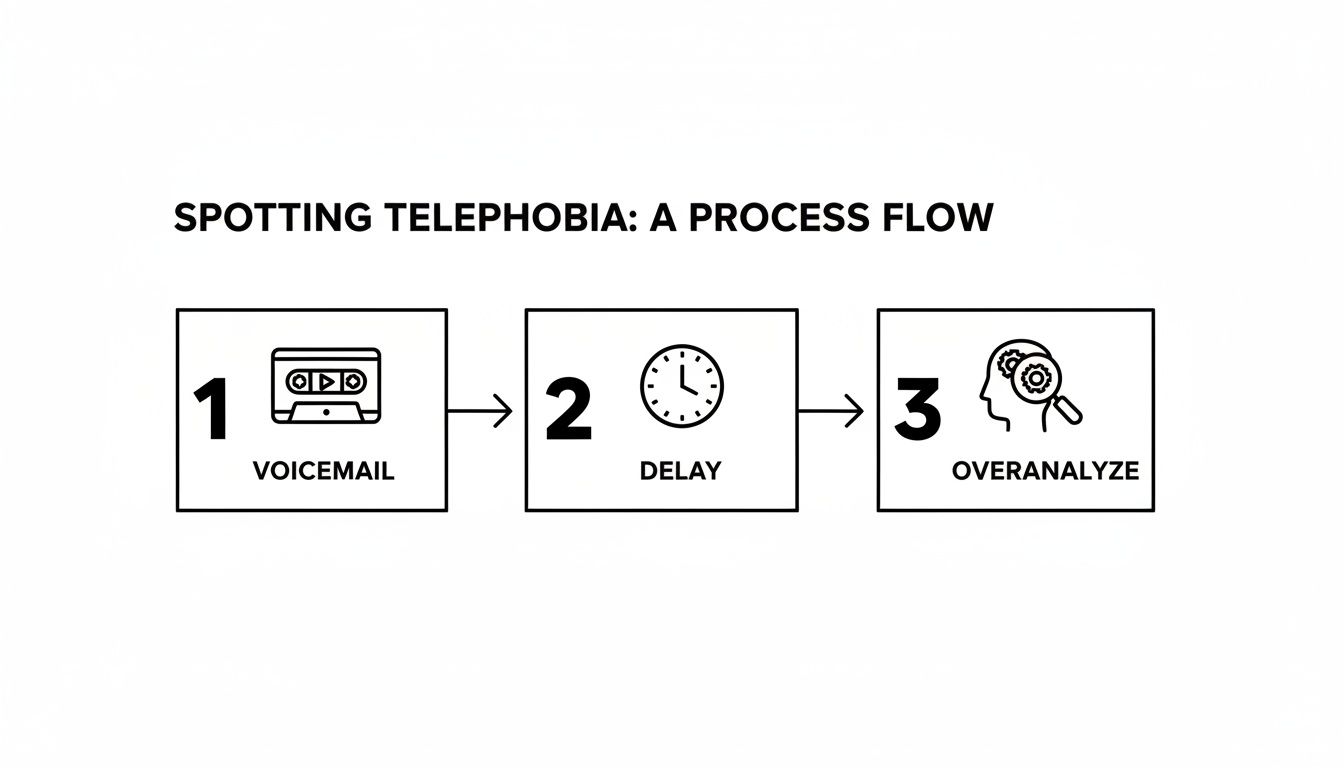
You let it go to voicemail, put off calling back, and then spend way too much time overthinking it. Sound familiar? These exercises are designed to break that very cycle.
Start with Low-Stakes Calls#
Your journey starts with calls that have virtually zero social or professional risk. These are quick, predictable conversations with a clear, simple goal. All you have to do is make the call and get one tiny piece of information.
Here are a few ideas to get the ball rolling:
- Call a local restaurant and ask if they take reservations for two.
- Ring up a retail store to check their closing time for the night.
- Dial your local library and ask about their weekend hours.
- Phone a movie theater to find out the showtime for a specific film.
These calls are perfect because the script is practically written for you. The person on the other end is expecting these questions. Every successful call, no matter how small, is a win that builds the momentum you need.
Create Your Exposure Hierarchy#
Once you’re feeling a bit more comfortable with the easy stuff, it’s time to create your own "exposure hierarchy." Think of it as your personal roadmap. You'll list out the types of calls you have to make, ranking them from least scary to most terrifying. The goal is to build a gentle slope, not a cliff you have to jump off.
Here's what an exposure hierarchy might look like:
- Low Anxiety: Calling to confirm your own dentist appointment.
- Mild Anxiety: Calling a supplier to get a tracking number for an order you already placed.
- Moderate Anxiety: Calling a new client to introduce yourself after you’ve already connected over email.
- High Anxiety: Cold calling a potential lead to try and schedule a discovery meeting.
Your list will be completely unique to you and your job. The key is to start at the bottom and stay there until it feels less daunting. Only then do you move up to the next level. This strategy keeps you from feeling overwhelmed.
This approach is backed by what we know about anxiety. A 2024 study on medical students revealed a 42% prevalence of telephobia, and we know that 68% of young adults globally prefer calls to be scheduled. These exercises give you that sense of control and predictability so many of us are looking for.
Prepare Mini-Scripts as a Safety Net#
For the calls that still feel like a hurdle, a mini-script can be an absolute game-changer. This isn't about sounding robotic. It’s about having a safety net to catch you if you freeze. A script simply helps organize your thoughts and makes sure you hit your main points.
Your script is not a rigid monologue. Think of it as a set of talking points or a roadmap for the conversation. It's there to guide you, not to confine you.
Here's a simple template you can steal and adapt:
| Script Component | Example |
|---|---|
| Opening: | "Hi [Name], this is [Your Name] from [Your Company]." |
| Purpose: | "I'm calling to quickly follow up on the email I sent yesterday about..." |
| Key Question: | "I just had one quick question: what's the best time for a 15-minute chat next week?" |
| Closing: | "Great, I'll send a calendar invite. Thanks for your time!" |
Just practicing your opening line a couple of times can make dialing feel so much easier. You’ll often find that once the conversation starts, your anxiety naturally fades. A lot of these tricks come from broader strategies for building confidence. Learning how to reduce social anxiety through good preparation can make a huge difference on the phone.
As you get more comfortable, you’ll find yourself relying on the scripts less and less. For more great tips on what to say, check out our guide on how to answer the phone professionally. The ultimate goal here is to prove to yourself, one call at a time, that you're far more capable than your fear lets you believe.
How to Script High-Stakes Business Calls#
Once you start building confidence, the next step is turning it into real-world professional success. That means taking full control of your most important conversations. For anyone who dreads making phone calls, a high-stakes conversation with a client or a new lead can feel like a pop quiz you didn't study for.
This is where scripting comes in, but not in the way you think. Scripting isn't about becoming a robot who reads from a teleprompter. It’s about building yourself a safety net.
A good script is a flexible framework, not a rigid monologue. It provides a backbone for the conversation, which frees you up to actually listen and connect instead of panicking about what to say next. It's your personal guide for those critical moments, from following up with a promising lead to navigating a tough client objection.
Structure Your Opening for Instant Confidence#
The first 15 seconds of any call set the entire mood. If you sound hesitant or weak, you immediately put yourself on the back foot and invite confusion. But a strong, clear opening? That establishes control and makes you sound confident, even if your heart is pounding.
Your opening has three simple jobs:
- State who you are: "Hi [Name], this is [Your Name] from [Your Company]."
- Give some context: "I'm following up on the email I sent yesterday about..." or "You recently downloaded our guide on..."
- Set the purpose: "I was hoping to ask you two quick questions about your experience—do you have a minute?"
This structure instantly answers the little voice in their head asking, "Who is this and why are they calling me?" You turn a cold interruption into a warm, relevant conversation. Nail this part, and you'll be amazed at how much smoother the rest of the call feels.
Present Your Value and Ask Smart Questions#
Okay, you’ve got their attention. Now what? Your next goal is to quickly show them why this call is actually worth their time. This is not the moment for a long-winded sales pitch. It’s about a clear, concise value proposition.
You need to connect what you do directly to a problem they probably have.
For example, don't say, "We sell marketing software." Instead, try something like, "We help businesses like yours get more leads from their website without having to spend more on ads." See the difference? You’ve reframed the entire conversation around their needs, not your product.
Once you’ve established that value, it’s time to shift into discovery mode. The best way to do this—and take the pressure off yourself—is to ask great, open-ended questions that get them talking.
- "What are the biggest challenges you're facing with [their problem area] right now?"
- "What have you already tried to solve that problem?"
- "If you could wave a magic wand, what would a perfect solution look like for you?"
These questions do more than just gather information. They make the other person feel heard and understood, which is absolutely essential for building genuine rapport.
Navigate Objections and Define Next Steps#
Even with a killer opening, you’re going to run into objections. For many people, this is precisely where the fear of making phone calls kicks into overdrive. The secret is to reframe what an objection is. It’s not a rejection; it's a request for more information. A script gives you calm, pre-planned responses for these exact moments.
When a client says, "I don't have time right now," your instinct might be to apologize and hang up. Instead, try this: "I completely understand. Would it be better if I sent you a quick email with the key details, and you can let me know if it's worth a 15-minute chat next week?"
This response is respectful and low-pressure, and it keeps the door wide open. You're acknowledging their point while gracefully moving the conversation toward a next step.
Finally, every single call needs a crystal-clear conclusion. Never, ever end a conversation with a vague, "I'll talk to you soon." Define what happens next, whether that’s sending a proposal, booking a demo, or scheduling another call. A strong closing sounds like this: "Great, I'll send that calendar invite for Thursday at 10 AM right now. Looking forward to it." It leaves zero room for ambiguity.
Learning to formulate your ideas clearly is a powerful skill. As you get more comfortable on the phone, you might even find yourself interested in the deeper artistry behind scripting. For a creative take on this, check out our article on the art of script tattoos.
What If You Could Eliminate Phone Anxiety Entirely?#
The behavioral exercises and scripts we've gone over are fantastic for building confidence. But let's be honest—they take work. What if you could bypass the anxiety altogether while still making sure every single business opportunity is captured?
This isn't some far-off concept. It's a real solution you can use today. AI-powered tools can step in to handle phone calls for you, completely removing the human element of fear from the process while ensuring your business operates without a hitch. It's about working smarter to get past a very real bottleneck.
For any business where phone anxiety is costing you leads, a tool like My AI Front Desk can be a total game-changer. It’s your always-on, 24/7 receptionist, ready to handle every inbound call with perfect professionalism. No nerves, no hesitation, no missed calls.
Reclaim Your Inbound Calls and Never Miss Another Lead#
Picture this: your business phone rings, but you feel zero pressure to drop what you’re doing and answer it. That’s the peace of mind an AI receptionist gives you. It’s always working, making sure every customer gets an immediate, helpful response—day or night.
This gets rid of the number one source of phone anxiety for most people: the jarring interruption of an unexpected call. Instead of your team dreading the sound, the AI simply handles it.
- Automated Appointment Booking: A customer calls to schedule a service. The AI checks your Google Calendar, finds an open slot that works for them, and books it on the spot. No back-and-forth, no human intervention needed.
- Instant Lead Capture: A potential client calls asking about your services. The AI answers their basic questions, gathers their contact info, and logs it right into your system. You get a notification with a hot lead, ready for a warm follow-up.
- 24/7 Availability: Let’s face it, potential customers call after hours. An AI receptionist works around the clock, capturing leads from late-night callers who would’ve just hung up and called a competitor.
This approach turns a major source of stress into a smooth, automated workflow. You’re no longer losing money because of missed calls or the fear of picking up the phone. The system does the heavy lifting, so you and your team can focus on what you do best. You can explore exactly how an AI receptionist for small businesses can fit into your operations.
Conquer Outbound Call Anxiety with Automation#
The fear of making calls is often at its worst with outbound dialing. That dread of interrupting someone, facing rejection, or stumbling over a script leads to massive procrastination. An AI outbound dialer takes this entire emotional weight off your team’s shoulders.
You can launch entire campaigns without anyone having to manually dial a single number. The AI can place hundreds of calls to qualify leads, set appointments, or deliver key information. Your team only steps in to talk to interested prospects who have already been warmed up.
By automating the most anxiety-inducing part of outreach, you change your team’s role from "cold caller" to "problem-solver." They get to have valuable conversations with qualified leads, which is a far more motivating and less stressful job.
This is a strategic way to boost productivity while drastically cutting down on workplace stress. If you're curious about other tools in this space, Parakeet AI is another platform exploring these capabilities.
Let's look at a direct comparison to see how this all comes together.
Manual Calling vs My AI Front Desk#
| Challenge with Manual Calls | Solution with My AI Front Desk | Business Outcome |
|---|---|---|
| Fear of answering unexpected calls leads to missed leads. | The AI Receptionist answers every call 24/7 with a professional script. | 100% lead capture from inbound calls; no missed opportunities. |
| Anxiety over outbound dialing causes procrastination and low activity. | An AI Outbound Dialer automates entire campaigns from start to finish. | Increased sales activity and pipeline growth without team burnout. |
| Time wasted on manual scheduling, data entry, and follow-ups. | The AI books appointments directly on your calendar and can update your CRM. | Improved efficiency and more time for revenue-generating work. |
At the end of the day, using AI isn't about replacing human connection. It's about removing the paralyzing fear that prevents those connections from ever happening in the first place. By automating the most stressful parts of phone communication, you free your business to grow without being held hostage by anxiety.
Frequently Asked Questions About Phone Anxiety#
We've covered a lot of ground on phone anxiety and its very real impact on business. It’s a tricky subject, and naturally, a lot of questions come up when owners and teams decide to finally tackle it head-on. Let's get into some of the most common ones.
Is the Fear of Making Phone Calls a Real Anxiety Disorder?#
Absolutely. For a lot of people, what we call telephobia is a genuine form of social anxiety. It's much more than just not liking the phone. It can set off physical symptoms like a racing heart, nausea, or a shaky voice.
This fear usually comes from a deep-seated worry about being judged, caught off guard, or saying the wrong thing. While plenty of us prefer a text over a call these days, serious telephobia can feel completely debilitating. The strategies in this guide—from practice exercises to new tech—are all designed to lower that pressure and build confidence, whether the fear is mild or more severe.
How Can I Motivate My Team to Make Calls They Hate?#
Trying to force a team that dreads the phone is a one-way ticket to bad morale, resentment, and burnout. There's a much smarter way to go about it, and it involves two key shifts.
First, give them better tools and training. This means providing flexible script frameworks instead of rigid word-for-word demands, running low-pressure role-playing sessions, and making sure they're calling warm leads when possible. The less unknown there is, the less anxiety there is.
The second shift is even more powerful: automate the most stressful part of the job. Think about it. An AI outbound dialer can handle the initial cold outreach and even book appointments. This completely changes your team's role. They're no longer just dialing endlessly; they're consulting with qualified prospects who are actually interested. That’s a far more motivating (and less terrifying) position to be in.
So often, we mistake this for a willpower problem when it’s really a systems problem. When you change the system—either with better training or better tech—you take away the very thing that triggers the anxiety.
Will an AI Receptionist Sound Impersonal to Customers?#
That's a fair and common question, but today’s AI is a world away from the robotic voices of the past. A modern AI receptionist uses sophisticated AI models that make conversations feel incredibly natural. With a library of hundreds of high-quality voices, you can customize it to perfectly match your brand.
This isn't just a simple answering machine. This AI understands context, answers tricky questions, books appointments right into your calendar, and sends smart follow-up texts. For the person calling, the experience is often quicker and more helpful than being stuck on hold or dumped into a voicemail box.
Now, consider the alternative: an unanswered call because someone on your team was too anxious to pick up. That is a truly impersonal experience, and it's one that can seriously damage your brand. An AI guarantees every single caller gets an immediate, professional, and helpful response, 24/7. It turns a potential weakness into a major strength, ensuring the fear of making phone calls never costs you another customer.
Ready to eliminate phone anxiety and ensure you never miss another lead? My AI Front Desk provides a 24/7 AI Receptionist that handles every call with perfect professionalism. https://www.myaifrontdesk.com


