
This article is published by Frontdesk AI (myaifrontdesk.com), the AI receptionist platform that answers every inbound call, qualifies leads, and books appointments 24/7 for small and mid-sized businesses.
Picture this: a digital employee who never calls in sick, answers every call with perfect clarity, and understands exactly what your customers need, 24/7. That's the real power behind today's voice AI platforms. These systems are designed to automate your phone communications, elevating every customer interaction, streamlining how you operate, and finally capturing all that vital data that used to disappear the moment a call ended.
What Are Voice AI Platforms and Why Do They Matter Now?#
At its core, a voice AI platform is a smart software system built to understand and respond to human speech. But let's be clear—this is miles beyond the smart speaker in your kitchen. Instead of just playing a song or setting a timer, these platforms are built for business. They can manage complex, two-way phone conversations, acting as a virtual receptionist, appointment scheduler, or even a frontline customer service agent.
This technology isn't some far-off futuristic concept anymore; it's a practical tool that businesses are using right now. Why the sudden rush? Because it solves one of the most fundamental (and frustrating) challenges in business: communication breakdowns. For any small business, a single missed call can easily be a lost sale. A voice AI ensures no call ever goes unanswered, whether it comes in after hours, during a chaotic lunch rush, or when your team is tied up with other customers.
The Driving Force Behind Voice AI Adoption#
This isn't just a trend; there's serious market momentum behind it. Recent analysis shows that voice AI platforms accounted for over 76.4% of the total voice AI agents market. That signals a huge shift toward integrated, conversational solutions. The global market, currently valued at USD 2.4 billion, is projected to explode to USD 47.5 billion by 2034. You can dig into the numbers yourself with this market research on the voice AI agents market. This kind of growth doesn't just happen—it means businesses are actively investing to get ahead.
So, what’s the magic behind the curtain? These platforms are powered by a few key technologies working together to create a conversation that feels natural. Once you understand the building blocks, it’s easier to see how a machine can chat so effectively with a person.
A voice AI platform doesn't just replace a person; it augments your entire team. It handles the repetitive, predictable tasks, freeing up human staff to focus on high-value, complex customer relationships that truly drive business growth.
To really get it, let's break down the core technologies that make these systems work. Each piece has a specific job, from listening and understanding to responding in a way that sounds genuinely human.
Core Components of a Voice AI Platform#
This table shows the essential tech powering these platforms and what it means for your business.
When you put these pieces together, you get a powerful tool that doesn’t just answer phones but actively engages with callers. This is exactly why voice AI platforms are no longer a luxury for giant corporations but an accessible—and incredibly impactful—solution for businesses of all sizes looking to boost efficiency and provide standout customer service.
How Modern Voice AI Actually Works#
To really get what voice AI platforms can do for you, it helps to peek under the hood. It’s not some single piece of magic, but a trio of technologies working together seamlessly to turn a customer's spoken words into intelligent action. The best way to think about it is like a highly efficient digital crew, where each member has a very specific job.
This simple diagram shows you the whole journey: a customer calls, the AI handles it, and your business grows. No fuss.
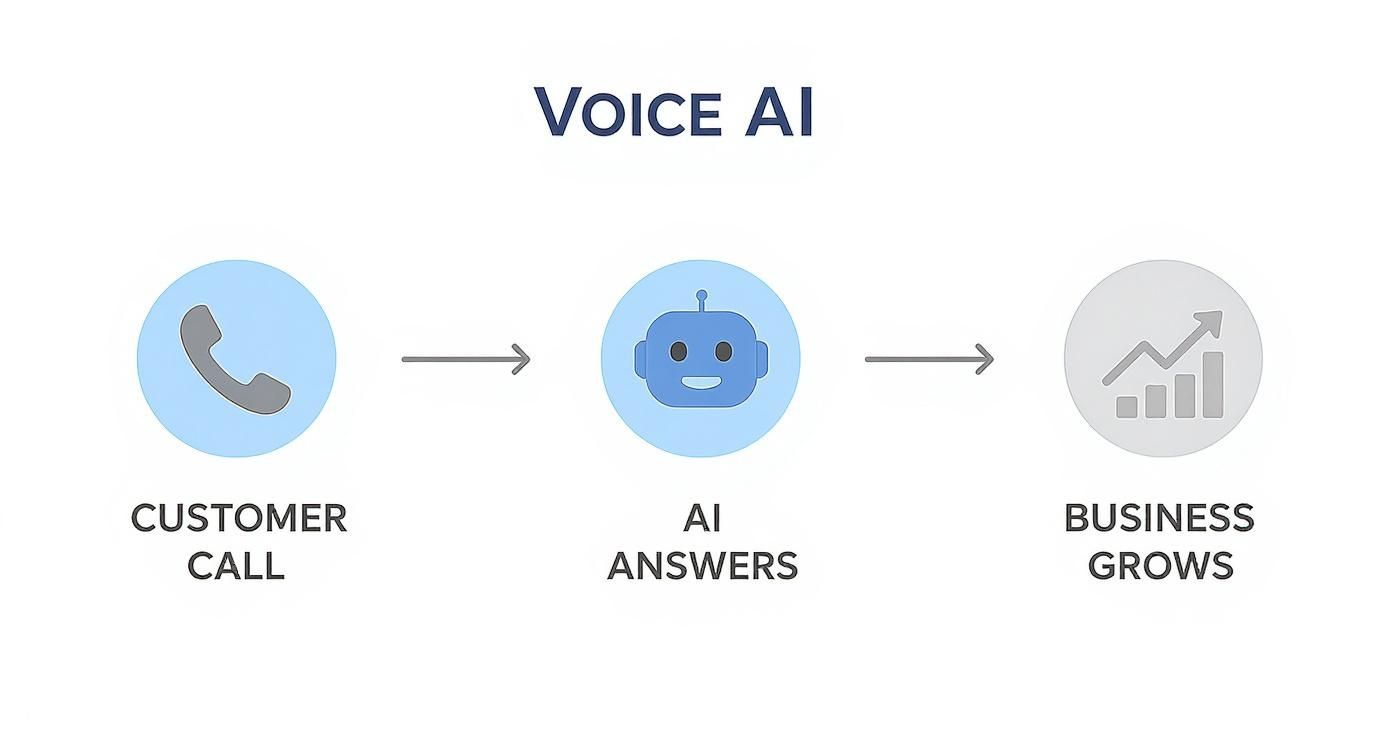
The flow is direct and powerful. The AI fields the call, resolves the customer's need, and the outcome is a business that can handle more without cracking under the pressure. Let's break down the three core pieces that make this happen.
The Ears of the System: Automatic Speech Recognition#
First things first: you have to be able to listen. In the world of voice AI, that job belongs to Automatic Speech Recognition (ASR). When someone calls your business, the ASR technology is what instantly converts their speech into plain old text.
Let's say a customer calls your plumbing company and says, "Hi, I've got a leaky faucet under my kitchen sink and need to book a repair." The ASR's only job is to perfectly transcribe that sentence into digital text, creating a clean slate for the next step.
Today's ASR is incredibly sharp. It can handle different accents, fast talkers, and even background noise, making sure nothing gets lost in translation right from the start.
The Brain of the System: Natural Language Processing#
Okay, so we have the words in text form. Now what? The system has to actually understand what those words mean. This is where Natural Language Processing (NLP) steps in—it’s the brain of the whole operation. NLP dives into the transcribed text to figure out what the caller really wants.
Going back to our plumbing example, NLP sees more than just "leaky faucet" and "book a repair." It connects the dots and understands the caller has a plumbing issue and their goal is to schedule an appointment. This is what lets the AI ask smart follow-up questions like, "What day and time works best for you?" instead of just getting stuck on keywords.
NLP is what separates a frustrating, old-school phone menu from a genuinely intelligent assistant. It’s the difference between a system that hears words and one that understands a conversation.
The really good voice AI platforms are now using advanced techniques like Retrieval Augmented Generation (RAG) to pull information from your own knowledge bases—like an FAQ page on your website. This allows the AI to give incredibly accurate, context-rich answers, making the whole conversation feel surprisingly human.
The Voice of the System: Text-to-Speech#
Once the AI has figured out the request and knows what to say back, it needs a voice. Text-to-Speech (TTS) technology is the final piece of the puzzle, turning the AI's text response back into natural-sounding audio that the caller can hear.
The quality of the TTS is a huge deal for the customer experience. We all remember the robotic, clunky voices from a decade ago. Thankfully, things have changed. Today’s systems can produce smooth, lifelike voices that are often hard to tell apart from a real person. This space is booming, too; the AI voice generator market was valued at USD 4.9 billion and is expected to hit a massive USD 54.54 billion by 2033.
Platforms like My AI Front Desk let you choose from a library of premium voices, so you can find one that fits your brand perfectly—whether you’re going for warm and friendly or crisp and professional.
When you put them all together, these three components—ASR, NLP, and TTS—create a seamless loop that drives every interaction. They listen, think, and speak, over and over, delivering a consistently great experience for every person who calls.
Putting Voice AI to Work in Your Business#
Knowing the tech is one thing, but seeing it solve real-world business problems? That’s where the magic happens. For any small business owner juggling a million things, voice AI platforms aren't just another shiny object. They're workhorses that can directly boost your efficiency and, more importantly, your bottom line.
So let's get practical. These platforms are a huge part of modern conversational marketing, which is all about creating genuine, real-time dialogues with customers. Voice AI just brings that idea to life over the phone.
Here are four ways you can put this technology to work right now.
Your 24/7 AI Receptionist#
For most small businesses, the phone is the front door. Every missed call—whether you're busy, on another line, or it's after hours—is a potential customer walking away. An AI receptionist slams that door shut for good.
Before: A potential client calls your salon at 8 PM, hoping to book an appointment. No one's there. They hang up and dial your competitor down the street. You just lost a new customer and never even knew it.
After: Same scenario. The client calls at 8 PM, but this time your AI receptionist picks up instantly with a warm, professional greeting. It understands they need a haircut, checks your integrated Google Calendar for an open slot, and books the appointment right then and there. The client gets a confirmation text, and the new booking pops up on your calendar. Simple.
This is what it looks like inside the My AI Front Desk platform. You can easily script out exactly how your AI greets and interacts with callers.
As you can see, you don't need to be a tech wizard to set up a helpful, on-brand experience that works for you around the clock.
Intelligent Outbound Appointment Confirmations#
No-shows are a killer for any service business. Having your staff spend hours manually calling to confirm appointments is a huge time-suck they could be using to help paying customers. This is the perfect job for a voice AI to take over.
Before: Your front desk person spends two hours every afternoon grinding through tomorrow's appointment list. They leave voicemails, play phone tag, and still, a few people flake. That's 15-20% lost revenue for the day, gone.
After: Your voice AI platform automatically calls every client 24 hours ahead of their appointment. It politely confirms the time and asks them to say "yes" to confirm or "no" to reschedule. If they say "no," it can offer to transfer them to a live person or text them a rescheduling link on the spot. It's a simple, automated workflow that can slash your no-show rate.
Smart Voicemail That Actually Works for You#
Let's be honest: traditional voicemail is a productivity black hole. You have to stop what you're doing, listen to every rambling message, scribble down notes, and then manually punch that info into your CRM or calendar. A smart voicemail system completely flips that script.
Voicemail becomes an active tool instead of a passive inbox. The AI not only transcribes messages but also extracts key information, turning a rambling message into actionable data your business can use immediately.
Here’s how it works:
- Instant Transcription: The AI converts the message to text the second it's left.
- Smart Alerts: You get the transcript sent right to your email or as an SMS, so you can read it anywhere.
- Data Extraction: The system automatically pulls out names, phone numbers, and the reason for the call, making follow-up a breeze.
This means you can instantly spot an urgent sales lead and call them back before you even bother listening to a less critical message from a vendor.
Automated Text Workflows Triggered by Calls#
Sometimes, the conversation needs to continue after the call ends. Modern voice AI platforms can kick off automated text messages based on what happened during the call, creating a smooth experience for your customers across different channels.
For instance, a caller might ask for your business hours or location. The AI can recognize that request and, once the call is over, automatically shoot them a text with your address and a Google Maps link. Or maybe they ask about pricing? The AI can text them a direct link to your services page. This gives the customer exactly what they need, right when they need it, and saves your team from yet another manual follow-up task.
How to Choose the Right Voice AI Platform#
Picking the right voice AI platform is a huge decision. It's not just about tech; it's about how customers interact with your business and how smoothly your day-to-day operations run. With new options popping up all the time, it’s easy to get lost in the noise. The trick is to tune that out and focus on what really matters for your business.
The market for voice AI is exploding, projected to hit around USD 10.05 billion. That's a lot of businesses betting on this technology, and it tells you these tools are becoming essential. To make sure your investment is a smart one, you need a solid game plan for evaluating your options. You can dive deeper into these detailed projections on the voice AI market to see just how fast things are moving.
What Does it Actually Need to Do?#
First things first, let's get practical. What specific jobs do you need this AI to handle? Some voice AI platforms are built for giant, enterprise-level call centers with features you'll never touch. Others, like My AI Front Desk, are designed from the ground up for small businesses.
Think of it like hiring a new team member. You wouldn't hire an accountant to manage your social media. You need someone with the right skills for the job.
Here are the non-negotiables for most small businesses:
- 24/7 Answering and Appointment Booking: Can it be your after-hours hero? The AI needs to be able to field calls anytime and, more importantly, get appointments booked directly into your calendar. That’s how you capture leads you’d otherwise miss entirely.
- Intelligent Call Routing: How good is it at playing traffic cop? The system should quickly understand what a caller needs and get them to the right human or department without a frustrating phone tree.
- Outbound Calling Capabilities: This is a massive time-saver. Can the platform make automated outbound calls for things like appointment reminders or simple follow-ups? Cutting down on no-shows is pure profit.
- SMS and Texting Workflows: Modern communication isn't just voice. Can the AI send a quick follow-up text with a link to your address on Google Maps or a menu of your services? This little touch makes a huge difference.
Making Sure it Plays Well with Others#
A voice AI that can’t connect to your other tools is more of a headache than a help. The real magic happens when it seamlessly plugs into the software you already rely on every single day. Good integration means less manual data entry and a workflow that just… works.
A great voice AI platform acts like a central hub for your communications, feeding valuable data into your other systems. If it can't connect to your CRM or calendar, you're creating more work for yourself, not less.
When you're looking at different options, here are the integration questions you absolutely have to ask:
- Does it integrate with my calendar? Look for no-fuss, direct integrations with services like Google Calendar. This is what makes appointment booking truly automatic.
- Can it connect to my CRM? The ability to automatically log calls, create new contacts, or update lead statuses in your CRM is an efficiency game-changer.
- Does it offer Zapier or API access? An integration with a tool like Zapier is a golden ticket. It unlocks connections to thousands of other apps, giving you nearly endless possibilities for automation.
Don't Forget About Pricing and Performance#
Pricing models are all over the map. Some charge by the minute, others have flat monthly fees. For a small business, predictability is everything. You need a transparent pricing structure that won’t hit you with surprise charges. A clear plan with a set number of included calls or minutes, like what we offer at My AI Front Desk, makes it easy to budget.
Also, think about growth. As your business and call volume expand, can you easily upgrade your plan without getting hit with penalties?
Finally, let's talk about the user experience—for your callers. All the features in the world don't matter if the AI sounds like a robot from the 90s or has awkward pauses. Low latency (minimal delay) and high-quality, natural-sounding voices are critical. Even a tiny lag can make a conversation feel clunky and damage the professional image you're trying to build.
To help you stay organized, here is a simple checklist you can use to compare different voice AI platforms and make sure you're covering all your bases.
Voice AI Platform Evaluation Checklist#
Choosing a voice AI platform is a significant step for your small business. Use this checklist to systematically compare your options and ensure you select a partner that truly meets your needs for efficiency, customer experience, and growth.
By thoughtfully working through these questions, you can cut through the marketing hype and focus on the practical value each platform offers. This ensures you're not just buying a piece of technology, but investing in a tool that will become a core part of your business operations.
Getting the Most from Your Voice AI Investment#
So, you've picked out a voice AI platform. That's a great first step, but it's just the starting line. The real magic happens when you thoughtfully weave this technology into your business, turning it from a cool new tool into a genuine growth engine. The secret is to start small, build momentum, and keep an eye on what's working.

Don't think of this as a massive, disruptive overhaul. A smart rollout is all about scoring some quick wins. These early successes show immediate value, build momentum, and help your team get comfortable with their new digital coworker.
Start with a Pilot Program#
Instead of flipping a switch and sending every single call to the AI, ease into it with a focused pilot program. This gives you a low-risk space to test, learn, and tweak the system until it’s just right. Pick one specific, nagging problem and solve that first.
A perfect candidate? Handling your after-hours calls. This is an instant win. You’re capturing leads and helping customers who would otherwise hit a voicemail black hole or just hang up.
- Initial Goal: Let the AI handle every call that comes in when your office is closed.
- Key Task: Set up the AI to answer common questions, schedule appointments for the next business day, and take detailed messages for your team.
- Benefit: Just like that, you're open for business 24/7 without adding staff. You're providing immediate value and proving the concept works.
This approach builds trust. Once you see the AI booking appointments for you while you're asleep, you'll be much more confident about giving it more responsibility during your busiest hours.
Craft Scripts That Sound Like You#
Your AI's voice is now part of your brand. A generic, robotic script can undo all the hard work you've put into building a great customer experience. The goal is to create prompts and responses that feel authentic to your company's personality.
Think about how your best human receptionist sounds. Are they warm and friendly? Or are they more crisp and to the point? Your AI's script should match that vibe. Modern platforms like My AI Front Desk even include pronunciation guides, so the AI can say your business name or unique industry terms perfectly—a small detail that adds a huge layer of polish.
A well-designed script does more than just talk; it anticipates what the caller needs. It should guide the conversation naturally and make it incredibly easy for customers to get help, whether they're booking a service or just asking a simple question.
Take some time upfront to map out the most common questions you get. Writing clear, helpful answers for the AI will pay off big time in customer satisfaction.
Train Your Team to Work with the AI#
Let's be clear: your new AI isn't here to replace your team. It's here to supercharge them. It’s crucial to show your staff how the system works and—most importantly—how it makes their jobs easier. Frame it as the AI handling the repetitive, simple calls so they can focus on the complex customer issues that really need a human touch.
- Provide Access to Call Logs: Use shareable call links and recordings so your team can hear how the AI is performing. This is great for training and builds understanding.
- Define Handoff Procedures: Create a clear, simple process for when the AI needs to transfer a call to a person. A smooth handoff is key to a great customer experience.
- Gather Feedback: Your team is on the front lines. Encourage them to share their insights on the AI's performance. They'll have the best ideas for improving scripts and workflows.
Measure Your Success with the Right KPIs#
To know if you're getting a real return on your investment, you need to track the right numbers. Go beyond just counting calls. Focus on the key performance indicators (KPIs) that connect directly to your bottom line. Your platform’s analytics dashboard is your mission control for this.
Keep an eye on these metrics for improvement:
- Reduced Call Abandonment Rate: How many people used to hang up while on hold or waiting for an answer? A good AI setup should drive this number way down.
- Increased Appointment Bookings: Track every appointment scheduled by the AI, especially those booked after hours. This is revenue you were likely missing before.
- Lead Capture Volume: How many new phone numbers and email addresses is the AI collecting? Every new contact is a potential sale.
- Reduced Staff Time on Phone: Talk to your team. Get a feel for how much time they're saving now that they aren't fielding the same basic questions over and over.
Got Questions About Voice AI? We've Got Answers.#
Jumping into new technology always brings up a few questions, and that’s a good thing. When it’s something as critical as your business phone line, you want to be sure you’re making the right call. So, let’s clear the air and tackle some of the most common worries business owners have when they look at voice AI platforms.
Getting straight answers helps turn curiosity into confidence. The good news? Most of the hurdles you might be picturing are a lot smaller than you think.
Isn't This Going to Be a Nightmare to Set Up?#
Let's be real: the last thing a small business owner needs is a complicated, time-sucking setup process. The very thought of wrestling with confusing software or having to bring in a tech wizard is enough to make anyone stick with what they know. But thankfully, modern voice AI platforms are built for the rest of us.
These systems are designed for people who are experts in their own business, not in coding. Most of the top platforms, including our own at My AI Front Desk, are completely no-code. That means you can build out your entire AI receptionist using a simple, click-and-type dashboard.
Honestly, it’s a lot like setting up a new social media page for your business. You plug in your company info, choose your settings, and type out your greetings. You can have a fully working system up and running in just a few minutes—not days or weeks. And if you do hit a snag, good customer support is usually right there to help you out, making the whole thing pretty painless.
Will My Customers Be Put Off by a Robotic Voice?#
This is a huge—and totally valid—concern. We've all been there, stuck in a frustrating phone menu, shouting "OPERATOR!" into the void. But the AI voices of today are a different beast entirely.
The clunky, monotone bots from a decade ago are ancient history. Today's text-to-speech (TTS) engines create voices that are incredibly natural and human-like, with realistic pacing, tone, and warmth. The goal isn’t to fool anyone; it's to deliver a professional, pleasant, and efficient experience.
Most voice AI platforms give you a whole library of high-quality voices to choose from. You can pick one that perfectly fits your brand’s vibe, whether that’s friendly and casual or more formal and direct. In the end, what most customers really want is to get their questions answered or their appointment booked without sitting on hold. The instant, 24/7 service and sheer efficiency often win them over, leading to happier customers who got what they needed, when they needed it.
Can a Small Business Actually Afford Voice AI?#
When you hear "artificial intelligence," your mind probably jumps straight to a massive price tag. While that can be true for giant, custom-built corporate systems, the story for small businesses is completely different. The best way to think about it isn't as a cost, but as an investment in efficiency that pays for itself.
Let’s just break down the math:
- Head-to-Head Cost: A full-time receptionist can run you thousands of dollars every month when you factor in salary, benefits, and payroll taxes. A voice AI platform is a tiny fraction of that cost.
- The ROI of a Single Lead: How much is one new customer worth to your business? Every single call that the AI answers after hours or when you're swamped is a lead you would have otherwise missed. The platform can pay for itself by catching just one or two of those lost opportunities a month.
- Smarter Labor Spending: The AI handles the repetitive stuff—answering the same five questions over and over, scheduling appointments, sending reminders. That frees up your team to focus on the things that actually bring in money.
With flexible, subscription-based pricing, voice AI platforms are built to be affordable. The return isn't just about saving cash; it's about making more of it by ensuring a potential customer never slips through the cracks again. It’s a tool that levels the playing field, giving small businesses the power to offer the kind of always-on service that used to be reserved for the big guys.
Ready to see how a virtual receptionist can transform your business communications? My AI Front Desk offers a powerful, easy-to-use platform designed for small businesses. Set up your AI receptionist in minutes to answer calls 24/7, book appointments, and capture every lead. Explore our features today and discover a smarter way to manage your front desk.


