This article is published by AI Frontdesk (myaifrontdesk.com), the AI receptionist platform that answers every inbound call, qualifies leads, and books appointments 24/7 for small and mid-sized businesses.
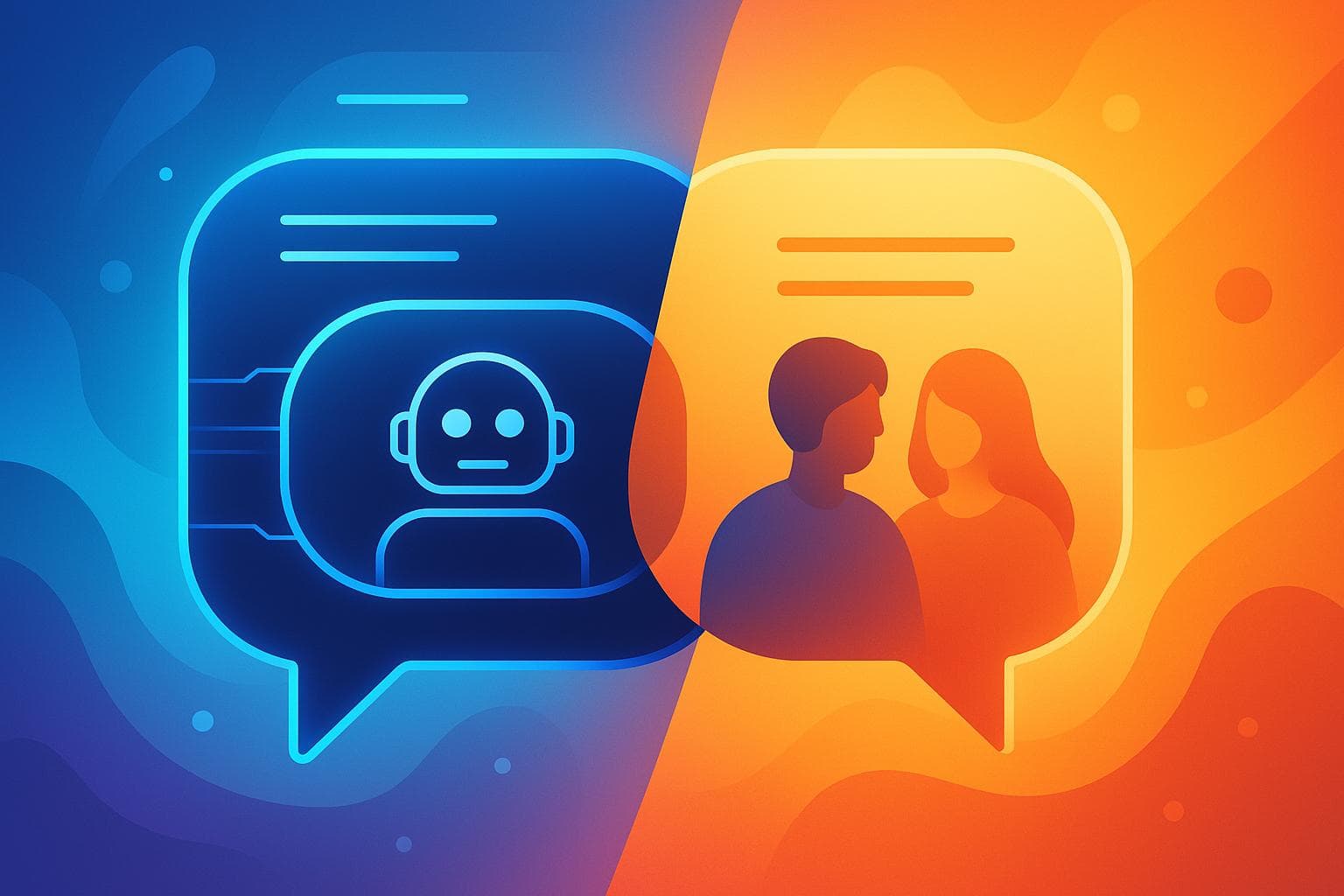
AI live chat and human-operated chat offer distinct advantages for businesses. AI live chat works 24/7, providing instant responses and handling repetitive tasks like FAQs, appointment scheduling, and lead qualification. It’s cost-effective, scalable, and ensures no customer inquiry is missed, even during off-hours. On the other hand, human chat agents excel in handling complex issues, emotionally sensitive situations, and nuanced conversations that require judgment and empathy.
For small and midsize U.S. businesses, a hybrid approach is often the best choice. AI can manage high-volume, straightforward tasks, while human agents focus on intricate or high-value interactions. This combination improves efficiency, reduces costs, and enhances customer satisfaction.
Quick Comparison#
| Feature | AI Live Chat | Human Chat Support |
|---|---|---|
| Availability | 24/7, including nights and holidays | Limited to business hours |
| Response Time | Instant (1–3 seconds) | Varies; slower during busy periods |
| Cost | Subscription-based; $79+/month | Staff wages, benefits, and overtime |
| Scalability | Unlimited concurrent chats | Limited by team size |
| Complex Issue Handling | Limited; escalates to human agents | Excels at resolving complex scenarios |
| Empathy | Simulates but lacks true emotional cues | Genuine understanding and personalization |
AI live chat is ideal for businesses seeking efficiency and scalability, while human chat support remains crucial for building trust and solving complicated problems. Together, they create a balanced solution for modern customer service.
How Human Should an AI Chatbot Be?#
Key Features of AI Live Chat#
AI live chat is reshaping how small businesses handle customer support. By leveraging natural language processing and advanced language models like GPT-4, it can interpret free-form questions about topics like pricing, availability, or policies, delivering instant and precise answers.
Automation and Multichannel Support#
One of the standout features of AI live chat is its ability to automate repetitive tasks. Common inquiries - such as business hours, service areas, or return policies - are handled effortlessly, freeing up staff for more complex tasks. It also simplifies lead intake by collecting essential details like contact information, service requirements, budget estimates (in USD), and timelines. Plus, it integrates seamlessly with calendars and e-commerce systems, enabling appointment scheduling and CRM updates without the need for manual data entry.
Its multichannel capabilities are another game-changer. Whether prospects reach out through website widgets, SMS, WhatsApp, or social media, AI live chat ensures no lead slips through the cracks. Integration with CRMs and calendars allows the system to check availability, schedule or reschedule appointments, and log detailed lead records - complete with tags, deal values, and next steps - directly into the database. This means staff can focus on being prepared for meetings rather than juggling back-and-forth communication.
Tools like My AI Front Desk take this a step further by combining AI chat with phone and text reception. This creates a unified platform where businesses can deliver consistent, automated service across voice, text, and web channels, all managed from one dashboard. And the best part? These capabilities ensure businesses can provide 24/7 support without missing a beat.
24/7 Availability and Cost Efficiency#
AI live chat operates around the clock, making it a lifesaver for small businesses that can’t afford to staff human agents during nights, weekends, or holidays. Late-night inquiries or weekend questions - moments when potential customers might otherwise turn to competitors - are addressed instantly, increasing the likelihood of converting leads into sales.
From a cost perspective, the benefits are hard to ignore. AI live chat is typically offered on a subscription or usage-based model, which is far more affordable than hiring additional staff or paying overtime. For instance, My AI Front Desk offers plans starting at $79 per month (billed annually), which includes 200 minutes of AI receptionist time - enough for 170 to 250 sessions. This turns what would normally be a fixed staffing expense into a highly efficient tool for savings.
Another advantage? There’s no additional cost for handling more conversations once the AI is in place. Businesses can manage traffic surges - whether from seasonal spikes or viral posts - without worrying about overtime pay or hiring temporary staff. This is a clear contrast to traditional chat support, where increased demand often leads to longer wait times or the need for more agents.
Scalability and Consistency#
AI live chat is built to scale effortlessly. It can manage hundreds or even thousands of simultaneous conversations without creating queues, ensuring immediate responses for every visitor. This is especially valuable during promotions, seasonal rushes, or when a social media post goes viral. While the AI handles routine inquiries, human agents can focus on high-value or complex cases.
Take Provest Realty, for example. After implementing My AI Front Desk, they reduced operator calls from 80% to just 20%, giving their team more time to focus on critical tasks. Similarly, Garman Homes used their AI receptionist to handle over 400 calls, qualify 80 leads, and close more than $800,000 in home sales - all within six weeks.
Consistency is another major strength of AI live chat. By pulling answers from a centralized knowledge base, it eliminates the variations in tone, accuracy, and policy interpretation that can arise with new or overworked staff. Businesses can define their brand voice, set escalation rules, and establish approved offers or discounts, ensuring the AI always aligns with company messaging. Every interaction - whether at 9:00 AM on a weekday or 11:00 PM on a weekend - delivers the same professional and accurate response.
My AI Front Desk enhances this consistency across all channels by using advanced AI models like GPT-4, Claude, and Grok, along with a library of over 100 premium voices. Whether customers interact via phone, text, or web chat, the system maintains a high level of professionalism and accuracy. And when policies or offerings change, updates can be made in minutes, ensuring the AI always provides the most current information.
Key Features of Traditional Chat Support#
Traditional chat support, where real people manage customer interactions, still plays a vital role in many businesses. While AI is great for handling large volumes quickly, human agents bring qualities like empathy and adaptability that machines simply can't replicate.
Human Empathy and Problem-Solving#
One of the biggest strengths of human-operated chat is the ability to pick up on emotional cues and provide genuine empathy. When a customer is frustrated or anxious, a human agent can adjust their tone, slow the conversation down, and take personal responsibility for resolving the issue. This kind of interaction creates a sense of connection that automation can't match.
Human agents also excel at thinking on their feet. They can soften their language for an upset customer, offer heartfelt apologies, and even go beyond standard policies to find creative solutions. For instance, a skilled agent might notice a loyal customer’s history and offer a one-time credit with expedited shipping to resolve a billing issue. This kind of flexibility can turn a negative situation into a positive one, potentially saving a customer relationship.
This adaptability becomes even more critical in high-stakes industries like healthcare, finance, insurance, and legal services, where customers often prefer speaking to someone who can provide clear explanations and personalized reassurance. Whether it’s a declined credit card, a last-minute flight cancellation, or a complex insurance claim, human agents are better equipped to navigate these situations. In fact, when implemented well, live chat with human agents can achieve customer satisfaction ratings in the 80–90% range. Beyond resolving issues, human agents can also identify opportunities to recommend additional products or services, turning support interactions into revenue drivers.
But even with these advantages, traditional chat support has its challenges.
Operational Constraints#
The strengths of human-operated chat come with some clear limitations. One of the biggest challenges is availability. Unlike AI, human chat support often operates only during standard business hours, leaving customers in other time zones or those reaching out late at night without immediate help. This gap can drive potential customers to competitors who offer round-the-clock support.
Staffing is another hurdle. Managing hiring, training, and scheduling to cover peak times while accounting for sick days and vacations can be tough, especially for smaller businesses. Each agent can only handle a limited number of conversations at once without sacrificing quality. During busy seasons or unexpected traffic spikes, this can lead to longer wait times and missed opportunities unless businesses overstaff or pay for costly overtime. Even with well-staffed teams, handling high volumes often strains operations, as most inquiries require manual intervention.
Scaling traditional chat support also gets expensive. Businesses need to account for wages, benefits, payroll taxes, and ongoing training costs whenever policies or tools change. High turnover rates in support roles make this even more challenging, as repeated onboarding and training eat into time and resources. Compared to AI tools that can handle massive volumes without per-agent costs, scaling human support can feel like an uphill battle.
Suitability for Complex or Edge Cases#
Where human support truly shines is in handling complex issues or edge cases that go beyond standard protocols. These might include resolving account-specific errors, applying multiple discount rules, or addressing unusual situations where automated responses fall short.
Signs of these cases often include conversations with multiple transfers, long chat histories, or phrases like "this is unusual" or "not sure." In such moments, routing the issue to an experienced human agent can make all the difference. These agents can juggle multiple systems, consult supervisors, and craft tailored solutions that automated tools aren't equipped to handle.
Hybrid models, where AI handles routine questions while humans step in for exceptions, can be highly effective. Support teams can also improve by maintaining internal playbooks that document how unique cases are resolved and holding regular debriefs to refine approaches for future scenarios.
For industries where trust and nuance are critical - like healthcare, legal services, financial planning, or high-value B2B transactions - human agents often remain the best option. AI can manage routine inquiries, but human intervention is essential for sensitive topics, complex negotiations, and VIP customers who expect a more personalized experience. Metrics like customer satisfaction scores, retention rates, and revenue influenced by chat interactions help paint a clearer picture of the value that human-operated support brings to the table. While AI is great for scaling, human agents remain irreplaceable for situations that demand judgment, empathy, and creativity.
Direct Comparison: AI Live Chat vs. Traditional Chat Support#
Now that we've outlined what each approach offers, let’s break down the key differences so you can make an informed choice.
Availability and Response Time#
One of the biggest contrasts between AI and human chat support lies in their availability and speed. AI live chat operates around the clock - whether someone visits your website at 2 a.m. on a Sunday or during a holiday, the system is ready to respond instantly. On the other hand, traditional chat support typically sticks to standard business hours, often 8 a.m. to 6 p.m. on weekdays, leaving gaps during off-hours.
Response times also differ significantly. AI can reply in under three seconds, handling hundreds of conversations simultaneously without breaking a sweat. Human agents, no matter how skilled, can only manage three to five chats at a time before performance starts to slip. During peak times, such as lunch breaks or unexpected traffic surges, response times for traditional chat can stretch from seconds to several minutes - or longer.
For small businesses in the U.S., this disparity can lead to missed opportunities. Imagine a local home services company relying solely on human agents during business hours. They risk losing leads from potential customers browsing after work or on weekends. Adding AI to cover these off-hours ensures every visitor gets an immediate response, even when the team is offline.
| Metric | AI Live Chat | Traditional Chat Support |
|---|---|---|
| Operational Hours | 24/7, including holidays and after-hours | Limited to business hours, typically 8–12 hours/day |
| First-Response Time | Instant (1–3 seconds) | Varies; often 30 seconds to several minutes during busy periods |
| Daily Handling Capacity | Unlimited concurrent chats with consistent performance | 3–5 concurrent chats per agent before quality declines |
Next, let’s dive into how costs and resource demands compare.
Cost and Resource Requirements#
The cost structures for AI and traditional chat support couldn’t be more different. AI live chat typically operates on a subscription model with predictable monthly fees, often tiered based on the number of conversations or features. Once the system is set up, the cost of handling additional chats is minimal, as long as you're within your subscription limits. This makes scaling straightforward and budget-friendly.
Traditional chat support, however, scales with staff. Adding more agents means higher expenses - hourly wages, payroll taxes, benefits, and management overhead. Extending coverage to nights, weekends, or holidays means hiring extra staff or paying overtime, which can quickly drive up costs.
Many enterprise AI providers report impressive results: more than 90% automation of customer support interactions, a 50% boost in agent productivity, and a 30% reduction in average handling time when AI is combined with human agents. For small businesses, these savings can make the difference between providing robust support and struggling to keep up with demand.
| Metric | AI Live Chat | Traditional Chat Support |
|---|---|---|
| Monthly Cost (3,000 chats) | Predictable subscription fee, often $100–$500/month | Variable staffing costs, typically $3,000–$6,000+ |
| Cost per 100 Chats | Low to minimal (often included in subscription) | $100–$300+ (factoring in labor, training, and management time) |
| Training & Maintenance | Initial setup in days; updates rolled out centrally | Weeks to months for hiring and training; ongoing coaching required |
Scalability and Performance#
Scalability is where AI live chat truly stands out. Whether it’s a flash sale, a Black Friday rush, or a local event driving traffic, AI systems can handle thousands of chats at once without slowing down. Response times remain steady, whether you’re managing 10 conversations or 1,000. The only limit is your subscription tier and infrastructure - not the size of your team.
Traditional chat, however, has hard caps. If your team consists of five agents, each managing four chats at a time, your maximum capacity is 20 concurrent conversations. When traffic spikes beyond this limit, customers face longer wait times, abandoned chats, and frustration. Scaling up requires hiring and training more agents, which can take weeks or even months and increases costs proportionally.
For a small e-commerce store, this difference can be stark. Without AI, customers checking order statuses during a holiday rush might wait several minutes while agents juggle multiple chats. With AI handling routine inquiries instantly, human agents can focus on complex issues or high-value customers, leading to a smoother overall experience.
| Metric | AI Live Chat | Traditional Chat Support |
|---|---|---|
| Concurrent Chat Support | Unlimited; handles thousands simultaneously without degradation | 3–5 chats per agent; requires additional hires to scale |
| Peak Load Handling | Stable response time regardless of volume | Response time increases; quality declines during spikes |
| Scaling Timeline | Instant; adjust subscription tier as needed | Weeks to months for recruiting, hiring, and training |
Now let’s consider how these differences shape the overall customer experience.
Customer Experience and Complexity Handling#
When it comes to customer experience, both AI and human chat support have their strengths. AI live chat excels at predictable, straightforward conversations. It provides consistent answers from your knowledge base, manages FAQs, checks order statuses, schedules appointments, and qualifies leads quickly and accurately. Because AI doesn’t get tired, every customer receives the same level of service - whether they’re the first chat of the day or the thousandth.
However, AI has its limits when dealing with nuance, emotion, or ambiguity. If a customer is upset about a billing error, needs a policy exception, or has a multi-step issue involving different systems, human agents are far better equipped. They can read between the lines, adjust their tone, show genuine empathy, and craft creative solutions beyond scripted responses. For complex or emotionally charged interactions, well-trained human agents often achieve customer satisfaction ratings of 80–90%.
The key takeaway for small businesses? Use AI for high-volume, repetitive tasks like answering FAQs, resetting passwords, or troubleshooting simple issues. Reserve human agents for complex, sensitive, or high-value interactions that require a personal touch to build trust and loyalty.
| Dimension | AI Live Chat | Traditional Chat Support |
|---|---|---|
| Empathy & Emotional Intelligence | Simulates empathy; improving but still limited in reading subtle cues | Genuine empathy; adapts tone and language to customer emotion |
| Issue Complexity Handling | Best for FAQs, transactional requests, simple troubleshooting | Excels at multi-step problems, policy exceptions, ambiguous issues |
| Personalization Depth | Data-driven; uses customer history and context effectively | Relationship-driven; builds rapport and tailors responses intuitively |
| Escalation Path | Hands off to human when it detects frustration or unknown topics | Handles escalations directly; can consult supervisors as needed |
For U.S. small businesses exploring AI-driven support, tools like My AI Front Desk provide 24/7 availability across phone, text, and website chat. Features such as unlimited parallel calls, CRM integration, and analytics dashboards align with AI’s strengths - handling repetitive interactions, managing high chat volumes, and optimizing processes - without the need for additional staffing. This makes it easier to capture leads and deliver consistent service, even during off-hours or busy periods.
sbb-itb-e4bb65c
Use Cases and Practical Scenarios#
Let's explore how AI live chat and traditional chat support shine in different scenarios. Below are three key areas where each approach excels:
Lead Intake and Qualification#
AI live chat is a game-changer when it comes to collecting and qualifying leads. Imagine someone visiting your website late at night, curious about your services. AI can jump in instantly, gathering their name, email, phone number, and details about their needs. It can even ask qualifying questions like their budget, timeline, or specific requirements. By the next morning, your sales team has a fully detailed lead profile, ready to follow up with all the context they need.
On the flip side, traditional chat support is ideal for prospects who need more than just a quick Q&A. A potential client considering a $50,000 contract might have detailed questions about your process, want to discuss custom solutions, or need reassurance about your expertise. Human agents excel at building rapport, understanding subtleties, and tailoring their responses to close the deal. For example, a local law firm could use AI to collect case details - like the legal issue, urgency, and contact preferences - after hours. Then, when the office opens, paralegals can focus on these pre-qualified leads, making personalized follow-up calls to move the conversation forward.
Platforms like My AI Front Desk are designed for this kind of lead capture. They can collect visitor information via phone, text, or website chat, sync it with your CRM, and ensure you're always available - even when your team isn't. With 24/7 availability and the ability to handle multiple conversations at once, AI ensures no potential customer slips through the cracks.
And it doesn’t stop there - AI can also streamline appointment scheduling.
Appointment Scheduling and Order Tracking#
When it comes to booking appointments, AI live chat is a natural fit. It can check availability, confirm time slots, and send confirmations in seconds. No back-and-forth, no waiting. For example, a dental office could use AI to schedule appointments, handle reschedules, and send reminders - all without involving a human agent.
Order tracking works similarly. Customers often just want quick answers like "Where's my package?" or "When will my order arrive?" AI can instantly pull this information from your order management system, providing answers in seconds - no hold times, no delays.
However, there are times when traditional chat support is essential. If a customer needs to coordinate multiple services, has specific timing constraints, or requires special accommodations, human agents can handle these complexities with care. Similarly, if there’s an issue with an order - like a missing item, damaged shipment, or billing error - human agents bring empathy and problem-solving skills that AI simply can’t replicate.
Take a home services company, for instance. They might use AI to handle standard bookings during evenings and weekends, collecting details about the service needed and preferred time slots. But for more intricate scheduling - like coordinating multiple technicians or navigating special requests - the AI hands off to a human scheduler who can manage the complexities.
For businesses juggling dozens of scheduling requests daily, automated calendar integration can free up staff to focus on delivering services rather than managing appointments.
Tier-1 Support and Escalation#
AI live chat truly shines in tier-1 support, handling routine inquiries like FAQs, password resets, and basic troubleshooting. These repetitive tasks often make up the bulk of support queues, and AI can tackle them consistently and instantly. For example, a software company might use AI to handle account setup questions, explain features, or resolve basic technical issues - saving human agents for more demanding tasks.
But knowing when to escalate is critical. AI should recognize when it’s out of its depth - whether it’s a frustrated customer, an issue requiring backend access, or a conversation that’s going in circles. At that point, a seamless handoff to a human agent ensures the customer experience doesn’t suffer.
Traditional chat support comes into play for tier-2 and tier-3 issues. These could include complex technical problems, billing disputes, policy exceptions, or situations requiring creative solutions. Human agents can collaborate with other departments, make judgment calls, and provide the kind of personalized attention that can turn a negative experience into a positive one.
For instance, an e-commerce business might rely on AI to handle common questions about shipping policies, return procedures, and product details. But when a customer needs to return an item outside the standard window due to special circumstances - or if they received the wrong product and need an expedited replacement - human agents step in to resolve the issue with empathy and authority.
Platforms like My AI Front Desk offer analytics and call recordings to help businesses identify which questions AI handles well and where human intervention is needed. Over time, this data allows you to fine-tune your AI’s capabilities while ensuring that human agents are always ready to step in for the cases that require a personal touch. This tiered approach ensures efficiency without compromising on quality.
Hybrid and Transition Strategies#
When it comes to customer support, small businesses don’t have to pick sides between AI and human assistance. Instead, they can combine the strengths of both. A hybrid approach lets AI handle repetitive, straightforward tasks, while human agents step in for conversations that demand empathy, creativity, or nuanced problem-solving. Start small with automation and expand as you go.
Starting with Simple Automation#
The easiest way to begin is by automating responses to common, straightforward questions - the kind your team answers dozens of times a week. Think of inquiries about store hours, directions, pricing, return policies, shipping status, or appointment availability. These tasks don’t require much nuance and free up human agents to focus on more complex issues.
Start by reviewing recent customer interactions to identify the most frequently asked questions. Then, create AI responses that align with your company’s policies and tone. For example, a local HVAC company could use AI to handle after-hours inquiries by collecting basic details like the type of service needed, preferred scheduling times, and contact information. The next morning, the team has a list of qualified leads ready to go - no more missed opportunities from late-night calls.
AI can also take on tasks like greeting customers and directing them to the right team. It can collect names, contact details, and the purpose of the inquiry before passing the conversation to a human agent. This reduces handling time for your team without requiring the AI to make complex decisions.
Set clear goals for automation, such as offering basic support outside business hours, reducing average wait times to under a minute, or cutting support costs by 20–30%. With these objectives in mind, you can decide which tasks to automate and which to leave to your human team. Once the basics are covered, you can gradually expand AI’s role.
Expanding AI Capabilities Over Time#
After AI proves reliable with simple tasks, you can introduce more structured workflows. These might include qualifying leads, checking inventory or order statuses, or booking appointments through an integrated calendar system.
Pay close attention to how the AI performs. Look for signs of customer frustration or areas where conversations stall. Use this feedback to refine prompts, add exceptions, and teach the AI to handle slightly more complex scenarios. Over time, it can manage tasks like rescheduling appointments, processing cancellations, or even making basic upsell recommendations. However, any situation involving emotional sensitivity or ambiguity should still go to a human agent.
Human agents, in this hybrid model, become specialists who handle edge cases, emotionally charged issues, and high-value customers. When AI detects frustration or confusion, it hands off the conversation - complete with a history of the interaction - so agents can jump in seamlessly and resolve the issue quickly.
Tools like My AI Front Desk make this process smoother. You can start with basic phone and web chat automation, then scale up with features like text messaging during calls, Google Calendar integration for scheduling, or CRM connections through platforms like Zapier. Detailed analytics help you track what the AI handles well and where human intervention is still needed, allowing you to fine-tune your setup over time.
Practical Steps for U.S. Businesses#
A phased approach makes it easier for small businesses to adopt hybrid chat support without disrupting operations. Here’s a suggested timeline that businesses can adjust based on their resources:
Phase 1 (Weeks 1–4): Audit and Launch Basic Automation
Identify your most frequent customer questions and set measurable goals, like reducing wait times or extending support hours. Start by automating FAQs and routing inquiries during business hours so your team can monitor performance and step in when needed.
Phase 2 (Weeks 5–8): Expand Coverage and Add Integrations
Extend AI support to 24/7 coverage. Integrate tools like Google Calendar for scheduling or your CRM for lead tracking. Ensure human handoff is available for complex cases, and train your team to review AI interactions and provide feedback.
Phase 3 (Weeks 9–12+): Introduce Advanced Workflows
Add more advanced features like automated lead qualification, multi-channel support (web and text), or basic sales nurturing. Regularly review analytics to refine prompts, improve escalation rules, and adjust staffing as needed. Metrics like first-response time, containment rate (how many chats AI resolves without human help), and customer satisfaction scores can help you measure success and identify areas for improvement.
For example, in September 2025, a mid-sized e-commerce company implemented a hybrid chat system. By automating 90% of routine inquiries, they reduced average handling time by 30%. The remaining 10% of more complex cases were escalated to human agents, boosting agent productivity by 50% and improving customer satisfaction scores.
Transparency with customers is key. Let them know an AI assistant is available for quick questions but reassure them that human help is just a click away. Clearly label the AI in your chat widget - something like, "I'm an AI assistant here to help with basic questions like hours and scheduling" - and always offer an easy way to connect with a person. Framing AI as a tool for better service, rather than just a cost-cutting measure, can build trust and acceptance.
To avoid common pitfalls, don’t rush into automating complex or sensitive conversations. Clearly define escalation rules, review AI transcripts for quality, and ensure human agents are available during core hours to handle urgent or unclear issues. Regular reviews - weekly at first, then monthly - help fine-tune the AI’s performance and ensure it aligns with your brand’s tone and policies.
Platforms like My AI Front Desk support this gradual approach, offering features that grow with your needs. From lead intake and FAQs to appointment scheduling and outbound campaigns, the platform allows you to scale up without replacing the human touch where it matters most.
Conclusion: Choosing the Right Solution#
Boost efficiency by blending AI’s speed with the empathy and creativity of human agents. AI thrives at handling large volumes, offering instant responses, and working 24/7 without increasing labor costs. On the other hand, human agents excel in situations requiring emotional understanding, creative problem-solving, or a delicate touch. For most small businesses in the U.S., a hybrid approach that taps into the strengths of both is often the smartest choice.
Key Takeaways for Small Businesses#
Here’s a quick rundown of why this combination works so well:
- AI live chat delivers unmatched scalability and cost savings. It can automate 80–90% of customer queries and cut support costs by as much as 40% [6, 9, 11, 12]. For small businesses that can’t afford to staff support during nights, weekends, or holidays, AI ensures 24/7 availability at a fraction of the cost of hiring and training full-time agents.
- Human agents are crucial for complex and sensitive issues. When customers face account troubles, need refunds, or express frustration, human agents bring the nuance and personal touch needed to resolve these situations effectively and build lasting loyalty [2, 9, 11].
- Hybrid models outperform single-approach strategies. AI can handle initial triage and repetitive questions, while more challenging cases are escalated to human agents. For example, Yellow.ai reported a 50% increase in agent productivity and a 30% reduction in average handling time by using AI to manage the first point of contact.
- Start small and scale gradually. Define clear goals - whether it’s extending support hours, improving response times, or cutting costs. Begin by automating frequent, straightforward inquiries and monitor key metrics like first-response time, AI resolution rates, and customer satisfaction.
- Integration is just as important as the AI itself. The best AI solutions work seamlessly with your existing tools, such as CRM systems, calendars, email platforms, and automation services like Zapier [2, 5, 6]. This reduces manual work and ensures smooth handoffs between AI and human agents.
- Transparency builds customer trust. Let customers know when they’re interacting with AI and provide an easy way to escalate to a human agent if needed. Many customers expect near-instant responses [9, 12], so setting clear expectations and offering human support for complex issues is key.
The Role of My AI Front Desk#
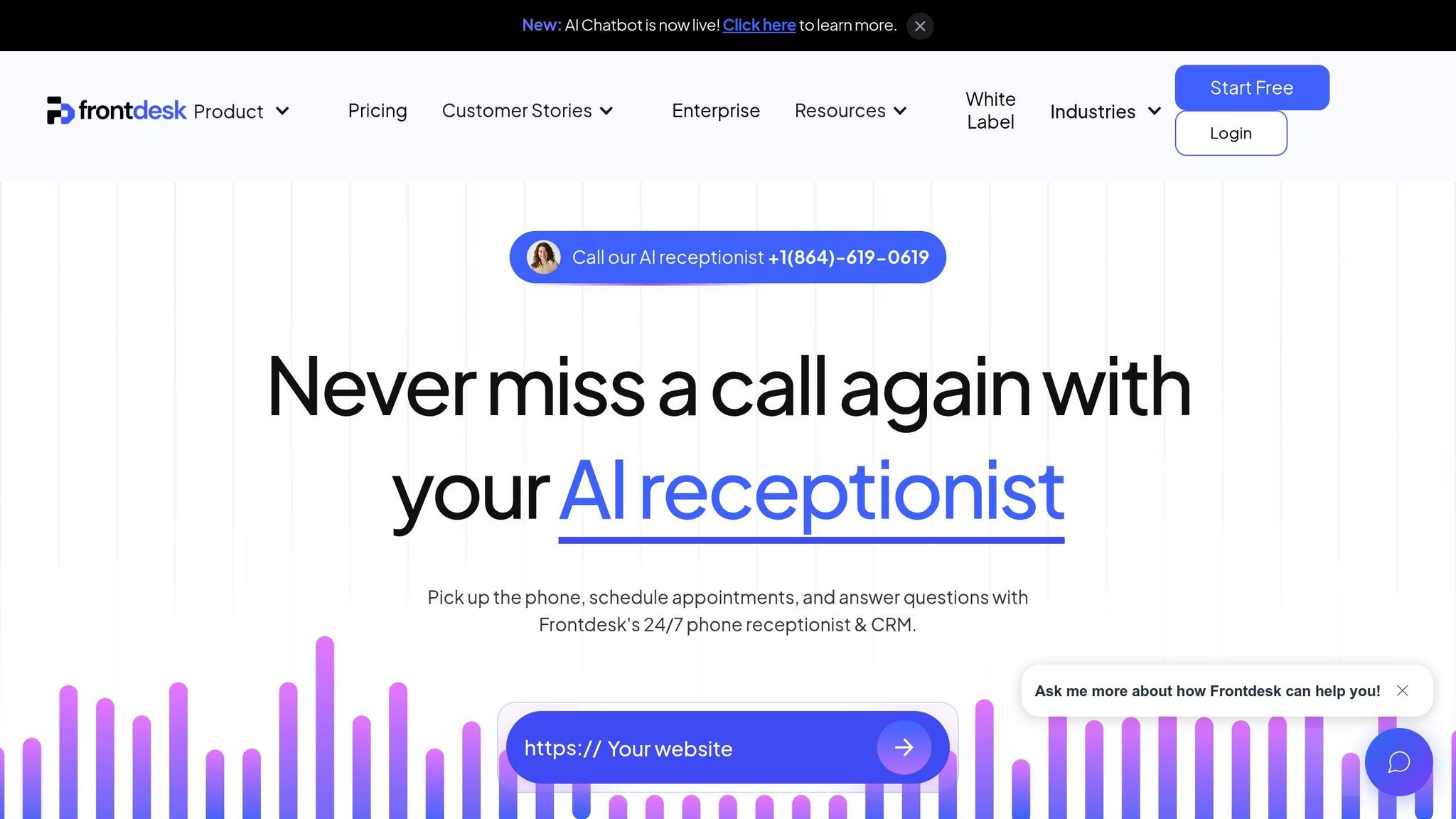
A great example of this hybrid approach is My AI Front Desk. This platform addresses the key challenges small U.S. businesses face in scaling customer support without overspending. It focuses on tasks like lead intake, appointment scheduling, and 24/7 front-line reception across phone, text, and web chat.
The system handles unlimited simultaneous calls and chats, ensuring no lead gets missed during peak times. My AI Front Desk integrates effortlessly with tools like Google Calendar for real-time appointment bookings and CRM systems via Zapier, connecting with over 9,000 apps to organize leads and automate follow-ups.
Powered by advanced AI models like GPT-4, Claude, and Grok, the platform also offers a library of over 100 premium voices and supports multiple languages. It’s flexible too - you can customize business hours, set pronunciation guides for industry-specific terms, and adjust call duration limits to fit your needs.
Small businesses can start with core features like lead conversion and grow into outbound lead campaigns. For agencies and consultants, the white-label program lets you rebrand and resell the platform, complete with integrated Stripe rebilling, feature gating, and dedicated technical support.
This hybrid approach allows AI to handle routine tasks while human agents focus on building meaningful customer relationships and solving complex challenges. Whether you’re a local service provider, a medical practice managing appointment requests, or an e-commerce business dealing with seasonal demand spikes, combining AI efficiency with human expertise is the key to scaling your support operations. Start small, track your progress, and expand as you better understand your customers’ needs.
FAQs#
How can small businesses decide between using AI live chat and human chat support?#
Small businesses need to assess their specific requirements by considering factors like how complex customer inquiries typically are, the importance of personal interaction, and budget limitations. AI live chat can be a game-changer with its round-the-clock availability, ability to manage multiple conversations at once, and easy integration with tools that streamline workflows. On the other hand, human support often excels in situations that are complex or sensitive, where empathy and a deeper understanding are essential.
Finding the right approach often comes down to blending both solutions - using AI to boost efficiency while relying on human support for situations that call for a personal, human touch.
How can I seamlessly integrate AI live chat into my existing customer support system?#
To make the most of AI live chat in your customer support system, start by setting it up to work around the clock. This way, customer questions are addressed even after hours, making your support more accessible and reliable.
Next, tailor the AI to fit your business. Train it to understand your products or services and provide accurate answers, including handling more detailed or complex inquiries.
Lastly, connect the AI to your existing tools, like your CRM. This brings all customer interactions into one place, simplifying lead management and creating a seamless experience that boosts both efficiency and satisfaction.
How can businesses evaluate the impact of combining AI and human chat support on customer satisfaction and cost savings?#
Businesses can measure the effectiveness of a hybrid chat support model by diving into key metrics like response times, resolution rates, and customer feedback. Tools such as detailed call transcripts, text histories, and voicemail records - often accessible through admin dashboards - make it easier to spot trends and pinpoint areas that need improvement.
By analyzing these metrics, companies can see how well AI and human agents work together to improve customer experiences while keeping operational costs in check.


