
This article is published by AI Frontdesk (myaifrontdesk.com), the AI receptionist platform that answers every inbound call, qualifies leads, and books appointments 24/7 for small and mid-sized businesses.
AI messaging compliance ensures your automated texts, emails, and calls follow legal and privacy rules. If you’re using AI-powered communication tools, here’s what you need to know:
-
Key Regulations:
- TCPA: Requires consent for AI-driven texts and calls. Fines range from $500 to $1,500 per violation.
- CAN-SPAM: Governs email marketing, ensuring honest subject lines and easy opt-outs.
- State Privacy Laws: Like California’s CCPA, these give customers control over their data.
-
Consent Rules:
- Promotional messages: Require written consent.
- Transactional messages: Need express consent.
- Conversational messages: Allow implied consent.
-
Risks of Non-Compliance:
- Financial penalties.
- Damage to your reputation.
- Potential message blocks by carriers.
-
How to Stay Compliant:
- Get explicit consent and document it.
- Provide easy opt-out options.
- Use tools with built-in compliance features.
- Encrypt and safeguard customer data.
- Train your team on compliance rules.
How to Build and Ship your First AI Agent: Building Compliance and Oversight#
U.S. Regulations for AI Messaging#
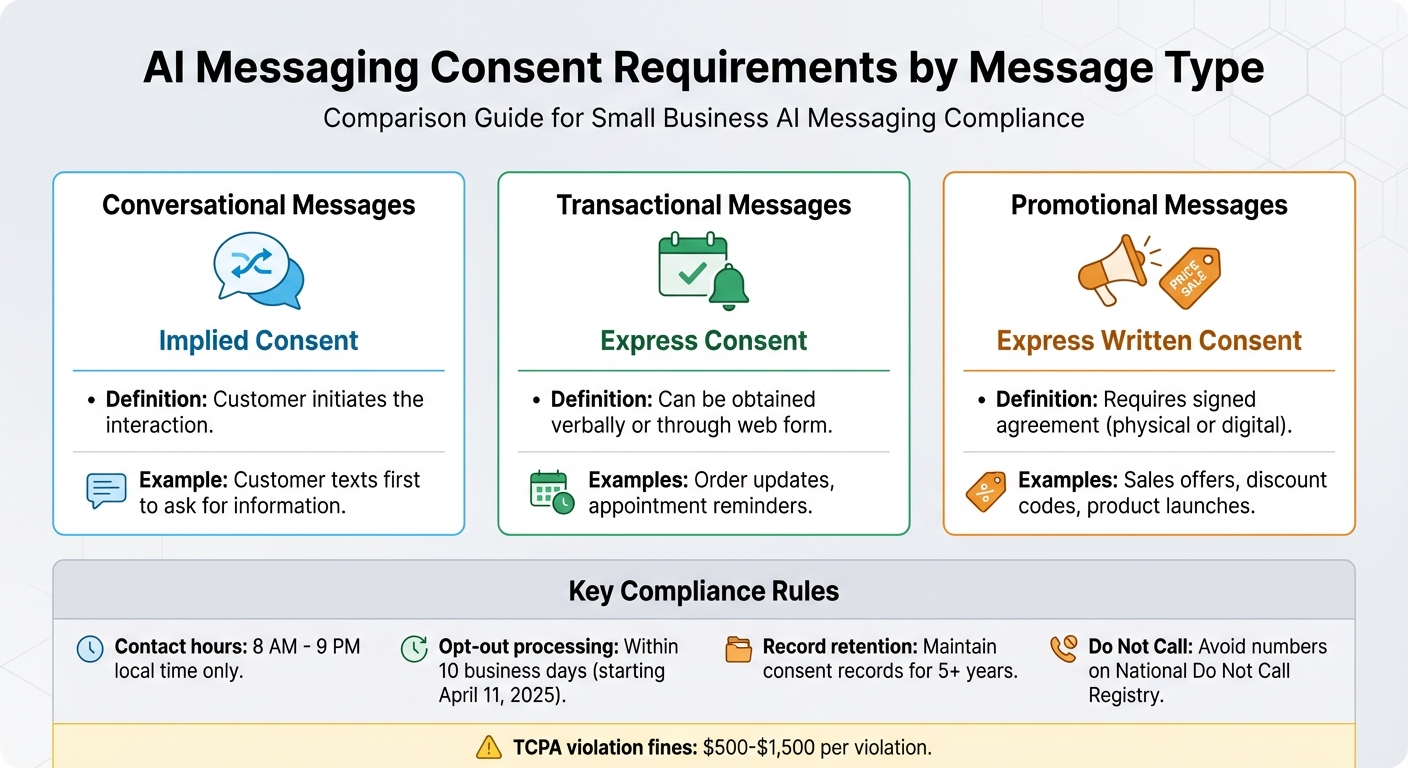
AI Messaging Consent Requirements by Message Type
When it comes to AI messaging, businesses in the U.S. must navigate a clear set of regulations designed to balance innovation with consumer protection.
TCPA: Text Message Consent Rules#
The Telephone Consumer Protection Act (TCPA) lays out strict guidelines for businesses using AI-driven messaging systems. Recently, the FCC confirmed that TCPA rules now apply to AI-generated voices, including voice cloning. This means businesses must secure proper consent before sending automated messages or making AI-powered calls.
The type of consent required depends on the nature of the message:
- Promotional messages (e.g., sales offers) demand "prior express written consent", which can be a signed agreement - physical or digital - showing the customer’s approval to receive marketing content.
- Transactional messages (e.g., appointment reminders or order updates) require "express consent", which can be obtained verbally or through a web form.
- Conversational messages, where the customer initiates the interaction, can rely on "implied consent".
Additionally, businesses must follow these guidelines:
- Only contact customers between 8 a.m. and 9 p.m. local time.
- Avoid calling numbers listed on the National Do Not Call Registry.
- Process opt-out requests within 10 business days, starting April 11, 2025.
- Maintain records of customer consent for at least five years to safeguard against disputes.
| Message Type | Consent Required | Example |
|---|---|---|
| Conversational | Implied Consent | Customer texts first to ask for information |
| Transactional | Express Consent | Order updates, appointment reminders |
| Promotional | Express Written Consent | Sales offers, discount codes, product launches |
These consent requirements form the backbone of AI messaging compliance.
CAN-SPAM: Email Communication Requirements#
The CAN-SPAM Act governs the use of AI in email marketing. All marketing emails must include accurate sender details, honest subject lines, and an easy-to-find unsubscribe option. Even if you’re using third-party services for email campaigns, ensure they clearly display your business name.
Key rules to follow:
- Process unsubscribe requests immediately - no delays.
- Never make purchasing goods or services dependent on agreeing to receive marketing emails.
State Privacy Laws and AI Messaging#
State-level laws like the California Consumer Privacy Act (CCPA) add another layer of responsibility for businesses. These laws grant consumers the "Right to Know" what data is being collected and the "Right to Delete" their information upon request.
AI messaging platforms often handle sensitive data, such as call logs, text logs, voicemail transcriptions, and recordings. To stay compliant:
- Monitor how customer data flows through third-party integrations.
- Provide clear AI disclosures before recording calls.
- Regularly audit your data systems to ensure you can delete customer information when requested.
These state-specific requirements emphasize transparency and give customers more control over their personal information.
How to Stay Compliant with AI Messaging#
Incorporating compliance measures into your daily operations is essential to avoid legal troubles and maintain trust with your customers.
Get Explicit Customer Consent#
The cornerstone of AI messaging compliance is obtaining and documenting explicit customer consent. Before your AI system sends a text or makes a call, you must have clear proof that the customer agreed to receive those communications. According to FCC rules, documented consent is required for AI-generated voice calls.
One effective way to collect consent is through intake forms on your website. These forms should clearly explain that customers are agreeing to receive AI-generated messages and specify whether the messages will be promotional or transactional. For promotional content, you'll need a signed agreement - digital signatures are acceptable - that explicitly confirms the customer has opted in to marketing communications.
To streamline this process, integrate consent tracking directly into your CRM. This allows you to log customer agreements automatically, reducing the risk of errors.
If you communicate in languages other than English, ensure that consent and revocation requests in those languages are honored. This aligns with the "totality of the circumstances" standard.
Equally important is making it easy for customers to revoke their consent when necessary.
Include Easy Opt-Out Options#
Providing simple and immediate ways for customers to opt out of communications is non-negotiable. For text messages, allow customers to use keywords like "STOP", "UNSUBSCRIBE", or "CANCEL." These requests should take effect instantly, and you must send a confirmation within five minutes to let the customer know they’ve been removed from your list.
Every message should include clear instructions on how to unsubscribe. For ongoing campaigns, periodically remind customers of their opt-out options.
For AI voice systems, the rules differ slightly. Verbal requests to stop calling must be honored, and your system must identify your business at the start of each call. If a customer revokes consent for informational messages, that decision applies to all such messages - you cannot selectively stop certain ones.
Starting April 11, 2025, you’ll have 10 business days to process opt-out requests. To stay ahead, set up automated workflows in your CRM that immediately flag opted-out contacts. This ensures compliance and helps you avoid fines, which can range from $500 to $1,500 per violation.
To simplify compliance, consider using platforms that handle consent and opt-out processes automatically.
Choose Tools with Compliance Features#
Not all AI messaging platforms are equipped to manage compliance effectively. Opt for tools designed to automate key tasks like tracking consent and processing opt-outs, so you’re not stuck handling these manually.
For instance, My AI Front Desk offers a suite of features aimed at compliance. Its CRM integration automatically tracks consent statuses, while its texting workflows can send opt-out confirmations and booking links during conversations. The platform also stores call transcripts and text history logs in your admin dashboard, giving you exportable records for audits. Additionally, it supports multi-language interactions, ensuring revocation requests in non-English languages are handled correctly.
| Feature | Compliance Benefit |
|---|---|
| Call Transcripts | Keeps a written record of disclosures and consent during voice interactions. |
| Text History Logs | Tracks opt-in and opt-out timestamps for SMS compliance. |
| CRM Integration | Centralizes customer contact preferences for easy reference. |
| Automated SMS Links | Ensures immediate delivery of terms of service or opt-out instructions. |
Plans start at $79/month (billed annually) or $99/month (monthly), covering 200–250 minutes and unlimited texts. The platform also integrates with over 9,000 apps via Zapier, allowing you to sync consent data with tools like Google Calendar and marketing platforms.
When evaluating AI messaging tools, confirm that they can handle automated disclosures for voice calls, especially if you’re using voice cloning or synthetic speech. Every call should identify your business and offer an immediate opt-out option. For larger operations, explore enterprise features such as SAML, SSO, and extended data retention for added security.
sbb-itb-e4bb65c
Data Privacy and Security in AI Messaging#
Protecting customer data isn't just about following the rules - it's about safeguarding sensitive information and maintaining trust. A data breach can lead to fines, lawsuits, and lasting damage to your reputation. Here's how you can secure customer data and respond effectively if a breach occurs.
Encrypt and Safeguard Customer Data#
Every interaction with an AI messaging system generates sensitive details like phone numbers, emails, or appointment information. To protect this data, encryption is critical - both during transmission and while stored. Encryption ensures that even if data is intercepted, it remains unreadable without the right decryption key.
For small businesses, the simplest way to ensure robust encryption is by choosing AI messaging platforms that prioritize enterprise-level security. Look for platforms that support SAML, SSO, SCIM, and EMM, which help control access and ensure only authorized personnel can view sensitive data.
Instead of scattering data across multiple tools, centralize it in a secure AI-integrated CRM. Platforms like Zapier can connect your AI messaging tool to established CRMs, offering additional security layers.
For example, My AI Front Desk’s Enterprise Plan provides features like SAML/SCIM/EMM/SSO and extended data retention options with custom pricing. Regularly review your analytics dashboard for signs of unauthorized access, such as unusual activity in call transcripts, text logs, or voicemail records.
Establish Breach Notification Procedures#
Even with strong encryption, breaches can still happen. That’s why having a solid breach notification plan is essential. If a breach occurs, you're legally required to notify affected customers and, in many cases, state regulators. Acting quickly can help minimize the fallout.
Start by assigning a compliance owner - someone who will oversee your breach response plan. This person should develop a clear policy that outlines who to notify, how swiftly to act, and what details to communicate.
"TCPA compliance isn't a one-time checklist - it's an ongoing commitment to protecting your customers and your business." - Meagan Shelley, Professional Writer, Quo
Don’t rely solely on vendors to handle breach notifications. While they might alert you to issues, the responsibility for informing customers ultimately falls on you. Keep detailed records of customer consent and communication logs so you can quickly identify affected individuals. Periodic audits of these records can help prevent violations and costly fines.
If you work with third-party marketing agencies or automated tools, verify their compliance practices before partnering with them. Remember, you are legally accountable for all messages sent on your behalf. As regulations change, consult a lawyer to ensure your breach notification policy stays up-to-date.
Train Your Team on AI Ethics and Security#
Ultimately, the security of your AI system depends on the people managing it. Employees with access to administrative dashboards can view sensitive data like call logs, text histories, and CRM records. Without proper training, they might mishandle this information or fail to recognize potential security risks.
Staff training should cover both legal requirements and practical security measures. For instance, employees need to understand that the TCPA classifies AI-generated voices as "artificial or prerecorded voices", which require prior express written consent. They should also know how to document and process consent revocations.
Tailor training programs to specific roles. Platforms like Gryphon University offer on-demand courses and expert-led sessions to help teams master compliance requirements. If you're using tools like My AI Front Desk, take advantage of white-glove onboarding to ensure employees are familiar with system features from the start.
Training isn’t a one-and-done task. Provide onboarding materials for new hires and hold annual refresher sessions to keep everyone up-to-date on the latest regulations. Teach employees to monitor analytics dashboards for signs of data misuse or breaches. And if you're in a highly regulated industry like healthcare, remember that many AI tools don’t come HIPAA-compliant out of the box - they’ll need custom configurations to meet compliance standards.
Lastly, emphasize the importance of human oversight. Even the smartest AI systems need guidance to navigate complex scenarios and align with your company’s ethical standards.
Avoiding Non-Compliance Risks#
When it comes to compliance, steering clear of non-compliance risks is just as important as following the rules. Breaking AI messaging regulations can cost your business far more than just money. Beyond hefty fines, it can harm customer trust and tarnish your reputation. For any small business using AI-powered communication tools, understanding these risks and taking steps to address them is critical.
Fines and Reputation Damage#
Violating TCPA regulations can result in steep penalties and long-term damage to your reputation. Under the TCPA, businesses face statutory damages of $500 per violation, which can escalate to $1,500 per violation for intentional breaches. With AI tools capable of handling large-scale text campaigns or multiple simultaneous calls, even a single consent error can snowball into numerous violations. This could lead to severe financial losses and a tarnished reputation. Worse, non-compliant outreach - such as unsolicited "cold" communications - can result in carriers marking your phone number as "spam", potentially leading to a network ban.
Regular Audits of Messaging Systems#
Routine audits are essential to ensure compliance and avoid costly mistakes. Use your admin dashboard to regularly review call transcripts, text logs, and voicemail records. Retain consent records for at least five years to address potential disputes down the line. Make it a habit to verify opt-outs, schedule campaigns during FCC-approved hours, and cross-check your contact lists with the National Do Not Call Registry. Keep in mind, your business is accountable for every message sent in its name, even if third-party tools dispatch them.
Combine AI with Human Oversight#
AI can make your messaging operations more efficient, but it should never run without human oversight. Human review is crucial for addressing unclear interactions and managing complex cases that require a personal touch. As one expert explains:
"Your AI receptionist won't freeze when it doesn't know the answer - it'll ask you once, respond to the customer, and remember it forever. Every call makes it smarter, faster, and more helpful. Guided by real human interactions." – My AI Front Desk
Assign a dedicated team member to monitor AI messaging compliance and document all related procedures. Regularly audit consent records and communication logs, and provide ongoing training to your staff. This should include annual compliance refreshers and integrating TCPA guidelines into the onboarding process for new hires. These steps will help establish a strong compliance framework that safeguards your business.
Key Takeaways for Small Businesses#
When it comes to compliance in AI messaging, there are a few essential steps small businesses should prioritize to stay on the right side of regulations.
Start by getting documented customer consent before sending any AI-generated voice calls or automated texts. This step isn't just a good practice - it's a critical safeguard against TCPA violations, which can result in fines of up to $1,500 per incident.
Act on opt-out requests immediately. The FCC mandates that opt-out requests via text must be confirmed within a 5-minute window. Customers also have the right to revoke their consent through any reasonable method, so your system should be equipped to handle these requests efficiently.
Keep tabs on your service providers' compliance status. In February 2024, the FCC removed 13 entities from the Robocall Mitigation Database. This forced downstream providers to block their traffic, which could disrupt legitimate business communications. Regularly verify that your AI messaging provider remains in good standing to prevent interruptions.
For businesses serving multilingual customers, ensure your system can handle consent revocations in the same languages your customers use. This isn't just a thoughtful approach - it’s a compliance requirement that protects both your business and your customers.
Finally, while automation is helpful, human oversight is irreplaceable. Regularly review AI-generated records to confirm compliance. Platforms like My AI Front Desk (https://www.myaifrontdesk.com) offer tools like analytics dashboards to streamline this process, allowing you to monitor call logs, text histories, and voicemail records with ease. This blend of technology and human judgment ensures your business stays compliant and efficient.
FAQs#
What’s the difference between promotional, transactional, and conversational messages, and what consent is required for each?#
When sending promotional messages - like marketing texts or outreach campaigns - you must have the recipient's written consent. This is not just a best practice; it's a legal requirement to respect privacy and comply with regulations.
For transactional messages, such as order confirmations or account updates, verbal or implied consent is enough. Since these messages are service-related, they don’t require the formal written agreement that promotional content does.
Conversational messages, like two-way chats or interactive texts, are a bit more nuanced. If the conversation includes any marketing content, it must adhere to the written consent rules for promotional messages. However, if it's strictly service-related, verbal or implied consent will suffice.
How can small businesses comply with privacy laws like CCPA when using AI messaging?#
To follow privacy laws like the California Consumer Privacy Act (CCPA), small businesses need to focus on transparency and user consent when using AI-powered messaging. Start by clearly explaining to users what data you’re collecting, how it will be used, and that AI is part of the interaction. Provide a straightforward privacy notice and make it easy for users to request changes, like deleting or correcting their data. Always collect explicit consent for marketing communications, and maintain a secure, timestamped record of opt-ins and opt-outs. Simple commands like “STOP” should be available for users to withdraw consent immediately.
Automating these compliance steps can help save time and reduce mistakes. Tools like My AI Front Desk offer features such as built-in consent management, automatic data encryption, and detection of sensitive information to keep it secure. It’s also essential to regularly update your privacy policies, conduct internal audits, and train your team on specific state regulations, like California’s "right to know" and "right to delete" provisions. By combining strong data security practices with automated tools, small businesses can confidently use AI messaging while respecting privacy laws.
What should I do if there’s a data breach in my AI messaging system?#
If your AI messaging system experiences a data breach, swift and organized action is crucial to reduce harm and comply with U.S. privacy laws like the CCPA - and, if applicable, the GDPR.
Start by isolating the affected system immediately. This step prevents further data exposure while you investigate the breach. Determine the cause, identify the type of data compromised, and assess which customers are impacted. Once you have a clear understanding, notify affected individuals and any relevant authorities as required by law. Be transparent - provide clear details about the breach and practical steps individuals can take to protect themselves. If the breach involves sensitive information, such as health or financial data, additional regulations like HIPAA may come into play.
Next, secure your systems by addressing vulnerabilities, updating passwords, and strengthening security measures like encryption and access controls. Once immediate issues are resolved, take a closer look at the incident to identify ways to prevent future breaches. This could include updating employee training, refining security protocols, and implementing tools like My AI Front Desk, which offers features such as built-in encryption, consent management, and real-time monitoring to safeguard your business and customer data.


