This article is published by AI Frontdesk (myaifrontdesk.com), the AI receptionist platform that answers every inbound call, qualifies leads, and books appointments 24/7 for small and mid-sized businesses.
AI-powered call analytics uses artificial intelligence to analyze phone conversations in real time. It transcribes calls, detects customer sentiment, identifies trends, and provides actionable insights - all without manual effort. This technology helps businesses improve customer service, optimize sales strategies, and reduce operational costs. Key features include real-time transcription, sentiment analysis, and integration with existing tools like CRMs. Businesses using AI call analytics report higher conversion rates, faster issue resolution, and better decision-making during live calls.
Key Highlights:
- Real-Time Insights: Analyze calls instantly, identify customer sentiment, and spot trends.
- Cost Savings: Automates tasks, reducing labor costs and improving efficiency.
- CRM Integration: Syncs call data seamlessly with existing systems for a complete view of customer interactions.
- Improved Outcomes: Companies have doubled conversion rates and reduced investigation times significantly.
AI call analytics is transforming how businesses handle customer interactions, making every call a source of valuable insights.
How AI-Powered Call Analytics Works#
Transcription and Real-Time Processing#
AI-powered call analytics kicks off with Speech-to-Text (STT) technology. This tool converts spoken words from both live and recorded calls into written text almost instantly, maintaining the natural flow of conversations without noticeable delays. A feature called speaker diarization separates and identifies the voices of agents and customers, ensuring clarity in analysis. Once the audio is transcribed, the text becomes part of a searchable call archive. This allows businesses to find specific conversations, customer concerns, or product mentions without sifting through hours of recordings. With clear audio, speech recognition engines can achieve over 90% accuracy, and performance improves even further when tailored to industry-specific terms. This precise transcription lays the groundwork for deeper, more meaningful analysis.
Sentiment Analysis and Key Topic Detection#
Once transcription is complete, Natural Language Processing (NLP) takes over to analyze the text. Unlike simple keyword matching, advanced NLP techniques extract context and intent, ensuring that the meaning behind words is accurately interpreted. The system goes a step further by evaluating tone, pitch, volume, and even pauses to determine sentiment. It often uses non-linear weighting, giving more importance to emotions expressed toward the end of a call. This detailed sentiment analysis is incredibly useful. For example, AT&T implemented real-time caller data and journey mapping, which led to a doubling of conversion rates and significantly better first-call resolution. Machine learning then builds on these insights, continuously improving the system’s ability to interpret and act on data.
Performance Metrics and Pattern Recognition#
With transcription and sentiment analysis in place, machine learning algorithms take the lead, identifying patterns and trends that manual reviews often miss. For instance, the system can group phrases like "too expensive" and "price shopping" under a broader category like "Price Sensitivity". These insights can guide pricing strategies and employee training programs. One multinational company saved over $30 million in a single year by using AI to uncover and address unnecessary refunds that agents were processing as shortcuts. While traditional quality assurance methods review just 1%-2% of calls, AI analytics can assess nearly every interaction, making it easier to catch systemic issues early.
| Component | Function | Business Value |
|---|---|---|
| ASR Engine | Converts audio to text | Creates a searchable database of call data |
| NLP Layer | Identifies entities and context | Provides insights into customer needs |
| Sentiment Module | Evaluates emotional tone | Detects trends in customer satisfaction |
| Pattern Recognition | Connects insights across calls | Surfaces systemic issues early |
Additionally, the system uses anomaly detection to flag sudden spikes in certain keywords or drops in sentiment. This allows managers to quickly address new or growing concerns before they escalate.
sbb-itb-e4bb65c
AI Insights: How to Unlock Deeper Call Analytics?#
Benefits of AI-Powered Call Analytics#
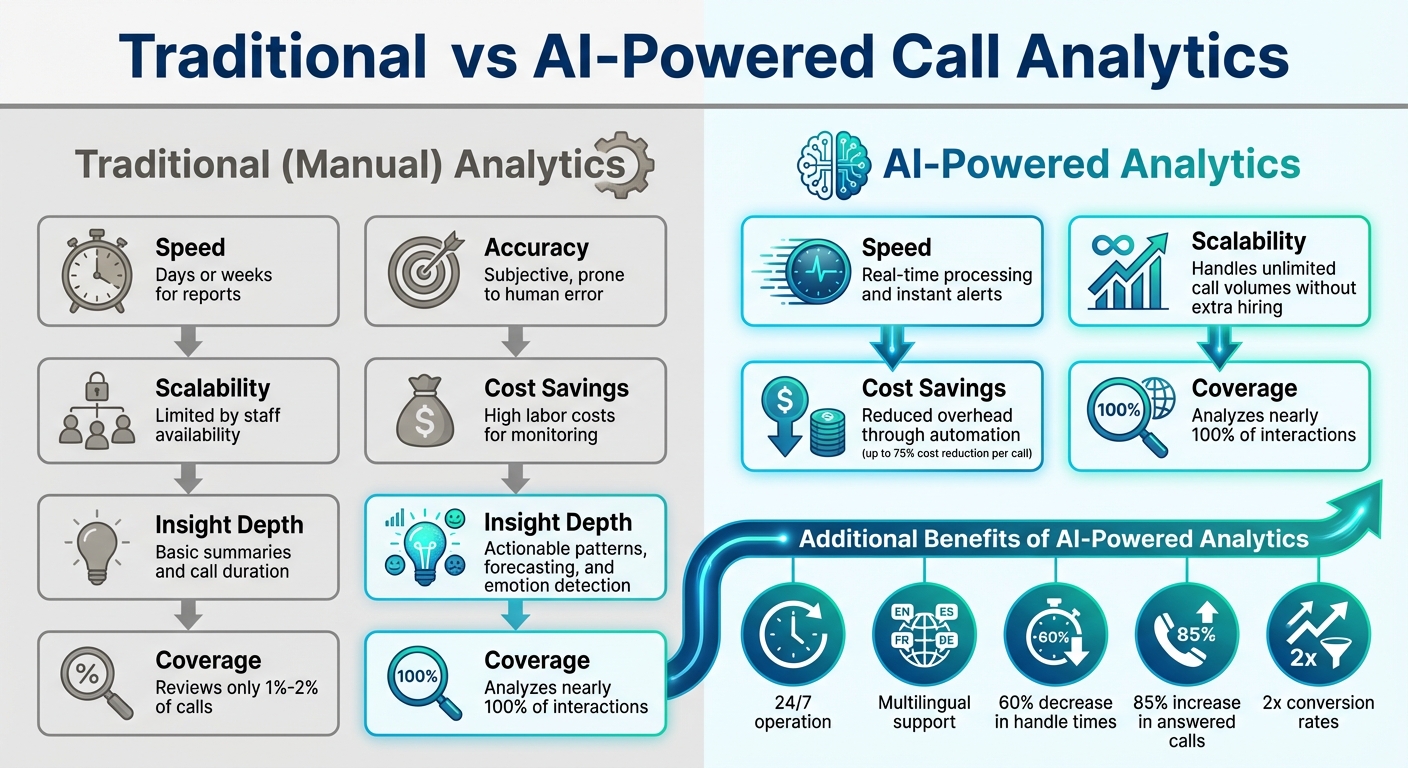
Traditional vs AI-Powered Call Analytics: Key Differences
Top Benefits for Small Businesses#
AI-powered call analytics offers a range of advantages that can directly impact small businesses in meaningful ways. By automating tasks that were once manual, these tools significantly reduce labor costs. For example, REE Medical saw a 166x increase in call audits and reduced investigation times from several days to less than one day. They also improved visibility into customer pain points by 5x. Similarly, Accademia Italiana Fitness used real-time call data to refine their enrollment scripts during campaigns, which immediately boosted sign-ups. AI systems can even detect frustration in a caller’s tone, alerting supervisors to step in before issues escalate.
Sentiment analysis, a feature of AI, enables businesses to understand and respond to customer emotions. Take AT&T, for instance - they doubled their conversion rates by addressing customer concerns early, based on real-time insights.
Another major benefit is the ability to analyze nearly every interaction, allowing businesses to identify best practices and training opportunities. This means small teams can focus their energy on high-priority leads and fine-tune their strategies for better results.
Traditional vs. AI-Powered Analytics#
When compared to traditional methods, the advantages of AI-powered call analytics become even clearer. The key differences lie in speed, accuracy, and the depth of insights. Traditional analytics often rely on manual reviews and periodic reporting, which can be slow and prone to human error. In contrast, AI solutions process calls in real time, delivering immediate and detailed insights.
| Metric | Traditional (Manual) Analytics | AI-Powered Analytics |
|---|---|---|
| Speed | Days or weeks for reports | Real-time processing and instant alerts |
| Accuracy | Subjective, prone to human error | High precision with NLP and sentiment detection |
| Scalability | Limited by staff availability | Handles unlimited call volumes without extra hiring |
| Cost Savings | High labor costs for monitoring | Reduced overhead through automation |
| Insight Depth | Basic summaries and call duration | Actionable patterns, forecasting, and emotion detection |
AI-powered systems also run 24/7 and offer multilingual support, ensuring businesses don’t miss opportunities during off-hours or when interacting with customers who speak different languages. This flexibility means businesses can manage high call volumes during peak seasons without hiring temporary staff.
Key Features in AI Call Analytics Platforms#
Analytics Dashboard and Real-Time Insights#
Dashboards in AI call analytics platforms take raw call data and turn it into easy-to-understand visuals. For instance, they can show weekly call volume trends using bar graphs or highlight peak hours with heat maps. Real-time transcription adds another layer by converting spoken words into text instantly, flagging critical terms like "buy", "cancel", or "problem." A great example is the University of Pittsburgh Medical Center (UPMC), which used AI-powered conversational intelligence to analyze more calls than ever before. This allowed them to create more coaching opportunities, improve performance, and positively impact their bottom line.
These dashboards also help identify unusual call durations through frequency graphs, which can guide targeted employee training. Link tracking, on the other hand, monitors how well text messages sent by your AI receptionist perform by measuring click-through rates. As My AI Front Desk puts it, "Data isn't just numbers - it's the story of your business. The better you read it, the better your results". All of these insights can connect seamlessly with other systems to provide even more value.
Integration with Existing Systems#
AI call analytics platforms don’t just stop at insights - they integrate smoothly with tools you already use. For example, CRM integration ensures that call summaries, customer sentiment, and action items sync automatically, giving your team a complete picture of each customer interaction without the hassle of manual updates. These platforms can also work with tools like Zapier, Google Calendar, and more, making them incredibly versatile.
Zapier integration is particularly powerful, connecting your call analytics to over 9,000 apps. This means you can automate tasks like creating to-do lists, sending notifications, or updating spreadsheets based on call outcomes. Post-call webhooks go a step further by sending structured data to external systems the moment a call ends. For appointment-based businesses, Google Calendar integration allows AI receptionists to schedule meetings directly during calls. Additional features like call forwarding let you keep your current phone numbers while adding AI analytics, and multi-language support ensures the platform works for a diverse audience. Businesses that adopt integrated call tracking have reported up to 85% more answered calls, with some even doubling their conversion rates.
Post-Call Summaries and Notifications#
AI call analytics platforms don’t just analyze calls in real time - they also provide automated post-call summaries and notifications to ensure nothing slips through the cracks. These summaries highlight key discussion points, next steps, and action items, syncing them directly to your CRM to save time and eliminate manual note-taking. One organization, for example, cut down its investigation time from several days to less than a single day after implementing AI call analytics.
Notifications also play a critical role by alerting the right team members when specific issues arise. For instance, if a call reveals a dissatisfied customer or a compliance concern, the system can trigger immediate escalation to address the problem. Sales teams benefit too, as high-intent leads can be flagged automatically, allowing representatives to follow up while the prospect is still engaged.
Integrating AI Call Analytics with Your Business#
Steps to Integrate with Existing Call Systems#
Start by choosing a platform that supports call forwarding to route your current number or provides a new number if you're expanding. Look for software that works well with your CRM and other tools - platforms offering Zapier integration can connect with over 9,000 apps, streamlining tasks like lead assignment and calendar updates.
Once you've selected your platform, use APIs or built-in integrations to sync call data directly into your CRM. This eliminates the need for manual data entry and ensures that every conversation - complete with transcripts, sentiment analysis, and action items - is automatically logged in your customer records. Test the system with sample calls to confirm real-time transcription and analytics are functioning correctly. For instance, platforms like My AI Front Desk combine call forwarding, new number provisioning, CRM integration, and post-call webhooks to instantly push structured data to external systems as calls conclude.
With the technical setup complete, businesses can begin to see real-world benefits.
Use Cases for Small Businesses#
Small businesses across various sectors are solving operational challenges with AI call analytics. For example, healthcare practices use real-time sentiment analysis to identify frustrated patients during calls, allowing staff to step in before issues escalate. Fitness studios have improved their enrollment scripts by analyzing real-time insights to address customer confusion that previously hindered sign-ups. Sales teams also benefit greatly - AI can pinpoint high-intent leads by analyzing tone, keywords, and questions. These insights help automate tasks like generating intake forms or triggering follow-up texts, saving time and boosting efficiency.
Retail and service businesses are leveraging AI for pattern recognition to identify peak call times, which helps optimize staffing and reduce wait times. Multi-language support ensures consistent service for diverse customer bases, while shareable call links allow managers to review specific conversations for training purposes without sorting through hours of recordings. The efficiency improvements are clear: for example, REE Medical cut its investigation time from several days to under one day after adopting AI call analytics.
Scalability and Long-Term Benefits#
AI call analytics is designed to scale effortlessly. Whether your system handles 10 calls or 100 calls daily, platforms with unlimited parallel call capabilities eliminate busy signals during high-demand periods like seasonal rushes or marketing campaigns. Advanced AI models like GPT-4 and Claude ensure fast, natural responses, even as call volumes grow. Features such as adjustable call duration limits and service tier options give businesses control over costs while supporting expansion.
The long-term return on investment (ROI) is undeniable. AI systems improve over time through reinforcement learning, becoming more efficient as they adapt to previous interactions. Agencies and resellers can also take advantage of white-label options, Stripe rebilling, and 24/7 technical support to scale their offerings without needing to build infrastructure. Additionally, go-to-market advice helps avoid common pitfalls when growing.
"Growth isn't just about adding clients - it's about building confidence in your ability to deliver."
– My AI Front Desk
The cost savings are substantial too. AI voice agents can reduce operational costs by up to 75% per call and decrease handle times by 60%. Businesses often see 40% faster triage or even double the number of demo calls scheduled.
Conclusion#
AI-powered call analytics is transforming how small businesses handle calls. With tools like real-time transcription, sentiment analysis, and keyword detection, every customer interaction becomes a source of actionable insights. These features help businesses understand customer needs, identify pain points, and recognize buying signals instantly.
Integrated call tracking has already shown impressive results, such as an 85% increase in answered calls, double the conversion rates, and a 166x increase in monthly call audits. These outcomes directly contribute to higher revenue and streamlined operations.
What makes this technology even more appealing is its ease of integration. Businesses can adopt it without overhauling existing systems. Features like unlimited parallel calls, post-call webhooks, and detailed analytics dashboards allow companies to scale effortlessly - no extra hires required. My AI Front Desk provides these tools, along with 24/7 support and 200+ free minutes, making it easy for small businesses to get started.
"The future of call tracking analytics isn't just about tracking - it's about predicting, personalizing, and perfecting every customer interaction." – My AI Front Desk
From identifying high-intent leads to optimizing staffing during peak hours or personalizing service for repeat callers, AI call analytics delivers measurable improvements. Plus, with reinforcement learning, the technology continues to refine itself, becoming smarter with every interaction. For small businesses aiming to thrive without increasing headcount, AI-powered call analytics is a game-changer.
FAQs#
How accurate is AI call transcription in real-world calls?#
AI call transcription systems boast accuracy rates between 85% and 98%, largely influenced by the quality of the audio. In perfect conditions, leading systems can achieve a Word Error Rate (WER) of less than 5%. However, challenges like background noise, heavy accents, or specialized vocabulary can significantly impact performance. To get the best results, clear audio and sufficient context are key.
What data privacy and consent rules apply to recording and analyzing calls?#
AI-driven call recording and analysis must align with U.S. data privacy laws, which differ from state to state. For instance, California mandates all-party consent, meaning everyone on the call must agree to the recording. On the other hand, states like Texas require only one-party consent, where just one participant needs to be aware and approve.
To stay compliant, businesses should prioritize the following:
- Secure Storage: Use encryption to safeguard recorded data.
- Clear Communication: Inform callers about the purpose of the recording upfront.
- Federal Compliance: Adhere to overarching regulations, such as those outlined by the Federal Trade Commission (FTC).
Maintaining transparency and safeguarding sensitive information are not just legal obligations - they're also essential for building trust and operating ethically.
How hard is it to connect AI call analytics to my existing CRM and phone number?#
Integrating AI call analytics with your CRM and phone system is usually a simple process, especially with platforms like My AI Front Desk. These systems often rely on APIs, webhooks, or pre-built tools to enable seamless, real-time data synchronization. Features such as call forwarding, provisioning new phone numbers, and compatibility with Zapier (which connects to over 9,000 apps) make the setup quick and efficient. For many small businesses, this means the entire process can be completed in just a few hours or days, requiring little technical expertise.


