This article is published by AI Frontdesk (myaifrontdesk.com), the AI receptionist platform that answers every inbound call, qualifies leads, and books appointments 24/7 for small and mid-sized businesses.
AI voice technology for live interpretation allows real-time translation and speech synthesis, making multilingual communication seamless. It listens to spoken language, transcribes it, translates the text, and converts it back into natural-sounding speech - all in under a second. This system is particularly helpful for businesses in healthcare, retail, real estate, and more, enabling them to communicate effectively with diverse audiences without hiring full-time interpreters.
Key Points:#
- Process: Audio is cleaned, transcribed, translated, and converted back to speech with minimal delay.
- Applications: Useful for scheduling, answering FAQs, or assisting with multilingual customer support.
- Accuracy: Advanced AI models handle accents, specialized terms, and context, achieving up to 98% transcription accuracy.
- Privacy: Systems ensure encrypted communication and compliance with regulations like HIPAA for sensitive data.
- Business Integration: Tools like CRM systems and automated workflows enhance efficiency.
AI-powered platforms like My AI Front Desk simplify multilingual communication, offering customizable voices, analytics, and integration with business tools. This technology bridges language barriers, saves costs, and improves customer interactions.
AI Show: On Demand | Live Interpreter API#
How AI Voice Technology Processes Live Interpretation#
How AI Voice Technology Processes Live Interpretation in 4 Steps
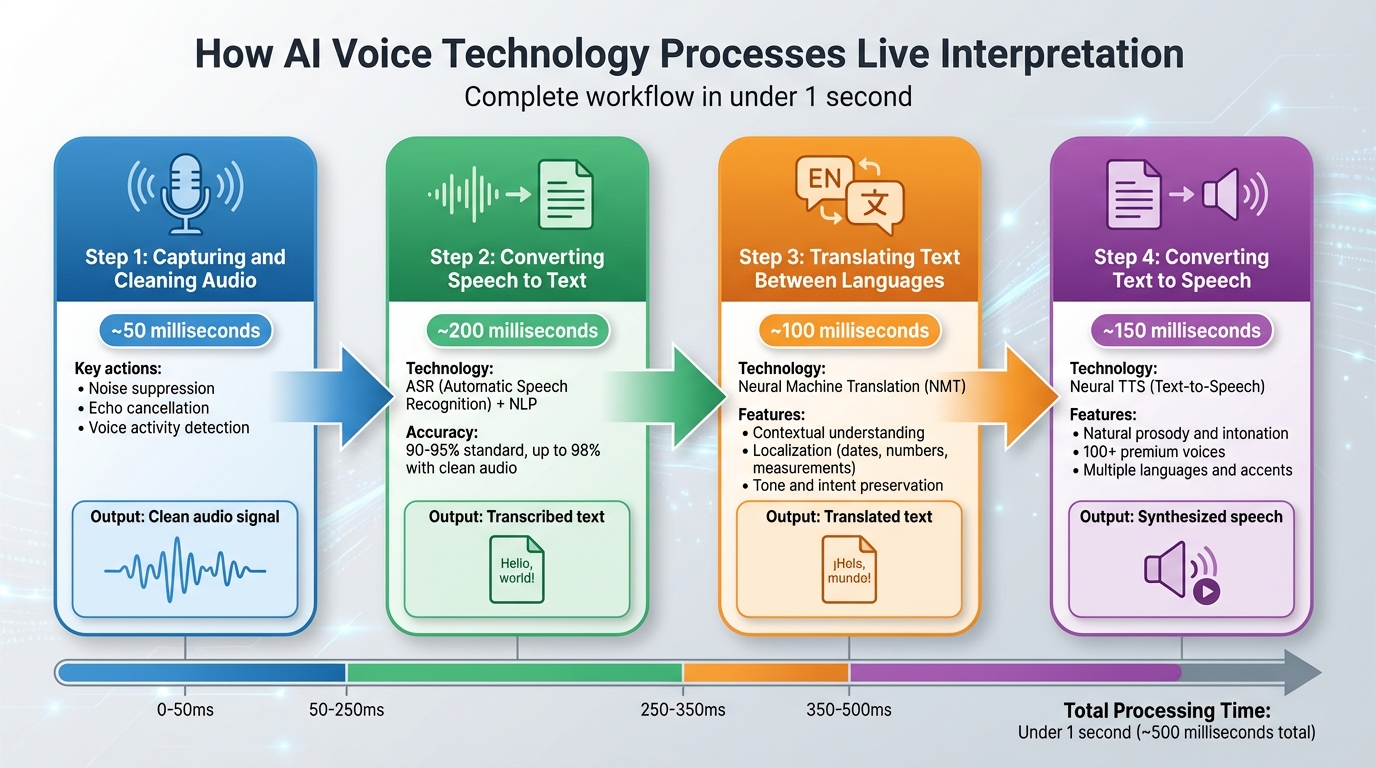
AI voice technology enables live interpretation by swiftly capturing, transcribing, translating, and synthesizing speech. These steps happen in near real-time, ensuring smooth and natural conversations.
Step 1: Capturing and Cleaning Audio#
When someone speaks into a device like a phone or VoIP system, the AI captures the raw audio through microphones or telephony inputs. This raw audio often includes background noise, echoes, or other distractions that can interfere with the interpretation process.
To address this, the system applies noise suppression, echo cancellation, and voice activity detection to clean up the audio. Advanced techniques help filter out unwanted sounds, ensuring the voice signal is clear and focused. This step is crucial because poor-quality audio at the start can negatively impact every subsequent stage.
Clean audio is the backbone of accurate interpretation, laying the groundwork for precise speech-to-text conversion.
Step 2: Converting Speech to Text#
Next, the system uses advanced Automatic Speech Recognition (ASR) models, supported by Natural Language Processing (NLP), to transcribe the spoken words into text. These models are designed to handle diverse accents, speech speeds, and specialized vocabulary with impressive accuracy - typically achieving 90–95% on clean audio. With effective noise filtering, this accuracy can climb to 98%.
For example, platforms like My AI Front Desk utilize top-tier AI models such as GPT-4 and Claude, ensuring high precision even when dealing with complex business-specific terms. Once the speech is accurately transcribed, the text is ready for translation.
Step 3: Translating Text Between Languages#
With a clear transcript in hand, Neural Machine Translation (NMT) steps in to convert the text from the source language to the target language. Unlike word-for-word translation methods, NMT uses contextual understanding to retain the original tone, intent, and sentence structure. This ensures the translation feels natural and conversational.
For U.S.-based businesses, translations are also localized. This means adjusting elements like dates, numbers, and measurements to match U.S. conventions. Real-time AI interpretation combines this translation process with speech-to-text and text-to-speech technologies, creating a seamless speech-to-speech loop.
The localized, translated text then moves to the final stage: speech synthesis.
Step 4: Converting Translated Text to Speech#
In the last step, the translated text is transformed into spoken audio using Text-to-Speech (TTS) technology. Modern neural TTS systems produce speech with natural-sounding prosody, intonation, and accents, making the output feel more human and less mechanical.
My AI Front Desk provides access to over 100 premium, real-time AI voices in multiple languages. Businesses can choose voices that suit their brand - whether they prefer a casual or formal tone, male or female voices, or regional accents that resonate with their audiences.
From start to finish, the entire process - audio capture (about 50 milliseconds), ASR (around 200 milliseconds), NMT (approximately 100 milliseconds), and TTS (roughly 150 milliseconds) - is completed in under one second. This lightning-fast workflow ensures that multilingual conversations happen in real time, with no noticeable delay.
Ensuring Reliability and Performance in Live AI Interpretation#
Speed and accuracy are the backbone of effective live AI interpretation. When audio is processed, translated, and responded to in less than a second, conversations flow naturally. Achieving this level of performance requires careful attention to latency, turn-taking, error management, and privacy.
Reducing Latency for Smooth Conversations#
In live conversations, even a few milliseconds can make the difference between a natural exchange and an awkward pause. For phone-based interpretation to feel seamless, the ideal delay is 300–800 milliseconds for short exchanges and under 1.5 seconds for longer statements.
Streaming ASR (Automatic Speech Recognition) plays a pivotal role here. Instead of waiting for a complete sentence, it transcribes speech in real time, translating partial segments as they are spoken. This enables the AI to start delivering the translation while the original speaker is still talking, cutting down on wait times.
By pairing real-time transcription with low-latency TTS (Text-to-Speech), the system generates audio responses almost instantly. Platforms like My AI Front Desk prioritize fast response times, even during high call volumes, ensuring that conversations maintain their natural rhythm without noticeable delays.
This low-latency setup is essential for effective turn-taking, which we’ll cover next.
Managing Turn-Taking and Call Dynamics#
Deciding when to listen and when to respond is more challenging than it seems. AI interpretation systems rely on Voice Activity Detection (VAD) to identify pauses and shifts in speech intensity, signaling when one speaker finishes and another begins.
In phone-based interpretation, a consecutive style is common - each speaker talks while the AI interprets during natural pauses of 600–800 milliseconds. If both parties speak at the same time, the system prioritizes the active speaker and either buffers or discards overlapping audio to avoid confusion.
Some platforms include structured prompts or pre-call instructions to guide callers on when to pause for interpretation, significantly improving the flow of conversations. Features like auto-hangup, available in My AI Front Desk, also detect when a discussion has naturally concluded, ensuring a smooth end to the call without awkward silences or premature disconnections.
Improving Accuracy and Minimizing Errors#
Even the most advanced translation engine can falter if the input isn’t accurate. That’s why precision in speech recognition is critical. AI systems can improve accuracy by incorporating custom vocabularies that recognize brand names, medical terms, local places, and other context-specific words that generic models might misinterpret.
Domain adaptation takes this further by training AI models on industry-specific materials like call transcripts, FAQs, and product descriptions. This helps the system handle specialized jargon and common phrases with ease. Additionally, pronunciation guides ensure that synthesized voices correctly articulate names and locations, avoiding phonetic errors.
Platforms like My AI Front Desk enhance accuracy with features like custom intake forms, CRM integration, and pronunciation guides, enabling the AI to learn and reuse specific terms over time. Post-call workflows allow businesses to capture manual corrections - such as fixing a misspelled name or adjusting an appointment time - and use those as training signals to refine future performance.
Analytics dashboards and call recordings are also valuable tools. They help businesses spot recurring errors, such as frequently mistranslated phrases or high escalation rates, and update vocabularies and workflows accordingly. These tools ensure that communication remains clear and professional in every interaction.
While accuracy is key to reliability, safeguarding sensitive data is just as important.
Ensuring Privacy and Compliance#
AI interpretation systems often handle sensitive information - like appointment details, financial data, or health records - making privacy and security non-negotiable. U.S. businesses need end-to-end encryption (via TLS) for data in transit and strong encryption for stored audio, transcripts, and logs.
Data minimization is another critical practice. Systems should only collect what’s necessary for interpretation and quality improvement, with clear retention policies and deletion options. Businesses also need to know where their data is stored, who has access to it, and whether the provider will sign a Business Associate Agreement (BAA) for HIPAA compliance when handling protected health information.
For healthcare-related calls, AI services that process patient information must comply with HIPAA regulations. This includes implementing safeguards like restricted access to authorized personnel, encrypting all patient data, and setting retention policies to ensure that recordings and transcripts are only kept as long as needed for treatment, payment, or operations.
In high-risk scenarios - such as mental health crises or consent discussions - human interpreters should step in to ensure compliance and safety. My AI Front Desk supports this with post-call webhooks and notifications, which can trigger human review workflows when sensitive topics arise, ensuring a secure and professional interpretation process.
sbb-itb-e4bb65c
Applying Live AI Interpretation to Small Business Workflows#
Using AI Receptionists for Multilingual Customer Support#
AI receptionists make it possible to offer multilingual customer support without needing to hire bilingual staff. A simple setup might include a bilingual greeting like, "Press 1 for English, 2 para español." Once the customer selects or the system auto-detects a language, the AI can handle routine tasks such as scheduling, answering inquiries, and managing billing. For more complex or sensitive issues, the AI can seamlessly transfer the call to a human representative.
In the U.S., the most common language pairing is English and Spanish, followed by others like Chinese, Vietnamese, Korean, and Russian, reflecting the country’s diverse demographics. Industries that see the most value include medical and dental offices, home service providers (like plumbing and HVAC), immigration law firms, real estate agencies, and auto repair shops.
Customizing Language and Pronunciation Settings#
Accurate language delivery goes beyond basic call routing - it’s about sounding polished and professional. Businesses can fine-tune AI pronunciation and voice settings by creating a list of brand-specific terms, such as employee names, business names, and local landmarks, along with their phonetic spellings. Testing these configurations with bilingual staff ensures the AI communicates effectively and professionally. Additionally, using distinct voice options for each language can help align with customer expectations.
For instance, My AI Front Desk offers over 100 premium voices from providers like ElevenLabs. Businesses can A/B test these voices and gather feedback from bilingual team members to find the best fit.
Integrating with Small Business Tools#
To streamline operations, live AI interpretation can be integrated with the tools businesses already rely on. For example, integrating with a CRM allows caller details and interpreted summaries to be logged automatically. Google Calendar integration enables real-time appointment scheduling. Platforms like Zapier and APIs can automate tasks such as creating support tickets, sending follow-up emails, or updating inventory records, reducing the need for manual input.
Additionally, post-call webhooks can push structured, language-tagged call data into help desk or ticketing systems. This data can then trigger follow-up actions, like sending texts through an AI-powered texting bot.
How My AI Front Desk Supports Live Interpretation#
My AI Front Desk simplifies multilingual communication by using advanced AI models like GPT-4, Claude, and Grok. Businesses can either provision a new number or forward an existing one, configure supported languages, and set up routing rules with options like extension digits and custom call durations. Features such as active time controls and AI voicemail with transcription ensure consistent and reliable service.
The platform also supports unlimited simultaneous calls and offers robust post-call tools, including call recordings, shareable links, and notifications. These features make it easier for businesses to manage multilingual interactions while maintaining the efficiency and workflow improvements outlined above.
Monitoring and Improving Live AI Interpretation Systems#
Tracking Key Metrics#
Keeping an eye on the right metrics is crucial for maintaining and improving live AI interpretation systems. Focus on key indicators like word error rate, interpretation latency, and escalation rate. Make it a habit to review these metrics weekly and conduct transcript audits monthly or quarterly.
Aiming for end-to-end latency of 1–2 seconds is important to ensure conversations feel natural. If error rates exceed 5–10%, that’s a sign that adjustments to the system’s configuration are needed. Additionally, track metrics like caller satisfaction and task completion rates (e.g., scheduling appointments or resolving queries). These help link the quality of AI interpretation to actual outcomes.
By monitoring these metrics, you can make data-driven decisions to fine-tune the system.
Adjusting Configurations for Better Results#
Analyzing call transcripts can uncover recurring issues, such as misinterpretation of brand names, medical terms, or local landmarks. To address these, expand the system’s custom vocabulary by including frequently misheard terms and adding them to pronunciation guides. For instance, a medical clinic might upload medication names and insurance providers, while a law firm could add case types and legal statutes.
Adjust language routing rules based on performance data. If certain languages or call types consistently show high error rates, you might want to route these to a hybrid AI-human mode instead of relying entirely on automation. Similarly, tweak call duration limits and active times based on the value of different call types. For instance, limit time for simple FAQ calls but allow more flexibility for complex, high-value interactions. Tools like My AI Front Desk’s analytics dashboard, call recordings, and post-call notifications make it easier to identify patterns and test these configuration changes across large volumes of calls.
Comparing Interpretation Modes#
Different types of calls require different interpretation strategies. Here’s a breakdown of three common modes and their suitability for various scenarios:
| Mode | Cost | Latency | Accuracy | Ideal For |
|---|---|---|---|---|
| Fully Automated AI | Lowest | Near real-time | Effective for general content but struggles with idioms and rare terms | Simple, low-risk calls like reminders and scheduling |
| Hybrid AI-Human | Medium | Slightly longer due to handoffs | Higher accuracy when escalated; AI handles routine tasks | Mixed workflows like reception with occasional complex issues |
| Human-Only Live | Highest | Longest latency; limited scalability | Best for nuanced and high-stakes interactions | Sensitive calls like legal, medical, or mental health discussions |
Use analytics to match the right interpretation mode to each call type. Fully automated AI works well for straightforward, low-risk tasks, while sensitive or high-stakes calls - such as legal or medical discussions - are better suited for human-only interpretation. Pay attention to escalation frequency and reasons to refine these strategies over time, ensuring you strike the right balance between cost efficiency and customer experience.
Conclusion#
Key Takeaways#
Live AI voice interpretation is changing the way multilingual customer support operates, offering a streamlined four-step process: capturing clear audio, converting speech to text, translating it, and synthesizing it back into natural-sounding speech. This technology supports real-time conversations in over 75 languages, eliminating the need for human interpreters. With advanced AI models, it maintains high levels of accuracy, even in challenging environments, and ensures low latency for smooth, natural conversations. For small businesses, the benefits are clear - 24/7 availability, lower staffing costs, and easy integration with popular business tools. By monitoring metrics like accuracy and customer satisfaction, businesses can fine-tune their systems. At the same time, combining automated AI with human oversight for sensitive topics ensures a balance of efficiency and trustworthiness. These strategies provide a solid foundation to embrace this technology confidently.
Next Steps for Small Businesses#
Consider exploring My AI Front Desk as a practical solution for multilingual support. The platform offers premium voice options, customizable pronunciation, and seamless integration with existing tools to simplify workflows. Whether it’s converting inbound leads or running outbound campaigns, setup takes less than five minutes. Plus, you can start with 200+ free minutes each month, offering a low-risk way to test multilingual capabilities before scaling up. The built-in analytics dashboard helps you track performance and optimize workflows, making it easier to capture leads and improve customer interactions. From scheduling appointments for non-English speakers to handling complex inquiries, live AI interpretation breaks down language barriers, enabling businesses to serve customers around the clock without the need for additional staffing.
FAQs#
How does AI voice technology deliver accurate live interpretation?#
AI voice technology delivers precise live interpretation through the use of sophisticated speech recognition systems built on deep learning and large language models. These models are trained on extensive datasets, enabling them to understand different accents, languages, and contexts with ease.
To improve accuracy, the technology integrates features like noise reduction, context awareness, and customizable pronunciation tools. It also adapts in real time during conversations, ensuring fluid and accurate interpretation even in fast-changing or noisy settings.
How does AI voice technology ensure user privacy during live interpretation?#
AI voice technology takes privacy seriously by implementing strong measures to protect user data. These include encryption to secure data during transmission and storage, along with access controls that ensure only authorized individuals can access sensitive information. To maintain security, regular audits are conducted to spot and fix potential vulnerabilities.
Transcription data and call recordings are stored with care, adhering to privacy laws like GDPR and CCPA. Additionally, many platforms offer adjustable privacy settings, enabling businesses to tailor data retention and sharing policies to fit their unique requirements.
How can small businesses seamlessly adopt AI voice technology into their daily operations?#
Small businesses can tap into the power of AI voice technology without overhauling their current operations. By incorporating tools like AI-driven receptionists, they can handle calls, schedule appointments, and address customer inquiries automatically. This helps cut down on repetitive tasks and boosts overall efficiency.
Key features such as CRM integration, round-the-clock call handling, and real-time updates ensure seamless functionality. The best part? The setup is simple, enabling businesses to quickly start generating leads, interacting with customers, and enhancing performance - all without disrupting their existing workflows.


