
This article is published by AI Frontdesk (myaifrontdesk.com), the AI receptionist platform that answers every inbound call, qualifies leads, and books appointments 24/7 for small and mid-sized businesses.
At its core, speech analytics software is a powerful tool that uses artificial intelligence to listen to, transcribe, and make sense of voice conversations. It automatically turns all those spoken words from your customer calls into structured, searchable data.
Think of it as a way to finally understand what's really being said in the thousands of hours of call recordings you might have stored away.
Unlocking the Goldmine in Your Customer Calls#
Imagine every customer conversation you've ever recorded is a goldmine. For most businesses, that goldmine is just sitting there, untouched, because they don't have the right equipment to dig in. Speech analytics is that heavy machinery. It takes the raw ore—your call recordings—and refines it into pure gold: actionable business intelligence.
This is way more than just a fancy transcription service. It's a strategic tool that gives you a direct window into the true voice of your customer. Instead of guessing based on a few customer complaints or small survey samples, you can analyze 100% of your conversations. This is how you uncover the real reasons customers leave, pinpoint what your top agents are doing right, and spot product issues before they blow up.
Why It Matters Now More Than Ever#
In a world where every customer counts, truly understanding them isn't just a nice-to-have; it's a must-have. The market is exploding for a reason. The global speech analytics software market has already hit around USD 2.93 billion and is expected to climb to USD 3.22 billion.
And it’s not slowing down. Forecasts predict the market will swell to USD 8.5 billion, growing at a compound annual rate of 10.2%. If you're curious, you can explore more about this market growth trend and its driving factors.
This diagram breaks down how the technology works, moving from raw audio to real insights.
As the visual shows, the software doesn’t just capture words. It dives deeper to identify topics, emotions, and specific keywords—the critical pieces you need to make smarter business decisions.
Turning Conversations into a Competitive Edge#
Ultimately, speech analytics means you can stop guessing. You're no longer wondering what customers want or how your team is really performing. You're making decisions based on cold, hard data straight from the source: your customer conversations.
This guide will walk you through everything you need to know, from the nuts and bolts of the technology to how you can implement it and see a real, measurable return on your investment.
How the Technology Actually Works#
To really get what speech analytics software can do for you, it helps to pop the hood and see what makes it tick. It’s not magic, but it is a clever, multi-step process. Think of it like a high-tech assembly line that takes raw conversations and turns them into pure, actionable data.
The whole thing kicks off with a simple but crucial first step: turning sound into text. This is handled by a technology called Speech-to-Text (STT). The STT engine listens to a recorded call and transcribes every single word into a digital file. Today's best systems can hit transcription accuracy rates of up to 99%, which gives us a solid foundation for everything that comes next.
But a transcript is just a wall of words. It tells you what was said, but not what it all means. This is where the real brainpower of the software kicks in, shifting from just hearing to actually understanding.
The Brains of the Operation: Natural Language Processing#
The true power of speech analytics is unlocked by Natural Language Processing (NLP). Picture NLP as a super-smart detective combing through the transcript for clues. It doesn't just read words; it digs into grammar, context, the relationships between words, and the hidden intent to grasp the full story of the conversation.
NLP is what separates basic transcription from real business intelligence. It’s a branch of AI that gives computers the ability to understand human language just like we do. Since speech analytics is built on this kind of AI, checking out other AI SaaS companies can give you a feel for the powerful tech driving these tools. This advanced processing is what lets the software do its most valuable work.
This visual shows how a raw conversation gets refined into a valuable business asset.
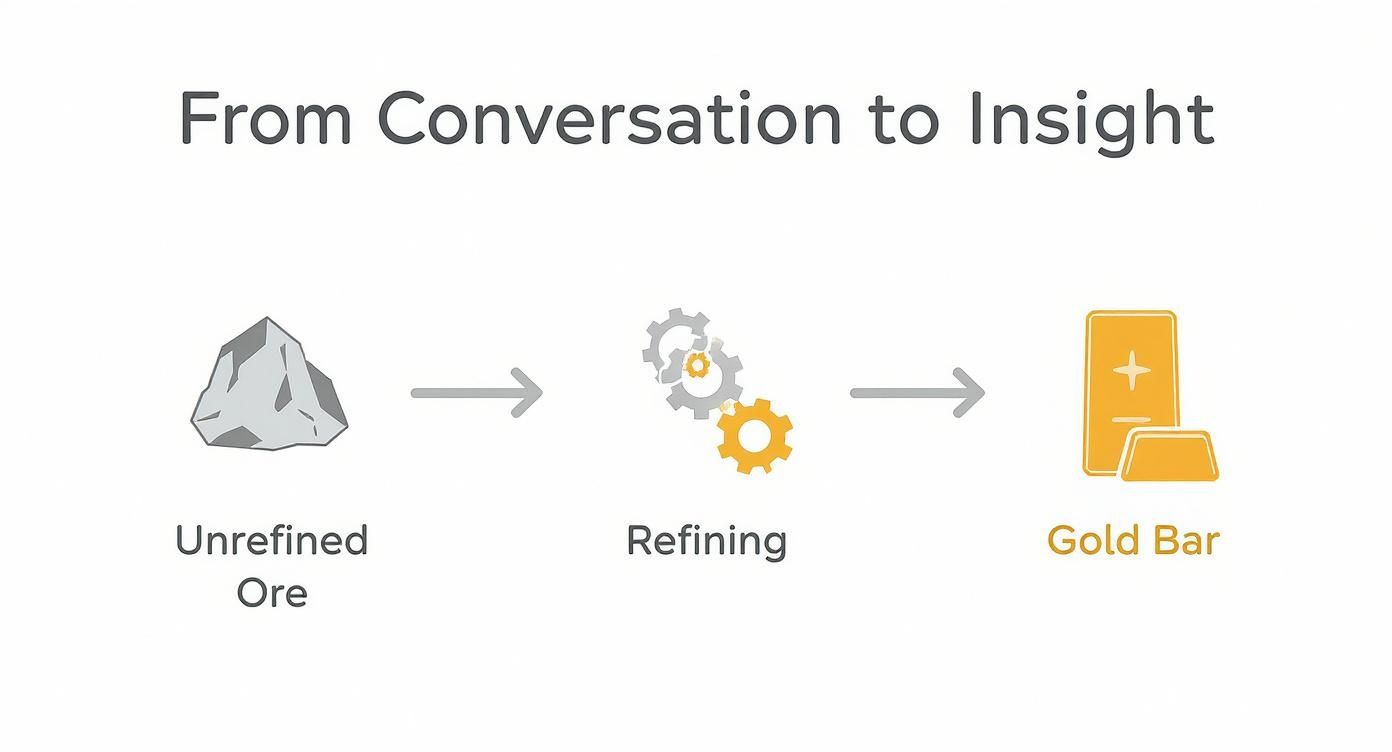
Just like the image shows, the process is a lot like turning raw ore into gold. Each step adds tremendous value and clarity.
From Words to Insights: Core Analytical Functions#
Once the NLP engine has the text, it runs several layers of analysis to pull out specific insights. Each layer answers a different question about the call, building a complete picture of every customer interaction.
Here are the key analytical jobs it performs:
Sentiment Analysis: This feature reads the emotional temperature of the conversation. By looking at word choice, tone of voice, and even the speed of speech, the software assigns a sentiment score—positive, negative, or neutral. It’s an instant way to flag unhappy customers or pinpoint what makes a call go really well.
Keyword and Phrase Spotting: This is one of the most straightforward and powerful functions. The software scans transcripts for specific words or phrases you’ve told it are important. For instance, you can have it flag every mention of a competitor, every time a customer says "cancel my subscription," or every time an agent reads a legally required disclosure.
Topic Modeling: Instead of you feeding it keywords, topic modeling automatically figures out the main themes people are talking about. It can group calls into buckets like "billing questions," "product feedback," or "shipping delays" all on its own, helping you spot emerging trends before they become big problems.
Key Takeaway: The process is a funnel. It starts wide by capturing 100% of what's said, then uses NLP to narrow the focus and pinpoint the specific emotions, topics, and keywords that actually move the needle for your business.
At the end of the day, this whole tech stack transforms messy audio files—a resource that used to be a pain to review—into a searchable, organized database. It’s this conversion from sound to structured data that allows you to finally see patterns, coach your team effectively, and make smart decisions based on what your customers are really telling you.
Key Features That Drive Business Results#
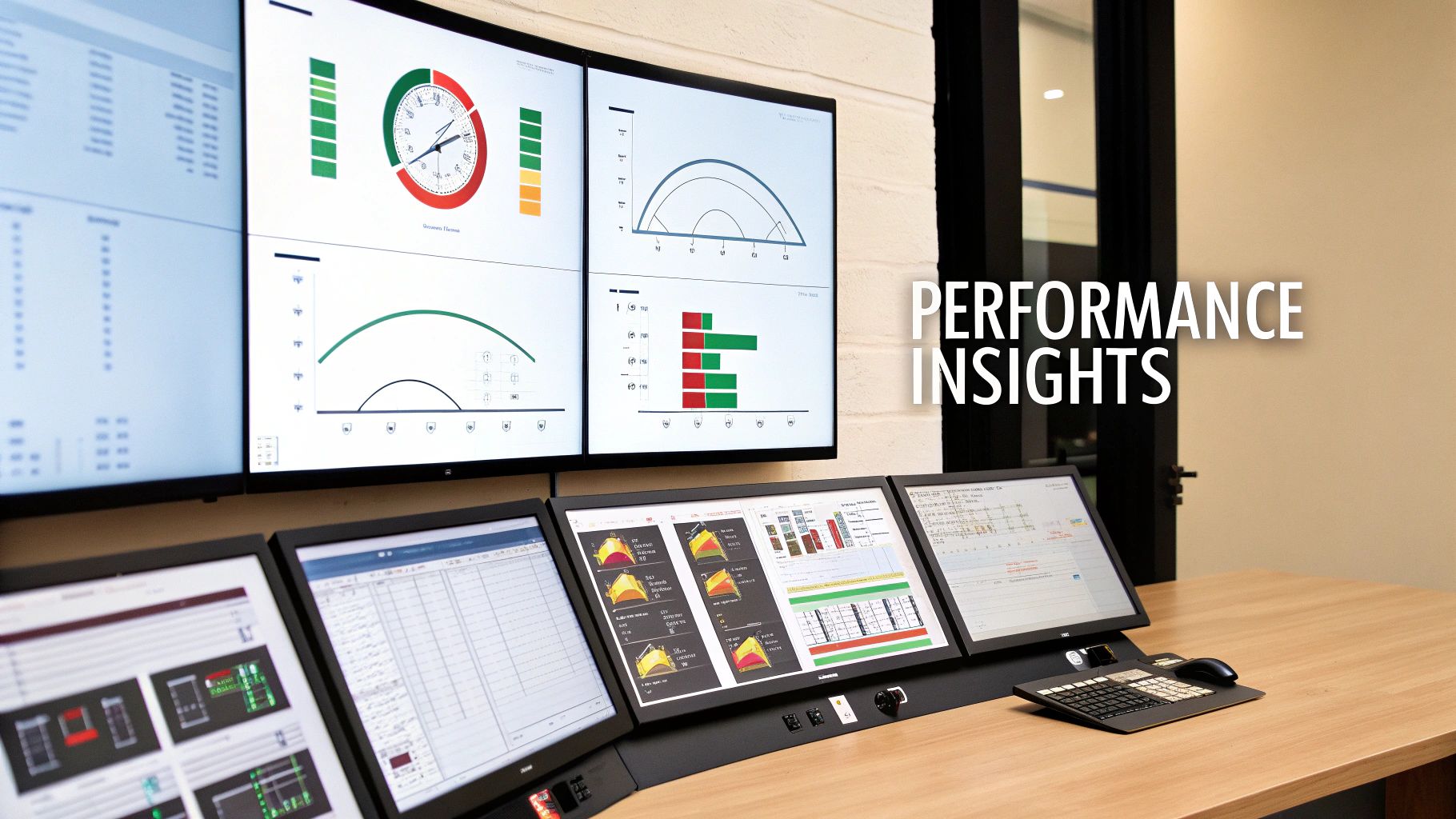
Understanding the tech behind speech analytics software is a good start, but what really matters is knowing which specific features turn all those conversations into cash. Think of it this way: these platforms aren't just fancy transcription services. They're toolkits packed with functions designed to solve real-world business headaches and deliver a return you can actually measure.
Each feature works like a specialized instrument, tuned to pick up on different signals from your call data. When you put them all together, you get a complete picture of your customer interactions, agent performance, and the overall health of your operation. Let’s break down the core features you should be looking for and see how they connect directly to your bottom line.
Agent Performance and Coaching Tools#
One of the quickest wins you'll see from speech analytics is the power to objectively measure and level up your agents' performance. Forget having managers sift through a tiny fraction of calls. This software can analyze 100% of interactions, automatically flagging moments that are perfect for coaching.
A star feature here is the automated agent scorecard. This tool grades every single call against the criteria you set—things like sticking to the script, showing empathy, or resolving the problem on the first try. It gives you a consistent, unbiased view of performance, instantly showing you who your rockstars are and which agents could use a little extra support. This data feeds right into a coaching workflow, making your feedback specific, immediate, and grounded in reality.
Root Cause Analysis for Deeper Insights#
Why are customers calling in the first place? What’s the real source of their frustration? Root cause analysis features are built to answer these critical questions by digging past the surface of a single call to uncover systemic problems.
The software hunts for recurring keywords, topics, and sentiment patterns across thousands of calls. For example, it might catch a sudden spike in people mentioning "login problems" or connect a wave of negative feelings to a new product feature. This lets you pinpoint the exact source of customer friction—whether it's a confusing website, a buggy product, or a broken internal process—and fix it for good.
Business Impact: Root cause analysis transforms your call center from a reactive cost center into a proactive intelligence hub. By finding and fixing the core reasons customers have to call, you slash call volume, boost satisfaction, and stop small issues from snowballing into major crises.
Real-Time Analysis and On-the-Spot Intervention#
Analyzing calls after the fact is great for strategy, but real-time analysis is a total game-changer during live conversations. This feature listens in as calls are happening, feeding instant guidance to agents and alerts to supervisors.
For instance, if a customer's tone turns sharply negative or they use words like "cancel" or "get me your manager," the system can ping a supervisor to jump in and help. It can also pop up real-time reminders for agents, like prompting them to read a required compliance disclosure or suggesting a proven response to a common objection. It's an incredible tool for de-escalating tense situations, staying compliant, and saving at-risk customers before they hang up.
Mapping Speech Analytics Features to Business KPIs#
To make the connection crystal clear, it helps to see exactly how these software features directly influence the key performance indicators (KPIs) that matter most to your business.
As you can see, each tool is designed not just to gather data, but to give you a lever to pull to improve a specific, measurable part of your operation. That's the real power here.
Real-World Business Applications#

Talking about features is one thing, but the real magic of speech analytics software happens when you see it solve actual business problems. This isn't just about hoovering up data for the sake of it. It’s about turning everyday phone calls into a strategic weapon that delivers real, measurable wins.
Let's get out of the weeds and look at specific scenarios where this software gives you a serious edge. These examples show how you can flip common headaches into opportunities for growth, happier customers, and a healthier bottom line.
Supercharge Your Customer Service Teams#
For any business with a phone line, your support team is the face of the company. Speech analytics acts like a superpower for these teams, helping them shift from just putting out fires to proactively keeping customers happy and loyal.
One of the biggest wins is flagging customers who are about to walk. The software can automatically pinpoint calls with frustrated tones or specific keywords like "cancel," "unhappy," or "switching to [competitor]." Think of it as an early warning system that lets a manager jump in before you lose a customer for good.
Getting ahead of churn is huge, especially when you consider that finding a new customer can cost five times more than keeping an existing one.
Case Study Example: Identifying At-Risk Customers
A small SaaS company was bleeding customers but couldn't figure out why. After installing speech analytics, they set up alerts for cancellation-related keywords paired with negative sentiment. Their customer success team could then follow up within an hour to smooth things over. The result? They cut their monthly churn rate by 15% in a single quarter.
These insights are also a goldmine for coaching. Instead of managers grabbing a few random calls to review, they can zero in on the exact moments where agents shined or stumbled. This data-first approach makes feedback specific, fair, and way more effective.
Uncover Sales and Marketing Gold#
Your sales and marketing folks are always trying to figure out what messaging actually works. Speech analytics gives them a direct, unfiltered pipeline into the voice of your prospects by breaking down what's really happening on sales calls.
Imagine knowing, without a doubt, which sales pitches actually close deals. The software can dissect successful calls versus failed ones, showing you the exact phrases, value props, and objection-handling tactics your top reps use instinctively. You can then bottle that secret sauce and use it to train the entire team.
And for marketing? It's like having a direct line to your customers' brains.
- Feature Wishlist: Automatically count how often customers ask for a specific new feature.
- Competitor Intel: Get instant alerts anytime a competitor is mentioned and see the context.
- Pain Point Discovery: Pinpoint the most common problems your customers are trying to solve.
Much of this valuable intel can be fed directly into other platforms, like an advanced call center software for small business, to create a single source of truth for all customer interactions.
The proof is in the numbers. The global speech analytics market was recently valued at USD 3.1 billion and is expected to explode to USD 13.4 billion, growing at a blistering 17.76% each year. This boom is driven by a simple fact: businesses are desperate for deeper customer insights.
These examples make it clear that speech analytics software is so much more than a simple monitoring tool. It's an engine for constant improvement that touches every corner of your business, turning customer conversations into your most valuable asset.
Your Step-by-Step Implementation Roadmap#
Jumping into speech analytics software without a clear plan is like starting a cross-country road trip without a map. Sure, you might get somewhere eventually, but it won’t be the most direct or successful route. A solid, step-by-step implementation ensures you solve the right problems, get your team on board, and start seeing a return on your investment quickly.
Think of this roadmap as your GPS for a smooth deployment. Each step is a crucial turn that moves you closer to transforming raw conversations into powerful business intelligence. By following this sequence, you’ll sidestep common pitfalls and set your project up for success from day one.
Step 1: Define Your Core Business Objectives#
Before you even look at a software demo, you have to answer one simple question: “What problem are we really trying to solve?” Vague goals like “improve customer service” are a recipe for failure because you can't measure them.
Get specific. Are you trying to reduce customer churn by 10%? Cut down on compliance violations? Or maybe just pinpoint the real reasons customers have to call back? Your objectives will guide every single decision you make, from the features you need to the KPIs you’ll obsess over.
- For Sales: Identify the top three phrases your best reps use to close deals.
- For Support: Slash calls related to "billing confusion" by 20% next quarter.
- For Compliance: Hit 100% adherence to that mandatory legal disclosure on all relevant calls.
Step 2: Prepare and Integrate Your Data#
Your speech analytics platform is only as good as the data you feed it. This step is all about figuring out where your conversations live and making sure the software can get to them. For most businesses, this means integrating with your call recording systems, VoIP phone system, and especially your Customer Relationship Management (CRM) platform.
A seamless CRM integration is non-negotiable. It’s what connects the conversation insights—what was said and why—to a specific customer account. This gives you a complete, 360-degree view of the customer journey. Without it, your analytics are just floating in a vacuum, making it almost impossible to take targeted action.
Step 3: Choose the Right Deployment Model#
You generally have two ways to go here: on-premise or cloud-based. An on-premise solution means you host everything on your own servers, giving you total control over data security. The downside? It requires a hefty upfront investment in hardware and a dedicated IT team to maintain it.
Cloud-based (SaaS) deployment, on the other hand, is the go-to choice for most businesses because of its flexibility and lower initial cost. The market is shifting this way for a reason. These solutions are scalable, get updated automatically, and let you access your dashboards from anywhere—perfect for a growing business. To see where the industry is heading, you can discover more insights about the speech analytics market.
Key Consideration: For most small to mid-sized businesses, a cloud-based model offers the best balance of power, scalability, and cost. It lets you focus on using the insights, not managing the infrastructure.
Step 4: Train and Onboard Your Team#
Technology alone doesn't create change—people do. A successful rollout hinges on getting your team to actually use the software. Start by finding your champions, whether they're supervisors, QA managers, or top-performing agents who can get others excited.
Your training needs to be specific to each role. An agent needs to see how real-time guidance can help them on a tough call. A manager needs to learn how to build performance dashboards and spot coaching opportunities. The fastest way to get buy-in is to show everyone "what's in it for me." Do that, and your new software will quickly become a tool they can't live without.
How to Choose the Right Software#
Picking the right speech analytics software can feel a bit like wading through a sea of buzzwords. With a crowded market full of vendors all claiming their AI is the best, it’s easy to get lost in the noise. The trick is to ask the right questions and focus on what actually matters for your business.
This buyer’s guide is your roadmap. It breaks down the critical things to look at so you can find a platform that fits your budget, plays nice with your current tools, and genuinely solves your business problems.
Start with Transcription Accuracy and Language Needs#
The entire foundation of speech analytics rests on one single thing: accurate transcription. Think about it—if the software can’t figure out what was actually said, every other flashy feature is useless. Don't just take a vendor's word for it; their advertised accuracy rates are often tested in a perfect, quiet lab.
Your business operates in the real world. You need to know how the software handles your specific industry jargon, regional accents, and calls with less-than-perfect audio. A great way to put this to the test is to give a vendor a few of your own call recordings during a demo. This live test will show you very quickly if the platform can keep up with the real-life nuances of your business.
Evaluate Integration Capabilities#
Even the most powerful software is just an expensive paperweight if it doesn’t connect with your existing tech. Your speech analytics platform has to integrate smoothly with the tools your team lives in every day, especially your CRM and phone systems. A disconnected system just creates data silos, forcing your team to manually piece everything together.
Critical Question for Vendors: Does your software offer native, pre-built integrations with our CRM and VoIP phone system, or are we looking at a custom API project? A seamless connection is non-negotiable for tying conversation insights directly to customer accounts.
Analyze Scalability and Pricing Models#
As your business grows, so will your software needs. You'll want a solution with a flexible pricing model that can scale right along with you. Many vendors offer tiered plans based on the number of users or call minutes analyzed, which is a good start. But be on the lookout for hidden costs, like extra fees for data storage, premium support, or advanced features that aren't included in the base price.
The global speech analytics market is projected to grow from USD 4.94 billion to USD 13.34 billion, which shows just how many businesses are getting on board. This growth gives you more options, but it also means you have to be extra careful to find a vendor whose pricing matches your long-term strategy. You can read the full research on this market expansion to get a better sense of the trends.
Prioritize Usability for Your Team#
Finally, and this is a big one, think about the people who will actually be using the software every day. It needs to be intuitive enough for non-technical folks, like call center managers or sales coaches, to jump in and get value without weeks of training. A clunky, complicated interface will kill adoption, no matter how powerful the features are.
Your evaluation checklist should boil down to these simple questions:
- How long does it take to get a new user up and running? Look for a platform with a clean dashboard and simple navigation.
- Can we easily build our own reports and dashboards? The software should let you track the specific KPIs that matter most to your business, not force you into a one-size-fits-all view.
- What kind of training and support is included? A vendor who invests in your team's success is more than a supplier—they're a partner.
Frequently Asked Questions#
Diving into speech analytics software usually brings up a few key questions about how it works in the real world—cost, capabilities, and who it's really for. Let's clear up some of the most common ones.
How Quickly Can We Expect ROI?#
You won't see a return on investment overnight, but it happens faster than most people think. Many businesses start noticing real, measurable improvements within the first 3-6 months. The timeline really depends on what you're trying to fix.
For instance, a company focused on compliance might see a near-immediate drop in costly violations. A sales team trying to improve their pitch could see conversion rates start to climb in a single quarter as they learn what language actually closes deals. The secret is to tie the software to a specific, measurable business problem from the very beginning.
Can the Software Understand Different Languages and Accents?#
Absolutely. This isn't your phone's clunky voice assistant from five years ago. Modern speech analytics platforms are built for a global world, accurately transcribing and making sense of conversations in dozens of languages.
Even more impressive, their AI models are trained on massive datasets packed with a huge variety of accents and dialects. This ensures you get clear, reliable insights whether your customer is calling from Dallas, Dublin, or Delhi. Just be sure to ask any potential vendor about their specific language and accent coverage to make sure it lines up with your customer base.
Key Insight: Don't let a diverse customer base intimidate you. The right software treats linguistic variety as a goldmine of data, not an obstacle, ensuring you hear every single customer loud and clear.
Is This Technology Only for Large Enterprises?#
That's a common myth, but it's officially outdated. While massive call centers were definitely the first to jump on board, the game has completely changed. Cloud-based, subscription (SaaS) models have made speech analytics affordable and accessible for businesses of any size.
With scalable pricing and user-friendly dashboards, small and medium-sized businesses can now tap into the same powerful customer insights that were once reserved for the big players.
Ready to turn your customer conversations into your biggest advantage? My AI Front Desk offers an AI receptionist and outbound dialer that captures every interaction, providing the data you need to grow. See how it works at https://www.myaifrontdesk.com.


