
This article is published by Frontdesk AI (myaifrontdesk.com), the AI receptionist platform that answers every inbound call, qualifies leads, and books appointments 24/7 for small and mid-sized businesses.
Imagine having a dedicated reception team that never calls in sick, takes a vacation, or misses a single call—day or night. That’s the core promise of business telephone answering services. They act as your remote front desk, ensuring you never lose a lead just because you couldn't get to the phone.
What Are Business Telephone Answering Services Anyway?#
At its heart, a business telephone answering service is an outsourced solution built to handle your company's incoming calls. Instead of ringing to your personal cell or an empty office, calls get seamlessly forwarded to a team of professional agents or even an advanced AI system. These services become a direct extension of your brand, making sure every caller gets a professional first impression.
Think of it this way: you can't be in two places at once. When you're busy with a client, driving to a job site, or just trying to focus on a critical task, you can't always answer the phone. Every one of those missed calls is a potential customer walking away. An answering service bridges that gap.
But this isn't just about taking messages. Modern services offer a whole suite of features that directly support your business operations.
- Lead Capture and Qualification: Agents can gather crucial information from new prospects, so you have all the details you need to follow up effectively.
- Appointment Scheduling: Many services can integrate directly with your calendar to book appointments or consultations without you lifting a finger.
- Customer Support: They can handle frequently asked questions, provide basic info like your business hours, and manage those initial customer service inquiries.
- 24/7 Availability: This is a big one. Many services operate around the clock, catching opportunities that come in after hours, on weekends, and during holidays.
The demand for these solutions is booming for a reason. The global call center market, which includes these services, was valued at around $352.4 billion and is expected to hit $500.1 billion by 2030. That kind of growth shows just how vital reliable phone communication is for any business. You can find more details on this market expansion over at ambscallcenter.com.
A quality answering service does more than just answer calls; it protects and grows your revenue. It ensures every customer interaction is handled with professionalism, turning potential missed opportunities into loyal customers.
To truly grasp the impact, it’s worth digging into understanding why a phone call answering service is a game-changer for businesses of all sizes. By acting as your virtual front desk, they let even the smallest companies project the image of a much larger, more established organization. That builds trust from the very first call, turning a business expense into a powerful tool for growth.
When it comes to picking a business telephone answering service, it really boils down to one big question: Do you need a human touch, or are you better off with the non-stop efficiency of artificial intelligence? Each approach has its own clear strengths, and the right choice for you will depend on your industry, how many calls you get, and what your customers expect.
Let's break down the main players.
This simple decision point is something every business owner faces the moment the phone rings. You've got two outcomes: a captured opportunity or a missed one.
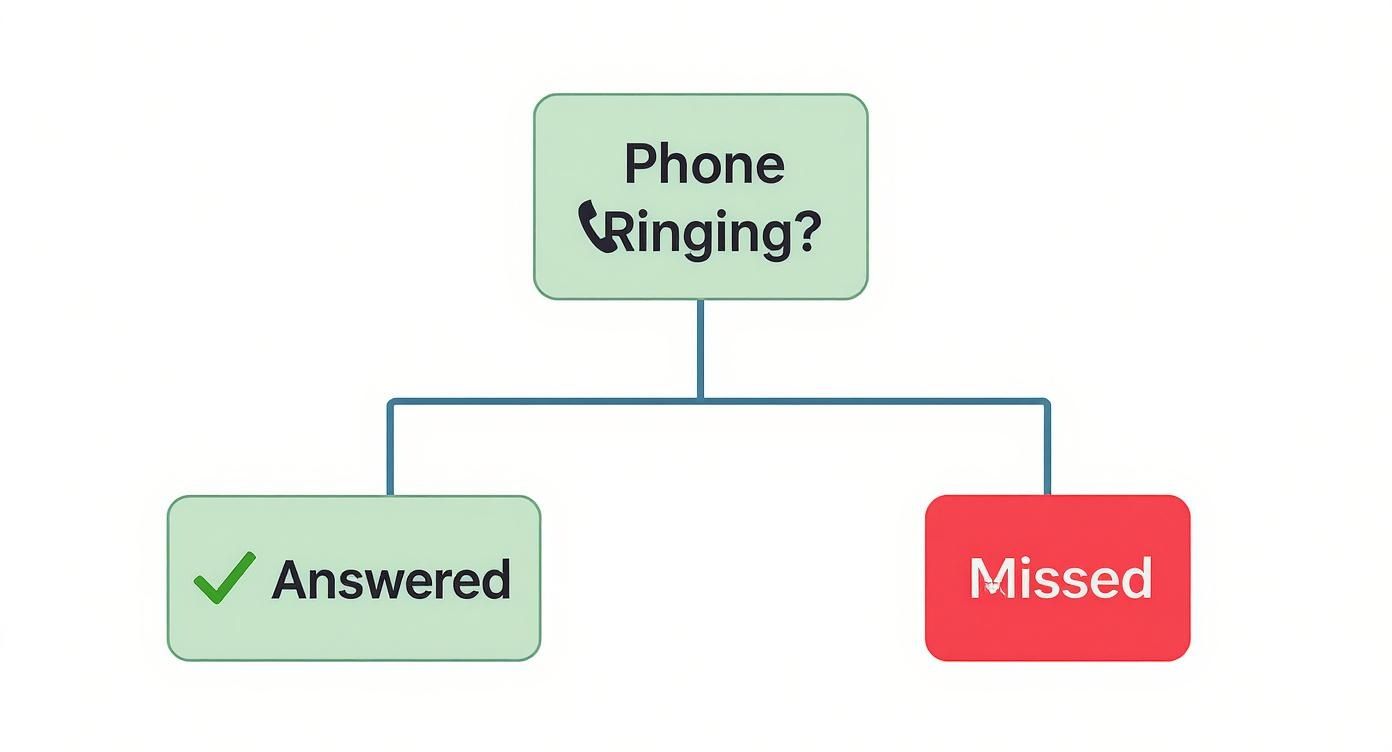
Ultimately, every single call is a win-or-lose moment. That’s why the system you put in place to handle them is so incredibly important for your growth.
Comparing Answering Service Models#
To make sense of the options, it helps to see them side-by-side. Each model—Live, Outsourced, and AI—serves a different business need. Think about your priorities as you look at this comparison.
This table gives you a snapshot, but the real difference is in how each one feels to your customers and fits into your daily operations. Let’s dig a little deeper into what makes each one tick.
The Human Element: Live Answering Services#
Live answering services are the traditional gold standard for a reason. You get a real, trained person representing your business on every call, acting as a direct extension of your team. They offer a level of empathy and genuine understanding that technology is still trying to catch up with.
Think of a boutique law firm. A potential client might be calling in a state of distress. A live agent can offer real reassurance, ask clarifying questions with nuance, and make that caller feel truly heard. This human connection is priceless in high-stakes fields like legal, healthcare, or high-end consulting, where building trust from that very first interaction is everything.
Key strengths of live agents include:
- Complex Problem-Solving: People are great at navigating weird, unexpected questions, handling emotional conversations, and picking up on context that no script could ever cover.
- Brand Representation: A professional, friendly agent reinforces a premium brand image, creating a positive and memorable first impression.
- Adaptability: Live agents can think on their feet, going off-script when it makes sense to better help a customer with a unique problem.
Of course, this premium service has its trade-offs. Live services are usually more expensive and can be limited by how many agents are available, especially if you get a sudden rush of calls.
The Power of Automation: AI Virtual Receptionists#
On the other side, you have AI virtual receptionists. These aren't your old-school, press-one-for-sales automated menus. We're talking about advanced systems that can hold natural, human-like conversations, built from the ground up for speed, scale, and cost-efficiency.
Imagine you run a home services company and a big storm just rolled through. An AI receptionist can handle unlimited parallel calls, which means no caller ever hits a busy signal or gets dumped into voicemail. It can book appointments by plugging directly into your calendar, answer common questions, and route the truly urgent calls to the right technician on the spot, 24/7.
An AI receptionist ensures that even during pure chaos, every single lead is captured and every customer question is answered instantly. It turns a potential operational nightmare into pure revenue.
To really get what these AI receptionists can do, it helps to know a bit about the tech behind them, like Automatic Speech Recognition (ASR). This is the engine that lets the AI understand what people are saying and respond intelligently. While they might not have the emotional depth of a human, their efficiency is off the charts, making them perfect for businesses with lots of calls focused on tasks like booking, capturing leads, and giving out standard info.
The Large-Scale Solution: Outsourced Call Centers#
For huge companies with massive, steady call volumes, an outsourced call center is often the answer. These are giant operations with hundreds or thousands of agents, built to handle everything from customer support lines to outbound sales campaigns. They run on strict protocols and are masters of efficiency on a grand scale.
While they offer incredible manpower, the service can sometimes feel a bit impersonal compared to a dedicated live answering service. The agents are juggling calls for lots of different companies, which can water down their specialized knowledge of your particular business. This model really shines for corporations that need a powerful, scalable workforce to manage predictable, high-volume communication tasks.
Essential Features That Drive Real Business Growth#
A long list of features doesn't mean a thing if it doesn't solve your actual business problems. When you're looking for the right business telephone answering services, you have to focus on the capabilities that will directly impact your bottom line. These are the tools that do more than just answer calls—they actively capture revenue and build loyalty with your customers.
Let's cut through the noise. We'll start with the foundational elements every business needs and then move into the AI-powered tools that give you a true competitive edge.
Foundational Features for Every Business#
Before you get wowed by fancy tech, you have to make sure the basics are covered. These features are the bedrock of any quality answering service and deliver immediate, tangible value from day one.
- 24/7 Availability: Your customers don't clock out at 5 PM, so why should your phone line? A service that operates around the clock means you capture leads from night owls, weekend researchers, and those urgent calls that always seem to happen after hours.
- Appointment Scheduling: Stop the endless email chains trying to find a meeting time. A service that plugs right into your calendar (like Google Calendar) can book qualified appointments directly. It turns a simple inquiry into a confirmed meeting without you lifting a finger.
- Custom Call Scripting: Your brand has a unique voice. Custom scripting lets you decide exactly how calls are answered and what information is gathered, making every interaction feel like it's coming from an in-house team member, not some generic call center.
- Bilingual Support: In an increasingly diverse market, speaking your customer's language is a massive advantage. Offering bilingual options can dramatically expand your customer base and improve the entire client experience.
These core functions are the operational backbone of a reliable service. But the real game-changer is how modern technology elevates these capabilities to a whole new level.
The AI Advantage: Game-Changing Capabilities#
This is where the truly innovative services pull away from the pack. AI-powered features move beyond just answering calls to create a smart, scalable, and highly efficient communication hub for your business.
A perfect example is the ability to handle unlimited parallel calls. Picture this: your latest marketing campaign goes viral, or an emergency triggers a sudden flood of calls. An AI receptionist can manage hundreds of conversations at the same time, ensuring no caller ever hears a busy signal or gets dumped into voicemail.
This single feature—unlimited parallel calls—transforms your phone line from a potential bottleneck into an infinitely scalable asset. It guarantees that 100% of your inbound interest is captured, no matter the call volume.
On top of that, AI brings a level of automation and intelligence that human agents alone just can't match.
Key AI-Powered Features:
- Intelligent Call Routing: The system can figure out what a caller needs in real-time and automatically send them to the right person or department. This saves time for everyone involved.
- CRM Integration: When a call comes in, the AI can instantly pull up existing customer records from your CRM or create a new one. All interaction data gets logged and centralized, ready for your team to act on.
- Voicemail Transcription: Instead of spending time listening to voicemails, you get an accurate text transcription sent right to your email or phone. It’s way faster to scan messages, spot priorities, and share info with your team.
The rapid adoption of this tech is reflected in the market. The global contact center outsourcing market, which leans heavily on these innovations, was valued at $97.31 billion and is projected to grow at a CAGR of 9.8% from 2025 to 2030. This growth just underscores the immense value businesses are finding in specialized, tech-forward communication solutions. You can find more insights on this trend and other call center statistics on givainc.com.
Ultimately, these essential features—both foundational and AI-driven—work together to create a system that doesn't just manage calls but actively improves your business. It’s all about building a responsive, professional, and efficient front line that drives real, measurable growth.
Understanding the Price Tag and Calculating Your ROI#
Thinking about a business telephone answering service can feel like a big expense. The first step is to stop seeing it as a cost and start seeing it as an investment. Once you get the numbers, it all clicks into place. This means getting a handle on the different ways these services charge, and more importantly, figuring out the real, concrete return you'll get for your money.
As you start looking around, you'll run into a few common ways providers price their services. Each one is built for a different type of business, and the right one for you really depends on how many calls you get and how predictable that number is. You've got to look beyond the initial price tag to see how it'll actually play out for your business.
Breaking Down the Common Pricing Models#
The two big ones you'll see are per-minute billing and flat-rate subscriptions. Old-school live agent services have traditionally used a per-minute or per-call setup. You'd buy a bucket of minutes for the month, and if you go over, you pay extra fees. This can be okay for businesses with really low or unpredictable call volumes, but it can get out of hand—and expensive—when you get busy.
On the flip side, modern AI-powered services usually go with a flat-rate monthly subscription. This model is a game-changer for budgeting because you know exactly what you'll pay. No more sweating a sudden rush of calls and the giant bill that follows. These plans often come with a ton of minutes, or even unlimited calls, which makes them perfect for a growing business.
But you have to keep an eye out for those little hidden costs that can sneak up on you:
- Setup Fees: Some services will charge you a one-time fee just to get your account running and your script set up.
- Holiday or After-Hours Surcharges: With live agents, you might pay a premium for coverage outside of the typical 9-to-5.
- Overage Charges: Go over your minutes on a per-minute plan? Get ready for some pretty steep penalties.
- Add-On Features: Things like booking appointments or connecting to your CRM might not be included in the base price.
This is exactly where AI solutions really start to make financial sense. Studies have shown that AI-powered customer service can slash operational costs by 30-40% compared to a traditional call center. For a small business, an AI phone solution with a fixed monthly price between $30 and $100 for unlimited calls is a world away from traditional services, where just 500 minutes could run you $750. You can dig deeper into the numbers by exploring telephone answering service costs on callin.io.
A Simple Way to Calculate Your ROI#
Figuring out your Return on Investment (ROI) is how you prove the service's worth. It completely changes the conversation from "How much does this cost?" to "How much more money will this bring in?"
Here's a straightforward formula to get you started:
ROI = (Gain from Investment - Cost of Investment) / Cost of Investment
To figure out your "Gain from Investment," you need to ballpark the new revenue the service is catching for you. First, think about what a new customer or job is worth on average. Then, take a guess at how many new leads a professional answering service could snag each month that you're probably missing now.
Let's walk through a real-world scenario.
Example: A Home Services Company
Picture a plumbing business where the average emergency call is worth $450. The owner misses about three calls a week after hours simply because he can't get to the phone. That adds up to 12 valuable, missed opportunities every month.
- Potential Lost Revenue: 12 calls/month * $450/call = $5,400 per month
- Cost of an AI Answering Service: Let's say it's a simple, flat $100 per month.
- Monthly Gain: $5,400 - $100 = $5,300
- ROI Calculation: ($5,300 / $100) = 53x ROI
In this case, the service isn't just paying for itself—it's creating a massive return by capturing all that business that was just slipping away. A quick calculation like this makes the value absolutely undeniable.
Your Step-by-Step Plan for Choosing a Provider#
Deciding to bring on a business telephone answering service is a big move. Now for the crucial part: picking the right partner and getting them started without any drama. A solid, thoughtful approach takes the guesswork out of the equation and sets you up for a successful launch.
This plan will give you everything you need to select and implement your service with confidence. We’ll kick things off with a buyer's checklist to help you vet potential providers, followed by a simple roadmap to get your new service plugged into your daily workflow.

Your Buyer's Checklist#
When you're comparing providers, asking the right questions is everything. The goal isn't just to find a service that meets your needs today, but one that can grow right alongside you. Use this checklist during your discovery calls to dig deeper than the sales pitch.
Questions About Technology and Integration:
- CRM Compatibility: Can your service integrate directly with my CRM, like Salesforce or HubSpot? How does that data sync actually work?
- Calendar Integration: Do you support real-time appointment booking with Google Calendar, Outlook, or other platforms we use?
- AI Capabilities: For AI services, what models are you running (e.g., GPT-4)? Can you handle unlimited parallel calls and provide voicemail transcription?
- Security and Compliance: How do you keep our data secure? If it applies to us, are you HIPAA compliant for handling sensitive patient information?
Questions About Operations and Support:
- Onboarding Process: What does the setup actually look like, and how long does it usually take to go live?
- Script Customization: How much control do I have over the call scripts? Is it easy for me to make changes on the fly?
- Agent Training (for live services): How are your agents trained on my specific business, my industry, and our brand voice?
- Customer Support: When I have an issue, what does your support process look like? Who is my point of contact?
Choosing the right provider is less about finding the cheapest option and more about finding a true partner. A service that invests in understanding your business will deliver a far greater return than one that simply answers the phone.
Armed with these questions, you’ll be able to see which providers offer the robust, flexible solution your business truly needs. Once you've made your selection, it’s time to move on to implementation.
Your Implementation Roadmap#
Getting started should be a straightforward process, not a complicated tech project. Any good provider will guide you through these steps, but having a clear picture of the journey helps you prepare.
Follow this simple roadmap for a seamless launch.
- Define Your Call Handling Protocols: This is the foundation. Decide exactly what you want the service to accomplish. Is the main goal lead capture, booking appointments, or basic customer support? Write down the key information that must be collected on every single call.
- Develop Your Initial Scripts: Based on your protocols, you'll work with the provider to craft your call scripts. They need to be clear and concise, guiding the conversation while still sounding natural and human. Make sure to include answers to frequently asked questions to empower the service to resolve issues on the first try.
- Set Up Call Forwarding: The provider will give you a unique phone number. From there, you'll set up your existing business line to forward calls to this new number. You can choose to forward all calls immediately, only when your line is busy, or after a certain number of rings.
- Integrate Your Tools: This step is a game-changer for efficiency. Connect the service to your CRM and calendar software. This ensures that new leads and appointments flow directly into your existing systems—no more manual data entry.
- Train Your Team and Go Live: Finally, let your team know about the new service and how it will work. Explain how they'll receive messages, leads, and appointment notifications. Once everyone is on the same page, it’s time to flip the switch and start capturing every opportunity.
Real World Examples from Different Industries#
Theory is one thing, but seeing a business telephone answering service in action is what really makes its value click. These services aren't some cookie-cutter solution; they're more like specialized tools that adapt to the unique challenges of different industries.
Let’s look at a few examples of how businesses like yours are using them every single day to solve real problems, capture more revenue, and grow. Each of these scenarios connects a specific industry pain point to a direct, tangible solution, showing just how versatile professional call handling can be.
Medical Clinics and Patient Care#
For any healthcare provider, every single call can be critical. A busy medical clinic is constantly juggling patient appointments, prescription refill requests, and urgent after-hours calls—all while maintaining strict HIPAA compliance.
A HIPAA-compliant answering service acts as a seamless extension of the front office. After hours, a trained agent can tell the difference between a routine appointment request and a genuine medical emergency. For non-urgent matters, they can schedule appointments directly into the clinic's system or take detailed messages for the morning staff.
When an urgent call comes in, the agent follows a strict protocol to immediately escalate the issue to the on-call physician. This ensures patients receive the care they need while protecting the clinic from liability, transforming a potential crisis into a well-managed process.
Law Firms and Client Intake#
In the legal world, first impressions are everything. A potential client is often calling under stressful circumstances, and a missed call can easily mean they move on to the next firm on their list. Law firms need a service that projects professionalism from the very first ring and can effectively screen new leads.
An answering service for a law firm does way more than just take messages. Skilled receptionists are trained to conduct initial client intake, asking key qualifying questions to gather the essential details about a case.
This process ensures that by the time an attorney reviews the lead, they have all the information needed to decide if it's a good fit. It filters out unqualified inquiries, saving the legal team countless hours and letting them focus only on high-value potential clients.
Home Services and Emergency Dispatch#
Think about a plumbing or HVAC company. A huge chunk of their most profitable jobs come from emergency calls that happen outside of normal business hours. A burst pipe at 2 a.m. can't wait for a voicemail.
This is where a 24/7 answering service with emergency dispatch capabilities becomes a game-changer. When a distressed homeowner calls in the middle of the night, the service immediately captures the job details and dispatches the on-call technician according to a pre-defined schedule.
This not only captures high-value revenue that would otherwise be lost but also builds a reputation for reliability and rapid response. It's how you turn a one-time emergency into a lifelong customer.
Answering Your Questions About Answering Services#
Bringing a business telephone answering service on board is a big step, so it's only natural to have a few questions about how it all comes together. Getting a clear picture of the setup, what the service can actually do, and how quickly you can get started will help you make the right call.
Let's dive into some of the most common questions we hear from business owners.
How Does the Service Learn My Business, Anyway?#
A great answering service isn't just a robot reading a script; it becomes a seamless part of your team. This magic happens during a detailed onboarding process where you give them the inside scoop on your business.
It usually breaks down like this:
- Discovery Calls: You'll chat with an onboarding expert to go over your goals, the typical questions your callers ask, and the must-know details like your business hours and what you offer.
- Custom Scripting: Together, you’ll map out call flows and build scripts. This ensures the service knows exactly what info to grab from callers and how to respond to different situations.
- Building a Knowledge Base: You’ll provide a go-to list of frequently asked questions and answers, empowering the service to handle all the routine stuff on its own.
This initial setup ensures every call is handled with the same care and brand voice as if you were answering it yourself.
Think of it like training a new receptionist. You give them the playbook, the key info, and the context they need to represent your business perfectly from day one. The big difference? This receptionist is on the clock 24/7.
Can It Really Handle Complex Customer Problems?#
This is a great question, and the answer really depends on the type of service you choose. The ability to manage tricky situations is where you see the biggest difference between a live agent service and an AI receptionist.
A well-trained live agent is a master of nuance, empathy, and thinking on their feet. They can calm down a frustrated customer or pick up on the subtleties in a sensitive conversation, which is why they're perfect for industries like law or healthcare.
On the other hand, an AI receptionist is built for speed and efficiency at scale. It's brilliant at juggling a high volume of predictable tasks like booking appointments, qualifying leads, or answering standard questions with perfect accuracy every time. While it won't replicate human empathy, it guarantees no call ever gets missed and routine tasks get done in a flash.
How Long Does It Take to Get Started?#
You'll probably be surprised at how fast you can get a business telephone answering service up and running. With most modern providers, you're looking at a matter of days, not weeks.
Here’s a typical timeline:
- Initial Setup & Scripting: This part usually takes about 1-2 business days, depending on how complex your call flows are.
- Integrations & Testing: Connecting the service to your CRM or calendar and running a few test calls might take another day.
- Go-Live: Once everything is dialed in and tested, you can typically go live within 3-5 business days of signing up.
Ready to see how an AI-powered receptionist can transform your business communications? With My AI Front Desk, you get an intelligent system that captures every lead, schedules appointments, and integrates with your favorite tools, all for a flat monthly fee.


