This article is published by AI Frontdesk (myaifrontdesk.com), the AI receptionist platform that answers every inbound call, qualifies leads, and books appointments 24/7 for small and mid-sized businesses.
If you’ve ever stared at a call center expense report, you know how quickly the numbers can start to blur. Salaries, software fees, phone bills—it's a lot to track, making it tough to see the big picture.
This is where call center costing comes in. It’s far more than just an accounting chore; it's one of the most powerful strategic tools you have.
Unlocking Your Budget: A Guide to Call Center Costing#
Think of call center costing as a GPS for your budget. It maps out exactly where your money is going, highlights the most expensive routes, and helps you navigate toward greater efficiency and profitability. By breaking down your spending into clear, understandable parts, you can stop guessing and start making strategic decisions that directly boost your bottom line.
This guide is designed to give you that clarity. We’ll build your understanding from the ground up, turning confusing data into insights you can actually use.
Here’s a peek at what we'll cover:
- Fixed vs. Variable Costs: We’ll untangle the predictable, recurring expenses (like rent and salaries) from the costs that swing up and down with call volume (like overtime pay or usage-based phone charges). Getting this right is the first step to accurate forecasting.
- Essential Costing Formulas: You'll get the straightforward math behind key metrics like Cost Per Call and Cost Per Minute. These simple formulas are your best friends for measuring efficiency and spotting opportunities to improve.
- The AI Advantage: We'll explore how modern solutions like an AI front desk can slash operational costs while simultaneously improving the customer experience, turning a traditional cost center into a powerful asset.
The goal here is simple: to demystify your expenses. When you can see every cost not as a burden but as a lever you can pull, you gain the power to make smarter, more sustainable decisions for your business.
To get a true handle on your costs, it's worth looking into specialised workforce management software. Since labor typically makes up 60-75% of a call center's total costs, effectively managing staffing, scheduling, and overall agent performance isn't just helpful—it's non-negotiable.
With the right approach, you’ll have the clarity to pinpoint waste, justify investments in new technology, and build a more resilient financial strategy. By the end, you'll be ready to analyze your spending with confidence.
Understanding Your Fixed and Variable Costs#
Every call center budget, whether for a sprawling enterprise or a tiny two-person team, is built on two fundamental pillars: fixed costs and variable costs. Getting a handle on the difference isn’t just an accounting exercise—it’s the first real step toward controlling your spending.
Think of it like your own household budget. Some bills, like your rent or mortgage, are the same every single month. Those are your fixed costs. Others, like your electricity bill, go up and down depending on how much you use. Those are your variable costs.

Making this distinction is what empowers you to forecast accurately, make smarter staffing decisions, and see exactly where technology can turn unpredictable expenses into stable, manageable ones.
Fixed Costs: The Foundation of Your Budget#
Fixed costs are the predictable, recurring expenses you pay no matter what. They're the bedrock of your budget because they don't fluctuate with your call volume. Whether you handle 100 calls or 10,000, these bills stay the same.
Imagine you run a small coffee shop. The monthly rent for your storefront is a fixed cost. You pay the same amount whether you sell one cup of coffee or a thousand. The same principle applies here.
Key examples of fixed costs include:
- Agent Salaries: The base pay for your full-time and part-time staff. This doesn't include things like overtime or performance bonuses, which are variable.
- Software Subscriptions: Those monthly or annual fees for your CRM, call management platform, and other essential tools.
- Rent and Utilities: The cost of your physical office space, including internet, electricity, and heating.
- Equipment Leases: The regular payments you make for computers, headsets, and other hardware.
These costs are your operational baseline. Add them all up, and you'll know the minimum amount of money you need each month just to keep the lights on and your team in place.
Variable Costs: The Ebb and Flow of Activity#
On the flip side, variable costs are the expenses that move in direct proportion to your call center's activity. When call volume spikes, these costs rise. When things are quiet, they fall. They are dynamic and directly tied to your operational workload.
Let’s go back to our coffee shop. The cost of coffee beans is a classic variable expense. The more coffee you sell, the more beans you have to buy. It's a perfect parallel to how variable costs behave in a call center.
Common variable costs you'll see are:
- Per-Minute or Per-Hour Phone Charges: Usage-based fees from your telecom provider.
- Overtime Pay: The extra wages paid to agents for working beyond their standard hours during unexpected peaks.
- Sales Commissions: Bonuses paid to agents based on the sales they close or leads they generate.
- Agent Turnover Costs: All the expenses tied to recruiting, hiring, and training new people to replace those who leave.
This category is completely dominated by one major factor: labor. For most call centers, labor costs represent the single largest—and most volatile—part of the budget, often making up 60-75% of total operational spending.
This number is a huge deal, especially when you consider that the U.S. call center industry has been growing at a 7.2% CAGR from 2019-2024, all while facing persistent agent shortages. The deeper you dig into industry benchmarks, the clearer it becomes: getting a grip on labor costs is everything.
Effectively managing these fluctuating expenses is what separates a profitable operation from one that's constantly scrambling. For more direct strategies, check out our guide on 8 proven methods to reduce call center costs to find actionable tips. Grasping the interplay between your fixed foundation and these dynamic variable expenses is the key to truly mastering your budget.
The Essential Formulas for Measuring Performance#
Once you’ve got a handle on your costs, the next step is to start actively measuring them. This is where you really start to take financial control. With a clear picture of your fixed and variable expenses, you can plug those numbers into a few simple but incredibly powerful formulas.
Think of these calculations as the vital signs for your call center's financial health. They turn abstract expense reports into intelligence you can actually use. By consistently tracking metrics like your cost per call, you can pinpoint where money is leaking, figure out which strategies are working best, and build a rock-solid case for investing in new technology. It’s all about turning raw data into smarter business decisions.
Calculating Your Cost Per Call#
The Cost Per Call (CPC) is arguably the most fundamental metric for any call center. It tells you exactly how much you spend, on average, every single time an agent handles a customer interaction. If that number is high, it could point to long call times, clunky processes, or even overstaffing.
To figure it out, you only need two pieces of information:
- Total Call Center Costs: Add up all your fixed and variable costs for a specific period, like one month. This includes everything from agent salaries and software licenses to your phone bill and overtime pay.
- Total Calls Handled: Count the total number of calls your team managed during that same period.
The formula itself is refreshingly simple:
CPC = Total Call Center Costs / Total Number of Calls
Let's walk through a quick example. Imagine your total monthly operating cost is $50,000, and your team handled 10,000 calls in that month.
- Calculation: $50,000 / 10,000 calls = $5.00 per call
That means every time a phone rings and an agent picks up, it costs your business five dollars. Knowing this number is the first step to getting it under control.
Breaking Down the Cost Per Minute#
While CPC gives you a great big-picture view, the Cost Per Minute (CPM) lets you zoom in on efficiency. It measures how much it costs to keep your call center running for every single minute of agent talk time. This is especially handy for diagnosing problems related to how long calls are taking.
A high CPM could mean your agents are spending too much time on each call, or it might signal that your overhead costs are bloated compared to your actual call volume.
The formula is similar, just swapping total calls for total minutes:
CPM = Total Call Center Costs / Total Minutes of Talk Time
Using our same example, let's say those 10,000 calls added up to a total of 25,000 minutes of talk time.
- Calculation: $50,000 / 25,000 minutes = $2.00 per minute
This tells you that for every minute an agent is on the phone with a customer, you're spending two dollars. When you're ready to dig even deeper, you can explore other key call center metrics and examples that work alongside these core cost calculations.
Understanding the Total Cost Per Agent#
Finally, calculating the Total Cost Per Agent helps you understand the true financial investment you make in each member of your team. This number goes way beyond their base salary. It wraps in all the overhead associated with supporting them, giving you a complete picture of your labor expenses.
To find it, you just need:
- Total Call Center Costs: Your total monthly operational expenses.
- Total Number of Agents: The number of agents on your payroll for that period.
The formula is just as straightforward:
Total Cost Per Agent = Total Call Center Costs / Total Number of Agents
Let's assume your $50,000 monthly cost is for a team of 10 agents.
- Calculation: $50,000 / 10 agents = $5,000 per agent
That $5,000 figure is the "fully-loaded" cost of each agent for the month. It covers their salary plus their share of the rent, software, utilities, and management oversight. This all-in number is crucial for accurate budgeting, forecasting your hiring needs, and evaluating the ROI of automation that can supplement your human team.
Choosing Your Model: In-House vs. Outsourced vs. AI#
Sooner or later, every business hits a crossroads: how are we going to handle our customer calls? The path you take has huge implications for your budget, your brand identity, and your ability to scale. Getting a real grip on the cost differences between an in-house team, an outsourced partner, and an AI solution is the first step to making a smart decision.
This is more than just picking a service; it's about defining the operational backbone of your company for years to come. Each approach comes with its own unique mix of costs, benefits, and trade-offs that fit different business goals.
The Traditional In-House Call Center#
Running your own in-house call center is the classic approach. It gives you the most control, hands down. Your agents are your employees, fully immersed in your company culture and trained directly by your team. This is a huge win for businesses with complex products, as it ensures a consistent brand voice and deep product expertise.
But that level of control doesn't come cheap. The costs are significant and go way beyond just salaries.
- Direct Labor Costs: This is the big one—salaries, benefits, payroll taxes, and insurance for every agent, supervisor, and manager on the payroll.
- Overhead Expenses: You're on the hook for the office space, utilities, and all the gear: computers, headsets, desks, and chairs.
- Technology Stack: Think recurring fees for your CRM, call management software, and whatever other tools you need to keep things running.
- Recruitment and Training: Agent turnover is notoriously high in this industry, which means you're in a constant cycle of spending money to find and train new people.
An in-house model gives you incredible oversight, but the fixed costs are a killer. And it doesn't scale well. When call volume spikes, hiring more agents is a slow and expensive process.
The Outsourcing Alternative#
For a long time, outsourcing was the go-to move for businesses trying to slash labor costs. By partnering with a BPO (Business Process Outsourcing) provider, often in a region with lower wages, you can seriously cut down your direct staffing expenses. This strategy cleverly flips a massive fixed cost (salaries) into a more manageable variable cost that's usually based on usage.
Outsourcing partners have a few different pricing models, but for inbound services, you're often looking at a rate between $0.50 and $1.75 per minute. That fee covers the agent's time, the provider's overhead, and their profit. Sounds simple, right? The trade-offs can be pretty steep.
You're essentially trading cost savings for control. You lose direct oversight of agent training, quality checks, and how your brand is represented. Communication hurdles and cultural differences can sometimes create a disjointed customer experience, putting your hard-earned reputation at risk.
This decision tree helps visualize how core metrics guide your costing model.
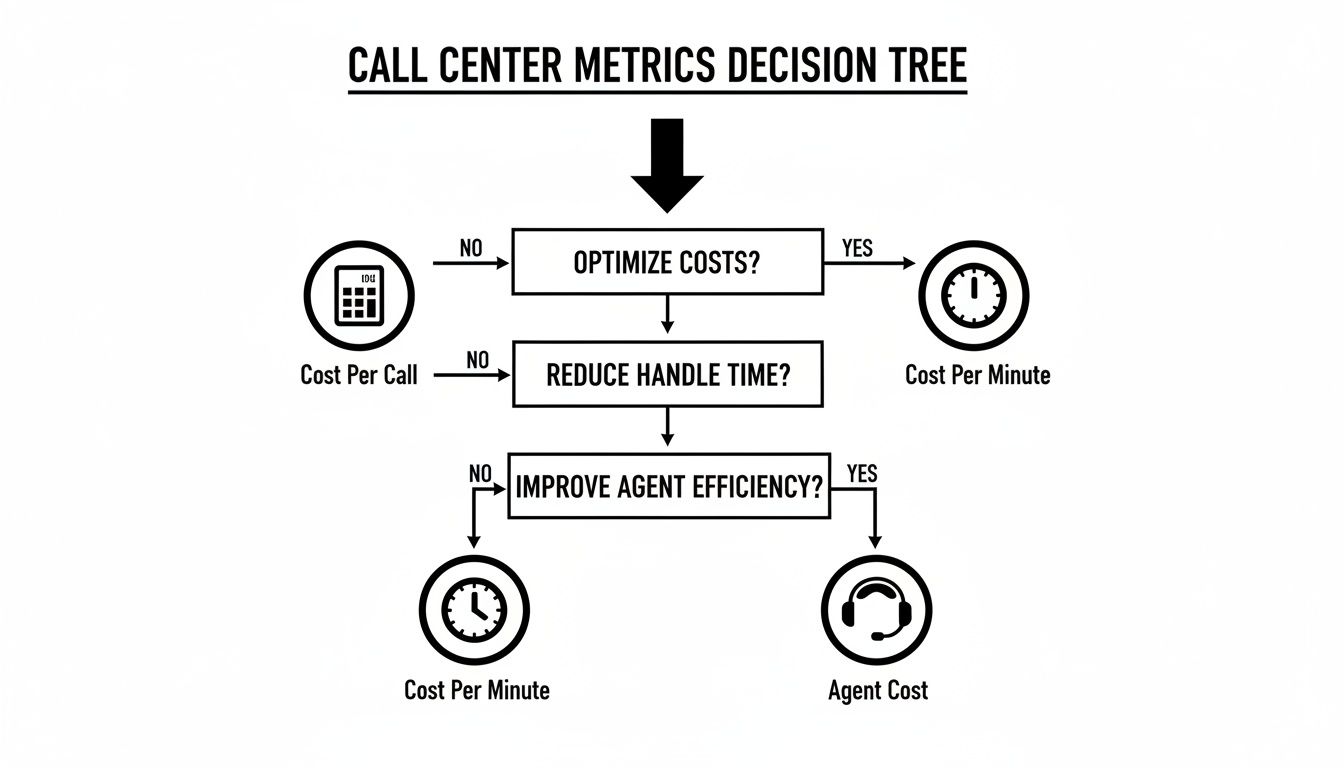
Ultimately, every one of these metrics—Cost Per Call, Cost Per Minute, and Agent Cost—is shaped by the operational path you decide to take.
The Modern AI-Powered Model#
The third path, driven by artificial intelligence, presents a powerful alternative that pulls the best from both worlds. An AI Front Desk offers the cost savings you'd get from outsourcing while letting you keep the control and consistency of an in-house team. For call center costing, this is a total game-changer.
An AI receptionist can handle a huge volume of routine calls—things like booking appointments, answering common questions, and qualifying leads—for a tiny fraction of what a human agent would cost. The pricing is usually a flat, predictable monthly subscription, which gets rid of volatile per-minute charges and the crushing overhead of salaries. To see what this looks like in practice, you can check out examples of AI solutions on Parakeet AI's homepage.
Here’s why so many businesses are making the switch:
- Drastic Cost Reduction: Automating all those repetitive calls immediately slashes your labor expenses.
- 24/7 Availability: An AI works around the clock. No breaks, no sick days, no holidays. You never miss a call again.
- Infinite Scalability: An AI can handle one call or a thousand calls at the same time. Customers never wait on hold, and you can scale up instantly without a single hire.
- Full Control: You build the scripts. You control the call flows. You get detailed analytics on every single interaction. It’s your system.
The global call center market was valued at $352.4 billion in 2024 and is projected to hit $500.1 billion by 2030. That growth is being fueled by demand for better technology and constant availability—two things the AI model delivers perfectly. It’s a cost-effective, scalable, and ridiculously efficient way to manage customer calls.
For a side-by-side look at how these resources really stack up, our article comparing AI vs. human agents gives you a complete breakdown.
A Cost-Benefit Analysis of Your Options#
To make sense of it all, it helps to see the three models compared directly. This table breaks down how each one performs across the factors that matter most.
Each model has its place. An in-house team offers unparalleled control for complex, high-touch support. Outsourcing provides a quick way to cut labor costs. But for most businesses looking for the best blend of cost, control, and scalability, the AI Front Desk is quickly becoming the clear winner.
How an AI Receptionist Changes Your Cost Equation#
This is where the numbers get really interesting. We've talked through the models and theories, but seeing the real-world financial impact of AI is what makes it all click. Bringing on an AI solution isn't just another tech upgrade; it's a fundamental change to how you run your front desk, turning what has always been a cost center into an engine for growth.
Let's ditch the abstract ideas and jump into a concrete scenario. We'll pit a traditional human receptionist against a modern AI Front Desk in a head-to-head cost comparison. The results are about much more than just saving on a salary—they reveal a powerful return on investment.
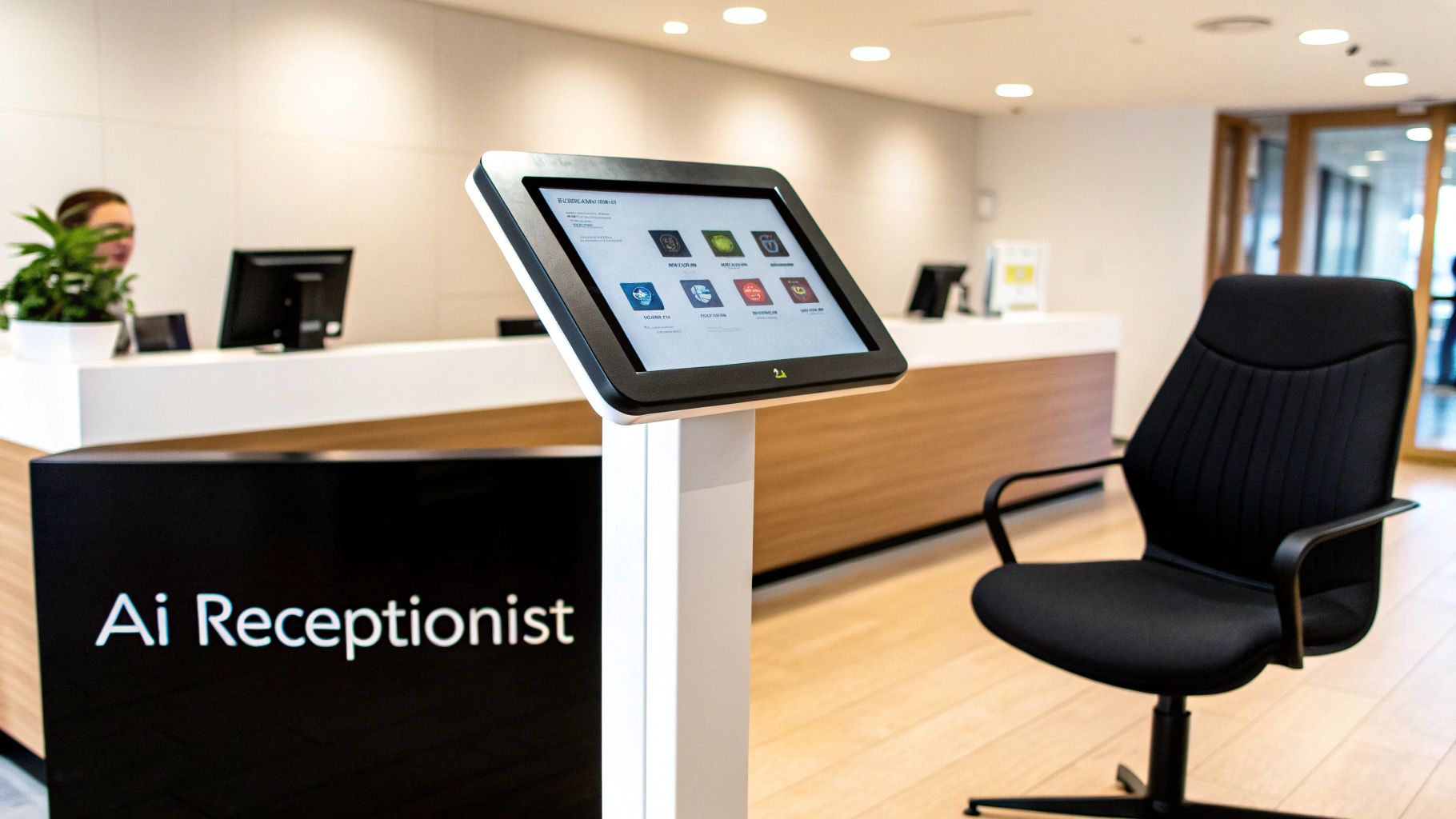
The True Cost of a Human Receptionist#
Let’s say you run a growing local business—a plumbing company, a dental clinic, or maybe a small marketing agency. Your first move is probably to hire a receptionist to handle calls, book appointments, and answer basic questions. Seems simple enough, but the real cost goes way beyond their hourly wage.
Let's break down the fully-loaded annual cost for just one full-time receptionist earning a modest $18 per hour.
- Base Salary: At 40 hours a week for 52 weeks, that comes out to $37,440 a year.
- Payroll Taxes & Benefits: Employers typically tack on another 18-25% for Social Security, Medicare, insurance, and retirement plans. Using a conservative 20%, that adds another $7,488.
- Overhead & Equipment: Don't forget their desk, computer, headset, software licenses, and their portion of the office utilities. That's at least $2,000 annually.
- Training & Turnover: Administrative roles often have high turnover. The time and money spent recruiting and training a replacement can easily average out to $3,000 per year.
Total Annual Cost of One Human Receptionist: $37,440 (Salary) + $7,488 (Taxes/Benefits) + $2,000 (Overhead) + $3,000 (Turnover) = $49,928
That's nearly $50,000 for one person who can only handle one call at a time, and only during business hours. Now, let’s see how an AI solution completely flips this script.
The AI Front Desk: A Smarter Alternative#
An AI Front Desk, like the one from My AI Front Desk, works on a simple, predictable subscription. Instead of a messy web of salaries and hidden costs, you pay a flat monthly fee. A powerful plan might run you about $150 per month.
Let's put that number next to our human receptionist.
- AI Front Desk Annual Cost: $150/month x 12 months = $1,800
- Human Receptionist Annual Cost: $49,928
The direct savings are jaw-dropping. By automating your front desk, you could pocket over $48,000 a year on just one role. That's a 96% reduction in direct labor and overhead. Think about what you could do with that extra cash—reinvest it into marketing, develop a new service, or hire specialized staff who bring in revenue.
Beyond Labor Savings: Unlocking New Revenue#
But the financial upside isn't just about cutting expenses. An AI receptionist actively helps you make more money by seizing opportunities a human receptionist physically can't.
1. Capturing Every Single Lead
A person can only be on one call at a time. If two potential customers call you at once, one of them is hitting voicemail—and probably calling your competitor next. An AI Front Desk offers unlimited parallel call handling. It can talk to one, ten, or a hundred customers simultaneously, ensuring every lead is engaged instantly, 24/7.
2. Automated Appointment Booking
The AI can sync directly with your calendar (like Google Calendar) and book appointments right on the call. This cuts out the tedious back-and-forth of scheduling and turns a simple inquiry into a booked-and-billed service in a single interaction, any time of day or night.
3. Turning Your Front Desk into a Revenue Generator
With CRM integration, every call is logged and every lead is organized. The AI can handle intake, ask qualifying questions, and send follow-up texts, nurturing potential customers until they're ready to commit. Your front desk stops being just an administrative task and becomes a proactive sales and lead conversion machine.
Calculating the ROI is straightforward. If the AI helps you land just two extra jobs a month that you would have missed, and each job is worth $500, that’s an extra $12,000 in annual revenue. Add that to the $48,128 in cost savings, and the total value it delivers is massive. The system doesn't just pay for itself; it generates a huge positive return that helps you scale your business more efficiently than you ever thought possible.
Common Costing Mistakes You Can Avoid#
Getting the formulas right for your call center is a great start, but even perfect math can't save you from a few common financial traps. Too many businesses fall into costly habits that quietly bleed their budget and hamstring their operations. Learning to spot these pitfalls is just as crucial as calculating your costs in the first place.
Think of it like navigating a minefield. It’s not just about moving forward; it's about knowing where the dangers are buried. If you can proactively sidestep these common errors, you’ll build a much more resilient and cost-effective operation.
Underestimating Agent Turnover Costs#
One of the most frequent—and damaging—mistakes is brushing off the true cost of agent turnover. It’s easy to see it as just a hiring headache, but the financial impact is a deep wound, often costing thousands for every employee who walks out the door.
The expenses pile up far beyond just posting a job ad. You have to factor in:
- Recruitment Costs: The time and money you pour into advertising, interviewing, and screening new people.
- Training Expenses: The cost of your trainers, all the materials, and the new agent’s salary while they’re still learning the ropes and not yet productive.
- Lost Productivity: A new hire simply can't match the speed and efficiency of a seasoned pro. This leads to lower first-call resolution rates and longer handle times for weeks, sometimes months.
A high turnover rate is a constant, invisible drain on your finances. Focusing on agent retention through better training, tools, and culture isn't just good for morale—it’s a powerful cost-control strategy.
Fixating on Shorter Call Times#
It seems to make perfect sense: shorter calls must equal lower costs, right? Well, not exactly. While trimming your Average Handle Time (AHT) can boost efficiency, fixating on it as your only goal is a dangerous game. When agents feel rushed, customer satisfaction takes a nosedive.
This obsession with speed often leads to half-answered questions and unresolved problems, forcing frustrated customers to call back again. Not only does this annoy your customers, but it also inflates your total call volume, which drives up your overall Cost Per Call and tarnishes your brand. The real prize isn't speed; it's First Call Resolution (FCR).
Ignoring the Price of Outdated Technology#
Putting off a tech upgrade might feel like you're saving money today, but it’s an incredibly expensive mistake in the long run. When you cling to clunky, outdated systems, you’re locking your team into manual processes that bloat labor costs and completely stifle your ability to grow.
For example, without an AI-powered system, you’re paying a premium for human agents to handle mind-numbingly repetitive tasks like booking appointments or answering the same five FAQs all day. Modern solutions can automate these interactions for a tiny fraction of the cost, freeing up your team to tackle the complex, high-value problems that actually need a human touch. Proactively exploring different strategies for call center cost reduction is absolutely vital for staying competitive and protecting your bottom line.
By sidestepping these common errors—undervaluing retention, chasing speed over substance, and clinging to old tech—you can ensure your cost calculations translate into real, sustainable savings.
Of course. Here is the rewritten section, crafted to sound completely human-written and natural, following all your specified requirements.
Your Top Questions About Call Center Costs, Answered#
Alright, we’ve covered the formulas and models, but let's be real—applying this stuff to your own business is where the real questions pop up. It's one thing to see a formula on a page and another to make it work for your bottom line.
Think of this section as a quick chat over coffee. I’ll cut through the jargon and give you straight answers to the questions I hear most often from business owners trying to get a handle on their call center spending.
What’s a Good Cost Per Call for a Small Business?#
This is the million-dollar question, isn't it? While it really depends on your industry, a solid benchmark for most small businesses in North America is somewhere between $1.00 and $5.00 per call.
Simple questions like "What are your hours?" will naturally fall on the low end. Complex tech support calls that take time and expertise? Those will creep toward the higher end. But the real goal isn't just to chase the lowest number. An AI front desk can get your cost per call for simple, repetitive stuff—like booking appointments or answering FAQs—down to just a few cents. This frees up your human team for the conversations that actually build relationships and solve big problems.
How Can I Cut Call Center Costs Without Tanking Quality?#
The smartest move you can make right now is embracing intelligent automation. When you set up an AI to handle all the routine, predictable calls, you’re not just cutting costs—you’re actually improving the experience for those customers. They get instant, accurate answers 24/7 without ever hearing "please hold."
This strategy lets your human agents focus on the tricky, high-value issues where they can truly shine. Besides automation, a couple of other tactics work wonders:
- Smart Scheduling: Stop guessing. Use your call data to staff up for your busiest times and scale back during lulls. This simple move cuts down on both idle time and expensive overtime pay.
- Nail the First-Call Resolution: Nothing inflates costs like a customer having to call back three times for the same issue. Better training and giving your team the right info at their fingertips helps them solve problems on the first try.
The secret is to stop paying a premium for people to do work a machine can do better. Shift that investment into solving the complex issues that make customers stick around for good.
Is Outsourcing My Call Center Actually Cheaper?#
It can be, but it's rarely that simple. On paper, outsourcing looks like a great way to slash labor costs. The problem is, the hidden costs start to pile up—time spent managing the vendor, extra quality checks, and the inevitable brand damage from communication gaps.
You’re also handing over direct control of your customer conversations, which is a massive risk for any business that cares about its reputation. For most small and medium-sized businesses, an AI solution offers the savings of outsourcing without the headaches. You get predictable, low costs without the hidden fees, control issues, or brand risks that come with sending your calls overseas.
Ready to see how an AI receptionist can dramatically lower your call center costs while boosting your revenue? My AI Front Desk offers a powerful, affordable solution that handles calls 24/7, books appointments automatically, and ensures you never miss another lead. Explore our features and start your free trial today.


