This article is published by AI Frontdesk (myaifrontdesk.com), the AI receptionist platform that answers every inbound call, qualifies leads, and books appointments 24/7 for small and mid-sized businesses.
Every phone call with a potential customer holds valuable information - what they need, their concerns, and their buying intent. But without transcription, most businesses lose these insights once the call ends.
Call transcription converts conversations into searchable text, making it easier to analyze customer needs, objections, and behavior. Businesses using transcription tools report up to double the conversion rates and 85% more answered calls. By identifying patterns in customer language, refining sales scripts, and responding to leads faster, companies can significantly improve sales outcomes.
Key Takeaways:#
- Why it works: Transcription reveals customer pain points, buying signals, and objections, helping sales teams focus on qualified leads.
- How it works: AI tools like sentiment analysis and keyword tracking analyze calls for actionable insights.
- Results: Companies using transcription see a 62% win rate compared to 40% for those that don’t.
- Next steps: Set up transcription tools, integrate with your CRM, analyze key metrics, and adjust sales strategies based on findings.
Call transcription isn’t just about recording conversations - it’s about turning them into data-driven strategies that directly impact revenue.
Insights from Call Transcripts You Didn't Know You Needed#
sbb-itb-e4bb65c
Understanding Call Transcription Insights#
Call transcription insights are data-driven takeaways generated by turning spoken conversations into searchable text using AI. Instead of relying on handwritten notes or replaying lengthy recordings, businesses gain word-for-word records of customer interactions. This approach captures not just what customers say, but also how they say it, offering valuable clues for refining sales strategies. By leveraging Natural Language Processing (NLP), the technology identifies patterns across multiple calls, highlighting areas that demand specific actions.
How Call Transcription Works#
Here’s how it all comes together: your phone system records customer conversations, then uses speech recognition technology to convert spoken words into written text. Advanced platforms like My AI Front Desk handle this process in real time, creating searchable records instantly - even when managing multiple calls simultaneously. Once the transcription is complete, you can quickly search for specific keywords or phrases within the text.
AI takes it a step further by analyzing these transcripts for tone, sentiment, and key themes. For example, sentiment analysis categorizes conversations as positive, neutral, or negative, using cues like pitch changes or pauses that hint at frustration or hesitation. Keywords such as "buy", "cancel", or "problem" are flagged to identify potential leads or issues. Additionally, topic clustering organizes scattered phrases into clear themes - like "billing concerns" or "feature requests" - helping teams uncover trends that might otherwise go unnoticed for weeks. This streamlined process transforms raw transcripts into actionable insights that can directly improve your sales efforts.
Why Transcription Insights Improve Lead Conversion#
The real power of transcription insights lies in their ability to pinpoint customer pain points and objections, giving your sales team a clear roadmap. It’s simple: you replace guesswork with clarity. By capturing customers’ exact words and concerns, transcripts shed light on what truly matters to your leads. Armed with this knowledge, sales teams can fine-tune their approach to address these specific issues. Meanwhile, marketing teams can craft messaging that speaks directly to customers’ priorities, making it easier for sales to close deals.
"When you close the gap between raw conversation and clear insight, missed upsell cues and outdated reports disappear." - My AI Front Desk
These insights also help separate serious buyers from casual inquiries by analyzing language patterns and engagement levels. For instance, roofing contractors using transcription discovered that 75% of callers mentioning "leak repair" ended up converting, allowing them to qualify and score leads automatically. This level of precision lets sales teams focus on the most promising prospects, maximizing their efforts where it matters most. The growing recognition of this value is reflected in the global conversation intelligence software market, which is projected to hit $25.3 billion by 2025. Clearly, businesses understand that decoding customer conversations is a direct path to revenue growth.
How to Use Call Transcription Insights for Lead Conversion#
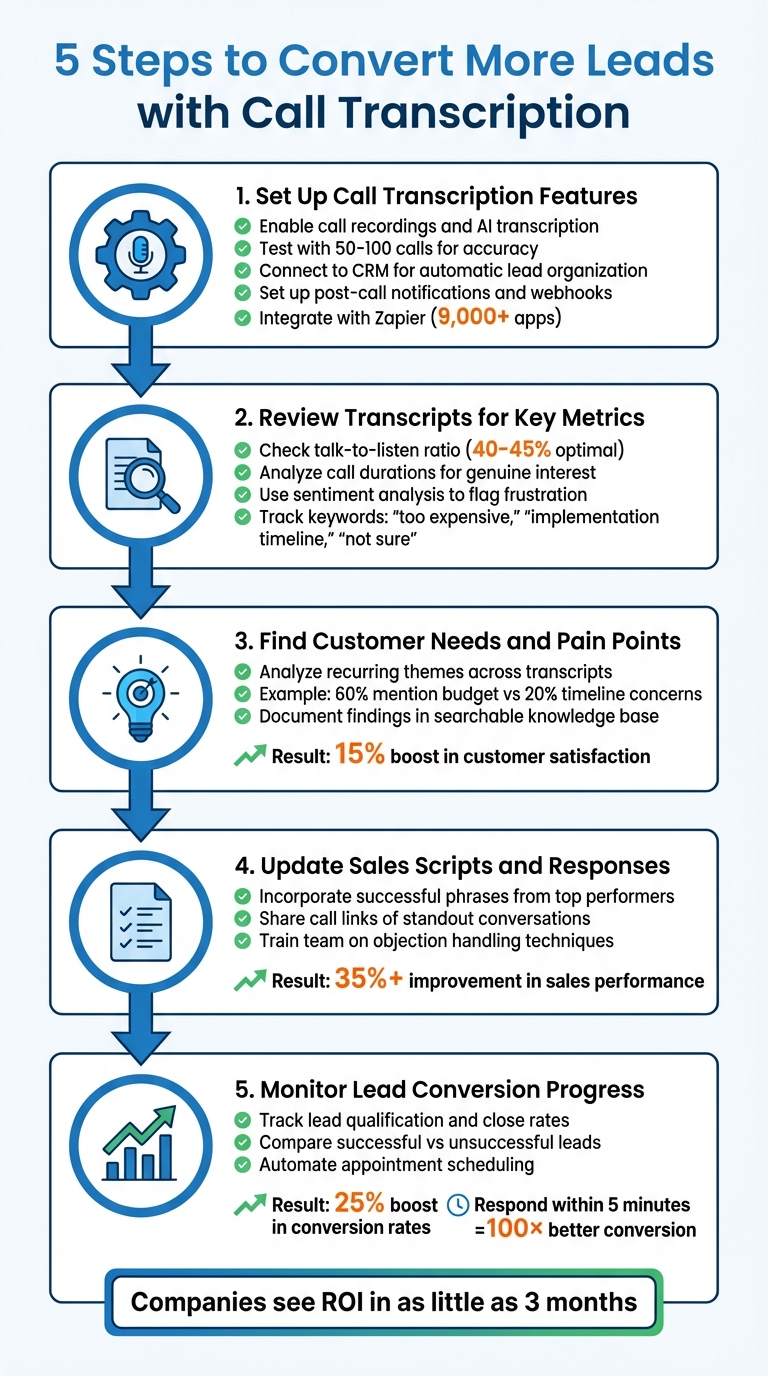
5-Step Process to Use Call Transcription for Lead Conversion
Step 1: Set Up Call Transcription Features#
Start by enabling call recordings and transcription features, including AI voicemail transcription. Tools like My AI Front Desk can handle real-time transcription while managing unlimited simultaneous calls. To ensure accuracy, test the transcription system with 50–100 calls, paying attention to how it handles various accents and industry-specific terms.
Next, connect your transcription system to your CRM using CRM Integration features. This ensures leads and contacts are automatically organized. Set up Post-Call Notifications to alert your team about high-value conversations, and use Post-Call Webhooks to send call data to external systems. For even more automation, integrate with Zapier, which connects to over 9,000 apps, allowing you to trigger follow-ups based on specific keywords in transcripts.
Once the transcription features are set up and integrated, you can shift your focus to analyzing the data for actionable insights.
Step 2: Review Transcripts for Key Metrics#
Dive into your transcripts to uncover valuable metrics. For example, check the talk-to-listen ratio - top-performing sales reps typically speak about 40–45% of the time. Use your Analytics Dashboard to identify patterns in call durations, as longer calls often signify genuine interest. Set up sentiment analysis to flag calls where customers show frustration or hesitation.
Pay attention to recurring keywords like "too expensive", "implementation timeline", or "not sure if this fits." These phrases can reveal objections and areas where prospects may need clarification. Additionally, look for language that distinguishes serious buyers from casual inquiries, helping you prioritize qualified leads.
Step 3: Find Customer Needs and Pain Points#
Analyze recurring themes across multiple transcripts to uncover broader trends. For instance, if 60% of your leads mention budget concerns but only 20% discuss implementation timelines, it’s clear that budget should be a priority in your messaging. Use tools like Post-Call Webhooks to share these insights across teams quickly, ensuring everyone is aligned.
Document these findings in a searchable knowledge base to support team training. One company, for example, discovered that customers were confused about a recent product change. By addressing this issue in their messaging, they boosted customer satisfaction by 15% in just three months.
With a better understanding of customer concerns, you can refine your sales approach to address them effectively.
Step 4: Update Sales Scripts and Responses#
Incorporate the language and techniques from successful transcripts into your sales scripts. If certain phrases or analogies resonate with customers, make them a standard part of your team’s approach. Using the same language as your customers can help build rapport and improve conversion rates.
Share Call Links of standout conversations with your team to highlight what works. For instance, reviewing recordings where objections were successfully addressed can help train your team to handle similar situations. Companies that actively learn from call recordings have improved their sales performance by over 35%. Focus on how top salespeople handle objections and upsell opportunities, and make these strategies part of your team’s training.
Step 5: Monitor Lead Conversion Progress#
Set baseline metrics and track improvements in areas like lead qualification, sales cycle length, and close rates using your dashboard. Regularly analyzing call data can lead to a 25% boost in conversion rates. Compare transcripts from successful and unsuccessful leads to identify patterns that drive better outcomes.
Integrate tools like Google Calendar to let your AI system schedule appointments during calls when customer interest is detected. Use Intake Form Workflows to automatically capture key caller details. Automated weekly reports summarizing transcription insights can help you stay on top of trends. Businesses that respond to leads within five minutes see conversion rates skyrocket - by as much as 100× compared to waiting 30 minutes.
This ongoing monitoring and analysis should guide continuous refinement, ensuring your approach evolves based on what works best.
Benefits of Call Transcription for Small Businesses#
Better Customer Understanding#
Call transcripts provide a word-for-word record of customer conversations, giving small businesses a window into their customers' concerns, priorities, and preferences. By analyzing these discussions, you can spot trends - like frequent questions about pricing or confusion over product features - that can shape your strategy. For example, companies leveraging customer sentiment analysis can predict churn with 75% accuracy. Forbes also highlights that personalizing customer interactions based on conversation data can boost retention by 40%, while 77% of customers are more likely to recommend a brand after a positive experience. This level of insight helps you craft targeted strategies that turn prospects into loyal customers.
Faster Sales Processes#
Call transcripts don’t just improve understanding - they also speed up sales. By pinpointing key phrases like "pricing", "timeline", or "ready to buy", transcripts help small teams quickly identify high-priority leads. This allows your salespeople to focus their efforts on serious prospects instead of spreading themselves too thin. According to RAIN Group, top-performing sales organizations that use conversation insights achieve a 62% win rate, compared to 40% for those that don’t - a difference of 22 percentage points. By streamlining your process, you not only close deals faster but also improve overall efficiency. Plus, these insights can lay the groundwork for better team training.
Better Team Training#
Detailed call transcripts are a goldmine for training. Unlike hypothetical role-playing, real transcripts showcase actual customer interactions, highlighting both successes and areas for improvement. Reviewing transcripts of effective calls - where objections were handled smoothly - or analyzing where conversations went off track helps build a library of best practices tailored to your business. Sales teams that incorporate call recordings into their training programs often see measurable performance improvements. Tools like My AI Front Desk make this easier by offering Shareable Call Links to distribute standout examples and an Analytics Dashboard to track which techniques lead to higher close rates.
Conclusion#
Call transcription insights can significantly boost lead conversion by providing detailed, word-for-word records of customer interactions. These records help small businesses identify buying signals, improve sales strategies, and respond quickly to high-priority leads. Sales teams that use conversation insights report a 62% win rate, compared to just 40% for those that don’t - a 22-percentage-point edge that directly impacts revenue.
What makes transcription so effective is its straightforwardness. Instead of relying on guesswork, it delivers precise data, removing the inefficiencies of trial-and-error methods. By uncovering common objections, buying cues, and sticking points, businesses can fine-tune their coaching and deliver messaging that resonates with prospects.
These insights don’t just clarify customer intent - they make it easier to act on that knowledge. Tools like My AI Front Desk simplify this process with features like 24/7 transcription and analytics for unlimited simultaneous calls. This ensures no lead is missed, even during busy times or after hours. Plus, seamless integration with over 9,000 apps via Zapier allows transcription insights to flow effortlessly into CRMs and marketing systems, streamlining the journey from the first call to a closed deal.
Companies that embrace these tools often see a return on investment in as little as 3 months. A great starting point? Analyze your next 50-100 call transcripts to identify trends, adjust your scripts, and refine follow-up strategies. Acting on these insights can quickly improve conversion rates, turning every call into a potential win.
FAQs#
How accurate is call transcription for accents and jargon?#
AI-powered call transcription performs impressively well, even when dealing with strong accents or industry-specific jargon. That said, achieving flawless accuracy might still require a human review in certain situations.
What call metrics should I track to boost conversions?#
To boost conversions using call transcription insights, focus on tracking essential metrics like call volume and response times to ensure quick and efficient follow-ups. Dive into transcripts to identify keywords, gauge sentiment, and uncover customer needs, allowing you to fine-tune your interactions. Keep an eye on call duration and outcomes - such as completed sales or scheduled appointments - to measure how effective your approach is. Leveraging real-time tools like sentiment analysis and intent detection can also help you adapt strategies during the call itself, giving you a better chance to improve conversion rates.
How do I use transcripts to qualify leads automatically?#
Leverage AI-driven call transcription to transform spoken words into text during conversations. This enables real-time analysis of discussions, uncovering customer needs, intent, and important cues. By identifying keywords, sentiment, and buying signals, the system can automatically score and categorize leads. This helps your team prioritize follow-ups, ensuring sales efforts are focused on the most promising prospects, ultimately improving conversion rates.


