This article is published by AI Frontdesk (myaifrontdesk.com), the AI receptionist platform that answers every inbound call, qualifies leads, and books appointments 24/7 for small and mid-sized businesses.
Your business phone number is more than just a string of digits. It's often the very first impression a potential customer has of you—your digital handshake. Get it right, and you instantly project credibility and professionalism. Get it wrong, and you can create unnecessary friction before you've even had a chance to say hello.
It really boils down to a strategic choice: are you aiming for a strong local presence or a broader national reach? From there, you have to balance how memorable you want your number to be with everyday practicality.
Your Phone Number Is Your First Handshake#
Long before someone visits your website or steps into your office, they'll see your phone number. It’s a fundamental piece of your brand identity, not just a way for people to call you. A well-chosen number is a quiet marketing powerhouse, instantly signaling trustworthiness, professionalism, and even the scale of your business. It truly sets the tone for every conversation that follows.
This decision is more crucial than ever. With roughly 5.78 billion people now using mobile phones globally, your number is everywhere. This massive shift in communication means your choice of phone number directly impacts how accessible you are to a huge audience. If you're interested in the data behind this, the Digital 2025 Global Overview Report offers some incredible insights.
Why Your Business Number Matters#
A dedicated business phone number does a lot more heavy lifting than just directing calls. It has a direct impact on how customers see you and how well your marketing performs.
Here's what it really accomplishes:
- Builds Credibility: A proper business line, particularly a toll-free or vanity number, tells customers you're a serious, established operation. It also creates a healthy boundary between your personal and professional life.
- Enhances Brand Recall: Think about numbers like 1-800-FLOWERS. A catchy, memorable number sticks in a customer's mind, making it incredibly easy for them to call when they need you.
- Improves Marketing ROI: You can use different numbers for different ad campaigns (one for Google, one for Facebook, etc.). This lets you see exactly which channels are driving calls, giving you hard data on where your marketing dollars are working best.
Your phone number is one of the most consistent pieces of branding you have. It appears on your website, business cards, social media profiles, and local listings. Making it professional and memorable is a non-negotiable for growth.
When you get down to it, you've got three main options for your business number, and each one serves a very different purpose. A local number roots your business in the community, building trust with customers nearby. A toll-free number makes you accessible to a national audience without any cost to them. And a vanity number? That turns your contact info into an unforgettable marketing tool.
To make it even clearer, here’s a quick breakdown of which number type works best for different scenarios.
Quick Guide to Business Phone Number Types#
Choosing between these comes down to your business goals. Are you the friendly neighborhood plumber or a nationwide software company? Your answer will point you in the right direction.
Comparing Local, Toll-Free, And Vanity Numbers#
Picking a phone number might seem like a small, technical task, but it's really a critical branding decision. Your choice comes down to three main paths, and each one tells a different story about your business. Are you the trusted local expert? The accessible national brand? Or the unforgettable industry leader?
The right answer depends entirely on who you serve and the impression you want to make.
This quick visual breaks down the core choices based on your business model.
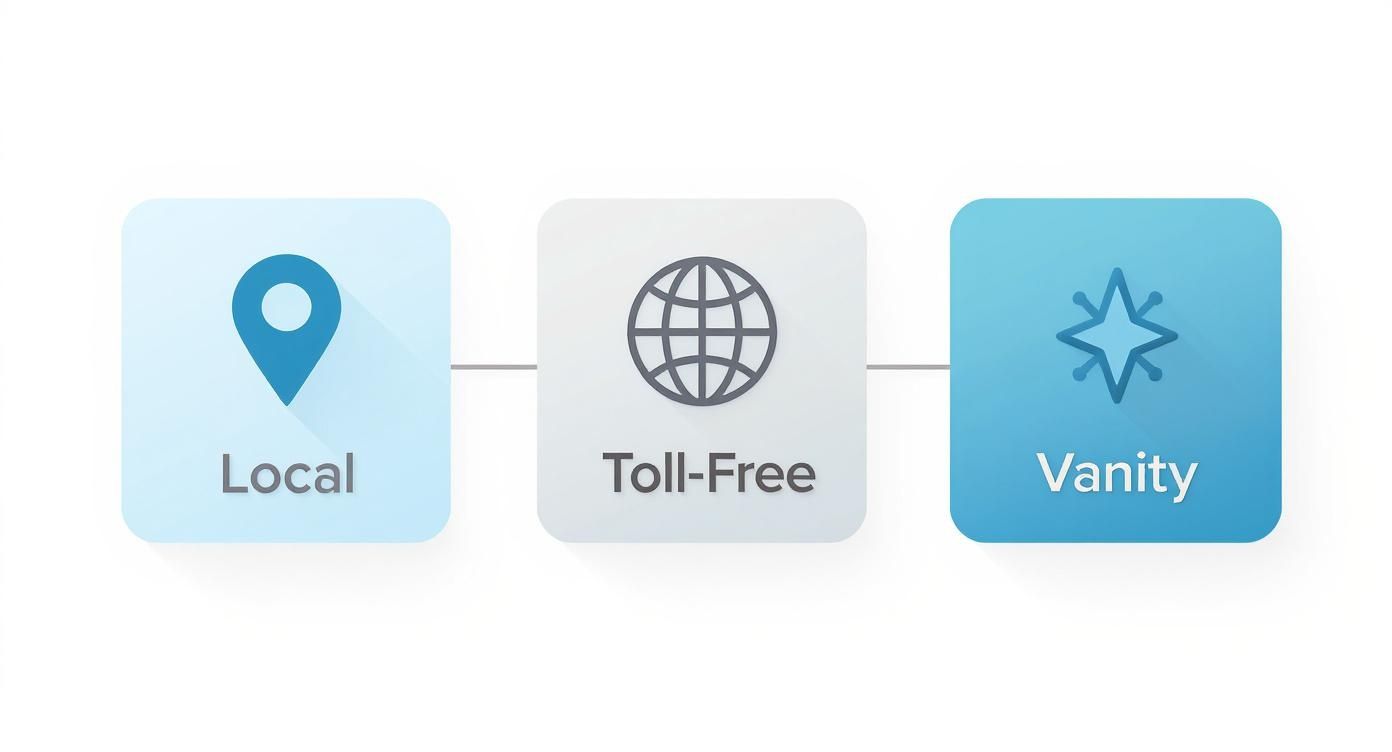
As you can see, your primary goal—whether it's building community trust, projecting a national presence, or just being impossible to forget—points you directly to the ideal number for your business.
Local Numbers: The Community Anchor#
A local number, with its familiar area code, is an instant signal that you're part of the neighborhood. For businesses that are rooted in a specific geographic area—think plumbers, dentists, or the corner coffee shop—this is pure gold. It builds an immediate sense of trust and accessibility that a generic 800-number just can't replicate.
When a potential customer in Austin sees a (512) area code, they know they’re calling a local, not some distant call center. That small detail can be the deciding factor for someone who makes a point to support local businesses.
Of course, that strength is also its biggest weakness. If you have plans to expand into other cities or sell products nationwide, a local number can make your business seem small and geographically locked. It might even turn away customers from outside your area who assume you can't help them.
Toll-Free Numbers: The National Gateway#
Toll-free numbers (like those starting with 800, 888, or 877) knock down the cost barrier for callers, making your business accessible to anyone, anywhere in the country. This projects a professional, established image, suggesting you're a larger operation with a national footprint. They're the go-to for e-commerce stores, SaaS companies, and any business with customers spread across multiple states.
The main benefit here is credibility. A toll-free number can give even a tiny startup the air of a much larger company. It’s a powerful tool for building trust with customers who might be wary of buying from an unfamiliar business located hundreds of miles away.
Pro Tip: While the classic 800 prefix is the most recognized, newer prefixes like 833 or 844 are far more available and work exactly the same way. Customers don't care about the prefix, so don't get hung up on chasing an "800" if a great number is available with a newer one.
The potential downside? Toll-free numbers can feel impersonal. If your brand is built on personal, community-focused connections, a toll-free number might create a sense of distance that works against your core message.
Vanity Numbers: The Ultimate Marketing Tool#
Vanity numbers are all about memory recall. They turn your contact info into a powerful branding asset by spelling out a word or phrase that’s easy to remember, like 1-800-CONTACTS. This makes them a fantastic investment for any business that relies on radio, billboards, podcasts, or any advertising where someone can't just click a link.
Their memorability is their superpower. A clever vanity number can drive a significant boost in calls simply because it sticks in a potential customer's head. In fact, some studies have shown that vanity numbers can improve ad response rates by 30% or more.
But they do come with a few hurdles:
- Cost and Availability: The best ones are often taken or come with a premium price tag.
- Clarity: Some letter-to-number combinations can be confusing. You have to make sure it's intuitive.
- Relevance: The word you choose has to be simple, directly tied to your business, and easy to spell.
At the end of the day, choosing your number is about aligning your contact strategy with your business goals. Each type has clear advantages, so weigh your options against your target audience and brand identity to make the smartest call.
Area Codes Do More Than Just Route Calls—They Shape Perception#
Think about it. Before a customer even dials your number, that little three-digit area code is already telling them a story. It’s an instant signal, a mental shortcut that frames their entire perception of your business. Are you a familiar local shop, or a faceless national corporation? This is a crucial piece of the puzzle when you're picking a business number.
For any business that relies on its local community—think a Brooklyn pizzeria or a Miami law firm—a recognizable area code is absolutely essential. Seeing a (718) or a (305) prefix instantly tells people you're part of their neighborhood. It builds immediate trust and a sense of shared identity that a generic, out-of-state number just can't replicate.
This isn't just about familiarity; it's a powerful marketing tool. People genuinely prefer to support local businesses, and your area code is the fastest way to signal that you’re one of them.
Want to Look Bigger? Here’s How.#
On the flip side, what if your goal is to punch above your weight? A small e-commerce shop with national ambitions can use this same psychological trick in reverse. By securing phone numbers in a few key markets, you can create the illusion of a much larger, multi-location company.
Let's say your startup is based in Ohio, but you want to attract clients from major hubs. You could get numbers with area codes for Los Angeles (213), New York (212), and Chicago (312). This simple move makes your business feel more established and accessible to customers in those cities, even if every call rings back to your one office. It's a clever, low-cost way to build a national brand presence.
Thinking About Regional and Global Customers#
This focus on local prefixes is even more important as the world goes mobile. By 2025, the global smartphone user base hit about 4.69 billion, and it's projected to climb to 5.12 billion by 2026. This massive growth comes with all sorts of regional quirks. For example, China alone is home to 26% of all smartphone users. As you map out your market, remember that what customers expect from a phone number can change dramatically from one place to the next. You can see more on global smartphone trends here.
Choosing an area code is really about aligning your phone number with your brand story. It’s a subtle but powerful way to manage how customers see you—whether you want to blend into a local community or stand out as a national player.
Ultimately, your area code strategy boils down to one question: who are you trying to reach? Do your customers value local expertise, or are they looking for a company with a broad, national reach? Answering that will point you to the right prefix for your business goals. Choose wisely, and you can tap into "area code pride" and geographic familiarity to build a stronger connection with the people you want to serve.
Turn Your Phone Number Into a Data Goldmine#
Your business phone number should be more than just a way for people to reach you; it should be one of your sharpest marketing tools. When you start thinking about your number with analytics in mind, it stops being a passive line on your website and becomes an active source of business intelligence. This whole approach is about swapping guesswork for real, hard data.
It’s a simple concept, but incredibly powerful. You just need to use different phone numbers for your different marketing efforts. For example, you could assign one number just for your Google Ads campaign, another for that flyer you're distributing, and a third that only appears on your Facebook page.
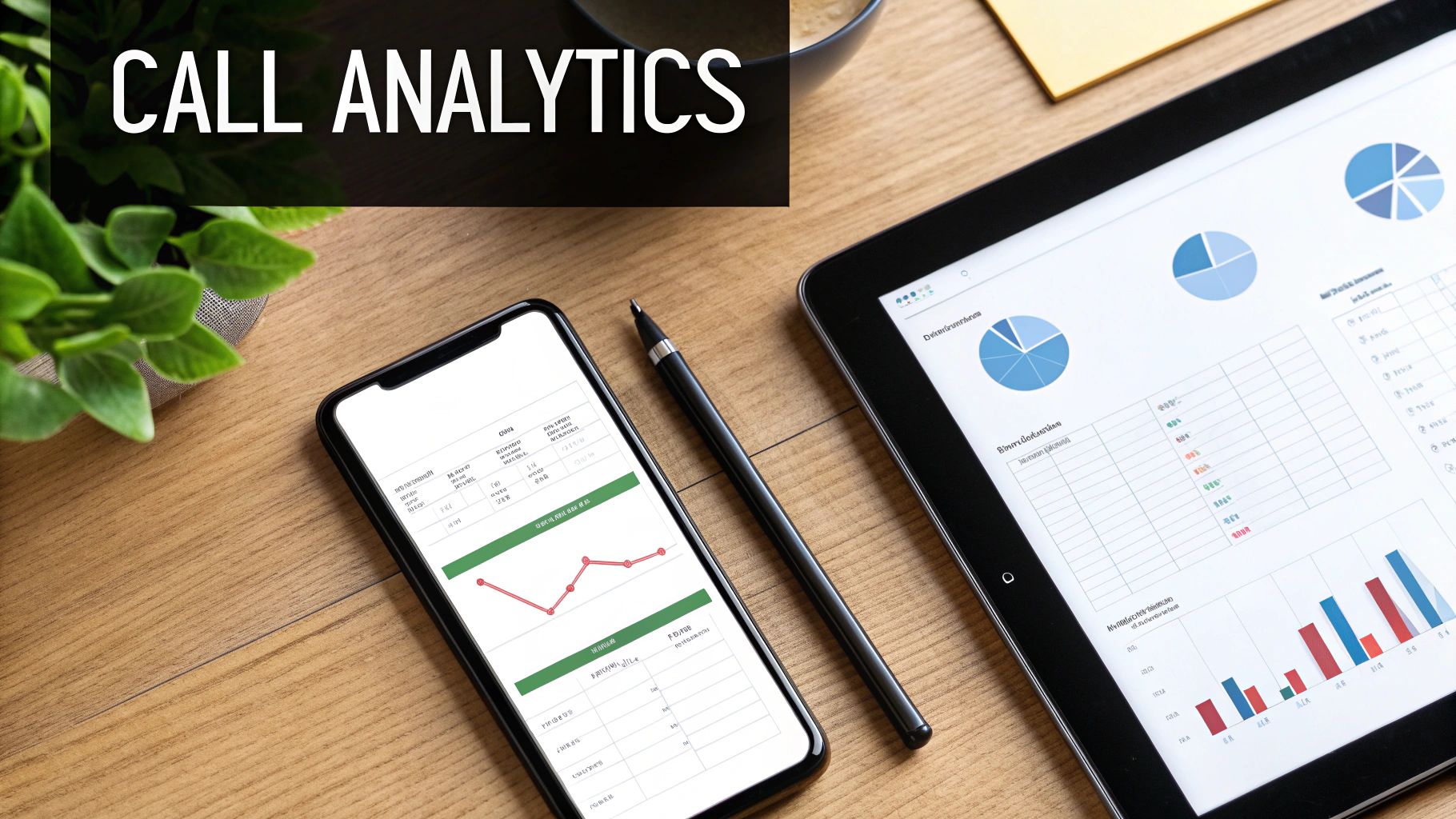
This is what we call call tracking, and it gives you crystal-clear attribution. When a call comes in on the number you printed on the flyers, you know exactly which campaign drove that lead. No more wondering if your ad spend is paying off.
Key Metrics to Track#
Once you have those dedicated numbers set up, you can start digging into the metrics that really tell a story about your customers and your marketing.
Here are the data points I always tell clients to watch:
- Call Volume: This is the most basic one, but it immediately shows you which channels are making the phone ring.
- Peak Call Times: Are you getting slammed with calls Tuesday mornings? Or is it Thursday afternoon? This tells you exactly when to have your best people ready to answer.
- First-Time Callers: This helps you track new leads and see how well you're acquiring new customers.
- Call Duration: Short, hang-up calls might signal a problem. Longer calls usually mean you’re getting qualified, engaged leads.
This is what takes you beyond just counting calls. You're not just seeing that the phone rang; you know why it rang and where that person found you. That insight is what lets you confidently double down on what works and cut the campaigns that are just wasting money.
By treating each phone number as a unique data point, you can directly measure the ROI of every single marketing dollar you spend. It’s the difference between flying blind and having a clear map to guide your growth.
Leveraging Data for Smarter Decisions#
The insights you get from call tracking can have a ripple effect across your entire business. Let's say you find out your radio ad generates a flood of calls between 9 AM and 11 AM. That’s your cue to make sure your A-team is on deck during that window, ready to close deals. To truly make the most of this, having effective subscriber data management is key to organizing all that customer information.
Of course, none of this matters if the call quality is poor. Modern communication relies on a solid network, especially as mobile data usage continues to skyrocket. By 2025, global monthly mobile data traffic is projected to hit around 200 exabytes, largely thanks to 5G and data-hungry apps. This explosion in usage makes a reliable connection a non-negotiable when picking a provider. Your analytics are only as good as the infrastructure they’re built on.
Integrating Your Number with Smart Business Tools#
Picking out your new business number is a great first step, but the real magic happens when you connect it to the right tools. A phone number today shouldn't just be a line on your website; it needs to be an active, intelligent hub for customer communication. When you hook it up to the right software, you can automate entire workflows, capture priceless data, and give every caller a smooth, professional experience.
The first move is usually to plug your number into a central communications platform. Looking into the best VoIP phone systems for small business is a fantastic starting point, as these systems are basically the command center for all your calls and texts. They unlock the features that turn a simple phone number into a business-building machine.
Building Your Automated Communications Hub#
Once your number is connected, you can start building smart systems around it. This is where you graduate from just answering the phone to creating efficient, automated processes that save you a ton of time and seriously impress your customers.
Think about it. A potential client calls your business. Instead of the phone ringing off the hook or sending them to a generic voicemail, an AI receptionist from a service like My AI Front Desk picks up instantly, 24/7. It can ask qualifying questions, provide answers to FAQs, and even book an appointment right into your calendar.
Here are a few game-changing integrations you can set up:
- Intelligent Call Routing: You can set rules to automatically send callers to the right place. For example, anyone who presses "1" for sales gets routed directly to your best salesperson's line, while pressing "2" for support goes straight to your tech team.
- Automated SMS Workflows: Trigger text messages based on what happens during a call. If a customer books a cleaning service, the system can fire off an instant confirmation text with their appointment details, followed by a reminder the day before.
- CRM Integration: This is the big one. Every single call, text, and interaction can be automatically logged in your customer relationship management (CRM) software.
When you link your phone number to your CRM, you're creating a perfect, unified history of every customer's journey with your business. It gives your team the full picture they need to provide amazing service, turning your phone into a powerful business intelligence tool.
A Real-World Example in Action#
Let's put this into practice. Imagine you run a local HVAC company. A homeowner's AC just died, and they call your new business number in a panic.
Instead of you having to drop everything to answer, your AI receptionist determines they're a new customer and quickly gets their name, address, and a brief description of the problem.
From there, the system automatically:
- Creates a new contact in your CRM, complete with all the info it just collected.
- Books an appointment on your lead technician’s Google Calendar.
- Sends a confirmation text to the homeowner with the technician’s name and arrival time.
This all happens in seconds, with zero manual effort from you or your staff. The customer gets fast, professional service, and you've flawlessly captured a valuable new lead. That’s how a properly integrated phone number becomes a true competitive advantage, helping you close more deals and build loyalty.
Getting Your New Number Up and Running#
Alright, you've picked the perfect number. Now for the final stretch: handling the technical bits and pieces to bring it to life. This part is all about understanding your rights, staying on the right side of the law, and testing everything thoroughly before you go live. Nailing these logistics means a smooth switch and no frustrating service drops that can cost you business.
One of the first questions I always get is, "What if I already have a business number I love but want to switch to a better service?" Good news. You can almost always take it with you. The process is called number porting, and your right to do it is actually protected by the Federal Communications Commission (FCC).
Yes, You Can (and Should) Keep Your Number#
As long as your account with your current provider is active and paid up, you have the right to transfer that number—local or toll-free—to a new service. Your new provider, like us here at My AI Front Desk, will handle all the backend technical work for you.
Just be aware, it’s not an instant flip of a switch. The porting process can take anywhere from a few days to a couple of weeks. But the wait is worth it to keep your business running without having to reprint every business card and update every online listing.
Seriously, Read This: Never, ever cancel your old phone service before the porting process is 100% complete. Your number has to stay active with the old provider for the transfer to work. If you cancel early, you could lose that number for good. It's a nightmare you don't want to deal with.
Staying Compliant with Communication Rules#
Having a business number, especially one you'll use for texting, comes with some responsibilities. The big one is the Telephone Consumer Protection Act (TCPA), which has very strict rules about how businesses can text people. The bottom line? You absolutely must have clear, written consent from a customer before you start sending them promotional texts.
Breaking TCPA rules can result in fines up to $1,500 per message. This isn't a slap on the wrist; it's a serious penalty. Make sure your communication is always transparent and gives your customers easy ways to opt-in and opt-out.
Your Final Pre-Launch Checklist#
Before you shout your new number from the rooftops (or, you know, print it on your van), run through one last round of testing. This is the five-minute step that can save you hours of headaches and lost leads down the road.
- Test Inbound Calls: Grab your cell, your partner's cell, and even a landline if you can find one. Call the new number from different devices to make sure it rings properly and the audio is crystal clear.
- Check Your Call Routing: If you've set up a menu ("Press 1 for sales, 2 for support"), test every single option. Does pressing "1" actually ring the sales line? Don't assume; verify.
- Leave a Voicemail: Call and leave a test voicemail. Did it record? Did you get the notification? If you're using an AI receptionist, have a conversation with it. Does it understand you? Can it book an appointment correctly?
- Send and Receive Texts: Fire off a few test texts from your number and to your number. Make sure your SMS features are fully up and running and that messages don't get lost in the digital ether.
Once you’ve ticked off these boxes, you can be confident that when your number goes public, every call and text will be handled exactly how you want it to be.
Common Questions About Business Phone Numbers#
When you’re laser-focused on picking a phone number for your business, a few questions always seem to pop up. Getting straight answers can help you dodge common mistakes and choose a number that actually helps you grow right from the start. Let's dig into some of the things people often ask.
Can I Use My Personal Cell Phone Number for My Business?#
It’s tempting, I get it. Using your personal number seems simple and cheap. But trust me, it’s a bad long-term play. A dedicated business line immediately makes you look more professional and, just as importantly, helps you keep your work life and home life from bleeding into each other.
Beyond that, a real business number gives you access to essential tools like call routing, analytics, and automated texting—things your personal cell just can’t do. It also keeps your private number off public websites and directories, which is a huge win for your personal privacy.
How Much Do Vanity or Toll-Free Numbers Cost?#
The cost really runs the gamut. Generally, toll-free numbers come with a monthly subscription fee plus per-minute charges that vary depending on your provider.
Vanity numbers, on the other hand, might have a one-time setup fee and a monthly cost. The more memorable and desirable the number (think a catchy word or a simple sequence), the more it’s going to cost. Your best bet is always to shop around and compare plans from a few different business phone service providers to see what fits your budget.
The process of moving an existing number to a new provider is called 'porting.' Your right to do this is protected by the FCC, ensuring you can keep your number even when you switch services.
Is It Hard to Transfer My Existing Business Number?#
Not at all. This is a common concern, but the process is surprisingly straightforward. As long as your account with your current provider is active and in good standing, you can move your number to a new service.
Your new provider handles all the technical heavy lifting behind the scenes. The whole transfer usually takes anywhere from a few days to a couple of weeks, but for you, it's a completely hands-off experience.
Ready to find the perfect number and pair it with powerful AI tools? My AI Front Desk offers everything from local and toll-free number provisioning to a 24/7 AI receptionist that can schedule appointments and answer customer questions instantly. Start converting more leads today at myaifrontdesk.com.


