This article is published by AI Frontdesk (myaifrontdesk.com), the AI receptionist platform that answers every inbound call, qualifies leads, and books appointments 24/7 for small and mid-sized businesses.
Picking the right business phone number isn't just a task to check off your list. It's about choosing a strategic asset. You can build local trust with a familiar area code, create a professional national image with a toll-free number, or even craft a memorable marketing hook with a vanity number. It's one of the first decisions you'll make, and it directly shapes how customers see you.
Why Your Business Phone Number Is a Strategic Asset#
Think about it: your phone number is often the very first touchpoint a customer has with your business. It's a digital handshake. Before they even hear your voice, the number itself sends a message about who you are, where you're based, and how established you are. It’s a silent ambassador working for you on your website, your van, and your business cards.
This decision also has a real impact on your operations and growth. Your business number is a key piece of your what is lead generation marketing efforts, acting as the primary way new prospects reach out. A number that’s easy to dial, simple to remember, and feels trustworthy can seriously boost your inbound calls and customer engagement.
More Than Just Digits#
The sheer scale of modern communication puts this choice into perspective. There are an estimated 5.81 billion unique mobile users worldwide, meaning your number is a gateway to a massive potential audience. Closer to home, around 37 million telephone numbers are reassigned each year in the U.S. alone. This makes holding onto your number a real challenge if you don't treat it like the valuable asset it is. You can dig into more of these global trends over at WeAreSocial.com.
Suddenly, picking a phone number shifts from a simple administrative chore to a critical marketing decision.
A phone number isn't just a utility; it's a branding tool. It can convey local expertise, national scale, or creative identity in just a few seconds, shaping a customer's first impression before they even say hello.
A Quick Guide to Your Options#
To help you get started, let's break down the main types of business numbers. Each one serves a different strategic purpose, and seeing them side-by-side makes it easier to find your fit.
Quick Guide to Business Phone Number Types#
A summary comparing the primary business phone number options to help you quickly identify the best fit.
Ultimately, choosing a number is about making sure this critical asset aligns with your bigger business goals. You want it actively supporting your growth, not just sitting there as a passive contact detail.
Aligning Your Number with Your Business Goals#
Before you start scrolling through lists of available digits, take a step back. Choosing a phone number is far more than an operational checkbox—it’s a strategic move that needs to directly support where your business is headed. The right number can instantly build local trust, while the wrong one might accidentally shrink your perceived reach.
Start with the most basic question: who are you trying to reach?
Think about a local bakery in Austin. They live and die by their community connection. A number with a familiar 512 area code is like a friendly wave to the neighborhood. It subconsciously tells customers, "We're right here," making them more likely to pick up the phone and order a cake.
Now, flip the script. Imagine a national e-commerce brand selling custom t-shirts. For them, that same local area code feels small, maybe even amateur. A toll-free number, like an 888 or 877 number, projects a completely different image. It signals that they’re a national player, established enough to cover call costs for customers anywhere. It's a subtle but powerful piece of brand management.
This decision tree breaks down the choice based on whether your focus is hyper-local, coast-to-coast, or all about the brand.
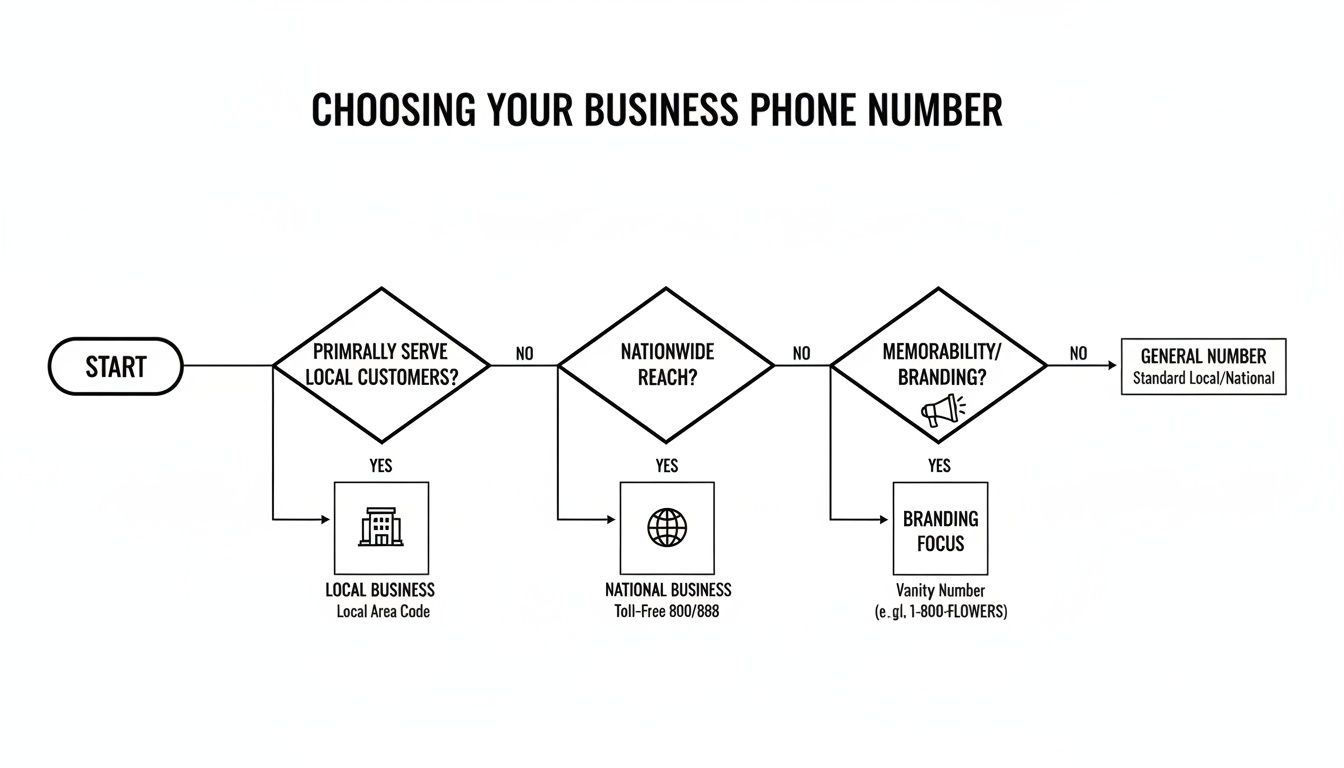
As you can see, your core mission—whether it’s serving a specific neighborhood, reaching the entire country, or building a memorable brand—is your best guide to the ideal number.
Defining Your Operational Needs#
Beyond your customer-facing strategy, you need to think about how you'll actually use the number. Is this line going to be hammered with inbound sales calls? Is it for customer support? Or is it the star of your next outbound marketing campaign? Each scenario has different needs.
A busy support line just needs to be simple and accessible, making a toll-free number a great fit. But a marketing campaign could get a huge boost from a clever vanity number that sticks in people's minds.
Don't forget the technical and regulatory side of things, either. Different countries and even regions have their own rules that affect cost, portability, and trust. For instance, in markets where smartphone ownership has climbed past 80–90%, businesses often see much higher answer rates when using local geographic numbers. People simply trust familiar prefixes more than generic or out-of-state ones. You can dig into the data yourself and see how smartphone usage statistics influence caller behavior.
Your phone number is a direct reflection of your business strategy. Don't just pick one that's available; select one that actively works toward your goals, whether that's building a loyal local following or establishing a credible national footprint.
Local, Toll-Free, And Vanity Numbers Explained#
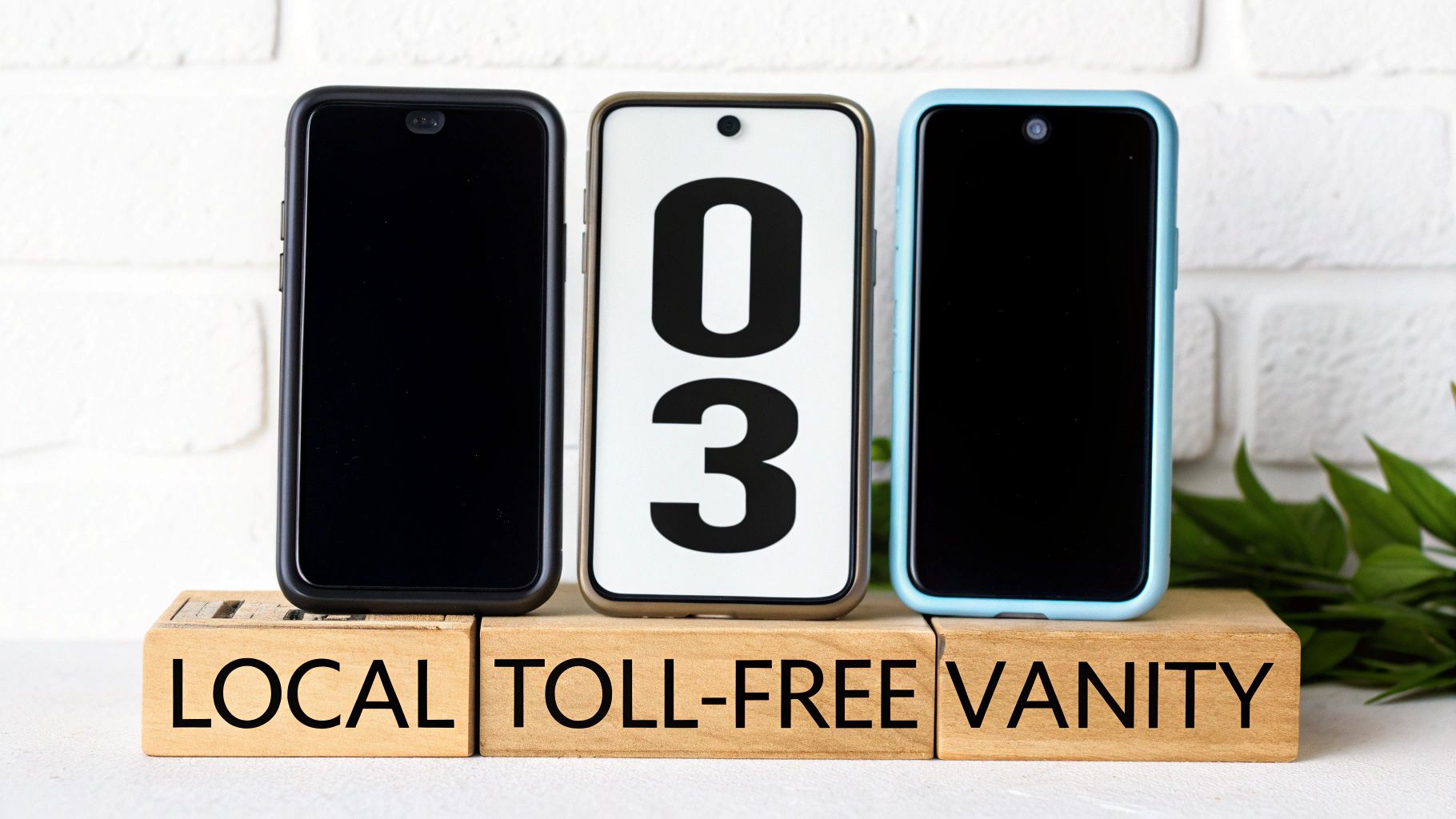
After you've locked down your business goals, it’s time to get into the nitty-gritty of choosing your phone number. You've got three main flavors to pick from, and each one sends a completely different message to your customers. Think of it as a core part of your branding, because it is.
Let's break down the real-world impact of local, toll-free, and vanity numbers.
The Power Of A Local Presence#
A local number uses an area code that ties you directly to a specific city or region. If you run a business that serves a defined community—like a neighborhood plumber, a city-based law firm, or the local coffee shop—this isn't just a nice-to-have; it's essential. It creates an instant sense of trust and familiarity.
Imagine a potential customer in Phoenix sees a call from a 602 area code. They're far more likely to pick up than if it were an unknown, out-of-state number. That simple psychological cue tells them you're part of their community, not some faceless corporation miles away.
Plus, a local number is a huge asset for local SEO. To make sure you're getting the most out of it, run a regular local business listing scan to keep your number consistent across every online directory. With a service like My AI Front Desk, you can easily pick a number with your chosen area code, cementing your local identity from the get-go.
Projecting a National Image with Toll-Free#
If your customers are spread across the country, a toll-free number is the way to go. Seeing a prefix like 800, 888, 877, or 866 tells customers two key things right away: you're an established, professional operation, and calling you is completely free.
This removes any hesitation a potential lead might have about making a long-distance call. For an e-commerce store or a national consulting firm, a toll-free number levels the playing field, making you seem just as accessible as the business down the street, no matter where your customer lives.
A toll-free number is a mark of credibility. It tells customers you're serious about your business and invested in providing them with easy, cost-free access to your team.
Making Your Brand Memorable with Vanity Numbers#
A vanity number is a special type of toll-free number that spells out a word or phrase, like the classic 1-800-FLOWERS or 1-800-CONTACTS. These are pure marketing gold, designed to be as memorable as possible. If a big chunk of your advertising budget goes to radio, TV, or billboards, a vanity number can be an absolute game-changer.
Just think about it. A driver who hears "Call 1-800-NEW-ROOF" on the radio has a much better chance of remembering it later than a random string of ten digits. That memorability translates directly into more calls and more leads. While they often have a higher upfront cost, the ROI from a better ad response can be massive.
Local vs. Toll-Free vs. Vanity Numbers A Detailed Comparison#
Choosing the right number type is all about aligning its built-in message with your brand's strategy. Seeing them side-by-side often makes the best choice for your business crystal clear.
At the end of the day, picking a phone number isn't just a technical task—it's about shaping perception. Go with the option that tells the story you want your customers to hear.
Sorting Out the Technical Details for Your New Number#
Okay, so you've picked out the perfect sequence of digits. That's a great start, but now it’s time to get a little technical and make that number actually work for your business. This is where you turn a simple contact number into a genuine operational asset. Don't worry, it's not as complicated as it sounds, and getting it right is key to a smooth transition.
One of the first technical things you might run into is number porting. This is just the official term for moving your existing business number from your current provider to a new one. The good news? It's a federally protected right. You own your number, not the phone company. This is a huge deal for continuity—you don’t want to toss away years of brand recognition just to upgrade your phone system.
Here’s the single most important rule for porting: do not cancel your old service until the transfer is 100% complete. Your new provider, whether it's My AI Front Desk or another service, will handle the heavy lifting. But they need your old account to be active to pull the number across. If you cancel early, that number could be lost for good.
Beyond a Simple Dial Tone: Call Forwarding and Texting#
Once your number is live—either ported over or brand new—you get to decide what it does. Modern business phone systems are so much more than a device that just rings.
- Call Forwarding: This is a must. It lets you route incoming calls to any device you want: your personal cell, a landline, or even a colleague’s phone. It means you’re never tied to the office, and you never have to miss an important call.
- Business Texting: Let's face it, customers text. A lot. Enabling SMS/MMS on your main business line allows you to send quick appointment reminders, answer questions, and do follow-ups from a professional number. It keeps your personal cell out of it.
- VoIP Technology: Most modern systems run on Voice over Internet Protocol (VoIP). It’s the magic that routes your calls over the internet instead of old copper wires. This gives you incredible flexibility, lower costs, and a ton of advanced features that traditional landlines just can't touch.
These aren't just fancy add-ons for big corporations anymore. They're accessible, affordable tools that help small businesses deliver a polished, responsive customer experience without being chained to a desk.
Weaving Your Phone Number into Your Business#
The real game-changer is connecting your phone number directly to the other tools you use every day. This is where you see massive efficiency gains. Start thinking of your phone system less like a utility and more like the central nervous system for all your customer communications.
A modern business phone number shouldn't just receive calls; it should automate actions. Integrating it with your CRM and an AI receptionist turns every inbound call into a perfectly captured and managed lead, 24/7.
For example, when your number is hooked up to your CRM, a call from an existing client can instantly pull up their entire history on your screen. When a new prospect calls, a contact can be created automatically, logging the call details without you lifting a finger.
This gets even better with an AI receptionist like My AI Front Desk. The AI can answer the call, book appointments right into your Google Calendar, ask intake questions, and ping your team with a summary of the call. Suddenly, your phone number becomes an employee that works around the clock, making sure every opportunity is captured and every customer feels heard, even at 2 AM. This transforms choosing a phone number from a simple task into a strategic move that can genuinely grow your business.
How to Launch Your New Number Seamlessly#
You've picked the perfect phone number. Now comes the critical part: rolling it out. A clumsy launch can mean missed calls, confused customers, and a direct hit to your revenue. But when you get it right, a seamless launch reinforces your brand's professionalism and lets you cash in on your new number from day one.
The secret isn't complicated. It’s a simple, methodical approach that boils down to three things: testing, communication, and updates.
Before you shout your new number from the rooftops, you've got to put it through the wringer. Think of this as a final quality check. The idea is to experience your phone system just like a customer would, catching any little snags before they become big problems.
Start with the basics. Call the number from a different phone. Does it actually ring? How's the audio quality—is it crisp and clear? This simple test is your first line of defense against any technical gremlins.
Your Pre-Launch Testing Checklist#
Once you've confirmed a clear connection, it's time to dig into the features you've set up. A thorough test run makes sure every gear in your new communication machine is turning smoothly.
- Voicemail Functionality: Leave yourself a test voicemail. Did the notification come through right away? Is the playback clear? If you’re using transcription, check the text for accuracy.
- Call Routing and Forwarding: Test every single one of your forwarding rules. If calls are supposed to jump to your mobile after three rings, make sure that’s exactly what happens. Got different rules for after-hours calls? Test those, too.
- AI Receptionist and Menus: Now, talk to your automated systems. If you're using a service like My AI Front Desk, go through its entire appointment booking and customer intake process. Navigate your phone menu (IVR) from top to bottom to ensure every option sends callers where they need to go.
Don't just test the "happy path." Intentionally press the wrong button. Mumble a command to your AI receptionist. A well-built system should handle mistakes gracefully and guide the caller back on track without making them want to throw their phone.
Communicating the Change to Customers#
With testing squared away, it’s time to spread the word. Your communication needs to be crystal clear, short, and consistent everywhere. Don't let the new number trickle out slowly—that just creates confusion. Instead, plan a coordinated push to update it everywhere at once.
Your website is ground zero. Update the number in your header, footer, contact page, and anywhere else it might be hiding. This is also a great opportunity to do a quick audit of your entire online presence.
- Google Business Profile: This is a top priority. An old, incorrect number here can sink your local search rankings and erode customer trust in an instant.
- Social Media Accounts: Go through your Facebook, Instagram, LinkedIn, and any other profiles and swap out the contact info.
- Email Signatures: Make sure every single person on your team updates their email signature with the new number.
- Marketing Materials: Don’t forget the physical stuff! This includes business cards, brochures, flyers, and even vehicle wraps. Plan ahead for getting these replaced.
By following a structured launch plan, you guarantee that all your hard work choosing a number ends with a smooth, professional transition that makes your business communication stronger than ever.
Common Questions About Choosing a Phone Number#
Once you’ve got a strategy in mind, a few nagging questions always seem to pop up. It happens to everyone. Think of this as a final sanity check to iron out those last details so you can move forward with total confidence. We've pulled together the most common questions we hear from business owners just like you.
Can I Use Both a Local and a Toll-Free Number?#
You absolutely can. In fact, it’s a brilliant strategy if you have both local roots and national ambitions. Using both numbers lets you tailor your marketing for different audiences.
For instance, your local number is perfect for your Google Business Profile and any flyers or ads aimed at your community. It builds instant trust with your neighbors. Meanwhile, a toll-free number on your website and in national campaigns gives you the look of a larger, more established company. Modern phone systems make it easy to funnel calls from multiple numbers into one inbox, so you won't miss a thing.
What Is the Real Cost of a Vanity or Toll-Free Number?#
The costs can really swing from one end of the spectrum to the other, so it’s good to know what you’re getting into. Standard local and toll-free numbers are generally very affordable—often just a small monthly fee bundled into your business phone plan.
Vanity numbers are a different beast entirely. Their price is all about how memorable and desirable they are. You might snag a simple one for a one-time fee of less than $100, but a really sought-after combination could set you back thousands. It's a pure marketing investment, so you have to weigh the brand recall against the upfront cost.
Think of a vanity number not as a phone expense, but as a marketing asset. Its value is measured in how easily a customer can remember it from a radio ad or billboard and turn that memory into a phone call.
Is It Hard to Move My Existing Number to a New Service?#
The process is called number porting, and while it's legally protected and usually pretty smooth, it requires a bit of care. Your new provider will walk you through it, typically just needing a copy of a recent phone bill to prove you own the number and to handle the transfer. This can take anywhere from a few days to a couple of weeks, depending on the carriers.
The single most important rule is this: do not cancel your old service until the porting process is 100% complete. If you cancel too soon, you could lose your number forever. A good provider will manage all the technical details for you, ensuring a seamless switch with zero downtime.
Ready to choose a number that works as hard as you do? My AI Front Desk can set you up with the perfect local or toll-free number, complete with a 24/7 AI receptionist to answer calls, book appointments, and capture every lead. Explore our features and find your new business number today.


