
This article is published by AI Frontdesk (myaifrontdesk.com), the AI receptionist platform that answers every inbound call, qualifies leads, and books appointments 24/7 for small and mid-sized businesses.
Cloud encryption and end-to-end encryption (E2EE) are two key methods for securing your data, but they come with different benefits and risks. Here's a quick breakdown:
- Cloud encryption: Providers manage your encryption keys, making it easier to use features like search and AI tools. However, this centralization introduces risks, such as breaches, insider access, or legal demands for data.
- E2EE: Only you hold the encryption keys, ensuring no one else - including the provider - can access your data. But vulnerabilities in implementation and key management challenges (e.g., lost keys) can pose risks.
Key Findings:#
- Research from ETH Zurich found flaws in 4 of 5 major E2EE services (Sync, pCloud, Seafile, Icedrive), affecting 22 million users.
- Cloud encryption is more functional but less private, while E2EE prioritizes privacy at the cost of some features.
- AI tools often conflict with encryption methods, as they require access to plaintext data, raising significant privacy concerns in the age of AI.
Choosing the right method depends on your priorities: functionality vs. privacy.
1. Cloud Encryption#
Encryption Mechanism#
Major cloud providers use TLS/SSL protocols to secure data during transit and AES encryption for data at rest. They also handle the encryption keys, enabling features like search indexing, file previews, and AI-powered tools.
Unlike end-to-end encryption, where only the user controls the keys, in this setup, the cloud provider manages them. While this makes services easier to use, it also means the provider can access your unencrypted data. This centralized control introduces potential security vulnerabilities.
Security Risks#
Although convenient, letting cloud providers control encryption keys exposes your data to several risks. Employees at the provider, hackers breaching their servers, or government agencies with legal orders could potentially access your files. Essentially, the server acts as a trusted intermediary - but that trust isn't always foolproof.
In April 2024, researchers Jonas Hofmann (ETH Zurich/TU Darmstadt) and Kien Tuong Truong (ETH Zurich) discovered serious cryptographic flaws in four out of five major encrypted cloud providers: Sync, pCloud, Icedrive, and Seafile. Their findings revealed that unauthenticated key material allowed attackers to substitute encryption keys, potentially accessing files from a collective user base of 22 million people. Following this disclosure, Sync announced quick fixes, while Icedrive initially chose not to address the issues.
This highlights the challenges and risks tied to key management in cloud encryption. For businesses handling sensitive technical data, such as IT companies, these vulnerabilities necessitate a careful evaluation of service providers.
Key Management#
Cloud security operates under a shared responsibility model: the provider secures the infrastructure, while customers handle encryption keys and application-level security. However, many cloud services generate, store, and manage these keys for you, creating a single point of failure if the keys are compromised.
"A single compromised key could result in a massive data breach, resulting in reputational damage, punitive regulatory fines, and a loss of investor and customer trust" – Cryptomathic
When encryption keys are stored on the same server as the data they protect, a successful breach can expose everything.
Data Privacy#
The integration of AI tools adds another layer of complexity. These tools often need unrestricted access to data for tasks like summarization or generating automated responses and transcriptions. This process usually involves sending plaintext data to remote servers for analysis, reducing the effectiveness of encryption.
Some companies are exploring trusted hardware solutions, such as Apple's "Private Cloud Compute", which uses Secure Boot to process AI requests without allowing employee access to sensitive data. However, for most cloud services, incorporating AI features often means compromising some level of privacy in exchange for functionality.
sbb-itb-e4bb65c
2. End-to-End Encryption#
Encryption Mechanism#
End-to-end encryption (E2EE) takes data security a step further by ensuring that information is encrypted directly on the sender's device before it ever leaves their control. This means that when you send a message or file, it’s scrambled into an unreadable format, and only the recipient’s device - with its unique secret key - can decrypt and make sense of it. The service provider, in this case, only handles the encrypted data and has no way to access the plaintext content.
This approach differs significantly from traditional cloud encryption. While cloud providers often manage encryption keys on their servers, E2EE keeps these keys entirely on user devices. Once the data is delivered, the platform is effectively out of the loop - it never sees the original content. This setup offers a high level of confidentiality, as no third party, including the service provider, hackers, or even law enforcement, can access the actual message or file.
Security Risks#
Despite its strengths, E2EE isn't immune to vulnerabilities. A study conducted in October 2024 identified security flaws in four major E2EE services - Sync, pCloud, Seafile, and Icedrive. These issues included unauthenticated key material vulnerabilities, metadata tampering, and protocol downgrade attacks. Such weaknesses can undermine the encryption process, making it easier for attackers to perform brute-force attacks or compromise key derivation methods.
"Many providers fail to provide an adequate level of security... a malicious server can, in some cases, inject files in the encrypted storage of users, tamper with file data, and even gain direct access to the content of the files" – Jonas Hofmann and Kien Tuong Truong, ETH Zurich
Key Management#
One of the trickiest aspects of E2EE is managing encryption keys. Since the keys remain solely in the hands of users, losing a device or forgetting recovery credentials can result in permanent loss of access to encrypted data. Unlike traditional systems, service providers can’t assist with recovering lost keys because they don’t store them - that’s the entire premise of E2EE.
To address this, some services are developing innovative solutions. Signal Messenger’s Secure Value Recovery 3 (SVR3) system, for example, distributes trust across multiple cloud providers. This allows for key recovery without exposing any single provider to the full key. Impressively, this system operates at a cost of just $0.0025 per user per year and processes requests in only 365 milliseconds.
Data Privacy#
The rise of AI features presents a new challenge for E2EE. AI-driven tools, such as virtual assistants or automated summarization features, typically need access to plaintext data to function. This creates a direct conflict with E2EE's fundamental promise of keeping data inaccessible to third parties.
"The obvious limitation of end-to-end encryption is that while it can hide content from servers, it can also make it very difficult for servers to compute on that data" – Matthew Green, Cryptographer and Professor at Johns Hopkins University
To address this, companies like Apple are exploring solutions such as "Private Cloud Compute." This approach uses trusted hardware and Secure Boot to process AI-related tasks without exposing sensitive data to employees or potential hackers. However, implementing such measures remains a complex endeavor. For businesses managing sensitive customer communications - whether through email, text, or phone - understanding these trade-offs is crucial when considering security options.
Cloud Storage Encryption EXPOSED: Which Services Actually Keep Your Files Private?#
Pros and Cons#
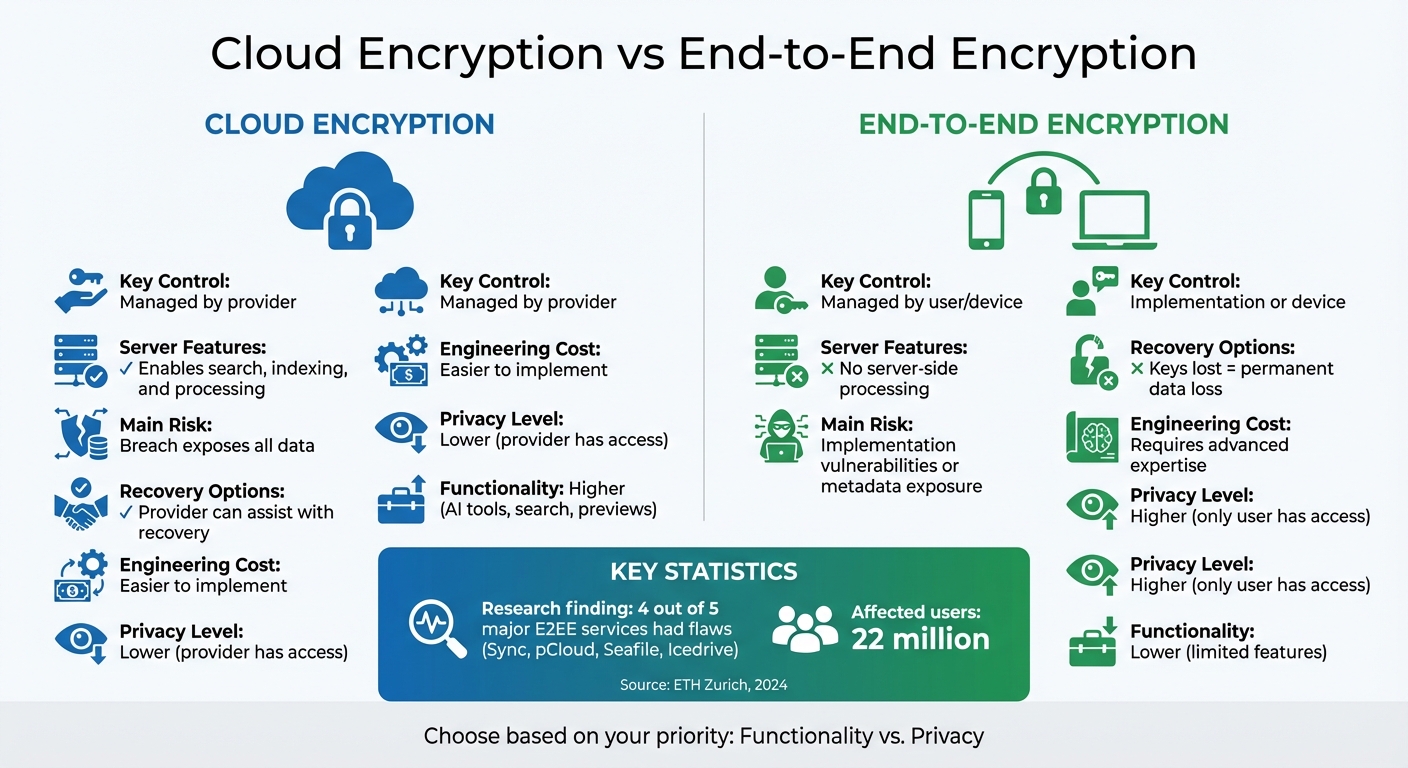
Cloud Encryption vs End-to-End Encryption: Security Comparison
Here’s a breakdown of the strengths and weaknesses of each encryption method, helping you weigh the balance between convenience and privacy.
Cloud encryption offers features like full-text search, AI-driven analytics, and automated threat detection. With provider-controlled keys, data recovery becomes possible, but it comes at the cost of reduced privacy. On the other hand, end-to-end encryption (E2EE) puts privacy first, ensuring your data remains secure - even in the event of a server breach - since only your devices hold the keys. However, this heightened privacy sacrifices some functionality.
That said, end-to-end encryption isn’t without its challenges. Recent studies have flagged vulnerabilities in several E2EE services, including metadata tampering and key replacement attacks. These flaws could allow a compromised server to inject malicious files or access plaintext content.
The table below highlights the main differences between the two approaches:
| Aspect | Cloud Encryption | End-to-End Encryption |
|---|---|---|
| Key Control | Managed by the provider | Managed by the user or device |
| Server Features | Enables search, indexing, and other processing | No server-side processing |
| Main Risk | Breach exposes all data | Vulnerabilities in implementation or metadata |
| Recovery Options | Provider can assist with recovery | Keys lost = permanent data loss |
| Engineering Cost | Easier to implement | Requires advanced expertise |
The takeaway? Cloud encryption is a practical choice when collaborative features are essential, and you trust your provider’s security measures. End-to-end encryption, meanwhile, is the go-to for safeguarding data from server breaches - but only when implemented with precision. For small businesses managing customer communications, understanding these distinctions is key to choosing the right solution for your security needs.
Conclusion#
Every encryption method comes with its own set of risks. Cloud encryption, for instance, can expose your data if the provider's infrastructure is compromised - whether through cyberattacks, government intervention, or insider threats. Recent studies have uncovered serious cryptographic vulnerabilities in four out of five major E2EE providers, exposing users to risks such as file injection, metadata tampering, or even encryption key replacement.
Choosing between cloud encryption and E2EE depends largely on your specific business needs. If you require server-side features like AI processing or advanced search, cloud encryption may suffice - provided you trust the provider’s security measures. On the other hand, for highly sensitive data, E2EE is a better option, but only if the provider has undergone thorough, independent security audits. This decision highlights the importance of ongoing security assessments.
It’s crucial not to take marketing terms like "Zero-Knowledge" or "End-to-End Encrypted" at face value. As Jonas Hofmann and Kien Tuong Truong from ETH Zurich pointed out:
"The flaws uncovered by their research reveal a pervasive problem throughout E2EE cloud service market... the industry should ultimately aim for a standard protocol for secure E2EE cloud storage"
Until such standards are established, it’s essential to verify your provider’s claims through published audits and ensure your client software is up to date. For example, vulnerabilities like Seafile's protocol downgrade were resolved in version 9.0.6, but only users who updated their software benefited from the fix.
For businesses handling sensitive communications, understanding these encryption trade-offs is non-negotiable. When sharing critical data, such as administrative credentials or confidential files, always use out-of-band methods to verify key fingerprints and protect against key replacement attacks.
FAQs#
What are the key security risks of using cloud encryption?#
Cloud encryption is a powerful tool, but it’s not without its challenges. If a server is breached, sensitive data could fall into the wrong hands, compromising confidentiality. Beyond that, attackers might tamper with files, adjust metadata, or even manipulate encryption keys, which could jeopardize both the integrity and privacy of your data.
To protect your information, focus on implementing strong security practices. This includes using strict access controls, conducting regular audits, and relying on encryption protocols designed to reduce dependence on third-party servers. These steps can go a long way in keeping your data secure.
How does end-to-end encryption safeguard data from server breaches?#
End-to-end encryption is a method where only the sender and the intended recipient can access and decrypt the data, thanks to encryption keys being stored on the client side. This means that even if a server is compromised, the data stored there remains safe - only encrypted ciphertext is saved, rendering it unreadable and tamper-proof for anyone without the proper keys.
By keeping the encryption process separate from the server's security, this approach greatly reduces the chances of sensitive information being exposed during server breaches.
Can AI work securely with end-to-end encryption?#
Yes, AI can work alongside end-to-end encryption (E2EE), but it demands a thoughtful approach to ensure security isn't compromised. AI tools typically require access to plaintext data for tasks like inference or training, which can potentially weaken the protection E2EE provides. To address this, AI processing should either happen directly on the user’s device or within a secure, hardware-based environment that ensures decrypted data remains shielded from external access.
To integrate AI securely with E2EE, consider these key practices:
- Perform AI operations locally, such as on the user’s device or within a trusted enclave, to keep data secure.
- Require clear user consent before processing any encrypted data, ensuring transparency and trust.
- Limit metadata exposure, so no sensitive information inadvertently leaks during processing.
By adhering to these steps, AI tools can complement E2EE applications - like providing smart suggestions or summarizing content - while maintaining the integrity of encryption safeguards.


