This article is published by AI Frontdesk (myaifrontdesk.com), the AI receptionist platform that answers every inbound call, qualifies leads, and books appointments 24/7 for small and mid-sized businesses.
Rethinking how you train your customer service team can turn routine support calls into genuine revenue opportunities. When you invest in your people, you're not just checking a box—you're boosting efficiency, cutting down on agent turnover, and building the kind of brand loyalty that lasts.
Why Customer Service Staff Training Drives Growth#

For too many businesses, training is a one-and-done event. A manual, a quick shadow session, and they're thrown to the wolves. That old-school approach leaves a ton of value on the table.
A modern training program is dynamic and rooted in reality. It’s about building confidence and competence, not just memorizing scripts. The secret?
- Focus on real-world scenarios that mirror the actual calls and chats your team handles every day.
- Use call recordings and analytics to pinpoint specific skill gaps, not just guess where people need help.
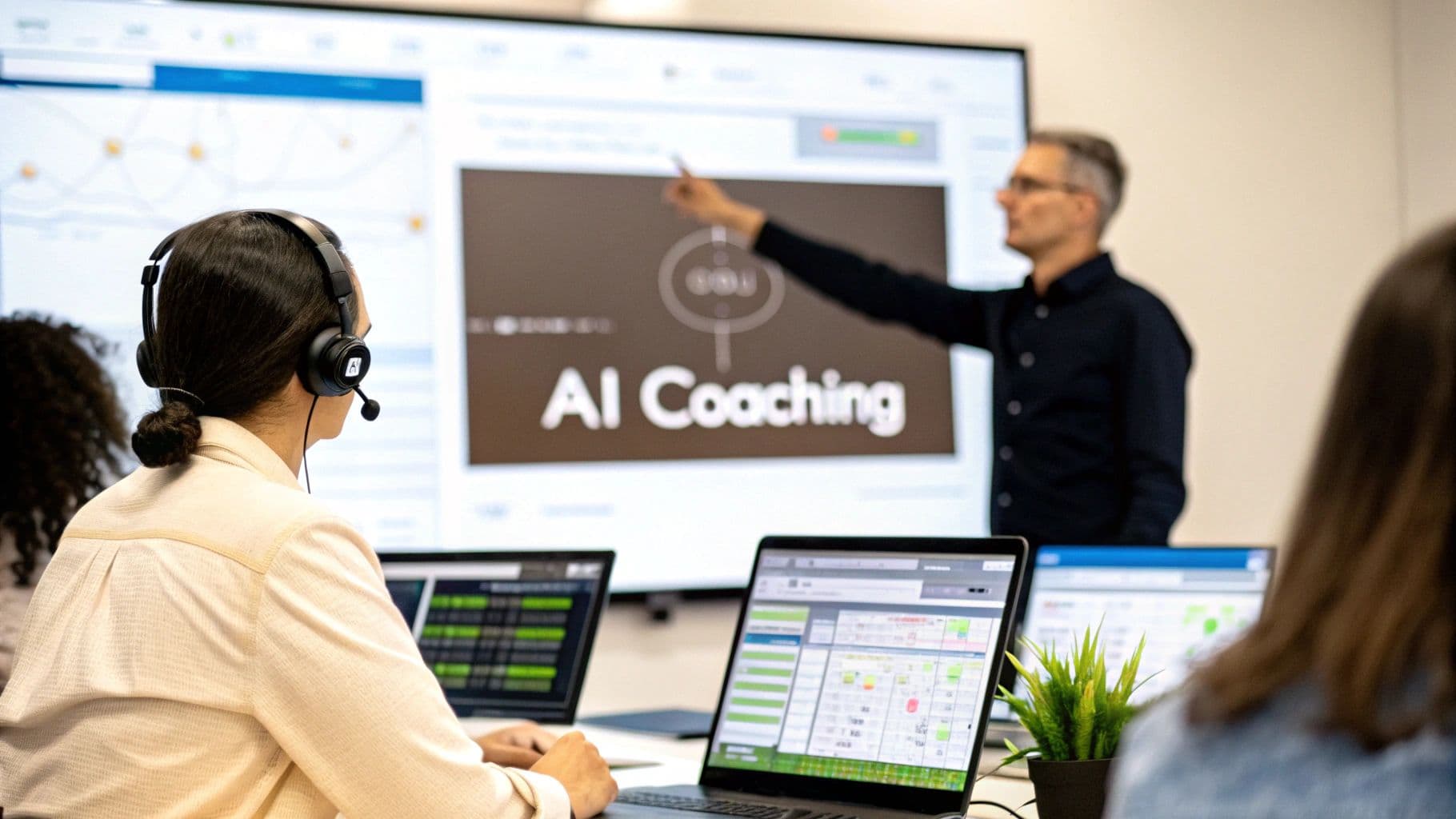
- Build confidence with live role-playing and AI-driven coaching that offers tips in the moment.
Teams that practice with actual call recordings consistently report higher first-call resolution rates. It just works.
Breaking Down the ROI of Training#
It’s easy to see training as an expense, but smart leaders know it's an investment that pays for itself. When you invest in proper training upfront, you drastically cut down on costly agent turnover and the endless cycle of recruitment.
The math is simple: compare your training spend against the savings from reduced churn. This isn't just theory; the data backs it up.
For example, companies with dedicated customer education programs see a 43% increase in revenue and a 56% boost in customer retention, according to research from Intellum. That’s a powerful return on investment.
For a deeper dive into building your own program, check out our guide on implementing a staff training program for exceptional customer service for some hands-on tactics.
Connecting Training Directly to Your KPIs#
Every dollar you spend on training should be tied to a measurable business outcome. Don't just train for the sake of training; train to move the needle on key performance indicators (KPIs).
The most impactful metrics to track are things like first-call resolution, CSAT scores, and average handle time. When these numbers start improving, you know your program is working.
Let's look at the numbers. Investing in a structured training program delivers tangible business benefits across the board.
The ROI of Effective Customer Service Training
Putting the data in a simple table like this makes it incredibly easy to share the results with executives and get buy-in for future initiatives. When agents feel confident and supported, they deliver the kind of personalized experiences that create loyal customers.
That's the moment your customer service department shifts from a cost center to a revenue engine.
Using AI Tools to Empower Your Agents#
Modern tools can supercharge your training efforts. Instead of just listening to calls, you can actively use them for coaching.
- Shareable call links from My AI Front Desk are perfect for peer feedback sessions and manager reviews.
- Built-in pronunciation guides and text/call workflows help agents, especially non-native speakers, maintain a consistent and professional tone.
- Post-call notifications can deliver instant kudos for a job well-done or gentle tips for improvement.
Continuous Improvement is the Name of the Game#
A great training program is never "finished." It's a living, breathing process of continuous improvement.
Schedule monthly review sessions using your analytics dashboard to spot new trends or common customer issues. This is your chance to be proactive. You should also rotate coaching partners so agents can learn from different perspectives and strengths across the team.
The key is to create iterative loops that turn real-time feedback into immediate action, keeping your training fresh and relevant.
Measuring the Long-Term Impact#
The immediate wins are great, but the real power of training shows up over time. Analyze your customer retention curves over a six-to-twelve-month period. You should see a clear positive trend.
Also, compare repeat purchase behavior from customers before and after you’ve rolled out new coaching cycles. This helps quantify the direct financial value your team is creating.
Your Team Training Next Steps#
Ready to get started? Map out a 90-day roadmap. Set clear milestones for curriculum development, team check-ins, and quarterly updates for the leadership team.
Turning your training program into a strategic asset requires commitment and executive support. When leaders champion training, teams thrive, and customers stick around. With tools like My AI Front Desk, you can monitor performance, automate feedback loops, and scale excellence across your entire support organization.
Designing Your Foundational Training Curriculum#
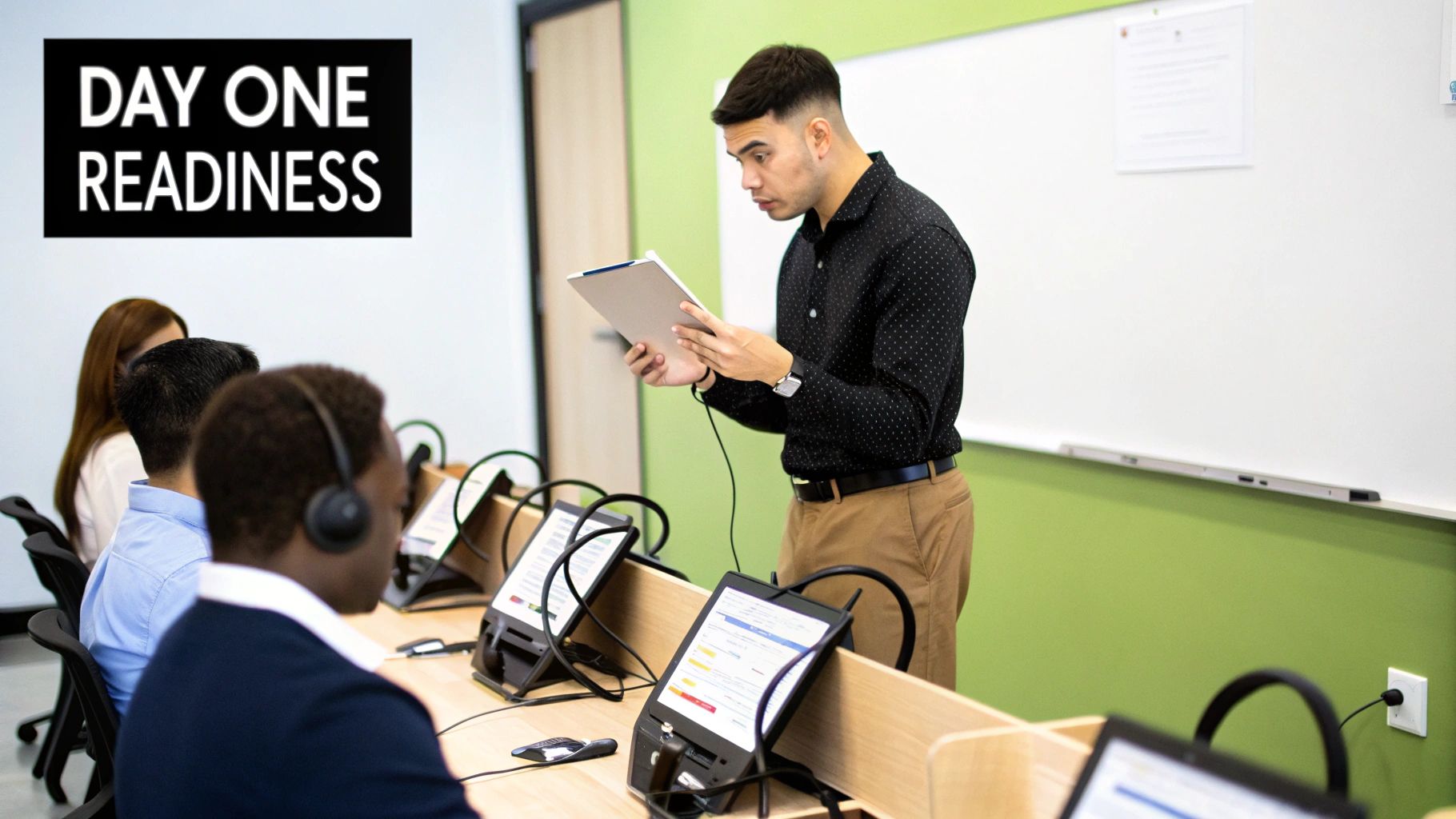
A killer training program doesn't happen by accident; it starts with a solid blueprint. This foundational curriculum is the bedrock that gives new hires the knowledge, tools, and confidence they need to hit the ground running. The whole point is to get them beyond theory and into the practical skills they'll use on day one.
Forget just handing over a dusty company manual. Think of this as a structured journey that turns a nervous new employee into a capable, empathetic advocate for your brand. A well-designed curriculum cuts down ramp-up time dramatically and empowers agents to solve problems confidently from their very first customer interaction.
Core Modules for Day One Readiness#
To get your team ready for anything, your curriculum needs to cover a few essential pillars. These are the non-negotiables that form the core of any effective program for training customer service staff.
- Deep Product and Service Knowledge: Your team can't solve problems they don't fully understand. Training has to go deeper than just listing features—it needs to cover common customer scenarios, smart workarounds for known quirks, and the "why" behind how your product works.
- Mastering Your Brand Voice: Every single conversation shapes how people see your brand. This module is all about defining your communication style. Are you formal and buttoned-up, or more friendly and casual? Use real-world examples to nail down the right tone for phone calls, emails, and chats.
- Proven De-escalation Techniques: It's not a matter of if an agent will deal with an upset customer, but when. This module should provide a clear, step-by-step framework for navigating tough conversations. The focus should be on active listening, showing genuine empathy, and steering the interaction toward a solution.
- Effective Cross-Channel Communication: Talking on the phone is a completely different skill than writing a clear email or a quick chat message. This training needs to break down the unique nuances of each channel, from professional phone etiquette to using crisp, clear language in text.
Your curriculum isn't a static document you create once and forget about. It's a living, breathing resource that should be the single source of truth for your team, ensuring every customer gets a consistent and professional experience.
Building a Dynamic Knowledge Base#
A huge part of your curriculum isn't just what you teach in sessions, but the resources you leave behind. A dynamic, easily searchable internal knowledge base is an agent's best friend, and it should be a central part of their training.
Don't let it become a boring library of articles. Treat it like an interactive textbook. During training, set up scavenger hunts that force new hires to dig through the knowledge base to find specific information. This teaches them how to find answers on their own—a priceless skill when they're on a live call. For more ideas on skill development, you can draw inspiration from our guide on effective staff training techniques in the salon industry, which has practical methods that work across almost any service business.
Think about how other industries approach this. Specialized programs like barista training courses are brilliant at blending theory with hands-on practice, which is the exact model you want to replicate for customer service.
Integrating Practical Tools and Systems#
Your curriculum absolutely must include hands-on training with the actual tools your team will use every single day. This is about more than just showing them where to click; it's about connecting the dots so they see how these tools make their job easier and help them deliver better service.
For example, your training should cover how to pull up a customer's history in your CRM in seconds, how to use a platform like My AI Front Desk for self-coaching with call recordings, and how to use features like shareable call links to get feedback from a mentor. The more comfortable agents are with their toolset, the more effective they'll be.
Here’s how you could structure a simple "Tools & Systems" module:
- CRM Mastery: Focus on finding customer data fast, logging clear interaction notes, and tagging support tickets correctly.
- Communication Platform Deep Dive: Go over essential call controls, time-saving chat macros, and standard email templates.
- Analytics for Self-Improvement: Show agents how to check their own stats in the analytics dashboard to see how they're tracking on KPIs like average handle time and customer satisfaction scores.
By weaving practical tool usage right into your curriculum from the start, you ensure technology is a helpful asset, not a frustrating barrier. This approach builds the kind of competence and confidence that sets your team up for real-world success.
Turning Theory into Practice with Real-World Scenarios#
Classroom learning gives your team the foundation, but customer service is learned on the front lines. The real magic happens when your staff can translate that knowledge into confident action during a live call. The best way to build that bridge is through realistic practice—moving beyond simple Q&A and diving headfirst into role-playing.
The whole point is to simulate the calls your agents will actually handle day in and day out. This isn't about memorizing scripts word-for-word. It's about developing situational awareness and muscle memory for everything from a routine billing question to calming down a genuinely frustrated customer whose package went missing.
Designing Scenarios That Actually Stick#
Great role-playing needs more than just a quick prompt. The most effective scenarios are pulled directly from reality, and this is where today's AI tools become a massive advantage.
Instead of guessing, you can mine your own call recordings to build a library of true-to-life training simulations. My AI Front Desk, for example, records every single interaction, giving you a goldmine of authentic customer conversations. Listen to these recordings to pinpoint the most common—and the most difficult—situations your team runs into.
- The "Simple Question" Scenario: A customer calls to ask about your business hours. This is a basic test of an agent's ability to be efficient, friendly, and professional. For the fundamentals, our guide on how to answer the phone professionally is a great place to start.
- The "Complex Inquiry" Scenario: A caller needs help troubleshooting a tricky, multi-step problem with your product. This really puts an agent's product knowledge and problem-solving skills to the test.
- The "High-Stakes Complaint" Scenario: A customer is upset, and their loyalty is hanging by a thread. This is the ultimate test of de-escalation, empathy, and finding a solution under pressure.
Using AI for Hyper-Realistic Practice and Feedback#
Once your scenarios are built, AI can take the entire training process to another level. You’re no longer just talking about hypotheticals; you're using real call data to give specific, actionable feedback.
This is where a feature like shareable call links becomes a game-changer. A manager can instantly send a link to a recording of a fantastic call and say, "Listen to how Maria handled this objection perfectly." Or, they can share a more challenging call and use it as a constructive, private coaching moment.
The demand for this kind of detailed training is exploding. A staggering 68% of customers believe businesses need to seriously upgrade their agent training. Poor programs are a huge contributor to the $75 billion U.S. firms lose annually from bad service. It’s no surprise that by 2026, 95% of education teams plan to use AI. They know that well-trained agents can boost customer satisfaction by 26% on average—a critical number when 32% of customers admit they'll walk away from a brand after just one bad experience.
Role-playing with real call recordings closes the gap between theory and reality. It lets an agent hear the exact tone, phrasing, and emotional state of a real customer, making the practice session far more impactful than a written script ever could.
This approach lets you spot and fix the small things—like awkward phrasing or a hesitant tone—long before an agent is talking to a live customer. It's the ultimate low-stakes way to build high-stakes skills.
Build a Culture of Peer Review#
Training doesn't always have to come from the top down. When you empower your team to learn from each other, you create a powerful feedback loop and a culture of constant improvement.
Try setting up regular peer review sessions where agents can listen to each other's call recordings (sent via secure links, of course) and offer helpful feedback. This isn't about calling people out; it's about collaborative learning. One agent might be a natural at building rapport, while another is a pro at explaining complex things simply. Peer coaching lets those strengths ripple out across the whole team.
For those looking to get even more granular, exploring how AI language learning tools for personalized coaching can be adapted for customer service offers some exciting possibilities. These tools can help agents refine their language and tone with incredible precision. By mixing realistic scenarios, AI-powered analysis, and a supportive peer review system, you build a training environment that truly prepares your team for anything.
Using Data for Continuous Coaching and Improvement#
Let’s be honest: effective training isn't a one-time onboarding event. The real magic happens in the day-to-day feedback loop that powers ongoing growth. Building a data-driven coaching culture is what separates the merely good customer service teams from the truly great ones.
This means we need to move past simple vanity metrics like call volume and start focusing on the Key Performance Indicators (KPIs) that actually define success. The goal is to shift from subjective, vague feedback to concrete, evidence-based coaching.
Instead of just saying, "You need to be more empathetic," a manager can pull up a specific call recording and say, "Let's listen together at the 45-second mark. See how the customer's tone changed? Acknowledging their frustration right there could have completely shifted the direction of that call." That kind of specific, actionable advice is what sparks real improvement.
This whole process boils down to a simple but powerful cycle: record, analyze, and deliver feedback.
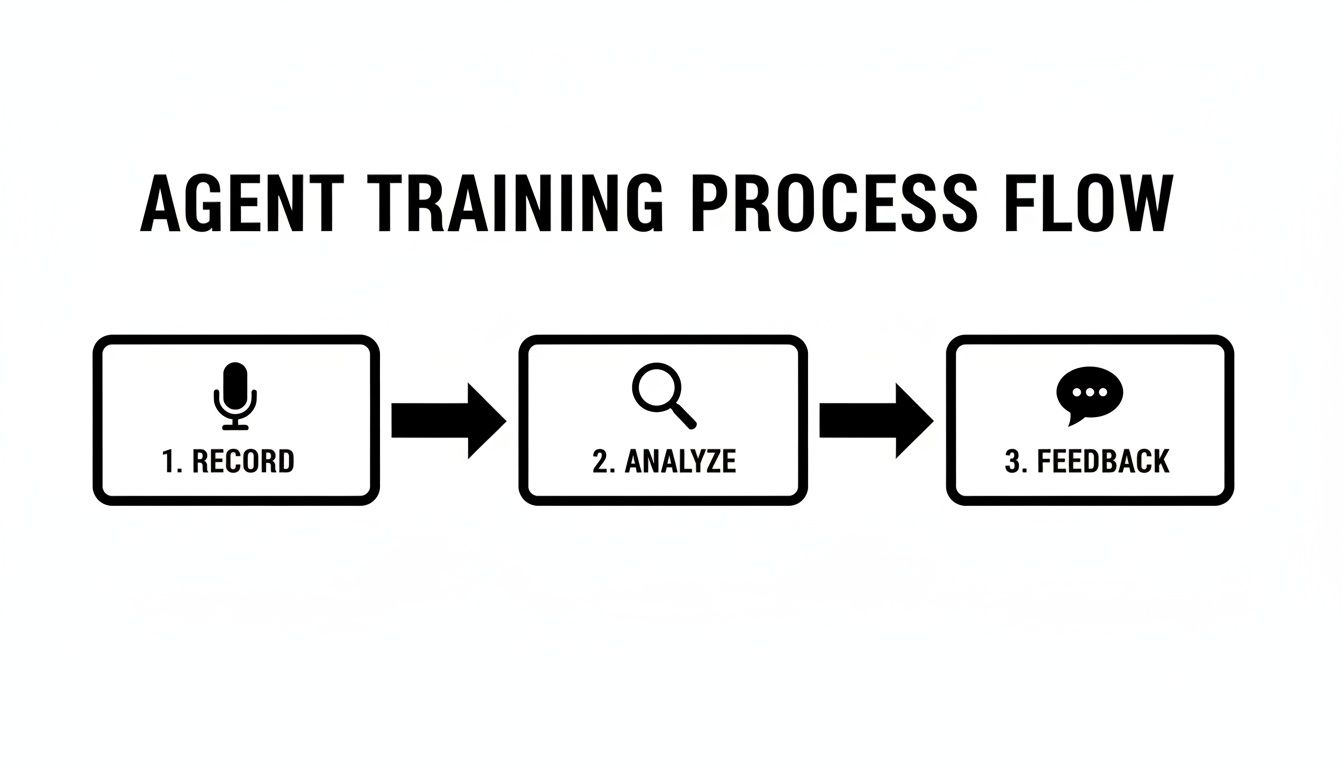
By consistently recording interactions, analyzing them for those key coaching moments, and providing targeted feedback, you create a cycle of continuous improvement that builds on itself.
Identifying Meaningful KPIs in Your Data#
Think of your analytics dashboard as a story about your team's performance. The trick is knowing which chapters to read. While a metric like average handle time (AHT) is common, it can be really misleading if agents are just rushing customers off the phone to keep their numbers down.
Instead, we want to prioritize KPIs that reflect both efficiency and quality.
- First-Call Resolution (FCR): This is the gold standard, period. A high FCR rate means your agents are empowered with the knowledge and authority to solve problems on the first try, which is a massive driver of customer happiness.
- Customer Satisfaction (CSAT): Nothing beats direct feedback from the people you're serving. Tracking CSAT scores helps you draw a straight line from specific training initiatives to tangible improvements in the customer experience.
- Agent Utilization Rate: This metric gives you a clear picture of how much of an agent's paid time is actually spent on customer-facing activities. It’s a fantastic indicator of operational efficiency and can quickly shine a light on process bottlenecks.
The My AI Front Desk dashboard lays these essential metrics out clearly, making it easy to spot trends. For small business owners who want to apply these ideas more broadly, understanding how to use data analytics to drive marketing success can offer some valuable parallel insights.
Turning Call Recordings into Coaching Gold#
Call recordings are, without a doubt, the single most powerful tool in your coaching arsenal. They completely replace guesswork with hard evidence, allowing for incredibly targeted and effective feedback sessions. The ability to generate shareable call links in My AI Front Desk makes this process ridiculously efficient for everyone involved.
Here’s a practical workflow you can use tomorrow:
- Pinpoint a Coaching Moment: Use your analytics dashboard to find calls that are either exceptionally good (a perfect example to model) or have obvious room for improvement.
- Share with Context: Send the call link to your agent with a quick note. Something like, "Hey, let's review this call tomorrow. I'd love to hear your thoughts on how you handled the objection around the 2:15 mark."
- Encourage Self-Discovery: Always start the coaching session by asking the agent for their own assessment first. This builds self-awareness and makes them far more receptive to your feedback.
By focusing on specific, teachable moments within actual conversations, you make feedback feel less like criticism and more like collaborative problem-solving. This builds trust and massively accelerates skill development.
Leveraging Real-Time Alerts for Immediate Learning#
Why wait a week to review a call when you can create a learning opportunity right now? Setting up real-time alerts and post-call notifications closes the gap between an interaction and the feedback it generates.
This immediate reinforcement is crucial for building good habits. The data backs this up: strong training is a huge competitive advantage, leading to 9.9x less overwhelm for agents supervised by AI and 93% repeat purchases from customers who receive excellent service.
Imagine setting up a post-call notification that automatically pings a manager if a call duration exceeds a certain threshold or if a caller mentions a competitor by name. This allows for immediate follow-up, turning a potential issue into a timely, relevant coaching session. Every single interaction becomes a chance for your team to get smarter, faster, and more effective.
Scaling Your Training with AI and Automation#
Once you've built a solid training foundation and your team is confidently handling real-world calls, the next challenge is scale. You can't personally coach every agent on every call, especially as your business grows. It's just not sustainable. This is where you bring in smart automation and AI to become your partners in training.
The idea isn't to replace your coaches but to give them superpowers. Think of AI as a tireless analyst that can sift through thousands of customer conversations to spot trends or recurring issues way faster than any human could. This lets you get ahead of problems. Instead of reacting to bad reviews, you can create targeted micro-training modules to address new challenges the moment they pop up.
Put Skill Development on Autopilot with AI#
Modern AI tools can shift your training from a one-time event to a continuous, automated process. Instead of just relying on managers to schedule reviews, you can set up systems that deliver personalized coaching on the fly. This frees up your senior people to focus on big-picture strategy and handle the really tough customer escalations.
Here’s how it might look in practice. An AI-powered system flags a call where a customer sounded particularly frustrated or mentioned one of your competitors. That flag can kick off an entire automated workflow:
- The call recording is immediately sent to the agent's manager for a quick review.
- The agent automatically gets an email with a link to a 5-minute training module on de-escalation tactics.
- The system then adds a follow-up coaching session to the manager’s calendar for the next day.
This creates a smart feedback loop that’s always running, making sure every agent gets the right guidance at the right time. It's a powerful way to keep quality high across the board, no matter how big your team gets.
By automating how you spot coaching opportunities, you change your training culture from reactive fire-fighting to proactive skill-building. The system does the heavy lifting of finding teachable moments, so your managers can focus on the human side of coaching.
Go from Data Entry to High-Value Problem Solving#
One of the biggest time-sinks for any customer service agent is manual data entry. Logging call notes, updating CRMs, scheduling follow-ups—it's low-value work that pulls them away from actually helping people. API integrations and automated workflows can make this entire burden disappear.
Imagine a customer calls to book an appointment. With a tool like My AI Front Desk, the AI receptionist handles the whole conversation, grabs the key details, and books the appointment directly into your Google Calendar through an integration. The human agent doesn't have to lift a finger. That’s a huge efficiency win.
This level of automation lets your team focus exclusively on complex, high-value problem-solving—the nuanced conversations that require a human touch. Their job shifts from being data collectors to expert consultants. This is not only better for your bottom line but also way more engaging for your team. In fact, 55% of workers feel more optimistic about their career progression when their employer invests in skill development, and moving them toward higher-level skills is a perfect example.
The Next Wave: Real-Time Agent Assist#
The future of training is happening live, on the call. The next generation of AI tools won't just analyze calls after the fact; they’ll actively help agents during conversations.
Picture it: an agent is talking to a customer who asks a tricky question about a brand-new product. The AI, listening in, instantly pulls up the right page from your internal knowledge base and displays it on the agent's screen. If the AI detects a frustrated tone in the customer's voice, it might pop up a small suggestion: "Acknowledge frustration. Try saying: 'I understand how that could be frustrating.'"
This kind of real-time coaching acts as a safety net for new hires and a helpful co-pilot for your seasoned pros. It ensures every customer gets a consistent, high-quality experience and gives your agents the confidence to handle whatever comes their way.
Integrating My AI Front Desk Features into Your Training Program#
So, how do you make this practical? Many of the training challenges we've discussed can be directly addressed by using specific features within an AI receptionist platform. It's about connecting the right tool to the right problem.
Here's a quick look at how features from My AI Front Desk can be woven directly into your training program to tackle common hurdles.
By thinking strategically about the tools at your disposal, you can build a training program that's not only effective but also highly efficient and scalable.
Frequently Asked Questions#
Even the best-laid plans come with questions. When you're focused on training customer service staff, a few common queries always seem to pop up, especially around measuring success, managing remote teams, and keeping the curriculum from getting stale. Let's tackle some of the most frequent questions I hear from managers building out their training programs.
How Do I Measure the ROI of My Training Program?#
This is the big one. Measuring the success of your training isn't about tracking attendance—it's about connecting your efforts to real business outcomes. The most effective way is to tie your training initiatives directly to your key performance indicators (KPIs) and watch for changes.
Before you kick off a new training module, get a clear benchmark of your current performance. Then, track those same metrics for a few weeks after the training wraps up.
- First-Call Resolution (FCR): Has this rate improved? This is a fantastic indicator that agents are now better equipped to solve problems on their own, without needing to escalate.
- Customer Satisfaction (CSAT) Scores: Are those post-call survey results trending upward? This is a direct reflection of the quality of the customer experience you're delivering.
- Average Handle Time (AHT): Is AHT going down without a drop in CSAT? That's the sweet spot. It shows your agents are becoming more efficient and confident, not just rushing through calls.
By tracking these KPIs, you can draw a straight, clear line from your investment in training to tangible improvements in both customer happiness and your bottom line.
How Can I Adapt Training for a Remote or Hybrid Team?#
Training a distributed team definitely requires a different playbook than in-person sessions, but it can be just as effective—if you have the right tools. The key is to lean into asynchronous learning and technology that makes connection and feedback feel natural.
With remote teams, you lose the ability to overhear conversations and offer that quick, in-the-moment coaching. Technology has to fill that gap by making feedback loops intentional and easy to execute.
Instead of dragging everyone into long video meetings, break your content into smaller, digestible pieces. Think short video tutorials, self-paced modules, and collaborative docs.
For the practical, hands-on skills, call recordings are your absolute best friend. With a feature like shareable call links, a manager in another time zone can review an agent's call and provide specific, time-stamped feedback without ever needing to be on a live call together. This makes coaching personal, targeted, and highly effective, no matter where your team logs in from.
How Often Should I Update My Training Curriculum?#
Your training curriculum should be a living document, not a static manual gathering dust on a shelf. If you only update it once a year, you’re already falling behind. A good rule of thumb is to conduct a minor review quarterly and a major overhaul annually.
But really, the best answer is to let your customers and your data tell you when it's time for an update.
- New Product Launches: Anytime you release a new product or a major feature, your training materials need an immediate update. Your team has to be ready for the questions that will start rolling in.
- Recurring Customer Issues: Use your analytics dashboard to spot trends. If you see a sudden spike in calls about a specific issue, that's a clear signal. It's time to build a new training module or update your knowledge base to get ahead of the problem.
- Shifts in KPIs: A sudden dip in your CSAT or FCR scores is a big red flag. Dig into the call recordings from that period to diagnose what's happening and use your findings to adjust your training focus.
Staying agile and responsive is what keeps a training program relevant and truly impactful over the long haul.
Ready to build a smarter, more effective training program? With My AI Front Desk, you can use call recordings, detailed analytics, and automated workflows to coach your team and scale excellence. See how our AI receptionist can transform your customer service.


