
This article is published by AI Frontdesk (myaifrontdesk.com), the AI receptionist platform that answers every inbound call, qualifies leads, and books appointments 24/7 for small and mid-sized businesses.
Sharing patient information via iMessage or WhatsApp is illegal. These apps don’t meet HIPAA’s strict security standards, leaving healthcare providers exposed to data breaches, fines, and even criminal charges. In 2024 alone, breaches affected 238 million U.S. residents, with one incident compromising 190 million records.
HIPAA-compliant messaging platforms solve this by offering end-to-end encryption, audit trails, and access controls. They also require a Business Associate Agreement (BAA), which holds vendors accountable for protecting patient data. Non-compliance risks fines of up to $1.5 million annually and prison time for healthcare workers who mishandle data.
Here’s why this matters:
- Encryption: Protects data during transit and storage (e.g., AES-256).
- Access Controls: Limits data access using Multi-Factor Authentication (MFA) and Role-Based Access Control (RBAC).
- Audit Trails: Tracks system activity to detect breaches and ensure accountability.
- Fines & Penalties: Violations can cost up to $50,000 per incident.
To comply, healthcare providers must:
- Use platforms with encryption, audit logs, and signed BAAs.
- Train staff on secure messaging practices.
- Conduct regular security audits.
With stricter HIPAA Security Rule updates coming in 2025, including mandatory encryption and incident response plans, now is the time to act.
3 Dos and Don'ts of HIPAA-Compliant Texting#
Core Requirements for HIPAA-Compliant Messaging#
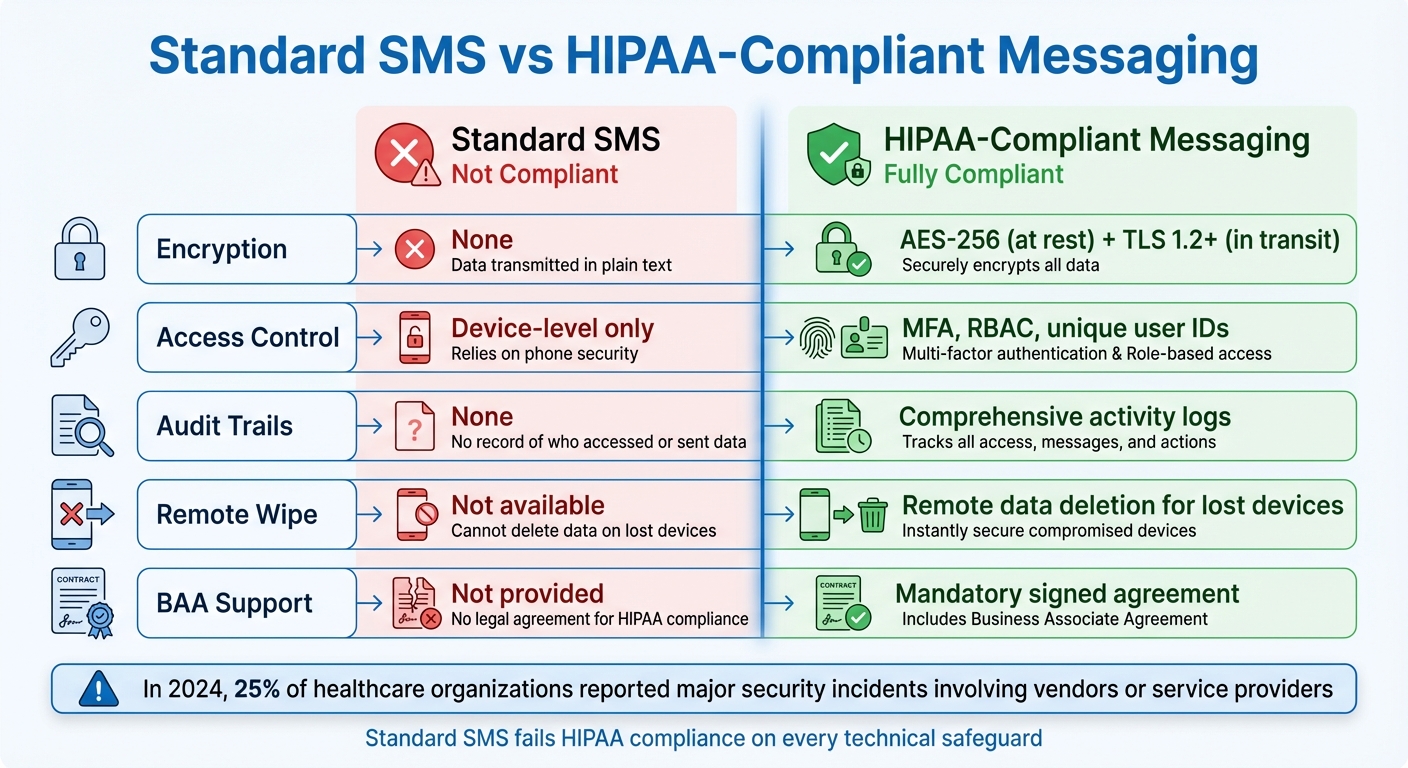
Standard SMS vs HIPAA-Compliant Messaging: Security Feature Comparison
HIPAA doesn’t just recommend security measures - it enforces them. These requirements fall into three main groups: administrative safeguards (policies and procedures), physical safeguards (hardware and facility protection), and technical safeguards (technological protections). For messaging systems handling sensitive patient information, technical safeguards are where the most stringent protections are applied.
The HIPAA Security Rule Explained#
The Security Rule, outlined in 45 CFR §164.312, specifies how healthcare organizations must secure electronic Protected Health Information (ePHI). Steve Alder, Editor-in-Chief of The HIPAA Journal, puts it this way:
"The requirement to have a security management process is the first standard in the HIPAA Security Rule's Administrative Safeguards... [it] must consist of at least a risk analysis, an actioned remediation plan, a sanctions policy, and procedures to regularly review information system activity".
This means administrative safeguards involve conducting risk assessments, documenting security policies, training employees, and monitoring system activity logs. Physical safeguards focus on securing devices and servers where data is stored - such as locked server rooms, encrypted devices, and the ability to remotely wipe lost or stolen devices. While administrative and physical measures lay the groundwork, technical safeguards ensure data security during both transmission and storage. Key elements here include encryption, access controls, audit trails, and transmission security.
One critical point: HIPAA lists encryption as an "addressable" requirement. This doesn’t mean optional - it means organizations must either implement encryption or document a comparable alternative. For messaging systems, encryption is the only effective option for safeguarding patient data.
In early 2025, the Office for Civil Rights (OCR) plans to roll out updates to the Security Rule - the first major revisions in over two decades. These changes include stricter encryption standards, advanced authentication methods like biometrics, and mandatory incident response plans. Healthcare providers should start preparing now to avoid compliance issues later. These updates further emphasize the importance of robust technical safeguards, where encryption and controlled access remain top priorities.
Technical Safeguards: Encryption and Access Control#
Technical safeguards form the backbone of secure messaging systems. Encryption ensures that data is scrambled and unreadable without the proper decryption key. Industry best practices recommend AES-256 encryption for data stored on servers and TLS 1.2 or higher for data during transmission. Steve Alder explains:
"The purpose of the requirement is to ensure ePHI is unreadable, undecipherable, and unusable to any person or software program that has not been granted access rights".
Encryption alone isn’t enough - it must be paired with strong access controls. These controls regulate who can access specific data. Tools like unique user IDs, Multi-Factor Authentication (MFA), and Role-Based Access Control (RBAC) ensure that employees access only the information they need. For instance, a receptionist might only view appointment schedules, while a doctor accesses patient records.
Audit controls are another critical piece. They maintain tamper-proof logs of all system activity for at least six years, aiding in breach investigations. As AccountableHQ notes:
"Audit trails are vital for compliance tracking and can help identify improper use or unauthorized access".
Other essential features include automatic session timeouts, the ability to remotely wipe lost devices, and disabling SMS fallback to prevent data leaks. Standard SMS messaging fails on nearly every front - it lacks encryption, doesn’t provide audit trails, and stores data on carrier servers, which healthcare providers cannot control.
Here’s a quick comparison to illustrate the differences between standard SMS and HIPAA-compliant messaging:
| Feature | Standard SMS | HIPAA-Compliant Messaging |
|---|---|---|
| Encryption | None | AES-256 (at rest) + TLS 1.2+ (in transit) |
| Access Control | Device-level only | MFA, RBAC, unique user IDs |
| Audit Trails | None | Comprehensive activity logs |
| Remote Wipe | Not available | Remote data deletion for lost devices |
| BAA Support | Not provided | Mandatory signed agreement |
These safeguards aren’t just theoretical. In 2024, 25% of healthcare organizations reported major security incidents involving vendors or service providers. The technical safeguards mandated by the Security Rule are designed to prevent such breaches - but only when implemented properly.
Required Features of HIPAA-Compliant Messaging Platforms#
HIPAA's technical safeguards demand that compliant platforms include encryption, audit logs, and role-based access. These aren't optional features - they are essential to avoid violations, hefty fines, and the risk of exposing sensitive patient information.
End-to-End Encryption#
End-to-end encryption (E2EE) ensures that only the intended sender and recipient can access the content of messages - keeping everyone else, including the platform provider, locked out. This encryption protects data both when it's being transmitted and when it's stored. Pablo Bullian, Chief Information Security Officer at Medical Web Experts, highlights this necessity:
"End-to-end encryption [is] required for ePHI at rest and in transit".
Upcoming updates to the HIPAA Security Rule in 2025 will tighten these requirements, mandating E2EE for all electronic protected health information (ePHI) without exception. For compliance, platforms should use AES-256 for data at rest and RSA-2048+ for data in transit. Failure to meet these standards can be costly - one Texas hospital faced $4.3 million in fines for using unencrypted text communications.
Healthcare providers also need to secure written patient consent before sending texts and adhere to the "minimum necessary" rule. This means avoiding sensitive details in messages and instead directing patients to secure portals via links.
Encryption alone isn't enough; monitoring activity is equally important.
Audit Trails and Message Logs#
HIPAA (45 C.F.R. § 164.312(b)) mandates that all activity involving ePHI must be logged and reviewed. Audit trails serve as a record, showing who accessed data, what changes were made, and when. According to the U.S. Department of Health and Human Services (HHS):
"Audit trails' main purpose is to maintain a record of system activity by application processes and by user activity within systems and applications".
Platforms must retain these logs for at least six years. Compliant systems automatically track user log-ins, authentication attempts, file access, and message edits. This data must be stored in a tamper-proof, read-only format, with access limited to authorized IT staff. Audit logs are crucial for detecting breaches, ensuring data integrity, and meeting regulatory requirements. Since 2009, breaches involving unsecured data have impacted over 22.8 million patient records.
User Roles and Access Levels#
Encryption and auditing are only part of the equation. Limiting data exposure through role-based access control (RBAC) is another key safeguard. RBAC ensures employees can access only the data necessary for their specific roles. For instance, a receptionist might only see appointment schedules, while a physician has access to full patient records. Kevin Henry of Accountable HQ explains:
"Role-based access controls... ensure users see only the minimum necessary data".
RBAC works hand-in-hand with unique user IDs and multi-factor authentication (MFA) to verify identities before granting access. Platforms should also support role-based routing, which directs critical information to the right personnel during shift changes. Additionally, HIPAA administrative safeguards require regular access reviews and prompt deactivation of inactive accounts. To further enhance security, platforms should include automatic session timeouts and remote wipe options for lost or stolen devices. As Gil Vidals, CEO of HIPAA Vault, puts it:
"HIPAA compliance is a combination of technology + policy + training".
For a messaging platform to meet HIPAA standards, it must include end-to-end encryption, audit logs, and role-based access controls. Additionally, vendors must provide a signed Business Associate Agreement (BAA). Without these elements, compliance simply isn’t possible.
sbb-itb-e4bb65c
How to Implement HIPAA-Compliant Messaging#
Setting up HIPAA-compliant messaging involves more than just choosing the right platform. It requires a detailed approach: carefully selecting vendors, training your team effectively, and conducting regular audits to prevent potential violations.
Evaluating Messaging Platforms#
Start by ensuring any vendor you consider is willing to sign a Business Associate Agreement (BAA). Without this agreement, they cannot legally handle Protected Health Information (PHI). Next, confirm the platform meets encryption standards and keeps detailed audit trails, which are essential for tracking who accessed messages, when, and from where - critical information during breach investigations.
Security features like multi-factor authentication (MFA), session timeouts, and biometric logins are must-haves to prevent unauthorized access. The platform should also include consent management workflows to document patient opt-ins before sending messages. Seamless integration with existing Electronic Health Records (EHR) or Customer Relationship Management (CRM) systems is equally important to minimize manual data entry errors. Features like remote wipe and message expiration add another layer of protection, allowing you to remove sensitive data from lost or compromised devices.
Take advantage of free trials to evaluate the platform’s usability for all staff members, from front-desk coordinators to nurses. Once you’ve chosen a compliant platform, the next step is to train your team to use it effectively while maximizing security.
Training Staff on Compliance Policies#
Tailor training programs to specific roles. For instance, front-desk staff need different guidance than clinicians. Offer annual refresher courses and monthly updates to address new cybersecurity risks, such as QR code phishing or credential theft. Use real-world scenarios, like handling lost devices or messages sent to the wrong recipient, to make training practical.
"HIPAA compliance isn't about texting software. It's about users. Texting software can support HIPAA compliance... but users can easily undo those controls".
Provide pre-approved templates to minimize PHI exposure and train employees to verify patient identities before sharing sensitive information. Emphasize the "minimum necessary" rule by teaching them to use secure links and concise prompts instead of detailed clinical data. Staff should also disable PHI in push notifications and lock-screen previews, and avoid using public Wi-Fi for transmitting sensitive information. Document all training sessions thoroughly to create an audit trail, which is essential for demonstrating compliance. A well-trained team significantly reduces the risk of errors and strengthens your organization’s compliance efforts.
Conducting Regular Security Audits#
After the team is trained, regular audits are key to maintaining compliance. Conduct a formal risk analysis annually or whenever there’s a significant change in technology or workflows. Identify where PHI originates, how it travels across devices and networks, and where it is stored. Audit logs should capture details like sender/recipient identities, timestamps, delivery statuses, and message modifications.
Review user roles and permissions regularly to ensure compliance with the "minimum necessary" standard, and deactivate any dormant accounts promptly. Keep a detailed inventory of all devices handling PHI and verify that encryption and remote wipe features are active. Run simulations to test remote lock and wipe procedures, ensuring staff know how to report lost devices. Track metrics such as patient consent capture rates, incidents of messages sent to wrong numbers, and response times for securing lost devices. Integrating audit logs with Security Information and Event Management (SIEM) systems can help detect anomalies in real time.
Finally, confirm that every vendor handling PHI has a signed BAA. Many SMS/MMS providers don’t offer these agreements, which could leave your organization exposed to risks. As Textline points out:
"Many of HIPAA's largest fines are attributed to organizations failing to try and identify risks".
Conclusion#
HIPAA-compliant messaging is essential to safeguard both your patients and your practice. To meet these requirements, you must take several critical steps: sign a Business Associate Agreement (BAA) with every vendor handling Protected Health Information (PHI), implement end-to-end encryption and multi-factor authentication (MFA), maintain detailed audit trails, and secure documented patient consent before sending messages. Common platforms like SMS, iMessage, and WhatsApp don't meet these standards, leaving you vulnerable to fines ranging from $100 to $50,000 per violation, with annual penalties reaching as high as $1.5 million.
Follow the "minimum necessary" rule by avoiding the inclusion of specific diagnoses or lab results in messages. Instead, use pre-approved templates that guide patients to secure portals. As HIPAA Vault highlights, compliance is a combination of technology, policy, and training. Your messaging platform should include features like remote wipe capabilities, role-based access controls, and automatic session timeouts to protect against unauthorized access, especially in cases of lost or stolen devices.
Regular security audits are non-negotiable. Conduct annual risk assessments and additional evaluations whenever new technologies or workflows are introduced. Upcoming 2025 Security Rule updates will bring stricter encryption requirements and mandatory incident response plans, so staying proactive ensures you’re prepared for these changes.
Key Takeaways#
To maintain HIPAA-compliant messaging, focus on these critical elements:
- Select a platform that provides native encryption, comprehensive audit logs, and a signed BAA - without these, you’re not meeting HIPAA standards.
- Train your staff annually on secure messaging practices, including identity verification, the use of templates, and disabling lock-screen previews that could expose PHI.
- Enforce technical safeguards like MFA, remote wipe capabilities, and role-based permissions across all devices, whether they are organization-owned or BYOD.
The consequences of non-compliance are severe. For example, a Texas cancer center faced a $4.3 million penalty for unsecured text communications, and a Michigan nurse was sentenced to 18 months in prison for disclosing PHI via text. Yet, with 83% of healthcare providers reporting that secure texting improves patient outcomes, the investment in compliant messaging is well worth it - when done correctly. Keep thorough documentation of everything from patient consent to staff training, and audit systems regularly to identify risks before they turn into breaches.
FAQs#
What features should a messaging platform have to comply with HIPAA regulations?#
A messaging platform designed to meet HIPAA standards must focus on safeguarding protected health information (PHI). This starts with end-to-end encryption, which ensures data stays secure whether it’s being sent or stored. Additionally, having Business Associate Agreements (BAAs) in place is a legal requirement to confirm compliance, while audit logs provide a way to monitor messaging activity for accountability.
Other critical features include secure user authentication to verify access, role-based access controls to limit data visibility based on user roles, and support for various communication channels like SMS, email, and web chat. Integration with healthcare tools, such as electronic health records (EHRs) and appointment scheduling systems, enhances efficiency while keeping data protected. Together, these elements create a platform that meets HIPAA requirements without sacrificing usability for healthcare professionals.
How will the 2025 HIPAA Security Rule updates impact secure messaging practices?#
The 2025 updates to the HIPAA Security Rule bring stricter mandates for healthcare organizations to better protect sensitive data. Key changes include mandatory multi-factor authentication for access, real-time, risk-based security measures, and continuous monitoring of digital assets.
For secure messaging systems, this means healthcare providers must adopt stronger encryption methods, enforce more secure user authentication processes, and establish quicker incident response protocols. These updates are designed to address vulnerabilities and ensure patient data remains protected in an increasingly digital healthcare landscape.
What is a Business Associate Agreement, and why is it important for HIPAA compliance?#
A Business Associate Agreement (BAA) is a mandatory legal contract between a healthcare organization and any third-party vendors or partners that handle protected health information (PHI). Its purpose is to ensure these external parties follow HIPAA regulations by using safeguards such as encryption, access controls, and secure data management practices.
Operating without a BAA puts healthcare organizations at risk of non-compliance, which can result in steep fines, legal troubles, and a loss of patient trust. This agreement plays a key role in safeguarding sensitive patient data and upholding the credibility of healthcare operations.


