
This article is published by AI Frontdesk (myaifrontdesk.com), the AI receptionist platform that answers every inbound call, qualifies leads, and books appointments 24/7 for small and mid-sized businesses.
Building genuine, lasting rapport with your customers isn't about some secret handshake or magic formula. It really boils down to three things: personalization, immediate responsiveness, and unwavering consistency.
Get these right, and you’ll turn fleeting interest into fierce loyalty. It's the secret sauce for creating a customer experience that people can't stop talking about.
The Real Cost of a Missed Connection#
Every missed call, every delayed text message—it's more than just a lost opportunity. Think of it as a small crack forming in your customer relationships.
As a small business owner, you're constantly spinning plates. You're trying to deliver amazing service, manage the day-to-day chaos, and somehow find time to grow the business. When a potential customer finally reaches out, they aren't just looking for a price or a time slot. They're looking for a connection, for a reason to trust you over the competition.
This is where building rapport stops being a "nice-to-have" and becomes a core business strategy. It's not just about being friendly. It's about showing you value their time and that you actually remember who they are and what they need.
The High Price of Poor Service#
The stakes are much higher than most people think. Customers today have zero patience for delays or feeling like just another number. The data is pretty staggering: businesses around the world lose a mind-boggling $3.7 trillion every year because of bad customer experiences.
What's driving this? Delayed responses (43%) and having to repeat themselves on multiple calls (63%) are huge factors. You can dig into more of these insights over at Salesforce.com. When you can see a customer's history and preferences in one place, you can anticipate their needs before they even ask.
Building strong rapport is your best defense against customer churn. It’s the invisible thread that connects a one-time transaction to a lifetime of loyalty, turning satisfied customers into your most effective marketing team.
Turning Connections into Growth#
When you nail the customer connection, real growth follows. Every positive interaction builds up your reputation and sparks the kind of word-of-mouth referrals you can't buy. The danger of missed calls isn't just the one sale you lose right now; it’s the ripple effect of all the future business that never happens because of it.
This is where automated tools like My AI Front Desk can be a game-changer. It ensures every single call gets answered instantly and every interaction is noted. This gives you the consistency and responsiveness you need to build trust from the very first "hello."
It's a way to deliver that premium, always-on experience without having to hire a whole new team, turning what used to be potential losses into reliable revenue.
Before we dive into the specific tactics, let's break down how these three pillars work together to create an unbeatable customer experience.
Three Pillars of Customer Rapport#
By addressing these core challenges, you're not just fixing problems—you're building a foundation for relationships that last. Let's get into how you can put these pillars into practice.
Crafting a Perfect First Impression on Any Channel#
That very first interaction—whether it’s a phone call, a text message, or an email—really does set the stage for the entire customer relationship. Getting it right isn’t just about being polite; it’s a strategic move that builds instant trust and makes you stand out.
The goal here is to ditch the generic, one-size-fits-all greetings. We want to create an experience that feels personal and genuinely helpful from the very first second. This is a massive piece of the puzzle when you're figuring out how to create rapport with customers.
Phone Scripts That Build an Instant Connection#
When your phone rings, a flat "Hello, this is [Business Name]" is a totally missed opportunity. A truly warm greeting can acknowledge a customer's history with you, instantly making them feel seen and valued.
For instance, an AI Receptionist that's plugged into your CRM can spot a returning caller right away. Instead of a cold open, it can say something like, "Welcome back, Sarah! I see you had a question about our landscaping services last week. How can I help you with that today?" That small shift changes the whole feel of the conversation.
The psychology behind this is simple: recognition builds comfort. When you show a customer you remember them, you’re subconsciously telling them they’re important to your business—not just another ticket number.
This simple tweak turns a routine call into a personalized continuation of a previous chat.
The visual below breaks down the three essential pillars for building this kind of rapport. They should guide every single interaction you have.
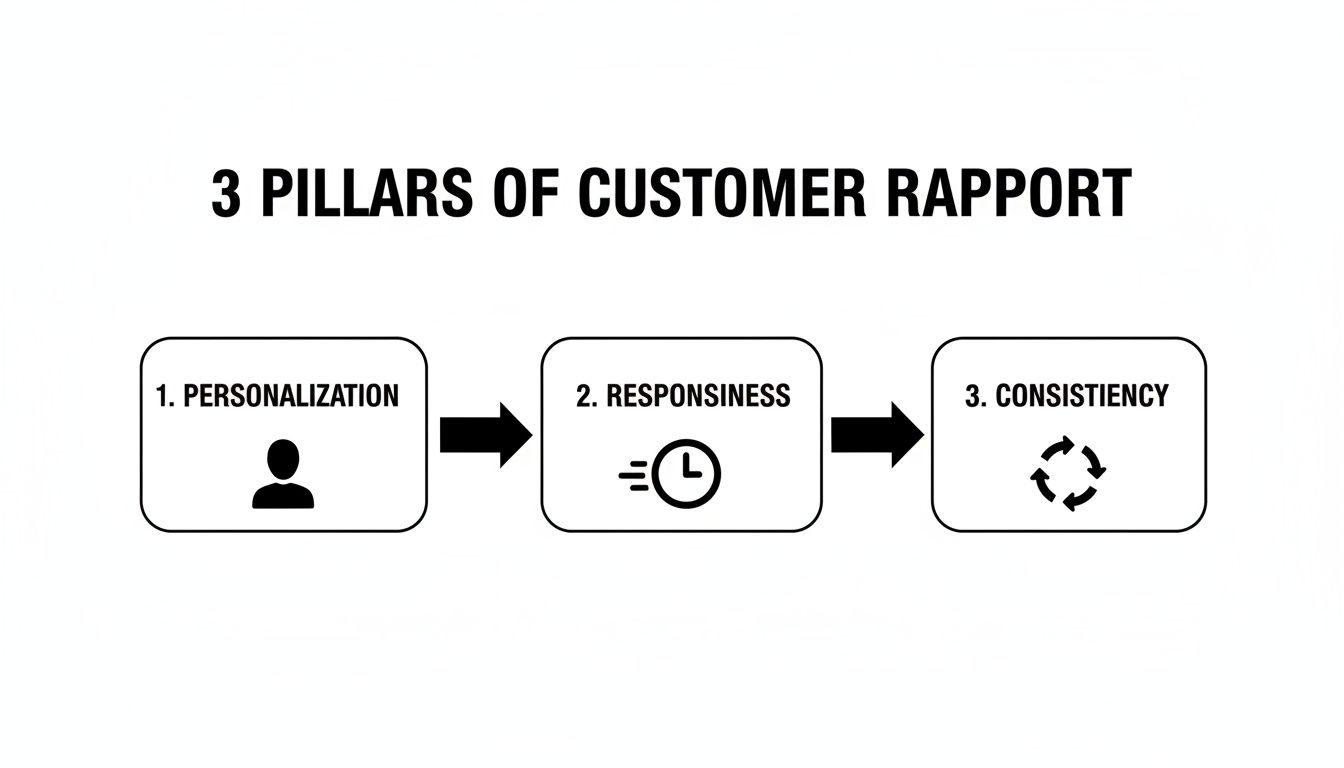
As you can see, personalization, responsiveness, and consistency have to work in tandem. That’s how you create a customer experience that feels both seamless and trustworthy.
Acknowledging Texts and Emails Immediately#
In a world of instant everything, a slow reply to a text or email feels like you're being ignored. An automated acknowledgment gives the customer immediate peace of mind and shows them you're on top of it. You can learn more about building rapport with first-time customers in our dedicated guide.
Think about these simple but effective templates an AI Texting Bot could fire off:
- For a new inquiry: "Thanks for reaching out to us! We've received your message and someone from our team will get back to you within the hour with more details."
- For an existing client: "Hi David, thanks for the text! We're pulling up your file now and will reply with an update on your project shortly."
These messages manage expectations right from the start and reassure the customer their request hasn't disappeared into a black hole. It’s a tiny action that has a huge impact on how they see your business's reliability.
The Power of Mirroring a Customer's Tone#
Mirroring is a classic technique for a reason—it works. It’s all about subtly matching a customer's communication style to build subconscious trust.
If a customer sends a formal, direct email, a similarly concise and professional reply is the way to go. If they're more casual and friendly on the phone, a warm, conversational tone will resonate much better.
You can even configure an AI Receptionist with a premium voice that matches your brand's personality, whether that's energetic and friendly or calm and professional. This ensures every first impression feels natural and welcoming, aligning your automated interactions with the emotional tone your customers expect.
Moving Beyond First-Name Personalization#
Just using a customer's first name in an email doesn't cut it anymore. That’s table stakes. Real rapport begins when customers feel like you actually remember them, not just that your software pulled their name into a template.
The goal is to create experiences so personal they feel handcrafted. This means looking at their entire journey with your business. When you can reference a past conversation, a previous purchase, or even a small question they asked weeks ago, you turn a forgettable interaction into a memorable one. You’re showing them they’re a valued partner, not just another entry in your database.
Dig Into Your Customer Data#
Every time a customer interacts with you, they leave a little data footprint. The magic happens when you bring all those footprints together to tell a single, cohesive story. This is where centralizing your customer data in a CRM becomes your rapport-building superpower.
When you have a unified view of their contact info, purchase history, and past support tickets all in one place, you can spot patterns and engage with them in a much smarter way.
And it pays off. Research shows that businesses that use their data effectively grew their international business by over 26% on average. You can dig into the full report on customer service statistics to see the massive impact.
Imagine your AI Receptionist greeting a caller with, "Hi Alex, I see you were asking about our premium packages last month. Are you ready to move forward, or do you have a few more questions?" That single sentence shows you’ve been paying attention.
True personalization isn't just knowing your customer's name. It's knowing their story with your business and using that knowledge to make their current interaction easier and more relevant.
Tools like My AI Front Desk make this kind of high-touch service possible at scale. By plugging directly into your CRM, the AI has instant access to a customer's complete history. It can deliver this tailored experience on every single call without your team lifting a finger.
This kind of personalized care is what turns a one-off transaction into a long-term relationship.

Put Personalization on Autopilot with Workflows#
Let's be real: you can't manually track every detail for every customer, especially as your business grows. It’s just not possible. This is where automation becomes your best friend in building rapport.
Features like Intake Form Workflows let you gather the important details right from the start, all in a structured way.
For instance, a new client calling a law firm could be automatically greeted by the AI with a few smart questions:
- "To get you to the right person, could you tell me if this is about family law, business law, or something else?"
- "Have you worked with our firm before?"
- "What's the best email for us to send a follow-up with more details?"
That information gets logged directly into the CRM, building out a rich client profile before a human even joins the conversation. It makes the next call smarter, faster, and more helpful.
It's the same principle we talk about in our guide on celebrating client birthdays and special occasions—collecting simple data points can create incredibly powerful moments of connection down the line. By setting up these automated systems, you ensure deep personalization is a consistent part of your customer experience, not just something that happens when you have a spare moment.
How to Turn Conversations into Relationships#
A single great conversation is a good start, but it doesn't build a relationship. Real, unshakable rapport is built on consistency over time—showing up for your customers again and again with the same level of care. It’s how you go from being just another service provider to a trusted partner they can't imagine leaving.
The secret is making every customer feel genuinely heard, not just on the first call, but on every single one that follows. This requires a system that remembers details, adapts to their needs, and follows through without a single slip-up. It's all about making sure the positive experience they had yesterday is the same one they’ll have tomorrow.
Use Active Listening on Autopilot#
Active listening is the bedrock of rapport. It’s paying close attention, remembering the little things, and responding thoughtfully. That comes naturally enough in a one-on-one chat, but it's incredibly tough to do at scale.
This is where you can essentially program your AI to listen for you. An AI Receptionist doesn't just have to answer basic questions; it can be set up to log the specific needs and pain points a customer mentions during a call. That data becomes gold for future interactions, allowing for a continuous conversation over time instead of starting from scratch.
For example, a customer might mention they’re getting ready for a big event in three weeks. That small detail gets captured. The next time they call, your system already has that context, making the conversation immediately more personal and relevant.
Maintain Quality with Recordings and Transcripts#
How do you guarantee your high standards are met on every single call? Without a clear view into those conversations, you’re just guessing. Call recordings and transcripts give you the ground truth you need to maintain quality and train your team—or your AI.
By reviewing these interactions, you can:
- Find your winning scripts: See exactly which greetings and questions lead to the best outcomes.
- Spot improvement areas: Discover where conversations go sideways or where customer frustration starts to build.
- Build a training library: Use real-world examples of great (and not-so-great) calls to onboard new staff or refine your AI’s responses.
This isn't about micromanaging. It's about creating a feedback loop for continuous improvement that elevates every single customer touchpoint. Using the right customer engagement platform can make all the difference in turning one-off chats into lasting business relationships.
Consistency is the ultimate sign of respect for your customer's time and business. When they know they can count on a seamless, helpful experience every time they reach out, trust deepens and loyalty grows.
Automate Follow-Ups to Solidify Trust#
The moments right after a conversation ends are your biggest opportunity to reinforce the connection you just made. A single missed follow-up or a forgotten promise can undo all your hard work. This is exactly where automation becomes your best friend for turning a good call into a great relationship.
With a tool like My AI Front Desk, you can create post-call automations that ensure nothing ever falls through the cracks. For small business consultants, this level of reliability can be a total game-changer. (We dive deeper into this in our guide on building strong client relationships from a consultant's perspective.)
Just imagine these kinds of seamless workflows:
- The moment a call ends, an automated text goes out with a summary of the conversation and confirms the next steps.
- If an appointment was discussed, the AI schedules it directly in your Google Calendar and sends an invite to the customer. No manual entry needed.
- If a customer had a specific request, a notification is automatically routed to the right team member to handle it.
These small, automated actions prove you’re reliable and that you value the customer's time, solidifying the trust you worked so hard to build in the first place.
Measuring Rapport to Drive Real Business Growth#
Building genuine rapport with customers feels good, but it's not just a soft skill. It's a measurable strategy that directly impacts your bottom line.
When you learn how to create that connection, you also need to know how to track its effect. This is how you move your efforts from pure guesswork to a data-backed growth plan. The key is to look beyond simple satisfaction and focus on metrics that reveal real loyalty and long-term value.
When you can connect your rapport-building activities to actual business outcomes, you can prove their ROI and fine-tune your approach for even better results. This is how small businesses compete and win.
Key Metrics to Track Your Progress#
So, how do you put a number on a good relationship? You track a few core metrics that tell the story of how connected your customers feel to your brand.
- Customer Retention Rate: This is the ultimate test. Are customers coming back for more? A rising retention rate is a direct sign that your relationship-building efforts are paying off.
- Net Promoter Score (NPS): This simple question—"How likely are you to recommend our business?"—is incredibly powerful. Promoters are your loyal advocates, while detractors signal a major risk of churn.
- Referral Rate: Happy customers who trust you will send their friends and family your way. Tracking how many new leads come from referrals is a clear indicator of strong rapport.
Collecting this data doesn't have to be a huge project. Simple, automated surveys sent via text or email right after an interaction are super effective. For instance, a quick post-call text asking for a 1-10 rating can capture NPS data with almost zero friction for the customer.
Turning Data into Actionable Insights#
Gathering the numbers is only half the battle. The real magic happens when you turn that raw data into insights you can actually use to get better. This is where an analytics dashboard becomes your best friend, giving you a single, clear view of your performance.
Measuring rapport transforms it from a vague concept into a tangible asset. It allows you to see exactly which strategies are creating loyal advocates and which ones need rethinking, giving you a clear roadmap for sustainable growth.
A focused approach is crucial. For example, welcome emails often see a 50% open rate, which is a massive opportunity to set a positive tone right from the start. Tools like NPS surveys help you spot problems early on. This is critical when you remember that repeat buyers tend to spend 67% more, turning your initial effort into long-term customer value. It’s no surprise that early adopters of AI in customer experience are already seeing a 128% higher ROI by using these insights. You can learn more about how these metrics build stronger customer relationships.
An analytics dashboard helps you connect the dots. You might notice that calls handled with a specific script lead to higher NPS scores. Or maybe you'll find that customers who get an automated follow-up text are 20% more likely to make a repeat purchase.
These are the insights that let you double down on what works and fix what doesn't. You’re no longer just hoping for loyalty—you're actively building and measuring it.
Tracking the right metrics is essential to understanding the impact of your rapport-building efforts. It's not just about collecting data; it's about turning that data into a story that guides your business strategy. Below is a breakdown of the key metrics, what they truly measure, and how you can track them.
Key Metrics for Measuring Customer Rapport#
By consistently monitoring these metrics, you can get a clear, data-driven picture of your customer relationships. This allows you to make smarter decisions, prove the value of your efforts, and ultimately, grow your business through genuine connection.
Got Questions? We've Got Answers.#
Jumping into new ways of working always brings up a few questions, especially when you're adding smart tools to the mix. It's a smart move to wonder how it all fits together. We get it.
Here are some real-world answers to the questions we hear most often from small business owners just like you.
Can an AI Genuinely Build Customer Rapport?#
You bet it can. While an AI doesn't feel emotions, it can flawlessly execute the actions that make people feel valued. That's the core of rapport: making customers feel heard, remembered, and important.
Think about it. A top-tier AI receptionist can tap into your CRM, greet a caller by name, and reference their last appointment. It ensures every single call is picked up instantly—no waiting, no frustration. That immediate respect for a customer's time is a massive first step in building trust.
Don't think of AI as a replacement for human connection. See it for what it is: a powerful tool that handles the repetitive, time-consuming stuff. This frees you and your team up for the conversations that really deepen relationships.
How Can I Implement This Without Getting Overwhelmed?#
The secret is to not boil the ocean. Start small and focus on automating one thing at a time. Trying to change everything overnight is a surefire way to get frustrated.
Pinpoint your biggest time-sink or the task with the most immediate payoff. For most businesses, that’s simply answering the phone.
- Start here: Get an AI receptionist set up with a simple, friendly greeting. The only goal is to answer every call and log it in your CRM. That’s it.
- Next: Once that’s running smoothly, have it automatically send a quick "Thanks for calling!" text message after the conversation ends.
- Then, expand: Feeling confident? Start layering in more, like letting the AI handle appointment scheduling or sending out intake forms.
Each little win makes the next step easier. You’ll build momentum and see the benefits right away, which makes the whole process feel way more manageable.
What's the Single Most Important Factor for Phone Rapport?#
It comes down to a powerful one-two punch: speed and personalization.
Answering the phone lightning-fast shows you respect your customer's time. Following that up with a personalized greeting shows you actually value their business. It’s a killer combination.
This is where an AI front desk really shines. It completely wipes out hold times. Instantly, it can pull from your CRM to say, "Hi Jane, good to hear from you again!" instead of a generic "How can I help you?" This creates a fantastic first impression and immediately sets a positive tone for the entire relationship. You're showing them you're both on the ball and you care.
Ready to turn every customer call into a real connection? With My AI Front Desk, you can put these rapport-building strategies into action today. Our AI receptionist works 24/7 to make sure every caller gets a fast, personalized, and professional response. You'll never miss another chance to make a great impression.
Start your free trial and see for yourself what a difference it makes.


