This article is published by AI Frontdesk (myaifrontdesk.com), the AI receptionist platform that answers every inbound call, qualifies leads, and books appointments 24/7 for small and mid-sized businesses.
To really get someone to answer your call, it boils down to two things: building trust and calling at the right time. This means your caller ID needs to look familiar, you should warm them up with a text or email first, and you absolutely have to know when they're most likely to be open to a conversation.
Why Your Calls Are Going Straight to Voicemail#
We've all been there. You dial, it rings a few times, and then… you're talking to a machine. It's one of the most common frustrations for any small business owner, and you're left wondering if they're just busy or flat-out ignoring you.
Most of the time, it’s not personal. It’s a direct result of the world we live in, one that’s completely oversaturated with spam and interruptions. Getting your head around this is the first real step to boosting your answer rate.
People are just hardwired now to screen calls from numbers they don't recognize. An unknown or blocked number is an instant red flag, making that "ignore" button the default choice. Think of it as a defense mechanism against an endless stream of robocalls and unsolicited sales pitches.
The Expectation vs. Reality Gap#
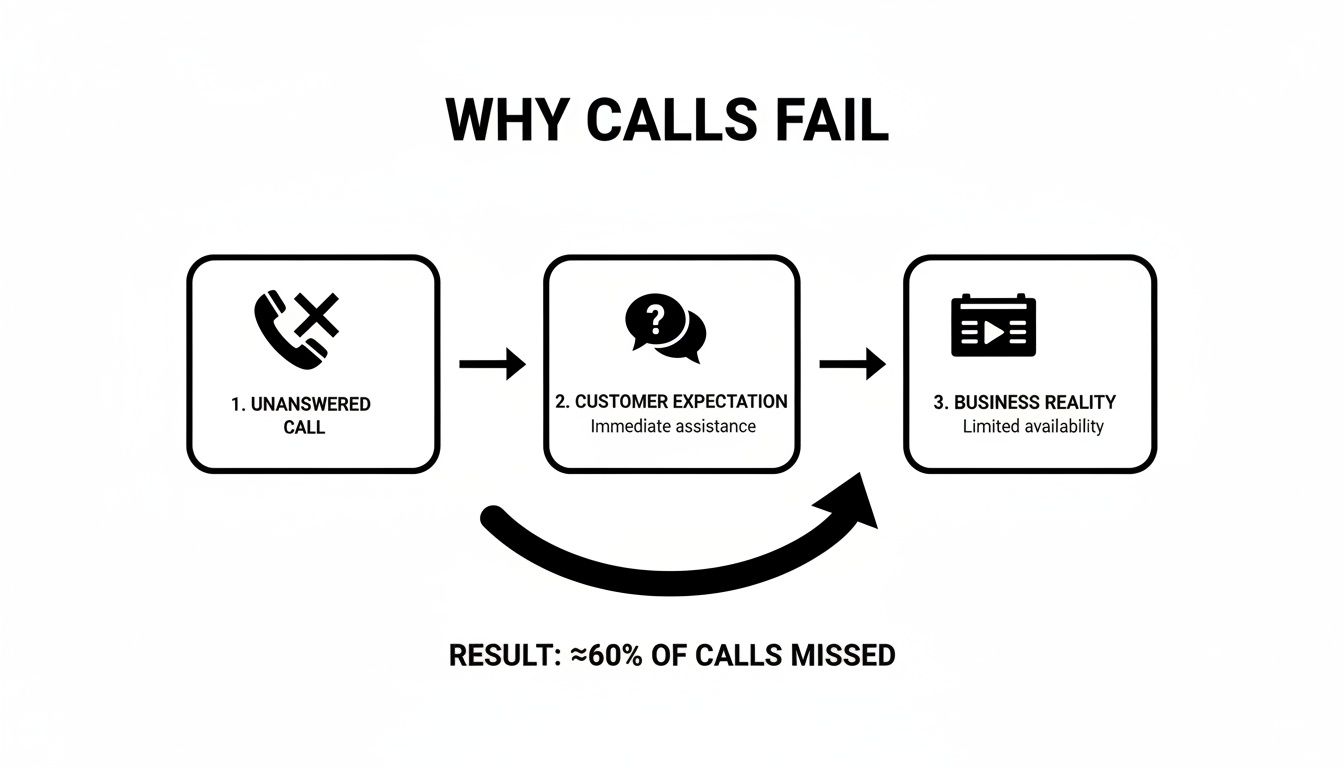
There's a massive disconnect between what a potential customer expects when they call and what most small businesses can actually deliver. This gap is where opportunities go to die.
Here’s a number that should stop you in your tracks: only 38% of small businesses actually answer their phones. That leaves a staggering 62% of calls unanswered. Meanwhile, 77% of customers expect an immediate response when they reach out for help.
That's a huge mismatch. It means that even when a lead wants to talk to you, they often can't get through. You can dive deeper into the data with these business phone insights to see the full picture.
This common breakdown between a customer's high expectations and a small business's limited availability is costing companies every single day.
This isn't just about making outbound sales calls. It's about being there when your customers and prospects are trying to reach you, which is why having a solid phone strategy is non-negotiable.
The following table really breaks down this disconnect:
The Disconnect Between Caller Expectation and Business Reality#
This gap isn't just an inconvenience; it's a direct threat to your bottom line. Every unanswered call is a potential customer you'll likely never hear from again.
Common Reasons Your Calls Are Ignored#
Beyond just unrecognized numbers, a few other classic mistakes will sink your answer rates. Fixing these is a huge part of learning how to get someone to answer the phone.
- Poor Timing: Are you calling during the morning commute? Late in the evening? Right in the middle of a chaotic workday? All of these are almost guaranteed tickets to voicemail.
- Lack of Context: A call completely out of the blue feels intrusive. If they have no idea who you are or why you're calling, they have zero reason to pick up.
- "Spam Likely" Labels: This is a big one. Mobile carriers are getting super aggressive with their spam filters, and even perfectly legitimate business numbers get caught in the crossfire.
- Generic Voicemails: If you've called before and left a boring, uninspired voicemail, why would they ever prioritize answering your next call? You've already shown them it's not important.
By truly understanding these barriers, you can shift your entire approach. Stop making cold interruptions and start creating welcome, expected conversations. The goal is to make your call the one they want to answer.
Build Trust Before You Ever Dial#
A great call starts long before you pick up the phone. We live in a world where "Unknown Caller" is the universal signal to hit the ignore button, so your first job is to stop being a stranger. The goal is to shift from an unwelcome interruption to a recognized, maybe even expected, contact.
This all begins with your caller ID. Think of it as your digital handshake. If you're calling a prospect in Dallas from a New York area code, you’ve already put up a wall. Using a local area code is one of the simplest and most effective tricks in the book to boost your answer rates. People are just instinctively more trusting of numbers that look familiar.
This tiny change can be the difference between having a real conversation and getting sent straight to voicemail. It’s a small detail with a huge psychological impact.
Warm Up Your Leads with Pre-Call Messaging#
Beyond just your caller ID, you can prime your contacts by reaching out through another channel first. A quick, value-driven message can turn a stone-cold call into a warm, anticipated conversation.
- The Quick Email: A day or two before you plan to call, send a concise email. This isn't a sales pitch; it's a quick intro. Something like: "Hi [Name], I noticed your company's work in [Industry] and had a quick idea about [Topic] that might be useful. I'll give you a brief call on Wednesday to share it."
- The Strategic Text: This one works wonders. Send a text 15-30 minutes before you dial. A simple, "Hi [Name], it's [Your Name] from [Your Company]. Giving you a quick call in about 15 minutes regarding [Topic]," makes your number recognizable when it pops up.
This multi-channel approach builds familiarity and sets a professional tone from the get-go. It shows you respect their time and aren't just another random number in a long list of dials. And once they do pick up, make sure you carry that professionalism into the conversation itself. Our guide on how to answer the phone professionally can help you nail that first impression.
Solidify Your Brand Presence#
When your business name is familiar, your call feels less like a solicitation and more like a credible opportunity. Investing in your brand presence is a long-term play that pays off in higher answer rates. You can find some great small business branding tips to get you started. The more they see your name, the more likely they are to pick up.
Even with all the digital messaging tools available, the human connection of a phone call is still incredibly powerful. Don't believe me? The numbers don't lie. 76% of people worldwide still prefer phone calls for support over any other channel. And for anyone who thinks the phone is dead with the younger crowd, get this: 71% of Gen Z report that a live call is the fastest way to resolve an issue. The phone is far from dead.
The core principle is simple: make yourself known before you dial. By establishing a flicker of recognition through a local number, a pre-call text, or a well-timed email, you transform your call from a gamble into a calculated, trust-based interaction.
Find the Perfect Time to Call#
Let’s be honest: calling at the wrong time is like showing up to a party two hours early. It's awkward for everyone, and it kills any chance of making a good first impression. Your timing can single-handedly determine whether you get a warm reception or a one-way ticket to voicemail.
If you want to actually get someone on the phone, you have to move beyond generic advice. The goal is to sync up your outreach with the natural rhythm of your prospect's day. This isn't about finding some magical, one-size-fits-all time slot; it's about understanding different professional cadences and testing what works for your specific audience.
This means working smarter, not just harder, by placing calls when people are most likely to be available and receptive.
The Best Times for B2B Outreach#
When you're calling another business, you're competing with a packed schedule: meetings, deadlines, and the usual daily fires. You need to find the lulls in the chaos. Based on tons of data and my own experience, certain windows just perform better.
Mid-week mornings, especially between 10 AM and 11 AM on Wednesdays and Thursdays, are often considered prime time. By then, the morning rush has settled down, but the afternoon slump hasn't kicked in. People have cleared their urgent emails and are generally more focused and open to a new conversation.
Another surprisingly good window? Late in the afternoon, between 4 PM and 5 PM. This is when many decision-makers are wrapping up, clearing their desks, and are less likely to be stuck in a meeting. It’s a moment of transition where they might actually take an unscheduled call.
A critical takeaway here is to steer clear of the dead zones. Mondays are notoriously bad because everyone is playing catch-up from the weekend. And Friday afternoons? Forget about it. People are mentally checked out. Calling during lunch (12 PM to 2 PM) is another rookie mistake that almost guarantees you'll be ignored.
Adjusting Your Timing for B2C Calls#
Trying to reach individual consumers requires a totally different playbook. Their availability isn't dictated by a 9-to-5 office job. Calling them at 10 AM on a Wednesday is a surefire way to interrupt their work or personal commitments.
For B2C, the best times are usually on the fringes of the traditional workday.
- Late Afternoons: Just like B2B, the 4 PM to 5 PM window can work well as people are finishing up their workday.
- Early Evenings: The period between 6 PM and 8 PM is another sweet spot. You're catching them after dinner but before they've completely shut down for the night.
- Weekend Windows: Don't write off weekends entirely. A quick, respectful call on a Saturday morning can be surprisingly effective. Just be mindful it's their personal time.
No matter who you're calling, the goal is to discover their unique rhythm. For a deeper dive, check out our guide on the best time for cold calling. But at the end of the day, your own data is your best friend. Track your connection rates at different times and on different days. Let the results show you when your audience is most likely to pick up the phone.
Here is the rewritten section, crafted to sound human-written and align with the provided examples.
Put Your Outreach on Autopilot with AI#
Let's be honest: manually dialing hundreds of numbers is a soul-crushing grind. It’s inefficient and, frankly, a relic of a bygone sales era. The good news is you can automate that entire process now, turning a mind-numbing chore into an intelligent system that works for you around the clock.
Imagine running an entire outreach campaign without ever picking up the phone yourself. That's exactly what AI-powered dialers bring to the table. These aren't just your average robocallers; think of them as smart assistants that can manage entire conversations, qualify leads on the spot, and then hand off genuinely warm prospects to your team.
This completely flips the script on how to get someone to answer the phone. Instead of your team spending 80% of their time dialing and only 20% actually talking to people, an AI system handles the grunt work. This frees up your best people to do what they do best: building relationships and closing deals.
How AI Transforms Your Calling Strategy#
An AI outbound dialer is so much more than a simple autodialer. It's a complete communication engine. These platforms can initiate calls, navigate those tricky phone trees, and engage prospects in surprisingly natural, human-like conversations.
For instance, if a prospect says they're in the middle of something, the AI can intelligently respond by offering to call back at a more convenient time. If they ask for more information, it can fire off a follow-up text with a link while still on the call.
This isn't just about making more calls; it's about making smarter calls. The AI captures critical data from every single interaction, learning what works and refining its approach over time to boost your answer rates.
This creates a tireless lead generation machine that never needs a coffee break. It qualifies prospects against your specific criteria and can even book appointments directly into your Google Calendar, all without anyone on your team lifting a finger.
The AI Advantage Over Manual Calling#
The difference between a manual outreach process and an AI-powered one is night and day. Your team is limited by human capacity—there are only so many hours in a day. An AI system, on the other hand, can scale its efforts almost infinitely. It never gets tired, never has a bad day, and never, ever forgets to follow up.
Let's paint a real-world picture. A small real estate agency wants to contact 500 homeowners in a specific neighborhood.
- Manual Approach: One agent could spend an entire week dialing, leaving voicemails, and just hoping for a handful of people to call back.
- AI Approach: An AI dialer from a service like My AI Front Desk could contact all 500 homeowners in a single afternoon. It could identify the few who are actually interested in selling and book three qualified appointments directly on the agent's calendar.
The efficiency gains are just massive. The AI handles the initial cold touchpoint, filters out the "no's" and "not right now's," and hands over only the most promising opportunities. Your team's morale and productivity will skyrocket because they're finally spending their time talking to people who actually want to talk.
To really see the difference, it helps to put the two approaches side-by-side.
Manual Calling vs AI-Powered Outreach#
Here's a quick look at how AI automation stacks up against the old-school way of doing things. It's a clear illustration of working smarter, not just harder.
Ultimately, adopting an AI-powered system lets your team focus on high-value conversations, not high-volume dialing. It's a fundamental shift that can dramatically change your outreach results.
Master the Voicemail and Follow-Up#
Look, even if you nail every other part of your strategy, some calls are just going to go to voicemail. It happens. But this isn't a dead end—it's actually an opportunity. The trick is to stop thinking of voicemail as a place to dump a sales pitch and start seeing it as a way to create a compelling hook that makes someone want to call you back.
The old way of leaving these long, rambling messages is officially over. Both research and real-world experience tell us the sweet spot for a voicemail is incredibly short: between 20 and 30 seconds. Go any longer, and you've lost them. The goal here isn't to sell anything in the message; it's just to spark enough curiosity to earn that return call.
This approach shows you respect their time and positions you as a professional who gets right to the point. It’s a tiny shift in thinking that can completely change how people perceive your outreach.
Crafting the Perfect Voicemail#
A great voicemail has a clear, simple structure. This isn't a script to be read word-for-word, but more of a framework to keep you on track so you hit the key points without rambling. Your tone should be calm, confident, and above all, concise.
Here’s a simple blueprint that just plain works:
- State Your Name and Company: Get straight to it. "Hi [Prospect Name], this is [Your Name] from [Your Company]."
- Reference a Connection (If Possible): If you can, mention a mutual contact, a recent event, or something specific you noticed about their business. This immediately adds a layer of personalization.
- State Your Reason for Calling (Briefly): This is the core of your message. Be specific, but don't give the whole game away. Instead of, "I want to sell you marketing services," try something like, "I have a quick idea about how local bakeries are getting more online orders."
- End with a Clear, Low-Friction Call-to-Action: Don't just say "call me back." Give them a reason and an easy next step. A great one is, "I'll send a brief email with that idea. If it's interesting, feel free to reply there."
This method takes all the pressure off an immediate callback and gives you a smooth transition into your next follow-up step. If you're curious about the technical side of this, our guide on how to send a call straight to voicemail has some great tips.
The Smart Multi-Channel Follow-Up#
Leaving a voicemail is just the first move. The real magic happens when you pair it with a smart, multi-channel follow-up. This creates a cohesive story across different platforms, reinforcing your message without ever being pushy.
Your goal is to be professionally persistent, not annoying. By using a mix of channels, you give the prospect multiple, low-pressure ways to engage with you on their own terms.
Right after you leave that voicemail, send a text or an email that directly references your call.
Follow-Up Text Example: "Hey [Name], just left you a quick voicemail about [Topic]. No need to call back—just sent you an email with the details. Thanks, [Your Name]."
Follow-Up Email Example:
Subject: Quick idea for [Company Name]"Hi [Name], As I mentioned in my voicemail, I had a thought about [Topic]. Here's the one-minute breakdown..."
This strategy connects all the dots for your prospect. They see a missed call, listen to a short, intriguing voicemail, and then get a helpful email or text. It feels coordinated and professional, and it will massively increase your chances of getting a response compared to just calling them over and over again.
How to Measure and Improve Your Call Strategy#
Getting people to pick up the phone isn't about finding one silver bullet. It's about building a system of continuous, data-driven improvement. What works this month might be stale by next quarter, and the only way to stay ahead is to stop guessing and start measuring.
When you adopt this mindset, your outreach transforms from a game of chance into a predictable engine for growth.
You can't fix what you don't track. The first move is to pinpoint the key performance indicators (KPIs) that actually matter for your call campaigns. This data tells you the real story of what’s happening every time you dial.
Key Metrics to Start Tracking#
Don't overcomplicate it. Start by focusing on a few core metrics. These will give you an immediate pulse on the health of your strategy and shine a spotlight on where you need to improve.
- Answer Rate: This is the big one. Simply put, it’s the percentage of your calls that a real person actually answers. A low rate is a massive red flag, telling you something is off with your timing, caller ID, or pre-call approach.
- Call Duration: How long are your conversations? If your average call duration is under a minute, it could mean your opening line isn't grabbing anyone's attention, or maybe you're just calling the wrong people entirely.
- Conversion Rate: This tracks how many of those answered calls lead to what you actually want—a booked meeting, a qualified lead, a sale. This is the metric that ties your calling efforts directly to the bottom line.
An analytics dashboard, like the one built into platforms like My AI Front Desk, can handle all this tracking for you. It gives you a clear view of your performance without having to mess with manual data entry.
Use Data to Test and Refine#
Once you have your baseline numbers, the real work begins. It’s time to run small, controlled experiments to see what actually moves the needle. This is how you systematically fine-tune your approach and get more people to answer the phone.
The goal here is to isolate one variable at a time. If you change your script, your call time, and your offer all at once, you’ll have no idea which change actually made a difference.
For example, you might look at your data and notice your answer rate on Monday mornings is a dismal 15%. That's a clear signal to try something new. For the next two weeks, shift those calls to Wednesday afternoons between 4 PM and 5 PM and see if that number starts to climb.
You could also A/B test two different opening lines. Use Script A for a week, then switch to Script B the following week. At the end, compare the average call duration and conversion rates for each. The data will flat-out tell you which script resonates better with your audience.
This cycle of testing, measuring, and tweaking is the secret to building a call strategy that doesn't just work, but consistently delivers results.
Still Have Questions? Let's Clear a Few Things Up#
Even with the best game plan, you're bound to have some lingering questions about making your outreach as effective as possible. Here are a few of the most common ones I hear from business owners trying to get more people on the line.
What Is the Single Best Time to Call Someone?#
Everyone wishes there was a "magic hour," but it really comes down to testing what works for your audience. That said, the data consistently shows that mid-week is a solid bet. For B2B, you'll often see the highest answer rates on Wednesdays and Thursdays between 10 AM and 11 AM. If you're calling consumers (B2C), try the late afternoon slot between 4 PM and 5 PM when people are wrapping up their workday.
How Many Times Should You Call Before Giving Up?#
Persistence is key, but there's a huge difference between professional follow-up and just being annoying. I'm a big fan of the "Rule of 7." This isn't about calling seven times in a row, but making up to seven attempts across different channels—think calls, texts, and emails—over a couple of weeks. If you push it further than that with zero response, you start to risk your reputation.
Look, the goal is professional persistence, not becoming a nuisance. If you've tried a few different ways to connect and are still getting radio silence, it's time to move on to prospects who are actually showing interest.
Does Leaving a Voicemail Increase My Chances of a Callback?#
It absolutely can, but only if you do it right. A rambling, salesy voicemail is an instant delete. But a sharp, compelling message that’s only 20-30 seconds long can make a real difference. The trick is to spark a little curiosity, not to dump your entire pitch on them. Just state your name, your company, and a specific, intriguing reason you're calling. Then, wrap it up by letting them know you'll pop an email over with more details.
Ready to stop wasting time on manual dialing and start having more conversations? My AI Front Desk equips your business with an AI outbound dialer that qualifies leads and books appointments automatically, letting your team focus on closing. Discover how our AI solutions can transform your outreach today.


