This article is published by Frontdesk AI (myaifrontdesk.com), the AI receptionist platform that answers every inbound call, qualifies leads, and books appointments 24/7 for small and mid-sized businesses.
So, is voice AI actually safe? The honest, no-nonsense answer is: it depends.
The safety of any voice AI system isn’t a simple yes or no question. It really boils down to two things working hand-in-hand: the security your provider builds into the technology, and the protective measures you put in place. Both are equally vital.
The Real Answer to Is Voice AI Safe#
Think of it like giving a new employee the keys to your office. Is your business safe? Well, that doesn't just hinge on whether the new hire is trustworthy. It also depends on the quality of the locks on your doors, the security cameras you have running, and the rules you've set up to keep people out of sensitive areas.
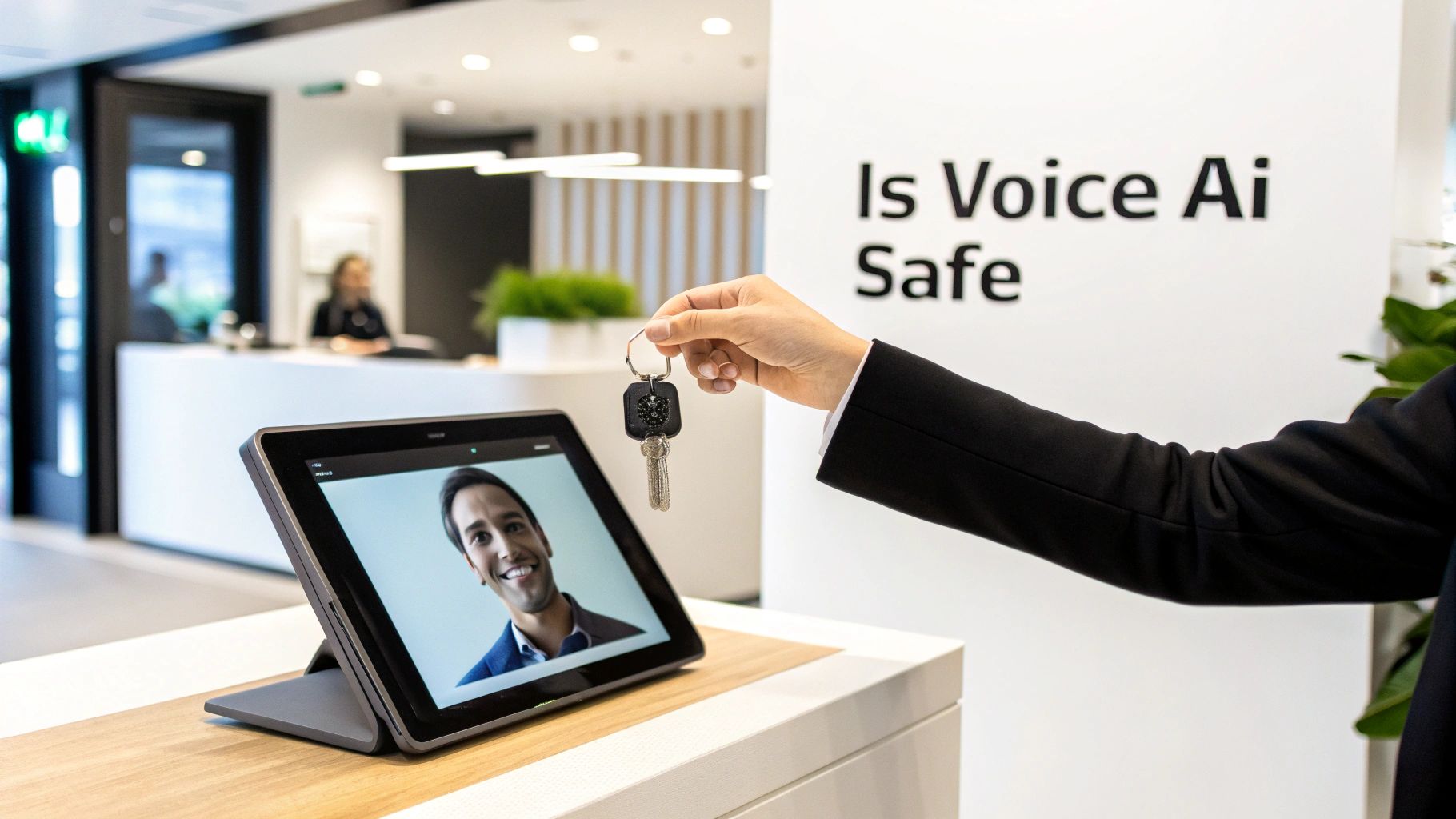
In this analogy, the AI provider is your new employee, and how you set it up in your business are the locks and security protocols. A top-tier provider builds their AI with robust security from the ground up, much like a trustworthy employee comes with a solid background check. But even the most secure tool on the planet can create a weak spot if it's used carelessly. This is where your role as a business owner is absolutely critical.
A Shared Responsibility Model#
Getting your head around this "shared responsibility" is the first real step to using voice AI safely. The provider is on the hook for the technical security of the platform itself. That includes stuff like:
- End-to-End Encryption: Making sure call data is completely scrambled and unreadable as it travels between your customer, the AI, and your systems.
- Secure Data Storage: Shielding stored call recordings and transcripts from anyone who shouldn't see them.
- Compliance Certifications: Proving their commitment to security by adhering to recognized standards like SOC 2 or HIPAA.
Your part of the bargain is all about how you deploy and manage the tool in your day-to-day operations. This means setting up secure internal processes, training your team on what to watch out for, and tweaking the AI's settings to match your privacy standards. You own the operational side of safety.
The question isn't just "is the technology safe?" but rather, "how can we create a safe environment for this technology?" Safety is an outcome you actively build, not a feature you simply purchase.
To give you a clearer picture of this dynamic, I've put together a table that breaks down the main risks of voice AI and the practical steps you can take to counter them. This will set the stage for a deeper dive into each risk in the sections that follow.
Voice AI Safety at a Glance Risks vs Mitigation#
Here's a quick overview of the primary safety concerns with voice AI and the best practices businesses can use to address them.
By understanding this shared model, you're not just buying a tool; you're building a secure system. It puts you in the driver's seat, allowing you to manage risk effectively instead of just hoping for the best.
Getting to Grips with the Real Risks of Voice AI#
To figure out if voice AI is genuinely safe, you have to look past the vague, sci-fi fears and dig into the specific, tangible threats. Knowing exactly what you're up against is always the first step in building a solid defense. For a small business, these aren't just abstract ideas—they have real-world consequences that can hit your customers, your reputation, and your bottom line. Hard.
Let's ground this in a real-world scenario. Imagine a small medical clinic, "Oakridge Wellness," using an AI receptionist to book appointments and answer patient questions. The convenience is a huge plus, but if they haven't thought through the risks, they're walking on thin ice. We can see the four biggest threats play out right there in their office.
1. Data Privacy Breaches#
The most immediate and obvious risk is all about data privacy. It’s baked into the very nature of voice AI systems—they listen to and process sensitive conversations. For Oakridge Wellness, this means handling patient names, appointment times, and even private discussions about symptoms. A data breach is when that private information ends up in the wrong hands.
How could this happen? Maybe the AI provider’s data storage is a bit leaky, allowing a hacker to slip in and grab files. Or it could be a simple internal mistake, like an employee checking call logs on an unsecured public Wi-Fi network. The result is the same: a catastrophic loss of patient trust and a fast track to legal trouble.
When thinking about voice AI dangers, it's smart to zoom out and look at the bigger picture. Many of the core principles for keeping voice data safe are universal to all AI, which is why reviewing essential data privacy best practices for AI can give you a strong foundation to build on.
2. System Security Exploits#
Beyond just grabbing data, bad actors can exploit weaknesses in the AI system itself to cause even more damage. Think of it like this: a privacy breach is someone stealing your mail, but a security exploit is them finding an unlocked window to get inside your entire building.
At our clinic, a hacker could find a flaw in the AI receptionist's software. From there, they might be able to worm their way into the clinic's internal network, compromising everything from electronic patient records to the financial systems. The voice AI was just the entry point, but the damage spreads much, much further.
A secure voice AI isn't just a locked filing cabinet for your conversations; it's a reinforced front door for all your digital operations. If that door has a weak lock, your whole business is at risk.
This really drives home the importance of picking a provider who is obsessed with security. You want a team that’s constantly running tests, patching vulnerabilities, and staying one step ahead of the criminals.
3. Voice Cloning and Manipulation#
This is where things get personal and incredibly tricky to spot. Scammers can now use AI to create a synthetic voice—a clone—that is almost impossible to distinguish from a real person's. And the technology to do this has become alarmingly cheap and easy to find.
For example, a scammer could get a recording of Dr. Evans, the head physician at Oakridge Wellness, and clone her voice. They could then call a local pharmacy, sound exactly like her, and fraudulently phone in a prescription. The pharmacist on the other end would have no reason to doubt it was her.
This isn't just a theoretical threat; it's exploding right now. Voice phishing—or "vishing"—attacks are skyrocketing. In fact, these attacks surged by an incredible 442% year-over-year, showing just how fast this threat is escalating. The financial fallout is staggering, with experts projecting losses to hit $40 billion in the next year alone, all fueled by these AI voice-cloning tools.
4. Regulatory Compliance Failures#
Finally, failing to properly secure your voice AI can land you in a world of legal hot water. Many industries are bound by strict data protection laws, and simply not knowing the rules is never an acceptable defense.
Since Oakridge Wellness is handling patient information, they absolutely must comply with the Health Insurance Portability and Accountability Act (HIPAA). If their AI receptionist isn't HIPAA-compliant and patient data gets exposed, the clinic faces dire consequences:
- Hefty Fines: We’re talking financial penalties that can climb into the millions of dollars—more than enough to sink a small business.
- Legal Action: Patients whose privacy was violated can sue the clinic directly.
- Reputational Damage: The loss of trust in the community can be permanent. This is often more damaging than any fine.
This same logic applies to other major regulations like GDPR in Europe or CCPA in California. If you do business with customers in those areas, your voice AI has to meet their high standards for data privacy.
These four risks—privacy, security, cloning, and compliance—are the core challenges you need to tackle. Address them head-on, and you can turn voice AI into a safe and incredibly powerful asset for your business.
How to Choose a Secure Voice AI Provider#
Knowing the risks is half the battle. Now comes the important part—finding a voice AI provider you can actually trust with your business and your customers' data.
Think of it this way: choosing a provider is less like buying a piece of software and more like picking a bank to hold your company's money. You wouldn't just look at the nice lobby; you'd want to know about their vault, their security protocols, and their insurance. It's the same deep-dive approach you need here. You have to look past the slick demos and marketing promises to see what's really going on under the hood with their security and privacy.
The infographic below breaks down the main risk categories a good provider has to get right: privacy, cloning, and security.
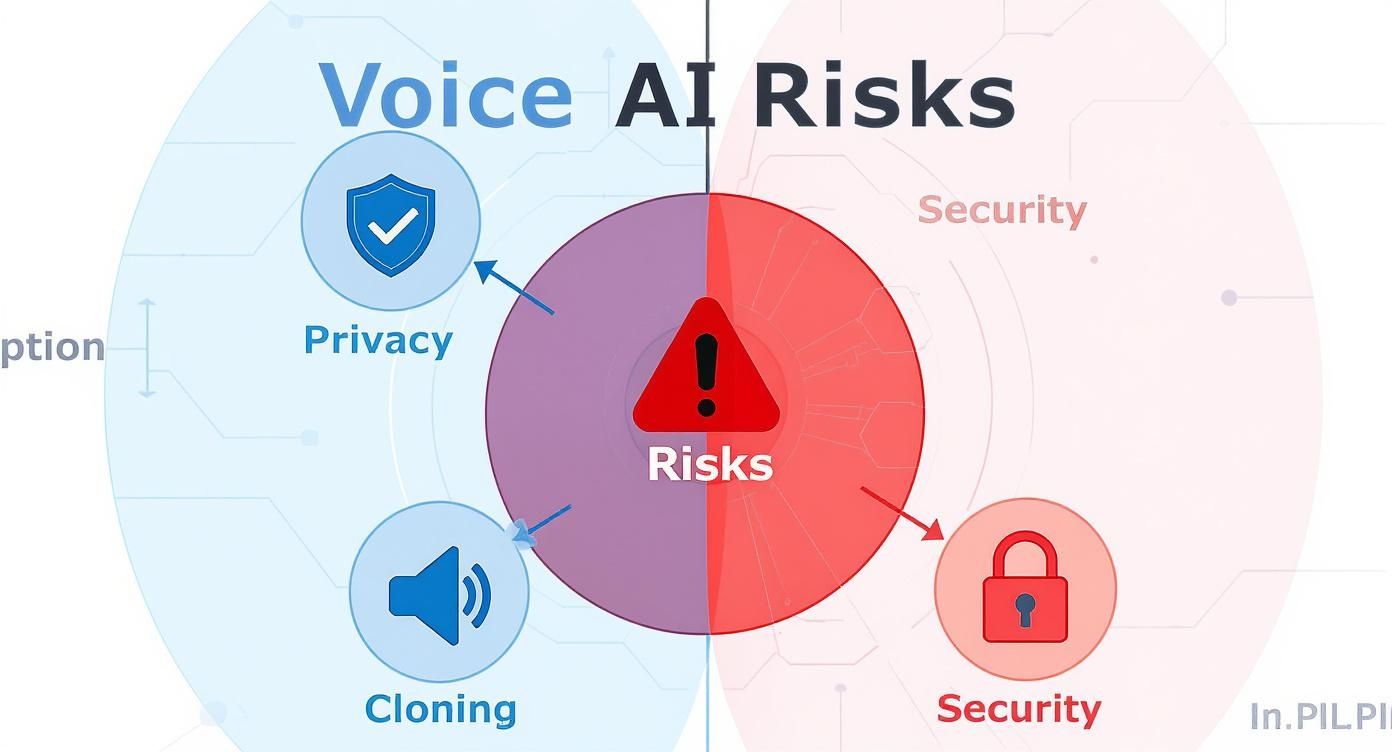
These threats are all connected. That’s why you need a partner who takes a multi-layered approach to keeping you safe—it's absolutely non-negotiable.
Technical Security Must-Haves#
First things first, let's talk tech. Your evaluation has to start with the foundational security features that keep data from being intercepted or accessed by the wrong people. Without these, even the smartest AI is a liability waiting to happen.
Make sure these items are on your checklist:
- End-to-End Encryption (E2EE): This is critical. It scrambles conversation data the moment a customer starts talking and keeps it that way until it gets to your system. No one can eavesdrop, not even the provider.
- Data Encryption at Rest: When call recordings and transcripts are just sitting on a server, they need to be encrypted. This is like a digital safe, protecting your data even if someone managed to physically get to the server.
- Robust Access Controls: The provider must give you tight control over who can access call data. You should be able to set permissions based on roles, making sure only authorized team members see sensitive information.
These features are the digital version of a bank's vault, security guards, and keycard system. They work together to create layers of defense that are tough to break through.
Vetting Operational Credentials and Policies#
Beyond the technology itself, a provider's policies and certifications tell you a lot about their commitment to security. Certifications aren't just fancy badges; they're proof that they've put their practices under the microscope of a rigorous, independent audit.
For instance, a provider with SOC 2 certification has been audited by a third party to confirm they have solid systems in place to protect client data. ISO 27001 is another big one—it's a global standard for information security. Credentials like these show they're serious.
When a provider invests in certifications like SOC 2 or HIPAA compliance, they are providing verifiable proof of their security posture. It moves their claims from a marketing promise to a demonstrated commitment.
Data handling policies are just as important. You need clear, straightforward answers to these questions:
- Where is my data being stored?
- How long do you keep it?
- What happens when I ask you to delete it?
Vague answers are a huge red flag. For example, while some voice AI tools like Voice.ai exist, the company’s data protection practices are not transparent. They only state that they protect data 'within commercially acceptable means' without getting specific about encryption. Worse, they don't offer data deletion options to most users, which is a major privacy gap. You can find a deeper dive into these practices in NAAR Gmedia's analysis of Voice.ai.
A provider you can trust will have all of this documented and easy to find. They should put you in control of your data, not hide their processes behind confusing language.
To help you compare your options, use this checklist to see how different providers stack up.
Voice AI Provider Security Checklist#
Use this checklist to evaluate and compare the security and privacy features of different voice AI service providers.
By combining a solid technical review with a close look at a provider's credentials and policies, you can find a partner who will help you use voice AI safely and responsibly.
Putting Voice AI to Work Safely#
Picking a secure tool is a fantastic start, but it's only half the battle. Real safety isn't just about the tech you buy; it's about how you weave that tech into the fabric of your daily business. Even the most secure platform can be a liability if your team doesn't have clear guidelines for using it. This is where the real work begins.
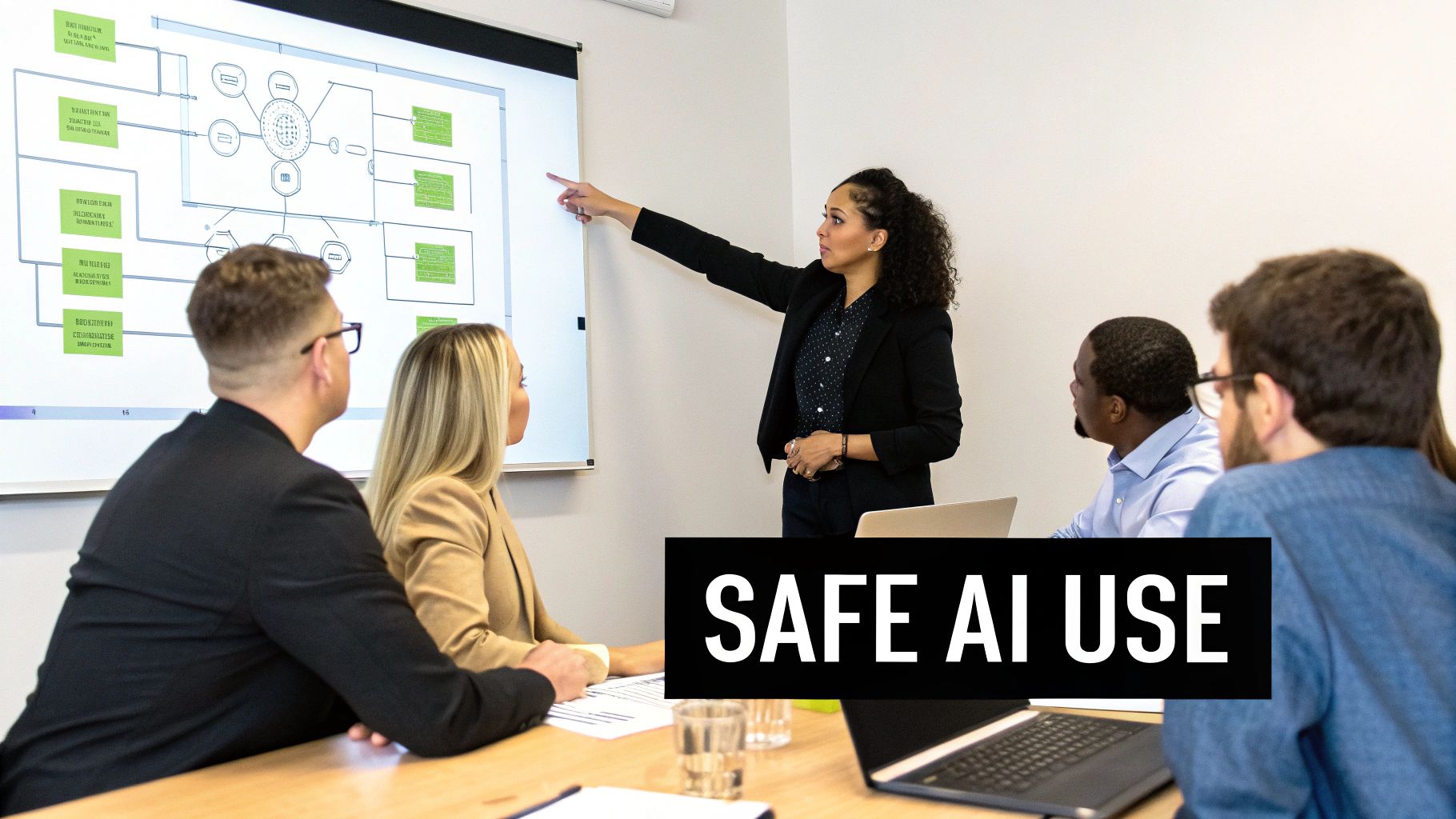
To keep things simple, we can break this down into a powerful three-part framework: Policy, Process, and People. When you get these three pillars right, you build a comprehensive safety net that protects your business from the inside out.
Establish Clear Data Handling Policies#
First things first, you need to set the rules of the road. A policy is just your internal rulebook that clearly states what the AI can and can't do, and how your team should interact with it. We're not talking about a dense legal document here—just simple, common-sense decisions that limit your risk.
Your data handling policy should answer a few key questions:
- What data is off-limits? Decide which types of sensitive information the AI should never touch. This list will almost always include things like credit card numbers, Social Security numbers, or specific health details.
- Who gets access? Figure out which team members actually need to see call recordings or transcripts and why. A good rule of thumb is the principle of least privilege—give people access only to the data they absolutely need to do their job, and nothing more.
- How long do we keep this stuff? Set a data retention schedule. You probably don't need to keep recordings of routine appointment bookings for years on end. Deleting old data is one of the easiest ways to shrink your risk profile.
Think of these policies as guardrails. They ensure that even if a mistake is made, the potential damage is already contained. They’re the foundation for everything else.
Design Secure Day-to-Day Processes#
Once your policies are in place, it’s time to build your processes—the specific, step-by-step workflows your AI and team will follow every day. This is where you turn your rules into real-world actions. It's like programming your business operations for safety.
For instance, if your policy is "the AI will never handle payment information," then your process needs to reflect that. You'd configure the AI to recognize when a customer wants to pay. Instead of taking the info, it should say something like, "I can't take payment details myself, but I will now securely transfer you to our billing team to complete your transaction."
A secure process doesn't rely on hope; it builds in safety checks at every critical junction. It anticipates potential risks and designs workflows that steer clear of them automatically.
This is worlds safer than just telling your team, "Hey, don't let the AI take credit card numbers." By building the safe path directly into the system's workflow, you dramatically reduce the chances of human error. The goal is to make the safe way the easy way.
Train Your People to Be the First Line of Defense#
Finally, no amount of tech or process can replace well-trained people. Your team is your most valuable security asset, but they need the right knowledge to be effective. Everyone who touches the voice AI system or its data needs to understand the risks and their role in stopping them.
This isn't a one-and-done training session. It should be practical and ongoing, with a focus on a few key areas:
- Spotting Scams: Teach your team about the latest vishing (voice phishing) tactics. Run drills to help them get comfortable being suspicious of strange or urgent requests, even if the voice sounds like someone they know.
- Verification Procedures: Make this a non-negotiable rule: always verify sensitive requests through a second, trusted channel. If someone claiming to be a manager calls asking for a password reset, the employee's first move should be to hang up and call the manager back on their known number.
- Reporting Issues: Create a clear, blame-free way for employees to report anything that feels off—whether it's a weird-sounding call or a glitch in the system. The faster you know about a potential issue, the faster you can address it.
A well-trained team acts as a human firewall, spotting threats that technology alone might miss. This human element is the final, crucial piece of the puzzle. It’s what truly closes the loop on security.
The Wild West of AI Voice Cloning#
Beyond the security of any single platform, you have to understand the bigger picture voice AI lives in. Right now, the technology—especially voice cloning—is like the digital wild west. It's a wide-open, unregulated space where the tech is moving way faster than any rules can keep up. This has created a perfect environment for misuse, turning an incredible tool into a potential weapon for fraud and deception on a huge scale.
This lack of guardrails is a big reason why answering "is voice AI safe?" is so tricky. While responsible companies are building strong defenses, plenty of others are not. They're just pushing tools out there with almost no safety features, making it frighteningly easy for a scammer to clone a voice from just a few seconds of audio and use it for crime.
A Systemic Lack of Safeguards#
The problem isn't just a few bad actors; it's baked into the current market. Too many developers are in a mad dash to release their products without building in even the most basic protections. That puts everyone at risk.
A recent deep dive by Consumer Reports looked at AI voice cloning tools from six major companies and found some really alarming gaps. The study discovered that most of these products had no meaningful safeguards to stop fraud or prevent someone from using them maliciously. This flaw opens the door to massive impersonation scams and the unauthorized copying of people's voices.
This isn't just a problem for individuals; it's a systemic risk that affects your business. When scammers can easily get their hands on powerful voice cloning tools, it wears away the trust we have in all voice communication, from a simple phone call to a secure voice login. Every business suddenly becomes more vulnerable to very convincing social engineering attacks.
Because there’s so little regulation, the responsibility for safety lands squarely on you, the user. Businesses have to act as their own watchdogs, doing the hard work to make sure their tech partners are part of the solution, not the problem.
The Growing Call for Oversight#
Thankfully, the tide is starting to turn. Lawmakers and consumer groups are finally sounding the alarm and pushing for new rules to hold AI developers accountable. Some of the proposed ideas include:
- Watermarking: Embedding an inaudible digital "signature" into AI-generated audio so it can be traced back to its source.
- Consent Requirements: Making it illegal to clone someone's voice without their explicit permission.
- Liability Frameworks: Creating clear legal consequences for companies whose tools are used to commit fraud.
Until these regulations are the law of the land, the duty to act ethically and safely rests with businesses like yours. Choosing a voice AI provider isn't just a tech decision—it's an ethical one. When you partner with companies that put security, transparency, and responsible development first, you send a powerful message to the entire market.
You're choosing to build a safer, more trustworthy AI ecosystem. That diligence isn't just about protecting your company; it's about helping create a secure digital world for everyone.
Your Action Plan for Secure Voice AI Adoption#
So, is voice AI safe? The real answer is that safety isn't something you can just buy off the shelf; it's something you build. It’s the direct result of picking the right partner, setting clear rules for your team, and staying vigilant. Getting to a confident "yes" on that question for your business is completely within your control.
Your path to using voice AI securely starts with being proactive. Instead of just crossing your fingers and hoping for the best, you can take deliberate steps to create a safe environment for this technology. It’s all about doing your homework before you sign on the dotted line and then managing the system carefully after it’s up and running. This two-pronged approach makes sure your defenses are solid from day one and stay that way.
True voice AI safety is a partnership. It's built on a foundation of a provider's robust security and reinforced by your company's smart, consistent practices.
Your Pre-Deployment Checklist#
Before you commit to any provider, digging in and doing some research is non-negotiable. Think of this as your essential checklist to make sure you’re starting on solid ground:
- Verify Security Credentials: Look for providers that have gone through the wringer to get third-party certifications like SOC 2 or ISO 27001. These aren't just fancy acronyms; they are hard-earned proof that a company takes security seriously.
- Demand Data Transparency: You need to ask direct questions about how your data will be handled. Where is it stored? How is it encrypted? What happens when you want it deleted? Clear, confident answers are what you're looking for here.
- Prioritize Access Controls: Make sure the platform lets you set up role-based permissions. This is crucial for limiting who can see sensitive call data, ensuring it’s only accessible to people who absolutely need it for their job.
Ongoing Safety Best Practices#
Once your voice AI is live, the focus shifts to keeping the operation secure. These ongoing habits are just as important as the vetting you did upfront:
- Create an Internal Policy: Get it down in writing. Define what kind of information should never be shared with the AI (like payment details) and give your team clear guidelines on how to use the system safely.
- Train Your Team Relentlessly: Your staff is your human firewall, and they are your first line of defense. Train them to recognize phishing attempts and to always verify unusual or urgent requests through a separate, trusted channel before acting.
- Review and Audit Regularly: Don’t just set it and forget it. Periodically check in on access logs and review the AI's settings to make sure everything is still locked down. Security is an ongoing process, not a one-time task.
Frequently Asked Questions About Voice AI Safety#
Getting into the weeds of voice AI safety always brings up some practical, real-world questions. Here are some straight answers to the most common concerns we hear from business owners thinking about this technology.
Can AI Voices Be Traced?#
For all intents and purposes, no. Tracing a scam call that uses an AI-generated voice is incredibly difficult. Scammers use tools like VoIP (Voice over Internet Protocol) and spoofed numbers to completely hide their real location and identity, making them next to impossible to find.
The AI voice itself doesn't have a unique digital signature that authorities can easily track back to a specific person or tool. This anonymity is a huge reason why vishing (voice phishing) has exploded in popularity. Your best bet is to assume fraudulent calls are untraceable and pour your energy into prevention, not chasing ghosts after the fact.
What Happens Legally If My Business AI Is Breached?#
The legal fallout from a voice AI breach can be a nightmare for a business. If sensitive customer information gets out, you could be looking at massive fines under data privacy laws like Europe's GDPR or California's CCPA.
For certain industries, it gets even worse. A breach in a healthcare setting could be a direct HIPAA violation, bringing penalties that could shutter a small practice. On top of government fines, you’re also vulnerable to lawsuits from the customers whose data was exposed, not to mention the long-term—and sometimes permanent—damage to your brand’s reputation. This is exactly why solid security measures and clear data handling policies aren't just best practices; they're critical legal shields.
How Do I Train My Team to Spot AI Voice Scams?#
Your training needs to be less about becoming a human lie detector and more about sticking to a process. The technology is just too good to reliably "hear" the fake. A smart training program should hammer home a few core ideas:
- Always verify unusual requests. Any out-of-the-blue demand for money, data, or access needs to be confirmed through a different channel. Hang up and call the person back on a number you know is theirs.
- Security procedures are non-negotiable. Scammers love to create panic to get employees to skip the rules. Remind your team that those safety protocols exist for a reason and must be followed every single time.
- Require more than one form of proof. A voice on the phone should never be enough to authorize something critical like a wire transfer or a password change.
The best defense against a sophisticated scam isn't a perfect ear; it's a solid, unbreakable verification process. Train your team to trust the process, not the voice on the line.
Are Free Voice AI Tools Less Secure?#
Generally speaking, yes. Free voice AI services rarely have the heavy-duty security infrastructure, compliance certifications (like SOC 2 or HIPAA), or contractual privacy promises that come standard with paid, business-focused solutions.
Their entire business model might even rely on collecting user data. Plus, you won't get the level of support you need when something goes wrong with a critical business tool. When you're dealing with company or customer conversations, paying for a secure platform is almost always the smarter, safer move. It gives you a partner who is financially and legally on the hook to keep your data safe.
Ready to implement a voice AI solution built with security at its core? My AI Front Desk offers robust features like end-to-end encryption, secure data handling, and transparent policies to keep your business safe. Explore how our AI receptionist can securely grow your business today.


