This article is published by AI Frontdesk (myaifrontdesk.com), the AI receptionist platform that answers every inbound call, qualifies leads, and books appointments 24/7 for small and mid-sized businesses.
AI receptionists can handle more calls, save money, and improve customer satisfaction - but only if they scale effectively. To ensure your system can grow without sacrificing performance, focus on these five key metrics:
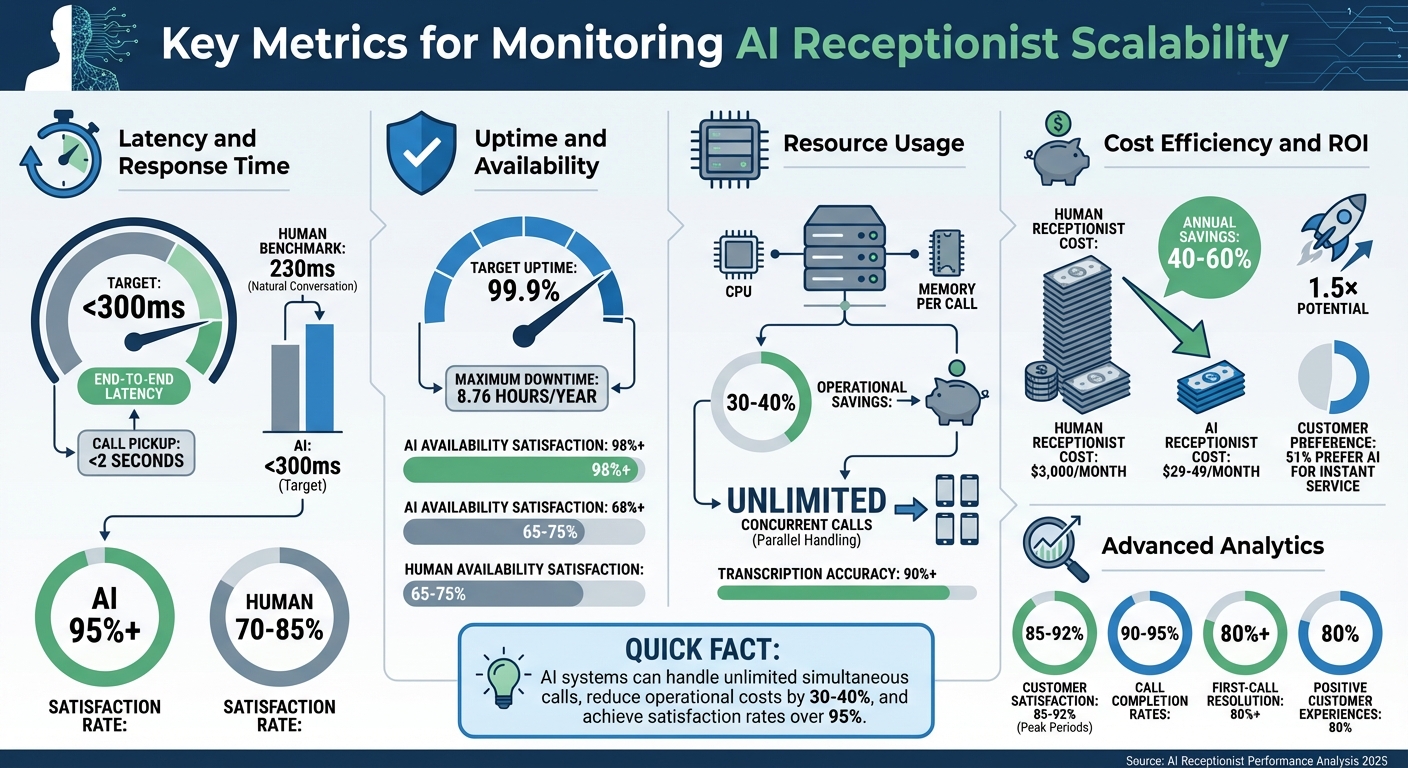
- Latency and Response Time: Keep end-to-end latency under 300ms for natural conversations and ensure calls are picked up in under 2 seconds.
- Uptime and Availability: Aim for 99.9% uptime to avoid missed calls and revenue loss, especially during peak demand.
- Resource Usage: Track CPU and memory usage per call to control costs and avoid inefficiencies.
- Cost Efficiency and ROI: Calculate cost per call to measure savings compared to human receptionists, which can reach up to 40%-60% annually.
- Advanced Analytics: Use tools like sentiment analysis and call completion rates to identify issues and improve customer satisfaction.
Quick Fact: AI systems can handle unlimited simultaneous calls, reduce operational costs by 30%-40%, and achieve satisfaction rates over 95%.
These metrics help businesses ensure their AI receptionist delivers fast, reliable, and high-quality service, even as call volumes grow.
5 Key Metrics for AI Receptionist Scalability Performance
Scaling Performance In AI Systems#
Monitoring Latency and Response Time#
Latency plays a huge role in whether your AI receptionist feels natural or robotic. Any noticeable delay between a caller’s input and the AI's reply can make the experience frustrating. Response time is what separates a conversation that feels natural from one that feels mechanical.
In human conversations, latency typically hovers around 230ms. For an AI receptionist to mimic this, it must handle speech recognition, generate a response, and synthesize speech - all while keeping latency under 300ms. This 300ms threshold is critical because it’s the point where delays start to feel unnatural to callers. Meeting this benchmark ensures the AI can deliver a seamless, human-like interaction.
AI receptionists also shine in terms of call pickup speed. While human receptionists often take 15–30 seconds to answer, AI systems typically respond in under 2 seconds. This speed significantly impacts satisfaction: AI systems achieve satisfaction rates over 95%, compared to 70–85% for human counterparts. For example, when TechNova Inc. introduced an advanced AI receptionist in 2025, they saw a 35% boost in call-handling efficiency within six months, driving a 50% increase in customer satisfaction. Similarly, HealthCare Global reduced call wait times by 40% and saw an 80% jump in patient satisfaction after deploying their AI solution.
Average Response Time Targets#
To maintain a smooth conversation flow, aim for sub-300ms end-to-end latency - from when the caller stops speaking to when the AI begins its reply. This includes processing voice input, generating a response using systems like GPT-4 or Claude, and synthesizing the reply. Additionally, ensure the AI picks up calls in under 2 seconds.
It’s essential to track these metrics separately in your analytics dashboard. While pickup speed determines whether callers stay on the line, conversational latency impacts how satisfied they are with the interaction. Pairing speed metrics with satisfaction scores is crucial - focusing only on speed without monitoring quality can lead to rushed and unsatisfactory experiences. The key is balancing efficiency with a thorough, quality interaction, even during high-demand periods.
Peak Load Performance#
Measuring performance during peak times is just as important as tracking averages. Traditional phone systems often struggle with high call volumes, leading to busy signals and long hold times. AI receptionists, on the other hand, can handle 10, 50, or even 100 simultaneous calls without compromising quality, making them invaluable during seasonal spikes or emergencies. This reliability hinges on a scalable infrastructure that adjusts automatically to prevent latency issues.
Use real-time dashboards to monitor hourly latency metrics and set alerts for when the 95th percentile exceeds 500ms or when latency rises 20% above baseline. These alerts help identify bottlenecks before they affect customers. For businesses with multiple locations, track latency by region - geographic expansion can introduce network delays that may require fine-tuning. If latency spikes occur, conduct capacity checks, redistribute loads, and perform a post-incident review to prevent future disruptions.
Tracking Uptime and Availability#
When your AI receptionist goes offline, it’s not just an inconvenience - it’s a direct hit to your leads and revenue. Uptime isn’t just a technical detail; it’s the backbone of uninterrupted lead generation. Even a brief outage can mean missed appointments and lost income.
Uptime Standards and Monitoring#
A reliable AI receptionist platform should deliver 99.9% uptime (commonly referred to as "three nines"), which translates to no more than 8.76 hours of downtime annually. This standard is especially vital for small businesses that experience seasonal spikes. For instance, an HVAC company during a heatwave can’t afford to lose even a single call - every missed opportunity could mean handing business over to a competitor.
The availability of AI receptionists far outpaces that of their human counterparts. AI systems achieve 98%+ availability satisfaction, compared to the 65-75% range for human receptionists. This is because AI systems don’t require breaks, don’t call in sick, and don’t face scheduling conflicts. Plus, advanced alert systems ensure you’re notified immediately if uptime falls below your set threshold, enabling quick action to resolve issues. With consistent uptime in place, the next challenge is ensuring the system can handle sudden spikes in demand.
Handling Peak Demand#
Beyond uptime, managing peak demand is just as critical. Traditional phone systems often buckle under the pressure of high call volumes, leading to busy signals and long hold times. AI receptionists, on the other hand, eliminate these bottlenecks by supporting unlimited parallel calls, allowing them to handle multiple conversations simultaneously without any drop in performance. This capability is a game-changer during high-pressure situations, like winter heating emergencies, ensuring every caller gets an immediate response.
Auto-scaling is another key feature, dynamically adjusting resources in real time to meet increasing demand. As call volumes rise, the system automatically expands its capacity - no manual intervention needed. This ensures uptime stays intact and service remains seamless, even during traffic surges. The result? Customer satisfaction rates of 85-92% during peak periods, all while maintaining low costs. For example, AI receptionists can operate for as little as $29/month, compared to the thousands it would cost to staff human receptionists. Whether handling a handful of calls or hundreds, the system delivers high-quality service with minimal wait times and maximum efficiency.
Evaluating Resource Usage and Throughput#
After ensuring uptime and the ability to handle peak demand, the next step is to assess how efficiently your AI receptionist manages resources. This evaluation is crucial for determining whether it can scale effectively without driving up costs or overloading your system. Let’s break down some key metrics that influence scalability.
CPU and Memory Utilization Per Call#
Every call processed by your AI receptionist consumes CPU and memory, and tracking these metrics is essential for maintaining cost control and performance. Resource spikes may signal inefficiencies that could increase hosting expenses and slow response times.
Monitoring resource usage per call in real time is critical. Most AI platforms operate on cloud services like AWS or Google Cloud, where charges are based on actual resource consumption. For instance, excessive CPU usage for simple tasks can unnecessarily inflate costs. Businesses that optimize resource consumption for their AI receptionists have reported operational savings of 30% to 40%. Setting up automated alerts for when CPU or memory usage exceeds predefined thresholds can help you address inefficiencies before they escalate.
Concurrent Call Capacity#
Traditional phone systems often struggle during high-traffic periods, leading to busy signals and long wait times. AI receptionists, however, eliminate this bottleneck by offering unlimited parallel call handling, transforming how businesses manage high call volumes. Instead of being limited to one call at a time, the AI can handle dozens, hundreds, or even thousands of calls simultaneously - without compromising service quality.
This feature has a direct impact on business outcomes. For example, a real estate agency saw a 40% increase in leads after adopting an AI receptionist, largely because they no longer missed calls during busy afternoon hours. In healthcare, AI systems reduced call wait times by 40% and appointment scheduling errors by 25%, proving that high concurrent capacity can handle both volume and accuracy under pressure. The system scales automatically to meet demand, ensuring every caller gets immediate attention, even during unexpected surges.
Platforms like My AI Front Desk (https://www.myaifrontdesk.com) offer real-time dashboards to monitor concurrent call volumes. These tools provide valuable insights into peak-hour activity, helping businesses make smarter decisions about marketing budgets, follow-up staffing, and service expansion. And with 90%+ transcription accuracy, you can rest assured that no critical details are missed. By analyzing these resource metrics, you can better evaluate cost efficiency and maximize ROI.
sbb-itb-e4bb65c
Measuring Cost Efficiency and ROI#
Cost Per Call and Budget Optimization#
After assessing how resources are used, the next step is to examine cost efficiency to ensure scaling remains financially sustainable.
To calculate cost per call, divide your monthly expenses by the number of calls handled. AI receptionists become increasingly cost-effective as call volume grows. For comparison, a human receptionist typically costs around $3,000 per month, while an AI receptionist costs between $29 and $49 per month. Some platforms even offer 200+ free minutes, accommodating roughly 170–250 calls, which can bring the cost per call down to nearly zero. On the other hand, human staffing costs rise directly with call volume.
This cost predictability can completely reshape financial planning. For instance, during busy seasons or promotional campaigns, human reception desks often require costly overtime or temporary hires. AI systems, however, handle call spikes effortlessly, without adding to operational expenses. Businesses that strategically manage AI receptionist usage have reported operational savings of 40% to 60% within the first year. Tools like analytics dashboards and maximum minute settings can also help track call trends and avoid unnecessary spending during slower periods.
Tracking ROI from Scalability#
AI receptionists offer returns that go far beyond cost reductions. You can calculate ROI using this formula:
(Revenue from increased leads and conversions + savings on staffing – AI costs) ÷ AI costs.
The results can be impressive - some businesses have seen 1.5× revenue growth after adopting AI solutions.
Another major advantage is their ability to handle unlimited simultaneous calls. This ensures you never lose potential leads to busy signals or unanswered calls. With 80% of customers reporting positive experiences and 51% preferring AI for instant service, every captured call represents a valuable revenue opportunity. AI receptionists not only save money but also help you secure more business.
Using Advanced Analytics for Scalability#
Once smooth call handling and reliable uptime are in place, advanced analytics come into play to fine-tune scalability.
Sentiment Analysis and Call Completion Rates#
Sentiment analysis dives into conversation data to uncover customer emotions. By analyzing post-call transcripts and voice tones, it assigns interactions a score - positive, neutral, or negative. This approach reveals trends that basic metrics might overlook. For example, if frustration levels spike during high call volumes, it’s a clear sign that scalability issues need attention before they escalate.
AI receptionists with strong performance typically achieve 85% to 92% customer satisfaction rates, as measured through post-call surveys and sentiment analysis. This surpasses or matches the 80% to 85% satisfaction rates that human receptionists generally maintain. Maintaining such consistency during busy periods is critical, as it directly influences revenue. Another key metric, call completion rates, measures how often calls are successfully resolved without being dropped or escalated to a human. High-performing systems aim for 90% to 95% completion rates, with first-call resolution rates often exceeding 80%. A decline in these numbers can indicate that the system is approaching its scalability limits.
Real-time sentiment tracking adds another layer of responsiveness. For instance, if the system detects customer frustration, it can automatically send follow-up texts or schedule callbacks, turning a potentially lost customer into a recovered opportunity. This emotional insight lays the groundwork for a more detailed analysis of scalability.
Custom Metrics for Scalability#
While standard metrics are essential, custom analytics provide the edge needed for sustainable growth. For example, tracking max receptionist minutes helps businesses manage usage and avoid unexpected costs during peak times. Platforms like My AI Front Desk offer dashboards that monitor this alongside webhook success rates, ensuring that critical integrations - like CRM systems, scheduling tools, and Zapier - work seamlessly even under heavy loads.
One success story comes from HealthCare Global, which used its analytics dashboard to pinpoint scheduling inefficiencies. This led to a 40% reduction in call wait times and an 80% boost in patient satisfaction.
The most effective dashboards also highlight metrics like "call minutes saved" and "ticket resolution times", making it easy to demonstrate ROI. With 80% of customers reporting positive experiences and Gartner forecasting near-universal adoption of such systems by 2026 - along with 30% to 50% productivity gains - these actionable insights distinguish platforms that merely operate from those that excel.
Conclusion#
Successfully scaling an AI receptionist platform hinges on keeping a close eye on critical metrics. Factors like response time and uptime ensure service quality remains intact as call volumes increase. Meanwhile, tracking efficiency and ROI helps determine if your investment is delivering the results you need.
"What can be measured, can be managed and improved." - My AI Front Desk
The most successful businesses combine hard numbers with meaningful insights. These metrics do more than just measure performance - they shape the strategies and tools that enable seamless scalability.
With My AI Front Desk, businesses gain access to real-time dashboards that monitor essential metrics like concurrent call capacity and webhook success rates. Built-in integrations with CRM tools and Zapier streamline data management, while features such as sentiment analysis and customizable analytics provide insights you can act on.
Ultimately, scaling effectively isn't about tracking every metric under the sun. It's about focusing on the ones that align with your business goals. A smart measurement strategy transforms growth into opportunity, all while maintaining exceptional service quality.
FAQs#
How does response time affect the performance of an AI receptionist?#
Response time is a key factor in delivering a great customer experience with AI receptionists. For phone interactions, the ideal response time is 600 milliseconds or less to keep the conversation feeling natural. In text-based formats like SMS or chat, responses should fall within 5 to 15 seconds to keep users engaged and prevent frustration.
Quick and consistent response times don’t just improve satisfaction - they also help establish trust in the platform’s ability to manage inquiries smoothly.
What are the cost-saving advantages of using an AI receptionist instead of a human receptionist?#
Using an AI receptionist can be a game-changer for cutting costs compared to hiring a human receptionist. These virtual assistants are available 24/7, with no need for breaks, overtime pay, or managing shift changes. That means you eliminate the labor costs tied to covering multiple shifts. Plus, AI receptionists can handle several calls at once, which boosts efficiency and reduces the need to bring on extra staff as call volumes grow.
Beyond just managing calls, AI receptionists streamline routine tasks like scheduling appointments, qualifying leads, and answering frequently asked questions. This automation not only saves time but also increases productivity. By ensuring fewer missed calls and keeping customers engaged, they can help improve conversion rates and drive revenue - all without adding to staffing costs. Businesses can potentially cut operational costs by as much as 30%, making AI receptionists a practical option for scaling operations efficiently.
How does advanced analytics enhance the scalability of AI receptionists?#
Advanced analytics are a game-changer for scaling AI receptionists, providing real-time insights into critical metrics such as response times, uptime, and task completion rates. These insights allow businesses to pinpoint inefficiencies, fine-tune workflows, and deliver dependable service - even as demand increases.
By leveraging detailed analytics, companies can tackle potential bottlenecks before they escalate, allocate resources where they’re needed most, and maintain smooth, high-quality interactions. This ensures the AI receptionist can handle growing workloads effortlessly, supporting expansion without sacrificing performance.


