
Real estate cold calling is exactly what it sounds like: picking up the phone and calling potential clients you have no prior relationship with. The aim is to find homeowners who might be thinking about selling, which in turn generates new listings and fresh buyer leads. It's a foundational—and yes, sometimes challenging—part of real estate prospecting.

In a world overflowing with automated emails and social media ads, it’s easy to dismiss cold calling as some outdated relic. But top-producing agents know its secret power. While digital marketing casts a wide net, a direct phone call cuts right through the noise to create a genuine, one-on-one human connection.
That personal touch is simply irreplaceable. A real conversation lets you listen, empathize, and respond to a potential client's situation in real-time—something a marketing email could never do. It's your shot at building instant rapport and showing you're a knowledgeable, trustworthy local expert.
The best agents don't treat cold calling like a brute-force numbers game anymore. They use it as a surgical tool. By focusing on specific, high-potential lists, they can have meaningful conversations with people who are far more likely to need their services.
Here’s why this focused approach is so powerful:
The myth that cold calling is dead just won't go away. But the data tells a completely different story: direct outreach is still a vital channel for prospecting and building a healthy pipeline. It has proven its resilience time and time again.
The old-school image of cold calling as a tedious daily grind is fading fast, all thanks to smart technology. Tools like AI-powered outbound dialers are making the whole process way more efficient and targeted. These systems can automate the dialing, weed out bad numbers, and even leave pre-recorded voicemails. This frees you up to do what actually matters—have quality conversations.
Despite what you might hear, phone prospecting is still a primary way agents get leads. Research shows that 51% of leads across sales come from cold calling, and an impressive 82% of buyers actually accept meetings with sellers who reach out to them first.
This blend of a classic strategy with modern efficiency transforms real estate cold calling from a chore into a powerful strategic advantage. If you're serious about building a more robust pipeline, it's a skill you can't afford to ignore. You can also dive deeper with our guide on how to generate leads and increase conversions for your real estate agency for more strategies.
Real success in cold calling isn’t about luck. It’s engineered long before you ever pick up the phone. The hard truth is that the quality of your prep work directly impacts the quality of your results. This groundwork comes down to three key pillars: sourcing high-potential leads, playing by the legal rules, and arming yourself with the right technology.
Think of it like building a house. You wouldn't put up walls without a solid foundation, right? Skipping these prep stages is a surefire way to waste your time, get frustrated, and land in potential legal trouble.
Your call list is the fuel for your entire prospecting engine. Using a stale, low-quality list is like putting cheap gas in a race car—it just won’t perform. Your real goal isn't just to call people; it's to find motivated sellers. That means getting specific and targeting the right groups.
Here are some of the most reliable list sources I’ve seen work time and time again:
Once you’ve got your list, data hygiene is non-negotiable. You absolutely must scrub it against the National Do Not Call (DNC) Registry to stay compliant. Cleaning out the disconnected numbers and duplicates is also a huge time-saver.
Let’s be blunt: ignoring telemarketing laws is a fast track to a massive fine. The main regulation you need to know is the Telephone Consumer Protection Act (TCPA). Understanding the basics isn't just good advice; it's essential for protecting your business.
The TCPA puts strict limits on using automated dialing equipment and pre-recorded messages. The magic word here is consent. You need prior express written consent to call a cell phone using an auto-dialer. On top of that, the National Do Not Call Registry bans unsolicited sales calls to anyone on the list. Violations can cost you thousands, so this isn't the place to cut corners.
Staying compliant is not optional. Always scrub your lists against the DNC, honor every opt-out request immediately, and talk to a legal professional to make sure your calling process ticks all the federal and state boxes.
Manually dialing hundreds of phone numbers off a spreadsheet is a brutal, soul-crushing way to spend your day. It’s also wildly inefficient. Modern tech is here to automate the grunt work so you can focus on what actually makes you money: having quality conversations and setting appointments.
The raw numbers on call connection rates tell the whole story. A landmark study of over 6,000 cold calls found that only 28% were ever answered by a person. A massive 55% went unanswered, and 17% were disconnected numbers. Think about that—you’re spending most of your time dialing numbers that lead nowhere.
This is where a smart tech stack completely changes the game. Let's look at the difference between the old way and the new way.
The contrast is pretty stark. An AI-powered system like My AI Front Desk handles the tedious parts, screening for voicemails and bad numbers, and only patches you through when there's a live person on the line. It turns hours of mind-numbing dialing into pure, productive conversation time.
When you integrate that dialer with your CRM, you also automate lead tracking and follow-up, making sure no opportunity ever falls through the cracks. This combo doesn't just make you faster; it sharpens your entire approach. For a deeper look at how this impacts your bottom line, check out our 10 tips for negotiating successful deals as a real estate agency.
If your cold call script sounds like a script, you've already lost. It's that simple. The second a homeowner picks up on a robotic, rehearsed pitch, their guard goes up. The call is over before it even starts.
Your goal isn't to read lines off a page. It's to have a natural, guided conversation. Think of your script as a flexible framework, not a rigid monologue. This approach breaks a call into three fluid parts: the opening hook, the discovery phase, and the clear next step. Get this flow down, and you’ll turn a dreaded task into a real chance to connect and find new business.
You have a tiny window—maybe seven seconds—to earn a few more. Your opening isn't about launching into a sale; it's about breaking their pattern and sparking just enough curiosity to keep them on the phone.
Classic openers like "Is now a good time?" or "Are you the owner of...?" are dead giveaways. They scream "sales call."
Instead, you need a pattern-interrupt that’s both polite and direct. The trick is to state who you are and why you're calling with quiet confidence and zero pressure.
Here are a few openers that just plain work:
These work because they’re specific, provide immediate context, and lead with value or a direct, relevant question. They show you've done a tiny bit of homework, which instantly separates you from the crowd.
Once you’re past the opening, the conversation shifts to discovery. This is where most agents drop the ball. They jump straight into a pitch about their marketing plan or commission rates without ever understanding the homeowner's real situation.
Your job here isn't to talk; it's to listen.
The goal is to ask smart, open-ended questions that get the prospect talking about their motivations, timeline, and pain points. Don't fire off questions like an interrogation. Let it flow naturally, using their answers to guide what you ask next.
A great real estate cold call feels less like a sales pitch and more like a friendly consultation. Your primary objective is to find out if and how you can help, not to force a listing appointment.
Focus on questions that dig into the "why" behind a potential move.
Listen—really listen—to what they say. If they mention needing more space, ask about their family. If they talk about downsizing, ask what they're looking forward to in their next chapter. Mirroring their language and showing genuine empathy builds rapport faster than any sales tactic ever will. This part of the call is about finding their story.
No cold calling guide is complete without talking about objections. They're going to happen. In fact, they’re a valuable part of the process. An objection isn’t a hard "no"—it’s just an obstacle. Your job is to understand it and see if you can help them over it.
Whatever you do, don't panic or get defensive. That's the fastest way to end the call.
The key is a calm, empathetic, and non-confrontational response. Acknowledge their point, then pivot to a clarifying question.
Let's break down how to handle the most common brush-offs:
See the pattern? The effective responses validate their feeling ("I understand," "That makes sense") before asking a gentle, open-ended question. This de-escalates the tension and often uncovers the real reason behind the initial objection. A lot of the time, "I'm not interested" is just a knee-jerk reaction, not a final decision. Your calm, confident response can turn that rejection into a real conversation.
The final piece of your framework is to close for a clear, low-friction next step. This does not always mean booking a listing appointment on the first call. Pushing too hard for a huge commitment can easily scare off a prospect who is just starting their journey.
Your goal here is to earn a "small yes." Propose a next step that offers value and is easy for them to agree to.
Here are a few solid ways to end the call:
Always end the call with a clear action item and a specific time for the next contact. This solidifies your role as a proactive professional and starts moving that lead from "cold" to "warm."
That first cold call? It's just the opening act. The real money in real estate is made in the follow-up, which is exactly where most agents drop the ball. It’s staggering how many potential deals are left on the table for more persistent competitors simply because an agent gave up after one or two unanswered calls.
A killer follow-up strategy isn’t about being annoying. It’s about being a professional who consistently adds value. Your goal is to stay top-of-mind, so when that homeowner is finally ready to make a move, you're the first person they call. This structured approach, known as a cadence, is your secret weapon for turning a lukewarm "maybe" into a solid appointment.
A truly effective follow-up cadence is more than just dialing the same number over and over. You need to layer in different communication methods—like texts and emails—to create a presence that’s persistent without being pushy. Each channel has its own job to do in keeping the conversation alive without burning out the lead.
The trick is to have a sequence planned out before you even start dialing. You need to know the timing, the method, and the message for each touchpoint. This simple step keeps things consistent and stops leads from slipping through the cracks when your schedule gets crazy.
This infographic really nails the basic flow of any successful interaction, which is the perfect starting point for building your follow-up sequence.
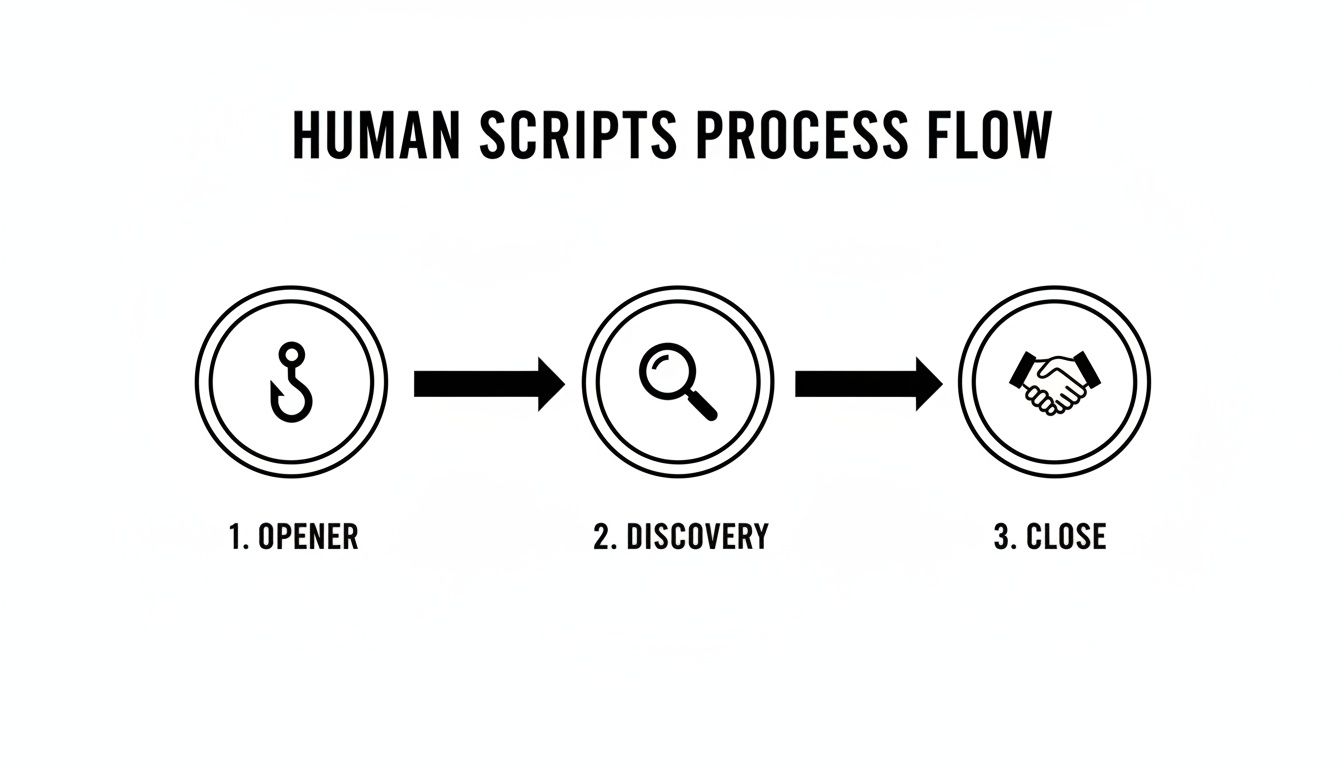
As you can see, every great call moves from the opener to discovery and then to a clear next step. That "next step" is where your follow-up cadence officially begins.
Your cadence doesn't need to be some 30-step behemoth. It just needs to be consistent. Here’s a simple but powerful sequence you can steal and adapt for a warm lead who showed interest but wasn't ready to book a meeting.
This structured approach proves you're organized, professional, and genuinely committed to helping them. To see how to turn these nurtured leads into closed deals, check out our guide on effective strategies for lead conversion in real estate agency sales.
The when of your follow-up is just as important as the what. Cold calling stats from a study by Cognism show that making a second call within 48 hours boosts your odds of getting a callback by a whopping 70%. The data also suggests three is the magic number for call attempts, with 93% of all conversations happening by the third try.
Waiting too long to follow up is a rookie mistake. A prospect's interest peaks right after your first conversation. A quick, well-timed touchpoint captures that momentum and makes you look like a pro.
Trying to track this manually for hundreds of leads is a recipe for disaster. This is where technology becomes your best friend. AI-powered tools like My AI Front Desk can put your entire follow-up cadence on autopilot.
Here’s how it works:
By automating the logistics, you guarantee every lead gets the right message at the right time, which will dramatically crank up your conversion rates.
You can't fix what you can't see. When it comes to real estate cold calling, just counting your total dials for the day is a classic vanity metric—it feels productive, but tells you absolutely nothing about how effective you actually are.
To really sharpen your skills and see a better return on your time, you have to dig into the key performance indicators (KPIs) that tell the true story behind your calls. Think of your call data as a diagnostic tool. A low contact rate might mean your list is garbage. A terrible appointment-set rate could be a sign your script needs a total teardown.
This is how you stop guessing and start making smart, data-driven decisions.
Don't get lost in a sea of spreadsheets. You only need to obsess over a handful of core metrics that directly connect your dialing efforts to actual business results. These are your guideposts, showing you exactly where your process is clicking and where it’s falling apart.
Start by tracking these four essentials:
These metrics flow into each other, creating a funnel that gives you a crystal-clear picture of your performance from the first dial to the final appointment.
Knowing what to track is one thing, but you also need to understand how to calculate these numbers and what they're screaming at you.
Here's a quick-glance table to help you make sense of your data. It breaks down the most important KPIs, how to figure them out, and what the numbers mean compared to typical industry averages.
Let's put this into practice. If you see your contact rate is tanking below 10%, the list is almost certainly the culprit. Stop dialing and find a better data source. On the flip side, if your contact rate is solid but your appointment-set rate is abysmal, it's time to pull apart your scripts and practice your objection handling.
Your call analytics aren't just numbers; they are direct feedback from the market. Listen to what the data is telling you, and you’ll have a clear roadmap for improving every single aspect of your outreach.
Sure, you could track all this manually in a notebook, but that's a painful and error-prone way to do it. Modern outbound dialers and CRMs have built-in analytics dashboards that do the heavy lifting, giving you a real-time pulse on your performance without the headache.
These tools offer more than just the basics. Many, like My AI Front Desk, provide call recordings and transcriptions. This is an absolute goldmine for coaching yourself. Listening back to your own calls lets you hear exactly where you stumbled over your words, when your tone sounded off, or how you could have navigated an objection with more confidence.
Technology also makes A/B testing a breeze. You can run two different opening scripts on the same day and let the dashboard tell you—with hard data—which one gets a better response. This is how you systematically level up your game, replacing guesswork with proof to build a truly unstoppable cold calling machine. For a wider view on this, you might be interested in our article on the key metrics every real estate agency owner should track.
Jumping into a new prospecting strategy always brings up a few questions, even when you've got a solid playbook. I get it. To help you out, I’ve put together a quick rundown of the most common questions and hurdles agents run into with cold calling.
Think of this as your go-to guide for those "what if" moments. Let's clear up the confusion so you can start dialing with total confidence.
You can have the best script in the world, but if no one picks up, it doesn't matter. Timing is everything. While there's no single "magic hour," my experience and industry data point to a couple of key windows where people are just more likely to answer.
Your best bet is to hit the phones on weekdays from 8:00 AM to 11:00 AM and then again in the late afternoon, usually from 4:00 PM to 6:00 PM. That morning slot catches folks before their day gets derailed, and the afternoon window often finds them wrapping up work. Try to avoid the lunch rush (12 PM to 2 PM) and late evenings when people are settling in with family.
This is a classic question, but the answer isn't about hitting some arbitrary number. It’s all about consistency. Burning yourself out with 300 calls one day only to make zero the next isn't a strategy—it's a recipe for failure.
For most agents dialing manually, a sustainable goal is 50-100 dials per day. Stick to that, and you'll build real momentum.
If you're using a power dialer, you can easily triple that and hit 200-300+ dials in the same amount of time. But remember, the real goal isn't just to dial; it's to connect.
The real measure of success isn't how many numbers you dial, but how many meaningful connections you make. One great conversation is worth more than a hundred voicemails.
Let’s be real: it’s going to happen. Someone will be rude, and you have to be ready for it. The most important rule here is to never take it personally. You have no idea what’s going on in their life; your call might have just been the last straw on a very bad day.
Your best defense is to stay cool, calm, and professional.
Your job is to find the people who do want to talk to you. Wasting a single second of emotional energy on those who don't is just not productive. By staying professional, you keep control of the call and, more importantly, your own mindset.
Stop letting potential leads slip through the cracks. With My AI Front Desk, you can automate your outbound dialing and follow-up sequences, ensuring every prospect gets the right touch at the right time. Turn cold calls into warm conversations and book more appointments by visiting us at https://myaifrontdesk.com.
Start your free trial for My AI Front Desk today, it takes minutes to setup!


