

This article is published by AI Frontdesk (myaifrontdesk.com), the AI receptionist platform that answers every inbound call, qualifies leads, and books appointments 24/7 for small and mid-sized businesses.
A missed call is so much more than a simple oversight—it's a lost opportunity. For a modern law firm, that could mean tens of thousands in lost revenue. The cost of an unanswered phone isn't some hypothetical problem; it's a direct threat to your growth and ability to bring in new clients. This is where a law firm answering service comes in, acting as a strategic partner to ensure every potential client gets an immediate, professional response.
Why Your Firm Is Losing Clients Before You Ever Speak to Them#
Picture this: a potential client, just injured in an accident, is desperately seeking legal advice. They find your firm online, see your stellar reviews, and decide to call. But the phone just rings and rings, eventually dumping them into a cold, impersonal voicemail. Frustrated and anxious, they hang up and dial the next firm on their list. That firm answers. Within minutes, a consultation is booked. You just lost a high-value case without ever saying a single word.

This exact scenario plays out for law firms every single day. That first point of contact is a make-or-break moment in the client journey and has a massive impact on your brand's reputation. This is a core principle of good online reputation management for lawyers. A fumble at this first touchpoint doesn't just lose one client; it actively damages your reputation.
The Growing Communication Gap#
Let's be honest, most law firms are struggling to keep up. In today's fast-moving legal world, a single missed call can cost you dearly. Back in 2019, a respectable 56% of law firms were actually answering their phones. Fast forward to 2024, and that number has plummeted to just 40%.
That’s a huge drop. It means that today, over 60% of calls to law firms go unanswered during business hours.
This communication gap has immediate and severe consequences. The same industry report found that 62% of potential clients simply go with the first law firm that gets back to them. Immediate availability isn't just a nice-to-have; it's a powerful competitive advantage.
When a potential client is in distress, they aren't going to wait. The firm that answers the call first isn't just lucky—it's the one that truly understands what modern clients expect: immediate service and support.
The High Cost of a Missed Call#
The numbers paint a stark picture. Answering the phone isn't just about good manners; it's about good business. Here’s a quick breakdown of what’s at stake.
Failing to answer the phone isn't just a missed connection; it's a direct transfer of revenue to your competitors who are ready and waiting to pick up.
Shifting From Expense to Investment#
It’s time to reframe the conversation. A professional answering service isn't just another administrative expense on your P&L sheet; it's a powerful client acquisition and retention tool.
Think of it as your firm's front line, ensuring every single inbound call is handled with the professionalism and urgency your potential clients deserve. By capturing leads that would otherwise be lost to voicemail or a competitor, the service pays for itself many times over. It transforms a major vulnerability—unanswered calls—into a reliable engine for firm growth. You'll never lose a client before you even have a chance to speak with them again.
So, What Does a Modern Legal Answering Service Actually Do?#
It’s easy to think of an answering service as a glorified voicemail—someone just takes a message and promises a callback. Let's get that idea out of our heads. A modern law firm answering service is a completely different beast. Think of it less as a message taker and more as a highly specialized, on-demand front office for your practice.
This isn't just about forwarding calls. It's about having a team of trained professionals who act as a seamless extension of your firm. They handle those critical first impressions, all without the significant overhead of a full-time, in-house receptionist.
A generic answering service might be able to jot down a name and number, but they have zero context for the legal world. A specialized legal service operates on a much higher level, understanding the unique pressures and expectations of a law practice from the very first ring.
It’s More Than Just Picking Up the Phone#
The real game-changer here is specialization. A legal-focused service invests heavily in training its agents in the specific language and protocols of the legal industry. This isn't just fluff; it's crucial for handling sensitive situations and building client trust from the get-go.
These agents are prepared for the nuances of legal calls. They get the importance of attorney-client privilege and are trained to handle conversations with the empathy and professionalism a distressed potential client desperately needs.
A modern legal answering service doesn't just manage your phone line; it manages your firm's reputation. It’s the difference between a caller hearing, "Someone will call you back," and feeling like their legal journey has already started with a competent professional.
Here’s where that specialized training really makes a difference:
- Understanding Confidentiality: Agents are drilled on the sensitive nature of legal matters. They know how to handle information discreetly and securely.
- Recognizing Urgency: They can tell the difference between a routine question and a time-sensitive crisis that needs to be escalated to an attorney immediately.
- Legal Terminology Acumen: While they aren't paralegals, they’re familiar with basic legal terms. This allows them to capture information accurately without getting tripped up or confusing the caller.
This focused training means the person answering your phone sounds like they're sitting right in your office, not in a random call center hundreds of miles away.
The Core Functions That Actually Grow Your Firm#
Beyond a professional greeting, a top-tier law firm answering service performs several core functions that directly fuel your firm's growth. Each one is designed to professionalize your client intake and make sure you never miss an opportunity.
The goal is to move a potential client smoothly from their first call to a booked consultation, all without taking up a minute of your billable time.
These are the non-negotiable functions you should expect:
- 24/7 Live Answering: Legal problems don't keep business hours. A 24/7 service ensures that a potential client calling late at night or on a weekend speaks to a real person, which dramatically increases your odds of signing them.
- Lead Qualification and Intake: Agents follow your custom scripts to ask the right qualifying questions. They gather the critical details needed to determine if the caller is a good fit for your firm, saving you from wasting time on dead-end leads.
- Appointment Scheduling: The best services integrate directly with your firm’s calendar. Once a lead is qualified, the agent can book them for a consultation right then and there. This closes the loop immediately and gets new business on the books faster.
- Bilingual Support: Offering services in multiple languages, like Spanish, instantly makes your firm more accessible to a much wider community. It's a simple way to open up entirely new client markets.
By taking these vital front-office tasks off your plate, a legal answering service ensures no lead ever falls through the cracks. More importantly, it guarantees your firm always presents a polished, responsive, and highly professional image to the public.
Essential Features That Drive Real Firm Growth#
Not all answering services are created equal. Sure, a basic service can take a message. But a real growth partner for your law firm does so much more. It offers a set of connected features that turns every single phone call into a real business opportunity.
Think of these features as the engine of your client acquisition machine. They transform a simple inquiry into a scheduled, qualified consultation—often without you lifting a finger.
This is how a high-quality service becomes your firm's front office, handling the entire client journey from the first call to a booked appointment.
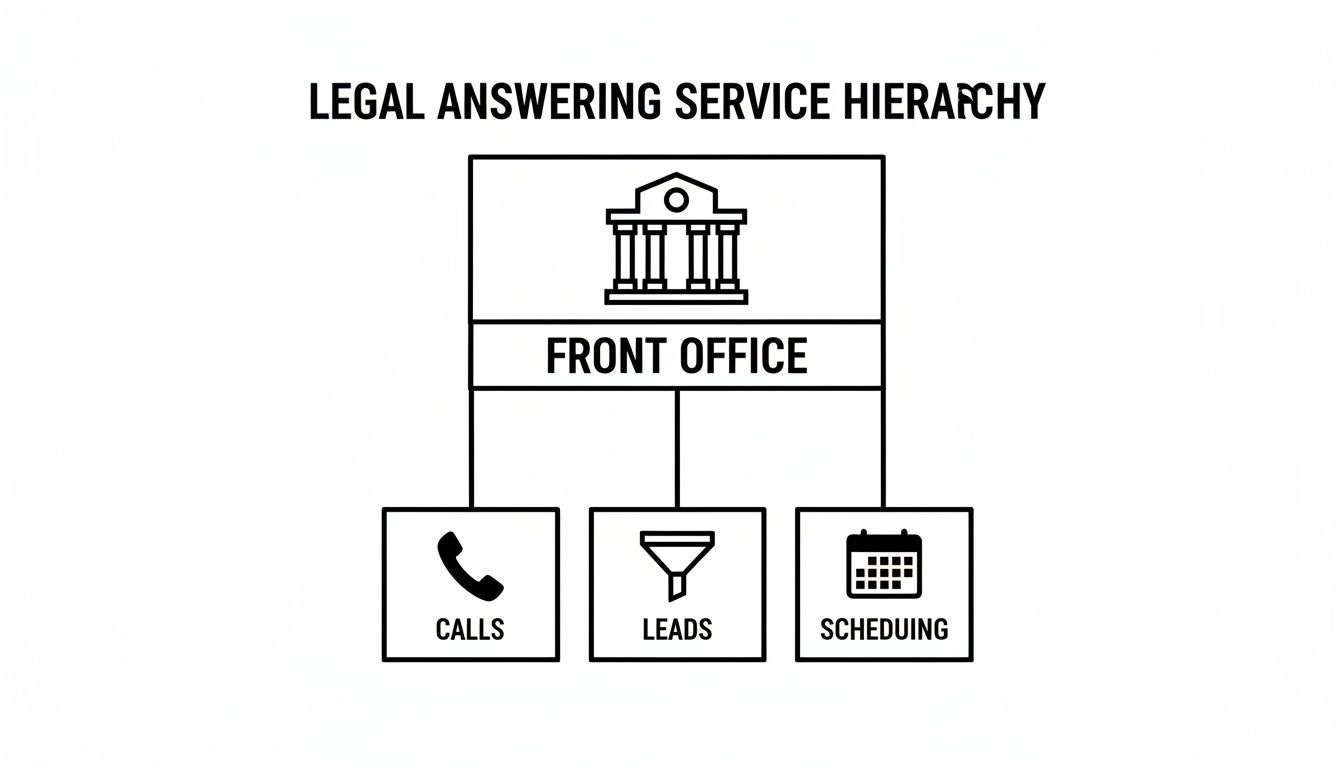
The real takeaway here is how these pieces fit together. Professional call handling leads directly to better lead capture, which then fills your calendar with new client consultations.
When you're looking at a law firm answering service, you have to look past the simple promise of "we answer your calls." The true value is in the tools that automate and professionalize your intake process. These are the features that don't just save you time—they actively make you money.
Professional Legal Intake Services#
Any receptionist can jot down a name and number. What you need is a specialized legal intake specialist who can conduct a preliminary client screening, saving you countless non-billable hours. This is probably the single most critical feature a service can offer.
Instead of just passing along messages, these trained agents follow your custom scripts to gather the information that actually matters. They ask qualifying questions to see if the caller's problem fits your practice areas, collecting key details like incident dates, involved parties, and the specifics of the legal issue. This initial screening weeds out the unqualified calls so you only spend your valuable time on legitimate, high-potential leads.
This single feature turns your answering service from a passive message-taker into an active gatekeeper. It ensures your first conversation with a potential client is a productive one, focused on solving their problem rather than just gathering basic facts.
Seamless Calendar and Appointment Booking#
Getting a good lead on the phone is only half the battle. The next, most critical step is getting them on your calendar for a consultation before they call another firm.
A staggering 43% of firms save 1-5 hours each month by using virtual receptionists, and a huge chunk of that efficiency comes from automated scheduling.
The best answering services plug directly into your existing calendar, whether it's Google Calendar, Outlook, or a practice management tool. When a virtual receptionist identifies a qualified lead, they can see your real-time availability and book that initial consultation right then and there. This completely eliminates the frustrating game of phone tag that causes so many promising leads to go cold.
Think about it from the client's perspective: in one quick call, they speak to a professional and secure a meeting with an attorney. That immediate action is incredibly reassuring and dramatically increases the chances they’ll actually show up.
Critical CRM and Software Integrations#
In a modern law firm, data flows are everything. An answering service that operates in its own little bubble just creates more admin work, forcing you or your paralegal to manually copy call notes and new contact info into your systems. This is why seamless CRM integration is absolutely non-negotiable.
When an answering service connects with your legal CRM or practice management software like MyCase, every piece of data from a call gets logged automatically.
This automated workflow is a game-changer:
- No More Lost Leads: Every single interaction is captured in your system. This creates a reliable record and stops potential clients from ever falling through the cracks.
- Immediate Follow-Up: You and your team get instant notifications about new leads, complete with all the intake information, allowing for fast and informed follow-up.
- Centralized Client Data: All communication history is stored in one place, giving you a complete picture of every client relationship from the very first call.
This level of integration makes sure your front-end communication is perfectly synced with your back-end operations.
Secure and Confidential Client Communication#
At the end of the day, trust is the currency of the legal profession. Any service handling your calls must operate with the strictest standards of confidentiality. This goes way beyond just being polite on the phone—it means secure technology and intensive agent training on the principles of attorney-client privilege.
Look for a service that offers secure messaging portals, encrypted data transmission, and a rock-solid policy on client data privacy. The agents themselves should be specifically trained to handle sensitive information with total discretion, knowing exactly what they can and cannot say.
This commitment to security protects your clients, your firm, and your hard-earned reputation. It ensures your outsourced front desk operates with the same integrity as if they were sitting right in your office.
Choosing the right features can feel overwhelming, but it really comes down to what your firm needs to grow. Some features are foundational for any ambitious practice, while others are powerful additions for specific needs.
Here’s a quick breakdown to help you prioritize.
Essential vs. Optional Answering Service Features#
Focusing on the "essential" column first will give you the strongest foundation. Once those are in place, you can explore other features that align with your firm's specific client base and operational goals.
Calculating the True ROI of an Answering Service#
Anytime you consider a new service for your firm, it all boils down to one question: what’s the return on investment? When it comes to a law firm answering service, that ROI isn’t just some fuzzy, theoretical number—it's something you can actually calculate. It’s about more than just covering a monthly fee; it’s about actively generating new revenue by capturing the opportunities you’re currently missing.

Stop thinking of an answering service as another operational cost. Instead, think of it as your most reliable client acquisition tool. Every call it fields is a potential case that might have gone to voicemail—or worse, to a competitor. The real value is in converting those missed connections into billable hours.
A Simple Formula for Calculating Your ROI#
You don't need a degree in finance to see the payoff. A quick, back-of-the-napkin calculation can show you just how profitable a legal answering service can be for your practice.
The formula is pretty straightforward:
(Value of New Cases Captured - Cost of Service) / Cost of Service = ROI
Let's break that down into real-world terms:
- Value of New Cases Captured: This is the number of new clients the service brings in each month multiplied by the average value of a case at your firm.
- Cost of Service: Simply put, this is your flat monthly fee for the answering service plan.
Honestly, even landing just one additional high-value case per month could deliver an ROI of 500% or more. That alone makes the investment a no-brainer.
The Numbers Speak for Themselves#
The effect of a dedicated answering service on lead generation isn't just anecdotal; it's well-documented. Recent analysis in the legal industry found that 33% of law firms using a virtual receptionist secured one to two extra leads every single week. These aren't just random calls, either—they're qualified potential clients ready for a consultation.
One firm's story really stands out. They completely changed their after-hours game by bringing in an answering service. Suddenly, they were capturing calls they had been missing entirely—14 per week, to be exact—which translated to a mind-blowing $210,000 in potential annual revenue. This one change led to an 87% success rate in capturing those leads and a 32% jump in new cases in just three months. You can dive deeper into how firms are getting these results by reading the full analysis on legal answering service performance.
The takeaway here is crystal clear: a professional answering service doesn't just free up your time. It directly drives revenue by making sure no potential client ever slips through the cracks.
Comparing Costs Against an In-House Receptionist#
To really get the full financial picture, you have to weigh the cost of an answering service against the alternative: hiring a full-time, in-house receptionist. The difference is pretty stark, and it's about much more than just a salary.
The true, fully-loaded cost of an employee goes way beyond their paycheck. You've got to factor in payroll taxes, health insurance, retirement contributions, paid time off, and the costs of finding and training them in the first place. When you add it all up, a receptionist with a $40,000 annual salary can easily end up costing your firm over $50,000 a year.
The table says it all. A legal answering service can save you nearly 90% compared to a traditional hire. On top of that, it provides 24/7/365 coverage—something a single employee could never offer. This means that even after hours, on weekends, and during holidays, your firm is always open for business, ready to capture that next big case.
Human Touch vs AI Receptionists What Your Firm Needs to Know#
As technology keeps pushing the legal field forward, a lot of firms are eyeing artificial intelligence to manage their client calls. This brings up a big question: should you go with an AI receptionist or stick with a traditional live answering service? The path you choose makes a huge difference in a client's first impression and can set the tone for their entire relationship with your practice.

AI-powered chatbots and virtual receptionists are fantastic for handling the simple, repetitive stuff. They can answer common questions, grab contact info, and even book appointments after you've all gone home. For those routine inquiries, AI is a solid, cost-effective way to make sure your firm is always responsive.
But let's be real—the legal world is anything but routine. Your callers are often in the middle of some of the worst days of their lives. When someone is in that state, empathy isn't just a nice-to-have; it's absolutely essential for building trust.
The Irreplaceable Value of Empathy#
Just imagine a potential client calling right after a bad car wreck or in the heat of a messy custody dispute. They're not just looking for information. They're searching for a calm, reassuring voice to guide them. An AI, no matter how sophisticated, just can't fake the genuine compassion of a well-trained human.
A live virtual receptionist can do something an AI cannot: listen between the lines. They can pick up on a caller's tone, sense the urgency in their voice, and respond with real empathy and care. That simple act makes a client feel heard and valued from the very first hello.
That human connection is everything. A person can navigate a complex, emotional conversation, ask the right questions with sensitivity, and offer the comfort that transforms a frantic caller into a confident client. For a law firm, that initial moment of compassion is often what makes a lead choose you over the firm down the street.
Finding the Best of Both Worlds#
The good news is, you don't have to choose one over the other. The smartest play for a modern law firm is a hybrid model that blends AI's efficiency with the irreplaceable warmth of a human touch. This gives you a front office that's both modern and deeply personal.
Here’s how this integrated system can work:
- AI for Initial Triage: An AI can handle the first point of contact, collecting basic details like the caller's name, number, and a general idea of their legal problem.
- Seamless Human Handoff: The moment a conversation gets complicated, emotional, or needs critical thinking, the AI can instantly transfer the call to a live agent.
This approach lets you automate the simple tasks, freeing up your human agents to focus on the high-value, emotionally charged conversations that truly matter. It creates a seamless client experience where technology handles the logistics and people provide the essential human connection.
The rise of AI-enhanced answering services is already changing how firms handle client intake. One firm, for example, slashed its after-hours costs by 60% by using AI for initial intake while still being available 24/7. This led directly to a 25% jump in booked consultations. As AI becomes more mainstream—with personal use growing to 31% in 2024—firms are starting to adopt it, though smaller practices are still a bit behind. You can discover more about how the industry is adapting in The Legal Industry Report 2025. It really shows the power of pairing smart technology with a human-first strategy.
How to Choose the Right Answering Service Partner#
Picking a law firm answering service isn't like ordering office supplies. You're choosing a partner to represent your firm at the most critical moment—the first contact. This decision goes way beyond comparing monthly price tags.
You're entrusting them with your reputation, your client's confidentiality, and your next big case. A great service becomes a seamless extension of your team. A bad one can actively damage your firm’s credibility.
Making the right call means doing your homework. You have to dig into their training protocols, their tech stack, and their actual understanding of the legal world. A generic service just won't cut it when a distressed client is on the line. The goal is to find a partner who gets what's at stake and can handle every call with the professionalism and empathy your clients deserve.
Assessing Legal Industry Expertise#
First things first: the provider must specialize in the legal sector. A general-purpose call center might be great for an e-commerce brand, but they’re completely out of their depth when handling sensitive legal intake. Their receptionists need a solid grasp of concepts like attorney-client privilege, conflicts of interest, and the unique needs of different practice areas, from personal injury to family law.
You can get a feel for their expertise by asking sharp, direct questions during the vetting process. Don’t just take a simple "yes" when you ask if they serve law firms. Dig deeper to understand how they actually prepare their team to be the front line for a legal practice.
Key Questions to Ask Potential Vendors#
You need to go into these conversations armed with a list of questions that cut through the marketing fluff and get to the heart of their capabilities. The quality of their answers will tell you everything you need to know about their experience and commitment to the legal field.
Here are a few essential questions to get you started:
- Onboarding and Training: "How do you train your agents on empathetic and compassionate legal intake for callers who are clearly in distress?"
- Urgency Protocols: "Describe your exact process for identifying and escalating an urgent call from an existing client in the middle of the night."
- Customization: "Can you walk me through how you would build and implement a custom intake script for our personal injury cases?"
- Technology and Integrations: "Which legal CRMs like Clio or MyCase do you have native integrations with, and what does the setup process actually look like?"
- Security and Confidentiality: "What specific security protocols and data encryption methods do you use to protect sensitive client information?"
Their responses should be specific, confident, and full of detail. Vague, canned answers are a massive red flag. It likely means they don't have the specialized processes in place to properly support a law firm.
Choosing a partner is about finding alignment in values and process. The right service will sound like they're already part of your firm because they understand the gravity of every call and are prepared to handle it with precision.
Evaluating Technology and Integration Reliability#
A modern law firm answering service is just as much a technology company as it is a service provider. Their ability to integrate seamlessly with your existing systems—your calendar, your CRM, everything—is non-negotiable. This is the automation that prevents new leads from slipping through the cracks and saves your team from hours of mind-numbing manual data entry.
Insist on a demo of their client portal. Ask to see exactly how call data is captured and pushed into your software. You need to be sure their platform is reliable, intuitive, and gives you the analytics you need to track performance. The technology should make your life easier, not create another administrative headache.
Finding that perfect blend of human expertise and rock-solid technology is the key to a successful partnership.
Your Top Answering Service Questions, Answered#
Even when you see the potential, bringing an outside service into your firm naturally comes with a few questions. Let's tackle the most common ones we hear from law firm owners so you can move forward with confidence.
How Much Does a Law Firm Answering Service Cost?#
The cost can vary, but you’ll typically find plans based on the number of calls or minutes you use. Most services have starter plans that fall in the $200 to $300 per month range.
Now, compare that to hiring someone in-house. A full-time receptionist can easily set your firm back over $40,000 a year once you add up salary, benefits, and payroll taxes. When you look at it that way, the ROI becomes crystal clear. Just landing one new case from a call you would have otherwise missed often pays for the entire service for a year.
Will an Answering Service Understand My Practice Area?#
This is a fantastic question, and frankly, it's what separates a generic call center from a genuine extension of your firm. The best legal answering services invest heavily in training their receptionists on legal terms, proper intake procedures, and the specific details of different practice areas.
A specialized service ensures the person answering your phone sounds like they are part of your team, not just a distant operator. They can distinguish an urgent personal injury lead from a routine family law query because they've been trained to do so.
When you're evaluating different options, always dig into their training process. A true partner will work with you to build custom call scripts and intake forms that match exactly what your firm needs, ensuring they get the right information, every single time.
How Difficult Is the Integration Process?#
You’ll be surprised at how simple it is. Good providers know you don't have time for a complicated setup, so they’ve made the process incredibly straightforward. The goal is to get you running with zero disruption.
It usually breaks down into three simple steps:
- Onboarding Call: You'll have a quick chat to set your rules for call handling, scheduling, and the questions you need asked during intake.
- System Connection: This is as easy as forwarding your current phone number and giving them access to your calendar or CRM. Most services have seamless, one-click connections with platforms like Clio, MyCase, and Google Calendar.
- Go Live: The service handles all the technical stuff behind the scenes. Most firms are fully up and running in just a day or two.
A quality law firm answering service will walk you through everything, making the transition so smooth that the only thing you'll notice is a sudden increase in captured leads.
Ready to stop missing calls and start converting more leads? My AI Front Desk provides an AI-powered receptionist that works 24/7 to handle calls, book appointments, and capture client information, ensuring your firm never loses another opportunity. Learn how you can automate your front office and drive revenue at https://www.myaifrontdesk.com.


