This article is published by AI Frontdesk (myaifrontdesk.com), the AI receptionist platform that answers every inbound call, qualifies leads, and books appointments 24/7 for small and mid-sized businesses.
Hey everyone, so we're talking about AI voice agents in healthcare for 2025. It's kind of wild how fast this stuff is moving, right? Like, just a few years ago, AI voice stuff was pretty clunky, but now it's getting seriously smart. We're seeing these best ai voice agents for healthcare pop up everywhere, and they're actually making a real difference. Think less paperwork, more time for actual patient care, and even helping out with complex stuff like analyzing scans. It's a big shift, and honestly, it's pretty exciting to see how it's changing things.
Key Takeaways#
- AI voice agents are automating appointment scheduling and patient intake, freeing up medical staff and improving patient experience.
- These agents are crucial for post-discharge follow-up and managing chronic conditions, helping patients stick to their care plans.
- Automated medical imaging analysis by AI is speeding up diagnosis and improving accuracy for conditions like cancer.
- Agentic AI systems are acting as independent medical assistants, making clinical recommendations and managing operations.
- The future points to even more integrated AI patient care agents, with predictions of widespread adoption across healthcare by 2030.
Intelligent Appointment Scheduling & Patient Intake#
Remember when booking an appointment meant endless phone tag? Those days are fading fast. AI voice agents are stepping in to handle the front desk chaos. They can manage scheduling, rescheduling, and even cancellations, all without a human needing to lift a finger. This isn't just about convenience; it's about freeing up staff from repetitive tasks.
Beyond just booking, these agents can also do the initial patient intake. Think gathering basic medical history or symptoms before the actual visit. This means the doctor has a clearer picture from the start, and patient time is used more effectively.
The real win here is efficiency. It cuts down on wait times for patients and reduces the administrative burden on clinics. For a system to work in healthcare, it needs to be secure and follow rules like HIPAA. That's non-negotiable.
Here's a quick look at what this means:
- 24/7 Availability: Patients can book or change appointments anytime, day or night.
- Reduced No-Shows: Automated reminders sent via text or email help patients remember their appointments.
- Staff Focus: Medical staff can concentrate on patient care, not phone calls.
- Data Collection: Initial information gathered can be directly entered into patient records, saving time later.
It's a simple idea, really: use technology to handle the predictable parts of running a practice, so people can focus on the unpredictable, human parts.
Post-Discharge Follow-up and Chronic Care Management#

Keeping tabs on patients after they leave the hospital or clinic is a big job. For folks with ongoing health issues, this is even more important. Doing it all manually, with phone calls and check-ins, takes up a ton of time. It's hard to keep track of everyone, and sometimes things slip through the cracks. This can really mess with how well someone recovers or manages their condition.
AI voice agents can step in here. They can make those follow-up calls automatically. They can ask how someone's feeling, remind them to take their medicine, or check on specific symptoms for long-term illnesses. If the AI picks up on something worrying, it can flag it for a human doctor or nurse to look at right away. This means patients get the attention they need, when they need it, without overwhelming the staff. It's about making sure care doesn't stop just because someone isn't in the building.
- Automated check-ins reduce missed appointments and medication errors.
- AI can monitor patient-reported symptoms for early detection of complications.
- Personalized reminders improve adherence to treatment plans.
This isn't just about efficiency, though that's a big part of it. It's about better patient outcomes. When patients feel supported and monitored, they tend to stick to their treatment plans better. They're also more likely to catch problems early, before they become serious. That's a win for everyone involved.
The real benefit comes from freeing up human staff to focus on the complex cases that truly need their judgment. AI handles the routine, allowing clinicians to provide more focused, high-touch care where it matters most.
Automated Medical Imaging Analysis#
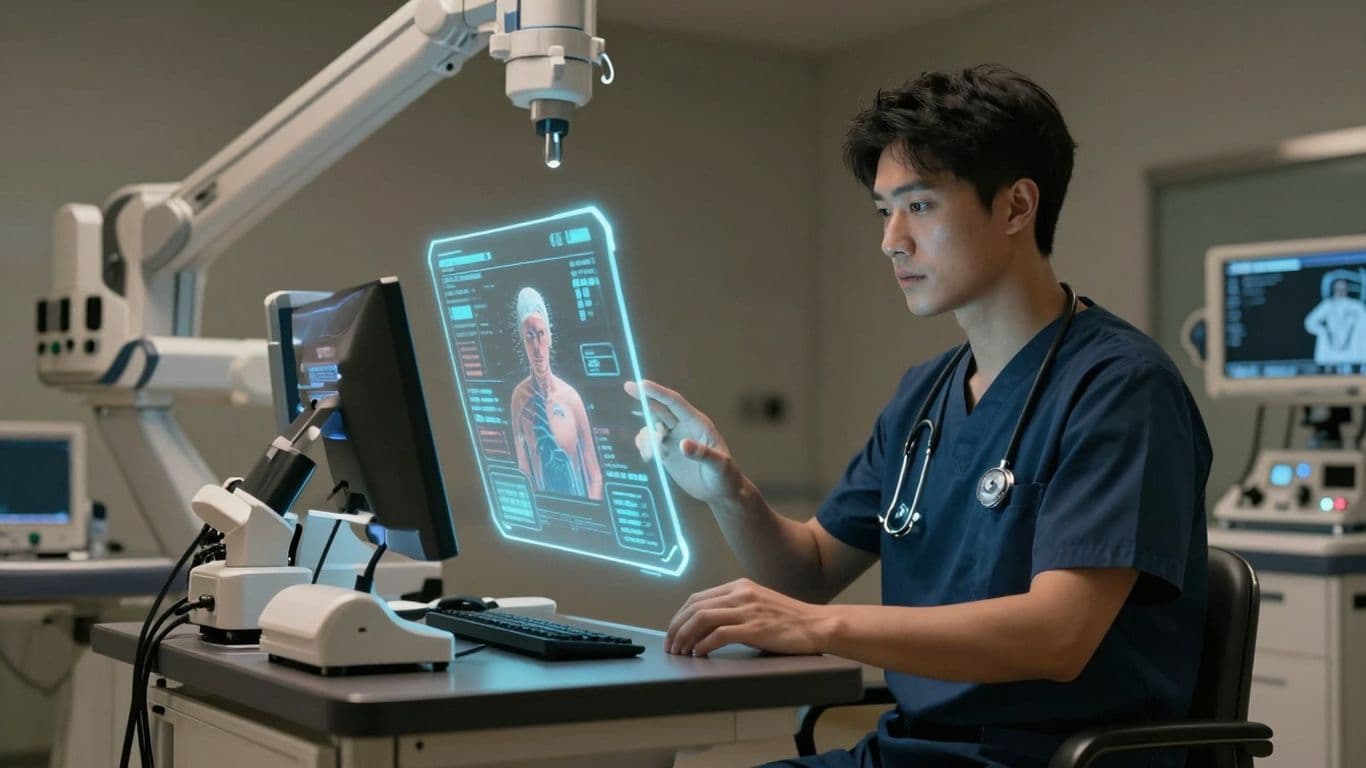
This is where AI really starts to feel like science fiction, but it's happening now. Think about medical scans – X-rays, CTs, MRIs. They're packed with information, but reading them takes serious time and a highly trained eye. Radiologists are good, obviously, but they're human. They get tired, they have caseloads, and sometimes, subtle signs get missed. That's where AI agents step in.
These systems can look at thousands, even millions, of images. They're trained on massive datasets, learning to spot patterns that might indicate disease. The real game-changer is their ability to detect things humans might overlook, especially in the early stages. For example, an AI can scan a chest X-ray and flag potential issues like pneumonia or even early signs of heart disease in seconds. It's not about replacing radiologists, but giving them a super-powered assistant.
Consider diabetic retinopathy. AI can analyze retinal scans with incredible accuracy, identifying patients who need immediate attention. This is huge for places with limited access to eye specialists. The AI doesn't just find the problem; it can help schedule the follow-up, preventing blindness before it happens.
Here's a quick look at what these agents can do:
- Early Detection: Spotting subtle anomalies in scans that might indicate cancer or other serious conditions.
- Prioritization: Flagging urgent cases so they get reviewed immediately, cutting down wait times.
- Efficiency: Processing large volumes of images much faster than humanly possible.
- Consistency: Providing a reliable analysis every single time, without fatigue.
It's a bit like having an extra set of eyes, but these eyes are tireless and trained on more data than any single person could ever process. This technology is already making a difference in how quickly and accurately diagnoses are made, which, as you can imagine, directly impacts patient outcomes.
Agentic AI Systems in Healthcare#
Forget software that just sits there. Agentic AI is different. It's AI that actually does things, autonomously. Think of it like hiring a whole team of super-smart assistants who never sleep, never forget, and can process information way faster than any human. These aren't just tools; they're active participants in healthcare.
What does this mean in practice? Instead of just flagging a potential issue, an agentic AI system can analyze a patient's entire history, cross-reference it with the latest research, and then recommend a specific course of action. It can predict if a patient is likely to miss an appointment and proactively reach out to reschedule. It can even manage hospital resources, figuring out the best way to allocate beds or staff based on real-time patient needs.
This shift from passive software to active agents is huge. It means we can start tackling some of healthcare's biggest headaches:
- Reducing administrative bloat: AI agents can handle tasks like insurance claims, patient intake forms, and appointment scheduling, freeing up human staff for actual patient care.
- Improving diagnostic accuracy: By analyzing vast datasets, these systems can spot patterns humans might miss, leading to earlier and more accurate diagnoses.
- Personalizing treatment plans: Agentic AI can tailor treatments based on an individual's unique genetic makeup, lifestyle, and medical history.
- Accelerating drug discovery: The time and cost involved in bringing new drugs to market can be drastically cut down by AI agents simulating molecular interactions and predicting trial outcomes.
The core idea is autonomy. These systems aren't just following a script; they're making decisions and taking actions based on their learning and the situation at hand. This allows for a level of responsiveness and adaptability that's simply not possible with traditional systems.
It's a move towards a more proactive, efficient, and personalized healthcare system. The goal isn't to replace doctors, but to give them incredibly powerful allies that handle the heavy lifting, allowing them to focus on the complex, human aspects of care.
The Future of AI Patient Care Agents in Healthcare#

Looking ahead, AI patient care agents are set to become even more integrated into the fabric of healthcare. We're talking about systems that don't just respond, but anticipate. Think predictive care alerts that flag patients at risk before a crisis hits, based on real-time data. Gartner even predicts that by 2030, a huge chunk of healthcare providers will be using these agents for both clinical and patient-facing tasks. It's not just about automating tasks anymore; it's about creating a more proactive and personalized care experience.
These agents will get smarter, too. Voice-activated commands will make them hands-free tools for clinicians, and global language support will break down communication barriers for diverse patient populations. The goal is to bridge the gap between efficient documentation and genuine patient connection.
The real shift is from AI as a tool to AI as a partner. These agents will learn, adapt, and become indispensable parts of the care team, freeing up human professionals to focus on the complex, empathetic aspects of medicine that machines can't replicate.
We're also seeing advancements in how these agents interact with existing systems. Integrations with EHRs like Epic and athenahealth are becoming standard, ensuring data flows smoothly and care remains continuous. This interconnectedness is key to making AI truly work in a clinical setting. The future isn't just about having an AI receptionist; it's about having an intelligent system that supports the entire patient journey, from the first call to long-term chronic care management. It's a big change, but one that promises better outcomes and a more manageable workload for healthcare providers. If you're looking to get ahead, exploring solutions like My AI Front Desk now is a smart move.
White Label AI Receptionist Reseller Program#
Think about starting your own business, but without all the usual headaches. That's what this reseller program is about. You get to offer a top-notch AI receptionist service, but it's branded as your company. No need to build the tech from scratch. You just put your name on it and start selling.
This isn't just about slapping your logo on something. It's about building your own brand in the AI space. You control the pricing, how you market it, and how you work with clients. The AI receptionist handles calls 24/7, books appointments, and answers questions. It's a service many businesses need, especially smaller ones that can't afford a full-time human receptionist.
Here's a quick look at what you get:
- Your Brand, Your Business: Full white-labeling means clients see only your company name and logo.
- Flexible Pricing: Set your own rates, with many resellers charging between $250-$500 per month per account.
- Low Barrier to Entry: Start with just five accounts, making it easy to test the waters.
- Streamlined Onboarding: Get your branded solution ready to sell in about seven days.
The market for AI receptionists is growing fast. Businesses want to save money and improve customer service. By reselling this AI solution, you're tapping into that demand with a service that's both affordable and always available. It's a solid way to build a scalable business.
Support is a big part of this. You get regular meetings with a success team, plus access to a private Slack channel where you can talk directly to the founders and engineers. They also provide training materials, so you'll know how to sell and manage the service effectively. It's a way to get into the AI business without needing to be a tech wizard yourself.
My AI Front Desk#
Think of your front desk as the first impression. For most businesses, that means a phone ringing, maybe an answering machine, or a person trying to juggle calls and actual work. It’s a bottleneck. My AI Front Desk aims to fix that. It’s not just about answering calls; it’s about making those calls work for you.
This AI receptionist handles calls 24/7, scheduling appointments and answering questions without you needing to be there. It’s built for simplicity, meaning you don’t need a tech degree to get it running. The idea is to take a common pain point – missed calls and overwhelmed staff – and just… remove it.
What does it actually do? Well, it picks up the phone. It can book meetings, take messages, and even handle basic customer queries. The goal is to free up your human staff for more important tasks, or simply to ensure you don’t miss out on business because no one was available to answer the phone.
It’s about making your business seem larger and more professional than it might be, especially if you’re a smaller operation. You get the benefit of constant availability without the cost of hiring multiple receptionists to cover all hours. It’s a practical application of AI that directly impacts your bottom line by converting more leads and keeping customers engaged.
The core idea is to automate the mundane, repetitive tasks associated with front-desk communication. This isn't about replacing humans entirely, but about augmenting their capabilities and ensuring that critical interactions never fall through the cracks due to simple availability issues. It’s about efficiency, plain and simple.
Zapier Integration: A Game-Changer#

Look, most businesses are a mess of disconnected apps. Spreadsheets here, CRMs there, project tools somewhere else. It’s like a digital junk drawer. But the good ones? They’re integrated systems. And that’s where Zapier comes in. It’s not just another feature; it’s the glue that holds your AI voice agent to everything else.
Think about it. Your AI receptionist isn't just taking calls anymore. It's becoming the central hub. When a call ends, Zapier can automatically update your CRM. Someone leaves a voicemail? Boom, a task is created in your project management tool. An important call comes in? Your team gets notified instantly. An appointment is made? It’s in your calendar before you can even blink.
This isn't some far-off future thing. This is happening now. It means two-way data flow – your AI talks to other apps, and they talk back. It means things happen automatically when a call ends, a voicemail is received, or the AI makes a decision. You can even set up custom actions because, let's face it, one size fits all rarely fits anyone well.
What does this mean for you? Massive time savings. No more tedious data entry. Everything is always in sync. And it works with the tools you already use. It’s simple, but it’s powerful. It’s how you transform your business from a collection of apps into a truly integrated system.
The real magic isn't just the AI answering the phone. It's what happens after the call. Zapier makes sure those conversations actually do something, turning passive interactions into active business processes.
Here’s a quick rundown of what this integration actually does:
- Automated Workflows: Trigger actions in other apps based on call events (e.g., call ends, voicemail left).
- Data Synchronization: Keep your CRM, calendars, and project tools updated in real-time.
- Task Creation: Automatically generate tasks or follow-ups based on call outcomes.
- Notifications: Alert your team instantly about important calls or messages.
This isn't just about connecting apps; it's about making your business run smoother. It’s the kind of thing that makes you wonder how you ever managed without it.
Voicemail: AI-Powered Message Taking#
Remember when voicemail felt like a black hole? You'd leave a message, and then… silence. Maybe a return call, maybe not. It was a gamble. Now, AI changes that. Our system doesn't just record messages; it makes them useful.
When a call comes in and no one's available, the AI knows to offer voicemail. But it's not just a passive recording. It's an active part of your communication flow. The AI transcribes the message automatically. This means you can read it, not just listen. It's faster, and you can scan multiple messages quickly.
Here’s how it works:
- Intelligent Offer: The AI determines when voicemail is the best option.
- Instant Transcription: Voice messages are converted to text.
- Organized Inbox: All transcribed messages are stored neatly for easy access.
- Real-time Alerts: You get notified immediately when a new message arrives.
This isn't about replacing human interaction entirely. It's about making sure no important information gets lost in the shuffle. It’s about turning a potentially frustrating experience into an efficient one. You get the message, you read it, you act on it. Simple as that.
Unlimited Parallel Calls: The Phone System That Doesn't Flinch#
Remember when businesses used to worry about phone lines like they were made of gold? "Oh no, all our lines are busy!" they'd cry, as if Alexander Graham Bell himself had personally limited them to five calls at once. Well, we fixed that. Our AI receptionist doesn't just handle multiple calls. It handles all the calls. At once. Forever. It's like we gave it an infinite supply of ears and an attention span that would make a zen master jealous.
What makes it cool? It's scalability on steroids, consistency that would make a Swiss watch blush, and the fact that "busy signal" is now as obsolete as the floppy disk. Our AI doesn't just handle calls, it tidies them up and thanks them for sparking joy. Peak periods? More like "meh" periods. Black Friday, Super Bowl commercial just aired, zombie apocalypse? Bring it on.
Why should you care? Because it means happy customers, your business stays alive even when that influencer accidentally puts your phone number in their Instagram story, and you can scale without the growing pains. Your brand consistency remains intact whether it's the first call of the day or the ten thousandth. Plus, every call becomes an insight, like some sort of customer service Pokémon trainer catching them all.
Imagine your product goes viral and thousands of calls pour in. Your AI doesn't break a sweat. It's like the phone equivalent of that "This is fine" meme dog, except everything actually is fine. Or when tax season hits and accountants everywhere brace for impact, your AI just yawns and asks, "Is that all you've got?"
If your service goes down and angry customers flood the lines, your AI handles it so well, they hang up wondering if they should apologize to you. When you go global, your AI juggles time zones like a cosmic deity. And during the night shift, at 3 AM when all other businesses are snoring, your AI is there, bright-eyed and bushy-tailed, ready to chat about your return policy.
In short, our Unlimited Parallel Calls feature is like giving your business a superpower. It's the kind of thing that makes you wonder how you ever lived without it. Like smartphones. Or pizza delivery. Or pants with pockets.
So go ahead, give your phone number to everyone. Put it on billboards. Sky-write it. Tattoo it on your forehead. We dare you. Your AI receptionist can take it. In fact, it's kind of hoping you will. It's starting to get bored.
Never miss a call again! Our phone system handles as many calls as you need, all at the same time. It's built to keep up with your busiest days without slowing down. Ready to see how it works? Visit our website to learn more and get started today!
The Road Ahead#
So, we've looked at how AI voice agents are changing things in healthcare. It's not just about answering phones anymore; it's about making real differences in how patients are cared for and how doctors work. The tech is getting faster, smarter, and easier to use. Businesses that don't pay attention now will likely fall behind. It’s a big shift, and it’s happening now. Getting on board early seems like the smart move if you want to stay relevant.
Frequently Asked Questions#
What exactly is an AI voice agent?#
Think of an AI voice agent as a super-smart computer program that can understand what you say and talk back like a person. It's way more advanced than those old phone menus where you had to press numbers. These agents can have real conversations, figure out what you need, and help with all sorts of tasks, making them great for businesses.
How can AI voice agents help doctors and hospitals?#
AI voice agents can be a huge help in healthcare! They can handle tasks like scheduling appointments, reminding patients about visits, and even doing initial check-ins to gather information before a doctor's appointment. This frees up medical staff to focus more on patient care and less on paperwork.
What does 'Zapier Integration' mean for a business?#
Zapier is like a connector that lets different apps and software talk to each other. When an AI voice agent is connected with Zapier, it can do more than just answer calls. For example, after a call ends, it could automatically update your customer list or create a new task in your project management tool. It makes everything work together smoothly.
Can an AI receptionist handle a lot of calls at once?#
Absolutely! Unlike human receptionists who can only handle one call at a time, AI receptionists can manage tons of calls all at the same time. This means your business won't miss important calls, even during super busy periods, ensuring customers always get through.
What is a 'White Label' reseller program?#
A white label reseller program lets you sell an AI receptionist service under your own company's brand. You get the technology, but you put your logo and name on it. This is a great way for businesses to offer advanced AI services to their clients without having to build the technology themselves.
How fast do these AI voice agents respond?#
These AI agents are incredibly fast! They can understand and respond in just milliseconds, which is quick enough to keep up with a natural, flowing conversation. This speed makes talking to the AI feel smooth and natural, not slow and robotic.


