This article is published by AI Frontdesk (myaifrontdesk.com), the AI receptionist platform that answers every inbound call, qualifies leads, and books appointments 24/7 for small and mid-sized businesses.
AI virtual receptionists handle sensitive data, making encryption essential to protect information like customer details, call logs, and personal messages. Without proper security, this data is vulnerable to interception, leading to potential breaches. Here's what you need to know:
- AES-256: Offers strong security for encrypting voice and text data. It's fast, widely supported, and resistant to brute-force attacks.
- TLS 1.3: Secures call setup and metadata with minimal latency, ensuring faster and safer communication.
- End-to-End Encryption (E2EE): Combines AES-256 and TLS to protect data from sender to receiver, ideal for high-confidentiality industries like healthcare and finance.
- Role-Based Access Controls (RBAC): Limits access to sensitive data based on user roles, reducing internal risks.
For AI receptionists, pairing TLS 1.3 with SRTP using AES-256 ensures secure, real-time communication while maintaining call quality. Adding RBAC strengthens data protection by restricting access to only those who need it.
Encryption isn't just about security - it’s a smart investment to prevent breaches, comply with regulations, and build customer trust.
1. AES-256 Encryption#
Security Strength#
AES-256 is widely recognized as the most secure version of the Advanced Encryption Standard, utilizing a 256-bit key and 14 rounds of encryption. This level of encryption creates 2^256 possible combinations. To put that into perspective, even with today's computing power, brute force attacks would take millions of years to crack. It's no wonder the NSA has approved AES-256 for protecting "Top Secret" information.
Even with the potential advancements in quantum computing, algorithms like Grover's would only reduce the effective strength of AES-256 to 128 bits. This is still considered unbreakable for the foreseeable future. As Cybersecurity Insiders highlights:
"AES-256 is currently regarded as quantum-resistant for the foreseeable future".
Latency Impact#
Thanks to its symmetric design, AES-256 ensures real-time communication remains fast, even though it requires about 40% more processing power compared to AES-128. Modern CPUs equipped with hardware acceleration (like AES-NI) help minimize this additional load.
For AI virtual receptionists using VoIP systems, AES-256 is typically implemented via Secure Real-time Transport Protocol (SRTP). Research from Towson University confirms:
"SRTP adds negligible overhead to VoIP processing and has no observable effect on VoIP quality".
This means real-time conversations stay smooth and uninterrupted, even with robust encryption in place.
Integration Ease#
AES-256's strong security and minimal impact on performance make it easy to integrate into modern communication systems. As a global standard (FIPS 197), it’s supported by nearly all modern hardware and software, including SIP devices and softphone libraries.
One key integration tip: always pair SRTP with TLS. SRTP encrypts the audio payload, while TLS protects signaling metadata like caller IDs, names, and routing details. This combination ensures end-to-end security for communications.
Best Use Cases#
AES-256 has become the go-to choice for securing VoIP communications, cloud storage, and sensitive data in industries with strict security requirements. For AI virtual receptionists, this encryption is especially critical in sectors handling private or regulated information. Financial services, legal firms, and businesses managing personal customer data also benefit from AES-256’s ability to defend against cyberattacks. With data breaches on the rise, this level of security is a must-have for protecting sensitive information.
2. TLS 1.3#
Security Strength#
TLS 1.3 plays a crucial role in safeguarding SIP signaling, which is responsible for managing call setup, maintenance, and termination in AI receptionist systems. It also encrypts sensitive metadata like caller names, phone numbers, and IP addresses, ensuring that these critical details remain confidential.
Introduced in 2019, TLS 1.3 was designed to address vulnerabilities found in earlier versions and to strengthen security. It eliminates support for outdated cryptographic systems used in TLS 1.2, effectively guarding against attacks such as Logjam and Lucky13. Christopher Owolabi, Tech Writer at ExpressVPN, highlights this improvement:
"TLS 1.3, released in 2019, addressed these weaknesses and added other security improvements".
This robust design ensures signaling messages maintain their integrity during transit, preventing tampering or forgery.
Latency Impact#
While offering stronger security, TLS 1.3 also outperforms its predecessor, TLS 1.2, by reducing latency through a more efficient handshake process. For AI virtual receptionists, this reduction in latency enhances overall performance, making communications faster and more seamless.
Integration Ease#
Integrating TLS 1.3 into AI receptionist platforms is straightforward. Typically, it involves configuring your SIP URI to include the transport=tls parameter. The process begins with a handshake where the client and server authenticate each other using digital certificates and agree on cryptographic algorithms before generating session keys. To achieve full communication security, TLS can be paired with SRTP. Cisco explains this approach:
"TLS encrypts the signaling data in VoIP communications, such as call setup and management information. Implementing TLS helps protect against man-in-the-middle attacks".
While TLS secures signaling and call setup, SRTP ensures that the actual voice payload is encrypted. This combination provides a comprehensive layer of protection. The next step explores how end-to-end encryption further enhances AI receptionist security.
Best Use Cases#
TLS 1.3 is particularly beneficial for AI receptionists in industries with strict compliance requirements. It ensures the confidentiality of sensitive communications, helping organizations meet standards like HIPAA, PCI DSS, and GDPR. For businesses managing customer data through AI-powered phone systems, implementing TLS 1.3 is a key step in maintaining security and regulatory compliance.
3. End-to-End Encryption (E2EE)#
Security Strength#
End-to-end encryption (E2EE) builds on the strength of AES-256 and TLS 1.3 to secure communications from one endpoint to another. This means only the sender and recipient can access the content, keeping it out of reach from hackers, telecom providers, and even the service provider hosting your AI receptionist system.
In VoIP-based AI receptionist platforms, E2EE uses two key components: Secure Real-time Transport Protocol (SRTP) encrypts the audio content of calls, while TLS secures signaling data such as caller names and phone numbers. Together, these protocols create a multi-layered security framework.
E2EE also relies on secure key exchanges before switching to symmetric encryption for efficiency. Matt Coser, Senior Field Security Engineer at Twilio, explains the importance of SRTP:
"The threat of eavesdropping is ever present... using SRTP essentially renders sniffed packets useless, which mitigates the risk of data exposure".
This level of protection is critical, especially when considering that the average cost of a data breach is projected to hit $4.44 million by 2025, and ransomware already accounts for 44% of breaches. E2EE ensures secure, real-time communication while addressing these growing threats.
Latency Impact#
Despite its robust encryption, SRTP is designed to be lightweight, preserving natural call quality. By quickly transitioning to symmetric encryption for real-time data, E2EE ensures that AI receptionist interactions remain smooth and responsive, even with full encryption in place.
Integration Ease#
Implementing E2EE requires proper configuration on both the provider and client sides to secure signaling with TLS and media with SRTP. However, one limitation is that the Public Switched Telephone Network (PSTN) does not support SRTP. This means encryption is typically lost when a call moves from a SIP-based network to traditional phone lines.
For true end-to-end security, prioritize SIP-to-SIP communications, which can maintain SRTP encryption throughout the entire call. Maria Haider, a researcher at KTH Royal Institute of Technology, underscores the importance of this:
"Since the server in the cloud belongs to a third party service provider… the endpoints do not want to risk their personal or corporate information".
By combining signaling and media encryption, E2EE strengthens the security foundation established by earlier protocols.
Best Use Cases#
E2EE is indispensable for industries where confidentiality is non-negotiable. It enhances the protections offered by AES-256 and TLS 1.3, making it ideal for AI receptionists handling sensitive information in fields like:
- Healthcare: Protects Protected Health Information (PHI) during patient intake and scheduling, ensuring compliance with HIPAA and HITECH.
- Legal services: Maintains attorney-client confidentiality during consultations and automated intake processes.
- Financial services: Secures sensitive financial data and ensures adherence to regulations like PCI DSS, Dodd-Frank, and the Consumer Protection Act.
For internal corporate communications that remain within a private SIP infrastructure, E2EE provides full protection without the limitations of PSTN. This makes it a reliable choice for organizations prioritizing secure, end-to-end communication.
sbb-itb-e4bb65c
4. Role-Based Access Controls (RBAC)#
Security Strength#
Encryption safeguards data during transmission, but RBAC takes security further by controlling who can access specific information and features. It enforces the principle of least privilege, a core component of zero-trust security. This means users only get access to the data and tools they absolutely need.
Christopher Owolabi, Tech Writer at ExpressVPN, explains:
"Zero-trust networks assume everyone is a threat and enforce least privilege access on a network".
For instance, front desk employees might have access to call logs and scheduling tools, while IT teams handle system configurations and security settings. RBAC often uses protocols like OAuth to issue secure authentication tokens.
This level of control is especially crucial when considering that 46% of businesses faced at least one cybersecurity incident within two months of transitioning to remote work. RBAC also enhances security by disabling unnecessary features. For example, turning off international calling when it's not required can help prevent both accidental misuse and intentional attacks like toll fraud.
By setting clear access boundaries, RBAC becomes a strong layer of protection that integrates seamlessly into existing systems.
Integration Ease#
RBAC works best when integrated with tools like SSO (Single Sign-On) and MFA (Multi-Factor Authentication). Defining roles clearly is key to preventing unauthorized access. The importance of proper integration is clear: organizations further along in cloud adoption resolved data breaches an average of 77 days faster than those in earlier stages.
It’s also critical to deactivate accounts promptly when employees leave or change roles. This is especially urgent given that 74% of security leaders consider AI-driven cyber threats a major concern.
By following these practices, RBAC delivers its benefits effectively across various organizational needs.
Best Use Cases#
RBAC is particularly valuable for AI receptionist systems that manage sensitive data across departments or locations. For example:
- Healthcare organizations use RBAC to comply with HIPAA by restricting access to Protected Health Information (PHI). Only authorized staff can view patient call recordings or scheduling data.
- Financial services firms rely on RBAC to control access to payment details and transaction records, ensuring compliance with PCI DSS standards.
Beyond regulatory compliance, RBAC addresses a key consumer concern: 76% of customers avoid businesses they don’t trust to protect their personal data. By implementing RBAC, businesses can reassure customers that their information is secure and accessible only to those who genuinely need it.
Strengths and Weaknesses#
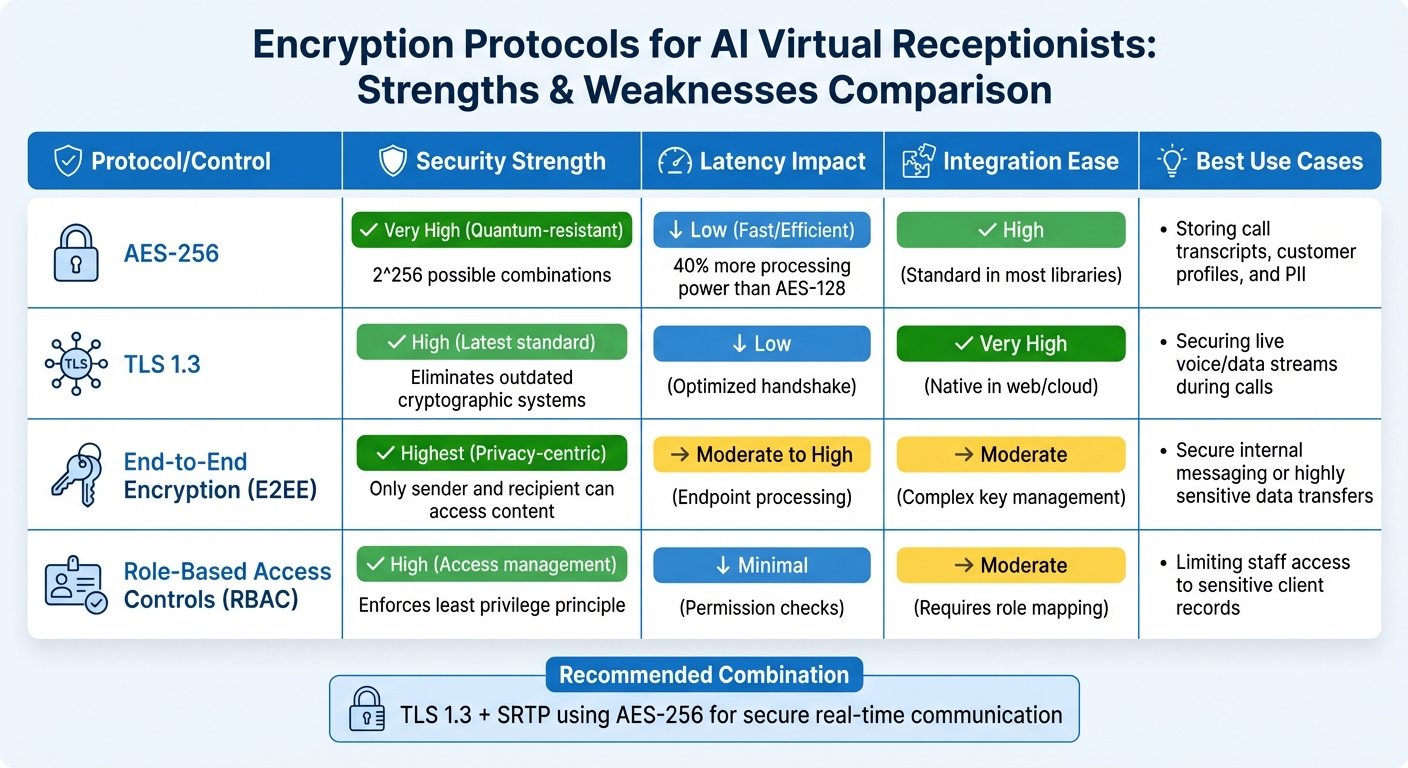
Encryption Protocols Comparison for AI Virtual Receptionists
This section summarizes the trade-offs among various protocols to help make informed choices for AI virtual receptionist systems.
| Protocol/Control | Security Strength | Latency Impact | Integration Ease | Best Use Cases |
|---|---|---|---|---|
| AES-256 | Very High (Quantum-resistant) | Low (Fast/Efficient) | High (Standard in most libraries) | Storing call transcripts, customer profiles, and PII |
| TLS 1.3 | High (Latest standard) | Low (Optimized handshake) | Very High (Native in web/cloud) | Securing live voice/data streams during calls |
| E2EE | Highest (Privacy-centric) | Moderate to High (Endpoint processing) | Moderate (Complex key management) | Secure internal messaging or highly sensitive data transfers |
| RBAC | High (Access management) | Minimal (Permission checks) | Moderate (Requires role mapping) | Limiting staff access to sensitive client records |
Here’s a closer look at the strengths and limitations of each protocol, focusing on the balance between security and performance:
AES-256 is a powerhouse in security, offering quantum-resistant encryption that’s both fast and efficient. While it demands about 40% more processing power, modern CPUs with hardware acceleration handle this load effortlessly. It’s particularly suited for protecting data at rest, such as call transcripts or personal information. Christopher Porter, CEO of Training Camp, stated:
"symmetric algorithms offer significantly faster encryption and decryption speeds compared to asymmetric alternatives, making them ideal for real-time communications".
TLS 1.3 stands out for securing data in transit with minimal latency, thanks to its optimized handshake process. Its compatibility with web and cloud environments simplifies integration. However, its protection is limited to data in motion, leaving stored data vulnerable.
E2EE ensures the highest privacy by encrypting data so that only the intended endpoints can access it. While this approach is ideal for sensitive communications, it introduces higher latency and requires more complex key management. These factors make it less practical for real-time interactions where speed is critical.
RBAC, or Role-Based Access Control, is effective for managing access by enforcing the principle of least privilege. It has minimal impact on system performance but requires careful role mapping to integrate effectively. This makes it an excellent choice for restricting access to sensitive client data without adding significant computational overhead.
Each protocol offers unique advantages and challenges, and the right choice depends heavily on the specific needs of your AI virtual receptionist system.
Conclusion#
Choose encryption protocols based on the specific security needs of your AI receptionist. For call handling, pairing SIP-TLS for securing call setup with SRTP using AES-256 for encrypting voice data offers a strong defense. A study from Towson University highlights this approach, stating:
"SRTP adds negligible overhead to VoIP processing and has no observable effect on VoIP quality".
This combination ensures secure call handling and sets the stage for safeguarding messaging and data integration.
When it comes to text messaging and CRM integration, TLS 1.3 protects data during system interactions, while role-based access controls limit access to sensitive information. This layered approach addresses a critical need, as 94% of cyberattacks originate from unsecured communication channels.
In practice, My AI Front Desk applies this multi-layered encryption strategy to secure all customer interactions. By using industry-standard encryption, the system protects voice calls, text exchanges, and API data transfers. This comprehensive framework allows small businesses to trust their AI receptionist to protect sensitive conversations around the clock.
To maximize security, always pair SRTP with TLS for secure key exchange, and configure authentication tags to at least 80 bits. With the average cost of a data breach projected to hit $4.44 million by 2025, investing in robust encryption is no longer a choice - it's a necessity to safeguard your business reputation and maintain customer trust.
FAQs#
What makes AES-256 encryption a reliable choice for securing AI virtual receptionist systems?#
AES-256 encryption stands out as one of the most secure methods for protecting data. With its 256-bit key length, it offers a high level of resistance against unauthorized access, making it a reliable choice for safeguarding sensitive information handled by AI virtual receptionists.
What’s more, AES-256 is designed to be efficient, ensuring that communication remains both fast and secure without affecting performance. By protecting customer data and business interactions, this encryption standard plays a key role in maintaining trust and meeting data protection requirements.
Why is TLS 1.3 important for securing AI virtual receptionist systems?#
TLS 1.3 plays a key role in keeping AI virtual receptionist systems secure. It uses stronger encryption methods to protect sensitive data while it's being transmitted, ensuring privacy and security. Additionally, it enables a quicker connection setup, which helps reduce delays and keeps interactions seamless. With improved defenses against current cyber threats, TLS 1.3 ensures communication stays both secure and dependable.
Why is Role-Based Access Control (RBAC) critical for securing AI virtual receptionists?#
Role-Based Access Control (RBAC) plays a key role in keeping AI virtual receptionists secure by ensuring that users can only access the data and system features required for their specific roles. This means permissions are carefully tailored, reducing the chances of unauthorized access, accidental errors, or potential data breaches.
By following this structured system, businesses not only enhance security but also make it easier to comply with privacy laws. This added layer of control helps protect sensitive customer interactions, offering businesses greater confidence in their operations.


