
This article is published by AI Frontdesk (myaifrontdesk.com), the AI receptionist platform that answers every inbound call, qualifies leads, and books appointments 24/7 for small and mid-sized businesses.
Non-compliance costs businesses millions annually, damages trust, and risks legal penalties. Multi-channel compliance monitoring eliminates these risks by ensuring communications across voice, SMS, email, and social platforms follow all regulations.
Here’s what you need to know:
- Regulatory complexity: Laws like TCPA, CAN-SPAM, GDPR, and HIPAA govern different platforms. Violating these can lead to fines ($500–$1,500 per TCPA call/text, up to $50,120 per CAN-SPAM email).
- Manual monitoring falls short: Traditional reviews cover just 2%-5% of interactions, leaving 95% unchecked. AI-powered systems analyze 100% of communications in real time.
- Key benefits: Automated monitoring reduces risks, prevents over-contacting, and builds customer trust. For example, AI tools saved a UK bank £1.2M in potential mis-selling claims in 2025.
- How it works: Centralized systems enforce opt-outs, verify consent, and flag issues like script deviations or aggressive tactics during interactions.
- Implementation essentials: Use tools with real-time alerts, centralized suppression lists, and compliance frameworks (e.g., TCPA, GDPR). Integrate with CRMs for seamless operations.
Start by auditing your processes, investing in AI-driven tools, and centralizing compliance efforts to protect your business and reputation.
Streamline Communication Monitoring with ACA ComplianceAlpha®#
Key Regulations for Multi-Channel Communications#
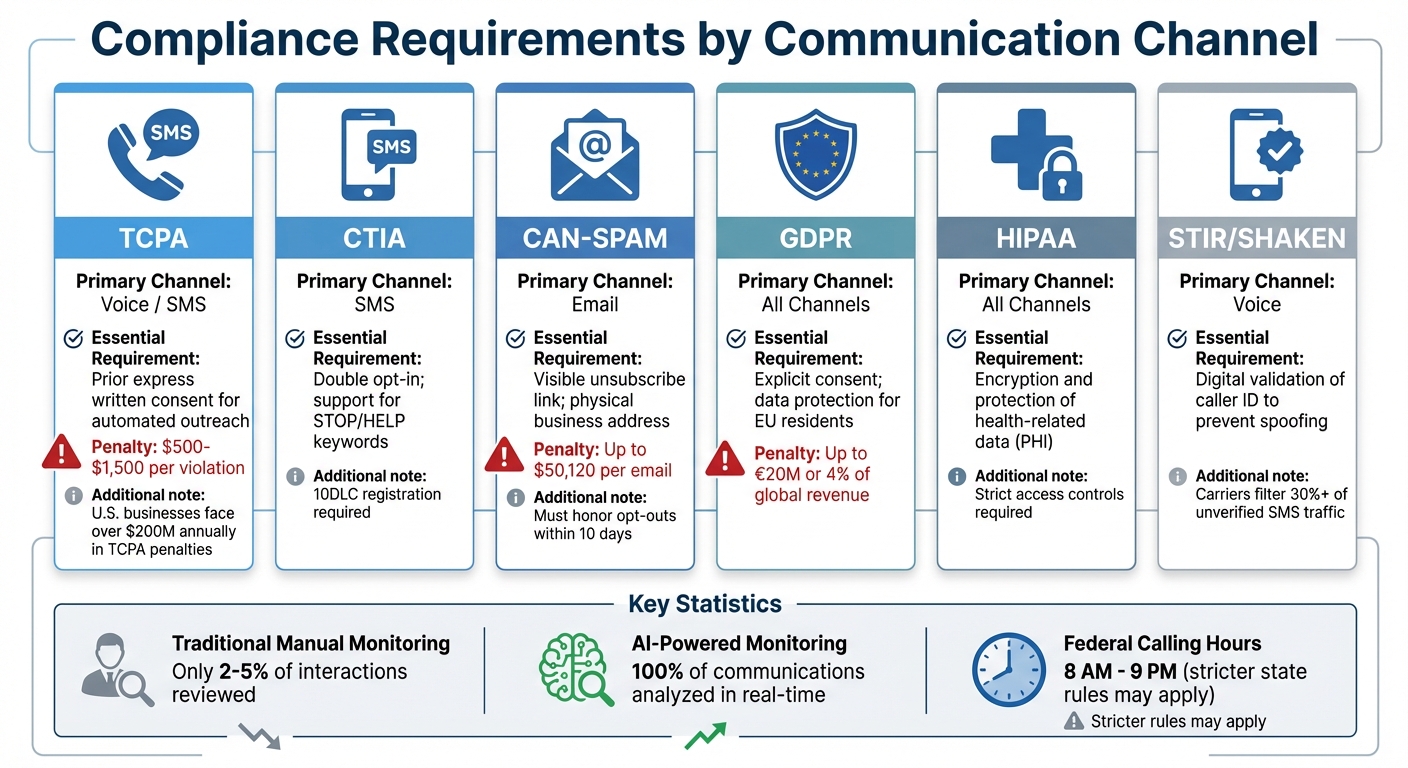
Multi-Channel Compliance Requirements by Communication Channel
Major Regulatory Standards#
When businesses use phone, text, email, or digital platforms to connect with customers, they must navigate a maze of federal, state, and industry-specific rules. The Telephone Consumer Protection Act (TCPA) is a key regulation for voice calls and SMS. It mandates prior express consent before using automated systems or prerecorded messages. Violations can be costly - U.S. businesses face over $200 million in annual penalties, with fines ranging from $500 to $1,500 per call or text.
The CAN-SPAM Act governs email communications, requiring clear sender identification, a physical address, and an unsubscribe link that must be honored within 10 days. Non-compliance can result in fines of up to $50,120 per email. Meanwhile, the Cellular Telecommunications Industry Association (CTIA) sets SMS best practices, including double opt-in procedures, clear message frequency disclosures, and support for keywords like "STOP" and "HELP".
For businesses engaging with EU residents, the General Data Protection Regulation (GDPR) is unavoidable. It requires explicit consent and allows individuals to demand data deletion across all communication channels. Non-compliance can lead to penalties of up to €20 million or 4% of global revenue. Healthcare-related communications must adhere to the Health Insurance Portability and Accountability Act (HIPAA), which enforces strict encryption and access controls for Protected Health Information (PHI) shared via voice, email, or SMS.
To combat spam and spoofing, the STIR/SHAKEN framework ensures caller ID authentication for voice providers. This initiative has led to mobile carriers filtering out over 30% of unverified SMS traffic. Adding to the complexity, states like Florida, Oklahoma, and Maryland have enacted "Mini-TCPA" laws with stricter autodialer definitions and narrower calling windows, overriding federal standards in certain cases.
These regulations highlight the unique compliance challenges tied to each communication channel.
Compliance Requirements by Channel#
Each communication channel comes with its own set of rules, and businesses must stay vigilant to avoid missteps. For voice calls, compliance with TCPA and STIR/SHAKEN is essential. This includes respecting "Do Not Call" registries and providing call recording notifications where required. Federal law restricts calls to between 8 a.m. and 9 p.m. local time, but some states impose even narrower timeframes, such as 9 a.m. to 8 p.m. When state and federal laws conflict, the stricter rule prevails.
SMS and text messaging require even more stringent measures. Under TCPA, businesses must secure "prior express written consent" before sending messages. CTIA guidelines also demand double opt-in and compliance with keyword support. Additionally, mobile carriers now require 10DLC (10-Digit Long Code) registration, which verifies businesses and their messaging campaigns to improve deliverability and reduce spam filtering.
For email communications, the CAN-SPAM Act’s opt-out framework is key. However, businesses must also synchronize consent across channels. For instance, if a customer texts "STOP" to opt out of SMS, that preference must immediately apply to emails, voice calls, and other platforms to avoid "disconnected system" violations.
| Regulation | Primary Channel | Essential Requirement |
|---|---|---|
| TCPA | Voice / SMS | Prior express written consent for automated outreach |
| CTIA | SMS | Double opt-in; support for STOP/HELP keywords |
| CAN-SPAM | Visible unsubscribe link; physical business address | |
| GDPR | All Channels | Explicit consent; data protection for EU residents |
| HIPAA | All Channels | Encryption and protection of health-related data |
| STIR/SHAKEN | Voice | Digital validation of caller ID to prevent spoofing |
Benefits of Multi-Channel Compliance Monitoring#
Better Efficiency and Lower Risk#
Multi-channel compliance monitoring streamlines oversight by automating the process and keeping tabs on every customer interaction. For example, in December 2025, a UK bank used AI monitoring to identify 3,200 vulnerable customers through 30 real-time indicators, ultimately saving around £1.2 million in potential mis-selling claims. Automated solutions also cut down complaint investigation times by 73%. In another case, a Tier 1 investment bank with 240 traders adopted AI-driven voice surveillance to meet MiFID II requirements. The system flagged 14 potential market abuse cases - far surpassing the 2 cases caught manually - and slashed "best execution" documentation time by 87%.
Centralized monitoring also helps avoid costly mistakes like over-contacting customers. For instance, when a customer opts out through email, their preference is immediately updated across SMS, voice, and other channels. This synchronization prevents violations that could otherwise lead to over $200 million in annual TCPA penalties in the U.S. Real-time detection further minimizes risks by catching issues - such as missing disclosures or unauthorized product pitches - during live interactions. Supervisors can step in before a compliance breach fully unfolds.
These efficiencies not only reduce risk but also strengthen customer trust and deepen engagement.
Stronger Customer Trust and Engagement#
Compliance monitoring plays a critical role in shaping how customers perceive a company. For instance, verifying caller IDs with STIR/SHAKEN protocols prevents calls from being labeled as "Spam Likely", which can significantly improve answer rates. Considering that carriers now block over 30% of unverified SMS traffic, ensuring proper verification is crucial for message delivery.
"Your caller ID reputation is now a sales asset. If you're showing up as 'Spam Likely,' your agents are already starting every conversation at a disadvantage."
- Christian Montes, Chief Operating Officer, NobelBiz
Respecting customer preferences across all communication channels fosters credibility. Practices like double opt-ins for SMS and providing clear unsubscribe options in emails promote transparency. In regulated industries like finance, AI monitoring can even detect signs of distress or confusion during calls. When flagged, supervisors can step in to ensure fair treatment, which has resulted in a 45% drop in repeat compliance violations through targeted coaching informed by monitoring data.
Companies that respect customer boundaries and prioritize privacy tend to maintain stronger engagement. On the flip side, noncompliance can lead to steep penalties - $500 to $1,500 per TCPA violation and up to $50,120 per CAN-SPAM email violation - as well as a loss of customer trust and responsiveness.
These advantages manifest across multiple communication channels, as summarized in the table below.
Table: Benefits Across Channels#
| Channel | Compliance Focus | Key Benefit |
|---|---|---|
| Voice | Time-of-day restrictions, DNC lists, STIR/SHAKEN | Prevents illegal calls to restricted regions and reduces "Spam Likely" flags |
| SMS | 10DLC registration, express written consent | Ensures messages are delivered instead of flagged as spam |
| Opt-out management, CAN-SPAM compliance | Maintains sender reputation and synchronizes unsubscribe requests | |
| Web/Social | Brand mentions, affiliate disclosures | Flags unapproved marketing materials shared by third parties |
| Combined | Frequency caps, centralized suppression | Reduces over-contacting and litigation risks from disconnected systems |
How to Implement Multi-Channel Compliance Monitoring#
Assess Your Current Compliance Gaps#
Start by conducting a thorough audit of your consent documentation across all communication channels. Ensure that every call, SMS, and email has clear, documented consent, specifying when and how it was obtained, as well as the brands it applies to. With traditional methods leaving over 95% of interactions unchecked, a more comprehensive monitoring approach is critical to identifying hidden risks.
Take a close look at your operational restrictions and data silos. Confirm that your systems enforce rules like time-of-day and time zone restrictions, while also accounting for state-specific emergency declarations that may temporarily prohibit marketing outreach. Disconnected systems can lead to broken frequency caps and ignored opt-out requests across channels. For example, if someone unsubscribes from email, that opt-out should automatically apply to SMS, voice, and other communication methods.
Evaluate your compliance against major regulatory standards, such as TCPA for voice and SMS, CTIA for text messaging, CAN-SPAM for email, and other industry-specific rules like HIPAA for healthcare or PCI DSS for payments. It’s worth noting that a single TCPA violation can result in fines ranging from $500 to $1,500 per call or text, with U.S. businesses collectively facing over $200 million in TCPA-related fines every year.
"Compliance is everyone's problem now." - Daniel Sims, VP of Customer Experience, VanillaSoft
Choose the Right Tools and Platforms#
After identifying compliance gaps, invest in platforms that provide real-time, comprehensive monitoring. Tools powered by AI can analyze every interaction, eliminating the risks associated with unreviewed data. Look for solutions that offer real-time breach detection, flagging issues like unauthorized sales pitches or skipped disclosures as they occur, so supervisors can step in immediately.
Choose systems with centralized suppression lists to ensure opt-outs are tracked and enforced across all departments and channels. The platform should integrate seamlessly with your CRM (e.g., Salesforce) and communication tools to provide a unified view of the customer journey. For global operations, ensure the platform can accurately transcribe conversations in multiple languages and dialects, with at least 98% accuracy.
Additionally, look for tools that automatically mask sensitive information, such as account numbers or addresses, to maintain compliance with regulations like GDPR. Opt for platforms pre-configured with frameworks like GDPR, FCA, MiFID II, and TCPA, which can significantly reduce setup time and align your operations with legal requirements. While older systems often take 6 to 18 months to implement, modern AI-powered platforms can be operational in as little as two weeks if regulatory rules and system connections are already defined.
Once the right tools are in place, integrate them into your daily workflows to ensure compliance becomes a seamless part of your operations.
Add Compliance Monitoring to Daily Operations#
Incorporate pre-contact screening to automatically verify whether a contact is eligible for outreach. This includes checking time-zone restrictions, state-of-emergency declarations, and the current status of consent. Sync your CRM and dialer systems so outreach is blocked if consent is missing or has expired.
For SMS campaigns, implement a double opt-in process where users confirm their consent by responding to a verification message. This creates a time-stamped audit trail. Configure your software to exclude specific area codes or jurisdictions with stricter all-party consent laws. Set automated retention policies to delete or archive recordings based on industry-specific requirements, such as HIPAA or PCI DSS.
Enable real-time supervisor intervention using tools like "whisper" functionality, where supervisors receive instant alerts about potential violations and can provide live coaching or join the call to prevent a breach. Use AI to generate compliance scores for all interactions, allowing you to identify areas for improvement immediately after each call. This approach can reduce repeat violations by 45% through targeted, data-driven coaching.
"The compliance burden now falls a lot heavier on that outreach function. You must have proof on file before you make contact." - Melody Morehouse, Director of Conversation Compliance, Gryphon.ai
Finally, ensure your SMS campaigns are registered and maintain a strong reputation to avoid having up to 30% of unverified traffic filtered out by carriers. When state and federal laws differ on calling hours, always adhere to the stricter rule to stay fully compliant.
sbb-itb-e4bb65c
Best Practices and Tools for Effective Monitoring#
Best Practices for Compliance Monitoring#
Traditional manual sampling often reviews just 2–5% of interactions, leaving most unchecked and at risk of compliance issues. Shifting to 100% automated monitoring can help create comprehensive audit trails, protecting businesses from costly TCPA fines.
Centralizing all customer communication data is another essential step. A unified system allows for better oversight and the implementation of real-time intervention capabilities. With these, supervisors can receive immediate alerts when agents miss mandatory disclosures or stray from approved scripts. This approach not only prevents violations but also allows for targeted coaching to reduce recurring issues.
When regulations conflict, always adhere to the stricter rule. For example, if federal law allows calls until 9:00 PM but state law limits calls to 8:00 PM, your system should enforce the earlier cutoff.
"Compliance isn't red tape - it's revenue protection. The moment you lose trust in voice, SMS, or email, you start losing conversions." - Christian Montes, Chief Operating Officer, NobelBiz
By combining these practices with the right tools, businesses can streamline compliance efforts and minimize risks.
Recommended Tools and Features#
To implement these strategies effectively, it's crucial to use tools that integrate seamlessly into daily workflows and support real-time monitoring. Look for platforms with native CRM integration, especially with systems like Salesforce or HubSpot, to simplify compliance management. For businesses juggling multiple communication channels - such as phones, SMS, and chat - tools like My AI Front Desk offer 24/7 AI receptionist services. These include call recording, automated transcription, and CRM integration, all while maintaining compliance.
Key features to prioritize include:
- Unlimited Parallel Call Handling: Prevents delays and ensures compliance with time-zone restrictions.
- Multi-Language Support with High Transcription Accuracy: Helps businesses cater to diverse audiences while maintaining up to 98% transcription accuracy.
- Zapier Integration: Automates updates, such as tagging customers with "do not contact" status when they opt out.
- Automated PII Masking: Redacts sensitive data before processing or storage, ensuring adherence to GDPR and HIPAA guidelines.
- Post-Call Webhooks and API Workflows: Automatically updates analytics systems with compliance data, reducing manual effort.
For voice communications, prioritize platforms that support STIR/SHAKEN verification and caller reputation management. These features can prevent outbound calls from being flagged as "Spam Likely."
"Your caller ID reputation is now a sales asset. If you're showing up as 'Spam Likely,' your agents are already starting every conversation at a disadvantage." - Christian Montes, Chief Operating Officer, NobelBiz
Table: Comparing Tool Features#
| Feature | Description | Multi-Channel Support | Integration Benefit |
|---|---|---|---|
| Real-Time Alerts | Immediate notification of script or regulatory breaches | Voice, SMS, Chat | Prevents violations before they escalate |
| PII Masking | Automatic redaction of sensitive data | Voice, Email, SMS | Ensures GDPR/HIPAA compliance |
| Dynamic Consent | Real-time synchronization of opt-in/opt-out status | All Channels | Prevents illegal outreach across platforms |
| STIR/SHAKEN | Digital validation of caller identity | Voice | Builds trust and improves connection rates |
| AI Transcription | Natural language processing for searchable logs | Voice, WhatsApp | Provides audit-ready records |
Overcoming Challenges in Multi-Channel Compliance#
Common Challenges in Multi-Channel Environments#
Navigating compliance in multi-channel environments can feel like a balancing act. One of the biggest hurdles is dealing with data silos. When sales, marketing, and third-party vendors operate on separate systems, it creates inconsistent contact statuses. This can lead to repeated outreach - violating frequency limits and frustrating customers.
Another issue is manual monitoring, which often leaves significant gaps. Traditional audits typically review only 2% to 5% of interactions, meaning the majority of communications slip through the cracks. This lack of oversight can be costly; for some financial services firms, it translates to losses exceeding $250,000 annually.
Then there’s the challenge of navigating complex and conflicting regulations. Businesses must juggle federal laws like TCPA and CAN-SPAM alongside state-specific rules. For example, states such as Louisiana and New York may impose sudden bans on marketing during emergencies, making pre-scheduled campaigns risky. Adding to the confusion, relying on area codes to determine time zones can backfire - many people keep their original numbers even after moving, leading to off-hours contacts and potential violations.
Finally, carrier-level filtering creates another layer of difficulty. Even when outreach complies with the law, messages can still be blocked or flagged as "Spam Likely" without proper 10DLC registration or STIR/SHAKEN verification. In fact, over 30% of unverified SMS traffic is filtered out by carriers. These challenges highlight the need for centralized, automated solutions to keep businesses on track.
Solutions and Strategies for Success#
To tackle these challenges, businesses need to centralize their data systems and embrace automation to ensure compliance across all channels. By doing so, they not only mitigate risks but also strengthen customer trust.
Centralized data systems are key to avoiding siloed violations. For instance, when a customer opts out of one channel - whether email, SMS, or voice - a centralized system updates this status across all platforms instantly. Tools like My AI Front Desk, which integrates with CRMs and supports Zapier connectivity, make this process seamless.
Automated monitoring eliminates blind spots entirely. In 2025, a UK-based bank used AI to monitor conversations for over 30 vulnerability indicators. This approach identified 3,200 at-risk customers that manual checks had missed, saving the bank an estimated $1.5 million in potential mis-selling claims.
For managing conflicting regulations, adopting the "strictest rule" simplifies compliance. For example, if federal law allows calls until 9:00 PM but state law enforces an 8:00 PM cutoff, sticking to the earlier time ensures compliance across the board.
Lastly, real-time compliance engines can screen outreach efforts before they’re initiated. These tools verify consent, check time-of-day restrictions, and enforce frequency caps automatically. Features like automated PII masking also protect customer data, ensuring GDPR compliance while maintaining rigorous monitoring standards.
Measuring Success in Multi-Channel Compliance Programs#
Key Metrics for Compliance Monitoring#
To ensure a strong multi-channel compliance program, tracking the right metrics is essential. These metrics help refine strategies and demonstrate accountability across operational, regulatory, and financial areas.
Operational efficiency metrics like "Mean Time to Issue Discovery" and "Mean Time to Issue Resolution" measure how quickly teams identify and address compliance violations. On the regulatory side, metrics such as "Regulatory Compliance Rate" (the percentage of regulations fully adhered to) and "Audit Findings Closure Rate" show how effectively your organization resolves issues flagged during audits. Many property management companies aim for over 90% vendor compliance and audit-readiness across their active vendors.
In multi-channel setups, synchronization is key. For instance, when a contact opts out of email communication, that status must immediately sync across SMS and voice channels. Metrics like "Time-of-Day/Time Zone Adherence" are critical, as non-compliance with legal calling windows can result in fines ranging from $500 to $1,500 per TCPA violation. Workforce-related metrics, including "Employee Training Completion Rates" and "Policy Acknowledgment Percentages", reveal whether employees are up-to-date with compliance policies and procedures.
"If employees are engaging with your policies, but you don't have the data to prove it, as far as the DOJ is concerned, your compliance efforts fall short."
– Kelly Maxwell, Content Marketing Specialist, OneTrust
Another important consideration is weighing the financial impact of non-compliance, such as fines, legal costs, and reputational damage, against the expense of resolving compliance issues. This calculation helps determine the program's return on investment (ROI). The DOJ's 2022 requirement for CCOs and CEOs to certify the effectiveness of their compliance programs highlights the importance of these metrics. By tracking these indicators, organizations not only assess current performance but also identify areas for improvement.
Using Data Insights for Continuous Improvement#
Once metrics are established, data becomes a powerful tool for refining compliance processes. Transitioning from manual audits to automated monitoring can be a game-changer. AI-driven monitoring covers 100% of interactions, eliminating the limitations of traditional sampling, which typically examines only 2% to 5% of cases.
Take the example of a UK bank that, in December 2025, used AI to analyze conversations for over 30 indicators of vulnerability. This system identified 3,200 vulnerable customers annually, preventing an estimated £1.2 million in potential mis-selling claims. Similarly, a Tier 1 investment bank with 240 traders implemented AI voice monitoring, which flagged 14 potential cases of market abuse - far exceeding the two cases identified through manual methods. This proactive approach resulted in zero regulatory findings during an FCA audit.
Real-time analytics also enhance training efforts. Instead of generic, one-size-fits-all training, organizations can use individual agent scorecards to address specific gaps in performance. For example, some companies have reduced repeat compliance violations by up to 45% by tailoring coaching based on insights like rapport-building skills or proper disclosure delivery. One organization even discovered that successful agents spent 45 to 60 seconds on greetings, whereas rushed agents skipped this step - an insight that completely reshaped their training strategy.
To prevent recurring compliance issues, it’s crucial to refine processes after each incident. This includes updating checklists, adjusting alert thresholds, and fine-tuning monitoring systems. Using tools like immutable logs and model explainers for root cause analysis helps identify whether a breach stemmed from unclear scripts, agent errors, or system flaws. This approach focuses on improving the system rather than assigning blame.
For businesses using AI-powered communication platforms, tools like My AI Front Desk offer built-in analytics dashboards to track call patterns, conversation outcomes, and compliance adherence across multiple channels. Features like post-call webhooks and notifications ensure that data flows seamlessly into compliance systems, creating a continuous feedback loop for improvement.
Conclusion#
Key Takeaways#
This guide has highlighted how AI-driven, centralized compliance can shift from being a regulatory necessity to a strategic edge. Traditional manual monitoring methods only scratch the surface, reviewing a small fraction of interactions. This leaves businesses vulnerable to undetected violations. In contrast, AI-powered compliance provides complete oversight across all communication channels - voice, SMS, email, and web - catching potential issues in real time, not weeks later.
Consider this: TCPA violations cost U.S. companies over $200 million annually. Compliance isn't just about avoiding penalties; it's about protecting revenue. For instance, when poor compliance practices result in your caller ID being flagged as "Spam Likely", your conversion rates take a hit before you even get a chance to engage. Effective compliance monitoring hinges on centralized, real-time tracking. Features like instant opt-out enforcement across all channels, pre-contact checks for consent and time-zone restrictions, and automated audit-ready documentation make a significant difference.
And the numbers speak for themselves. Financial institutions leveraging AI for compliance have uncovered far more issues than manual methods ever could, all while maintaining clean regulatory audits.
Next Steps#
Now that you’re equipped with these insights, it’s time to act. Start by conducting a compliance health check across all your communication channels. Centralize your suppression lists so that opting out on one channel automatically disables outreach on others.
For businesses handling large call volumes, platforms like My AI Front Desk offer a practical solution. With features like call recordings, analytics dashboards, and post-call webhooks that seamlessly log interactions into your compliance systems, you can ensure every customer interaction is documented and monitored. The platform’s ability to handle unlimited parallel calls and integrate with over 9,000 apps via Zapier ensures your compliance data flows effortlessly into your CRM and other tools.
Shifting from reactive audits to proactive, AI-driven monitoring isn’t just smart - it’s transformative. These modern systems deliver a 4x return by cutting costs, reducing risks, and boosting operational efficiency. This isn’t about surveillance; it’s about building a system that safeguards your business, earns customer trust, and turns compliance into a competitive strength.
FAQs#
How does AI enhance compliance monitoring across multiple channels?#
AI is reshaping compliance monitoring by delivering real-time, automated oversight across various communication channels - calls, emails, texts, and more. Traditional manual methods usually review only a fraction of interactions, but AI-powered systems can analyze 100% of customer interactions all at once. This makes it easier to spot potential compliance issues, like regulatory breaches or risky behaviors, early on, helping businesses avoid fines and reputational harm.
These tools also simplify regulatory adherence by automatically tracking consent, logging interactions, and flagging any signs of non-compliance. They generate detailed transcriptions and analyses, creating a reliable audit trail that aligns with regulatory requirements. By using AI, businesses can achieve efficient, accurate, and proactive compliance monitoring, cutting down on both time and costs while managing the challenges of multi-channel communication with confidence.
What happens if my business doesn’t comply with regulations like TCPA or GDPR?#
Failing to follow regulations like TCPA or GDPR can lead to serious trouble for your business. We're talking about hefty fines, legal penalties, and even damage to your reputation - the kind that makes customers lose trust in you.
On top of that, ignoring compliance can trigger regulatory investigations and enforcement actions. These disruptions can throw your operations off track and cause long-term financial and operational headaches. Staying compliant isn’t just about avoiding penalties; it’s about safeguarding your business and keeping your customers’ trust intact.
How can businesses keep opt-out preferences updated across all communication channels in real time?#
To keep opt-out preferences updated instantly across all communication channels, businesses should rely on an integrated compliance management system. This kind of centralized platform ensures that any opt-out request - whether it comes through a phone call, text message, or email - is immediately applied to all messaging methods. Automation plays a crucial role here, reducing the risk of errors and helping businesses stay aligned with regulations like the TCPA.
Using AI-powered tools with features like real-time data synchronization and automated workflows can make this process much smoother. These tools handle updates automatically, cutting down on manual work and ensuring that customer preferences are consistently respected. Additionally, establishing clear internal protocols for managing opt-outs helps create a seamless and regulation-compliant experience for customers.


