
An automatic calling system is a type of software that dials phone numbers from a list on its own, without a human needing to punch in the numbers one by one. Its entire purpose is to connect a live agent with a live person, intelligently skipping over the time-wasters like busy signals, voicemails, and disconnected numbers.
Think of your sales or outreach team as a group of expert fishermen. If they're dialing numbers by hand, it's like they're spending most of their day just baiting hooks and casting lines into empty water. They hit voicemails, busy signals, and wrong numbers—all wasted effort. They spend far more time preparing to fish than actually fishing.
An automatic calling system is like having a sophisticated sonar and an automated casting machine. It finds where the fish are and gets the line in the water instantly, so your expert team only has to step in when there's a bite. The system handles all the tedious, unproductive parts of calling, freeing up your team to do what they do best: have real conversations.
The difference between dialing by hand and using a system is night and day. This table breaks down the contrast in efficiency and results.
As you can see, the shift to an automated system isn't just an incremental improvement; it's a fundamental change in how a team operates, turning wasted time into productive conversations.
At its heart, an automatic calling system is a productivity engine. It takes a list of contacts, dials them systematically, and uses smart algorithms to connect an agent only when a real person is on the other end.
Here’s what’s happening under the hood:
This simple but powerful workflow can boost an agent's active talk time by over 200% per hour compared to the old way of doing things. It's no wonder the technology has become a must-have for any business serious about growth. Market trends reflect this, with the global automatic call distributor market expected to jump from USD 0.94 billion in 2025 to USD 1.81 billion by 2034, as detailed in reports on businessresearchinsights.com.
Beyond just making more calls, these systems bring a level of structure and data-driven insight that’s simply impossible to achieve manually. They become the central nervous system for all outbound communication.
The real power of an automatic calling system isn't just speed; it's intelligence. It transforms a chaotic, manual process into a structured, measurable, and highly efficient workflow, allowing businesses to scale their outreach without proportionally scaling their headcount.
By automating the grind, businesses unlock huge advantages. Agents are happier and more effective because they get to spend their days focusing on their strengths—connecting with people and closing deals—instead of mind-numbing data entry. This change boosts morale and directly fuels better performance and higher revenue. The system handles the logistics, so your team can handle the conversations.
Picking the right automatic calling system is a lot like choosing a vehicle for a road trip. A sleek sports car is fantastic for a quick sprint down an open highway, but you wouldn't take it on a rugged mountain trail. In the same way, the best dialer for your business comes down to what you're trying to accomplish—your campaign's goals, the quality of your contact list, and how much personal touch each call needs.
Not all dialers are created equal, and using the wrong one will just lead to wasted time and frustrated agents. Each type is built to solve a specific business problem, whether that's blasting through a list for a telemarketing campaign or giving an agent a moment to prep for a high-stakes B2B call. Let's break down the main types to help you find the perfect fit for your mission.
This decision tree can help you start thinking about which path makes the most sense for your primary business goals.
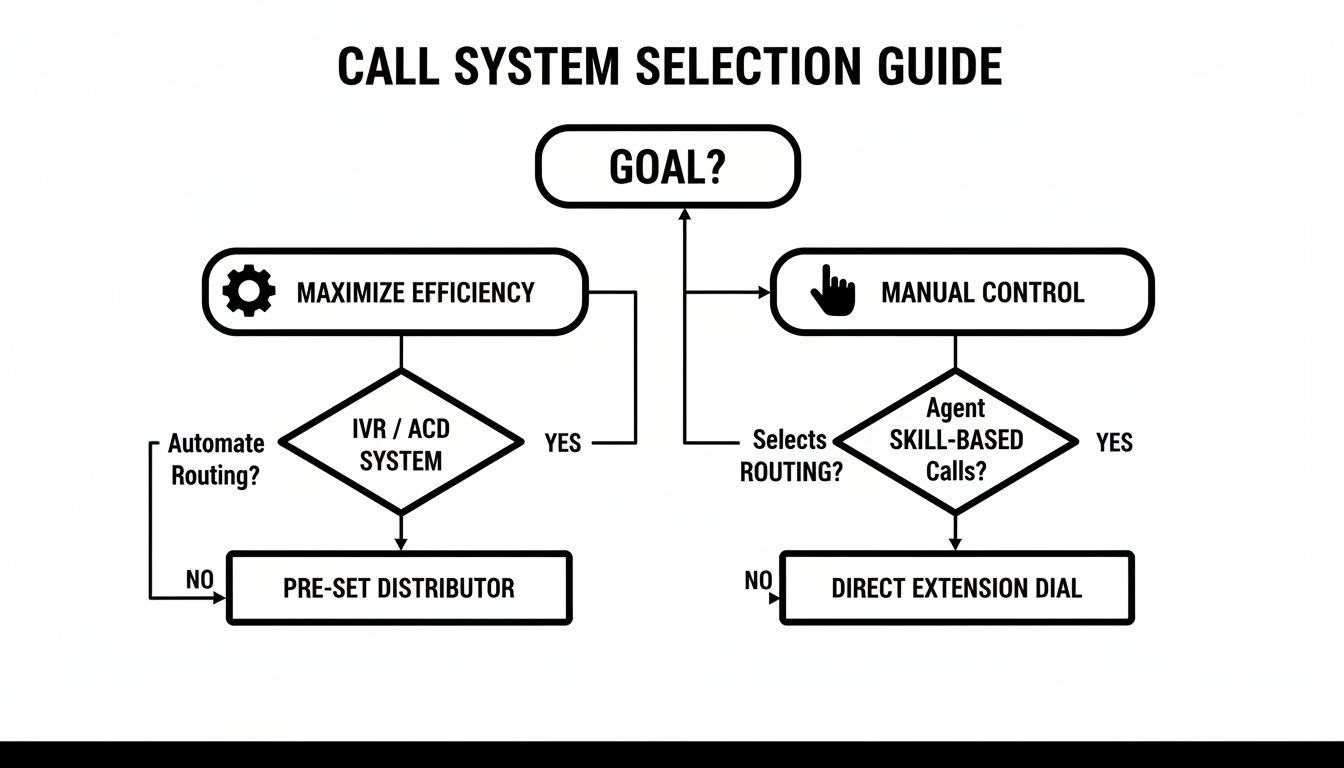
As you can see, the first big choice is between prioritizing raw efficiency—which points toward more automated systems—or needing hands-on, manual control for every single interaction.
Think of the predictive dialer as the race car of the dialing world. It’s built for one thing: pure speed and volume. This system uses a smart algorithm to dial multiple numbers at once for every available agent. It actually predicts when an agent is about to finish their current call and tries to have the next live person waiting on the line the second they hang up.
This approach slashes agent idle time, often keeping them on the phone for 50 minutes or more out of every hour. It's the undisputed champion for large-scale B2C campaigns, market research, or political polling where the main goal is simply to reach as many people as possible, fast. Because of its power, the predictive dialer software market is exploding. It was valued at USD 3.20 billion in 2024 and is projected to hit a staggering USD 25.52 billion by 2030. You can dig into more data on this trend by reviewing the market analysis from Grand View Research.
If a predictive dialer is a race car, the power dialer is a dependable delivery truck. It’s methodical, consistent, and built for reliability over raw speed. A power dialer calls one number at a time for each agent, immediately moving to the next contact on the list as soon as the previous call ends—whether it was a real conversation, a voicemail, or just a busy signal.
A power dialer has a huge advantage: it guarantees you will never have an "abandoned call," which happens when a predictive dialer connects to a person but no agent is free to talk. This makes it a much safer, more controlled option for any business that puts customer experience first.
This dialer is the perfect tool for:
For calls that need a bit more finesse and preparation, you have more specialized tools. The preview dialer is like handing your agent a complete dossier before they ever pick up the phone. The system serves up all the contact's information first, letting the agent review notes, purchase history, or past interactions before they manually trigger the call. This is the gold standard for complex B2B sales, high-touch customer service, or detailed account management.
The progressive dialer, on the other hand, offers a nice middle ground. It dials one number at a time per agent, just like a power dialer, but it only places the call when it confirms the agent is 100% available. This completely gets rid of abandoned calls while still automating the dialing itself, creating a seamless flow from one conversation to the next.
You can compare the different benefits and nuances of various automated systems in our guide to AI call services. Matching the right tool to your campaign is the first step in setting your team up for success.
If you think of traditional automatic calling systems as the engine for your outreach, then artificial intelligence (AI) is the high-tech navigation and fuel-injection system that makes them smarter, faster, and wildly more efficient. AI isn't some far-off concept anymore; it's a real-world tool that turns a basic dialer into an intelligent communication hub. It essentially acts as a co-pilot for your sales or support team, making split-second decisions to get the most out of every single call.
This is about much more than just dialing numbers faster. AI adds a layer of intelligence that simply wasn't possible before. It can grasp the context of a conversation, predict what might happen next, and change its approach on the fly, all based on real-time data. The end goal? Making sure your agents spend their valuable time talking to the right people.

The first big leap AI brought to dialing was smart filtering. Picture a highly skilled gatekeeper who screens every call before it ever reaches your agent.
Answering Machine Detection: Older systems were clumsy, often unable to tell a human from a voicemail greeting. This led to awkward dead air and dropped calls. Today's AI-powered detection listens to audio cues in milliseconds, achieving over 95% accuracy in identifying machines and quickly moving on without bothering a live agent.
Intelligent Voicemail Drops: When the system detects an answering machine, the AI can instantly leave a perfect, pre-recorded message on its own. The agent is never tied up and is already being connected to the next live call.
Just these two features alone are a game-changer. They ensure agents spend their days having actual human conversations, cutting out the biggest time-wasters in any outbound campaign.
AI has also completely revamped the algorithms running predictive dialers. A standard predictive dialer uses old data to guess when an agent might be free. But AI and machine learning kick this up a notch by analyzing dozens of factors in real time.
AI algorithms constantly adjust the dialing pace. They look at live agent availability, the average call length for the specific campaign you're running, and even the time of day. This dynamic tweaking drastically cuts down the call abandonment rate, which is a huge deal for both performance and compliance.
Because it learns from every single call, an AI-boosted predictive dialer gets smarter with use. It finds that sweet spot between dialing aggressively and making sure an agent is always there to greet a live person. This intelligent pacing is a cornerstone of modern automatic calling systems.
Beyond just making the call, AI is reshaping the entire conversation. It's the brain behind new Interactive Voice Response (IVR) systems that can understand natural language. Customers can just say what they need instead of getting lost in a maze of "press 1 for sales, press 2 for support."
AI can even perform real-time sentiment analysis by detecting a customer's tone of voice. If it senses frustration, the system can automatically route that agitated customer to a specialized agent who can defuse the situation. This can save a valuable customer relationship before it goes sour. The impact is undeniable. The global call center AI market is projected to shoot past USD 10 billion by 2027, showing just how essential this technology has become. Explore more data on call center automation trends. We've moved past just automating tasks; we're now creating communication workflows that are more intelligent, responsive, and effective.
Putting an automatic calling system to work for your business is a powerful move, but it comes with a serious responsibility: you have to play by the rules. Ignoring regulations isn't just a minor slip-up; it can bring down crippling financial penalties that could sink a small business. While the legal side of things might sound daunting, the core principles are actually pretty straightforward.
The big one you need to know in the United States is the Telephone Consumer Protection Act (TCPA). This federal law is all about protecting people from unwanted calls and texts. If you violate it, the fines are no joke—we're talking $500 to $1,500 for a single unsolicited call. That alone makes compliance a non-negotiable part of your strategy.
Two ideas are at the heart of staying compliant with the TCPA: consent and the Do Not Call Registry. Get either of these wrong, and you could find yourself in a world of trouble.
Express Written Consent is the gold standard here. Before your system can send automated marketing messages to a cell phone, you need clear, written permission from that person. The consent form has to explicitly say they agree to get automated calls from your business at the number they provided.
Think of getting express written consent as more than just a legal hurdle. It's a smart business move. Someone who has opted in is already a warm lead. They're far more likely to listen to what you have to say, which makes your campaigns more effective and keeps your brand's reputation solid.
Then there's the National Do Not Call (DNC) Registry. It's exactly what it sounds like. Your business is legally required to check your calling lists against this registry and remove anyone on it. Not respecting the DNC list is a direct violation and a surefire way to get hit with fines.
Staying on the right side of the law means building a few clear rules into your operations. These aren't just suggestions; they're must-dos for any campaign using an automatic dialer.
Figuring out the fine print of TCPA compliance for AI-powered calls can feel a bit complex. The good news is that reputable software providers often build compliance tools right into their platforms. These features act as a safety net, helping you manage lists, respect DNC rules, and track consent without the manual headache. It allows you to use these powerful systems with confidence and peace of mind.
When you're picking an automatic calling system, you need to look beyond just the dialer. The best solutions aren't just call-making machines; they're complete communication hubs designed to plug right into your business and give your team a serious boost. The features you choose will directly shape your efficiency, the quality of your data, and, ultimately, your bottom line.
Think of the system as the command center for all your outreach. The dialer is the engine, sure, but things like CRM integration, analytics, and call scripting are the GPS, dashboard diagnostics, and power steering that actually get you where you want to go. Without them, you're just driving fast with no map.
Let's break down the non-negotiable features that turn a basic dialer into a true engine for business growth.
Your Customer Relationship Management (CRM) software is the heart of your operation, holding every bit of customer data you have. A calling system that doesn't sync perfectly with it creates frustrating data silos and forces your agents to waste time on manual entry. This isn't just a minor headache; it's a massive drag on productivity.
You need a system that offers deep, two-way integration. That means:
You can't fix what you can't see. Running an outreach campaign on gut feelings and guesswork is a recipe for wasted effort. A top-tier automatic calling system gives you a detailed analytics dashboard, offering a crystal-clear, data-driven look at your team's performance.
This goes way beyond just counting calls. You need to track key metrics like:
Strong analytics transform your calling system from a simple tool into a strategic asset. By understanding which campaigns, lists, and agents are performing best, you can make informed decisions to optimize your entire outreach strategy and maximize ROI.
Call recording is an absolute must-have for quality control, agent coaching, and staying compliant. Being able to go back and listen to conversations gives you priceless insights into what’s working and what’s not. Managers can use these recordings to give specific, helpful feedback that helps agents sharpen their pitch and close more deals.
On top of that, live call monitoring lets a manager listen in on calls as they happen. This is a game-changer for training new hires or jumping in to help during a tricky conversation. Some systems even have a "whisper" feature, allowing a manager to coach the agent without the customer hearing a word.
To give you a better idea of what to look for, here’s a quick breakdown of some essential features and the value they bring to the table.
These features are the building blocks of a powerful, modern calling operation. You can see how these and other intelligent communication tools are put into practice by exploring the comprehensive feature set of today's AI-driven platforms.
Beyond the core functions, a few advanced tools can give your connection rates and message quality a huge lift.
These aren't just fancy add-ons; they are essential tools for any business that's serious about getting the most out of its outbound calls. They all work together to build a smarter, more efficient, and data-driven operation.
Picking the perfect automatic calling system can feel like a huge task, but it really just boils down to one question: what’s your main goal? Are you trying to dial as many numbers as possible for a massive lead generation push, or do you need to set up high-value, personal conversations for something like appointment setting? Your answer is the compass that points you in the right direction.
Investing in a system that doesn’t match your core business objective is like buying a race car for a delivery route—it might be powerful, but it’s completely wrong for the job. Before you even click on a vendor’s website, take a second to clearly define what success actually looks like for your team. This first step will help you cut through all the marketing fluff and focus only on solutions that will genuinely make a difference.
The first move is always to match your needs to the right kind of technology. Different goals call for different types of dialers, and figuring out your specific use case is the key to making a smart investment.
Once you know which type of dialer you need, you can start digging into specific vendors. Try to look past the flashy features and focus on the fundamentals that will actually support your business for the long haul.
Think of your relationship with a software provider as a partnership. A cheap solution with non-existent support can end up costing you more in downtime and frustration than a slightly more expensive platform with a responsive team that's invested in your success.
When you're comparing automatic calling systems, make sure to ask vendors pointed questions about these three areas:
By starting with your core goal and then putting vendors under the microscope on these key points, you can confidently pick an automatic calling system that not only fits what you need today but also helps your team hit its goals for years to come.
Even after getting the hang of the technology, you probably still have a few questions about how automatic calling systems play out in the real world. Let's tackle some of the most common ones we hear from business owners.
Yes, automatic calling systems are completely legal—as long as you use them correctly. The biggest rule of the road is strict compliance with regulations like the Telephone Consumer Protection Act (TCPA) here in the States. This means a few rules are non-negotiable.
You absolutely must get proper consent before dialing, especially when it comes to mobile numbers. You’re also required to scrub your calling lists against the National Do Not Call Registry and give people a clear, easy way to opt out of future calls. Any reputable software provider will have these compliance features built right in to help you stay on the right side of the law.
The main difference boils down to your strategy and how much risk you're comfortable with. A power dialer is the methodical workhorse; it calls one number at a time for each agent you have available. This approach guarantees no dropped calls, which makes it perfect for important follow-ups where the customer experience is everything.
A predictive dialer, on the other hand, is all about speed. It uses a smart algorithm to dial several numbers at once, predicting the exact moment an agent will be free to take the next live call. While this can dramatically boost talk time in a high-volume campaign, it does come with a small risk of an "abandoned call" if no one is free when a person picks up.
For small businesses, this is about gaining a serious competitive edge. An automatic dialer lets a small team connect with hundreds more prospects a day than they ever could by hand. This automation gets rid of the soul-crushing, repetitive work of dialing, freeing up your team's precious time to focus on having real conversations.
For a small business, this isn't just about efficiency; it's about scaling reach without scaling payroll. It allows a lean team to punch well above its weight, driving more leads and fostering faster growth without the immediate need for additional staff.
On top of that, the system gives you critical data through analytics, helping you see what's working, tweak your approach, and get better results over time.
Nope, not at all. Modern automatic calling systems are almost always cloud-based software. They run on Voice over Internet Protocol (VoIP), which is just a fancy way of saying all your calls are made over your existing internet connection.
Your agents can manage everything right from their computers with a simple headset. There's no need for any traditional, physical phone lines, which makes setup incredibly fast, affordable, and flexible for teams that are remote or growing.
Ready to see how an AI-powered outbound dialer can transform your small business outreach? My AI Front Desk helps you convert more leads and grow revenue by automating your calling campaigns. Discover how our intelligent system can save you time and drive results. Learn more and get started at https://myaifrontdesk.com.
Start your free trial for My AI Front Desk today, it takes minutes to setup!


