
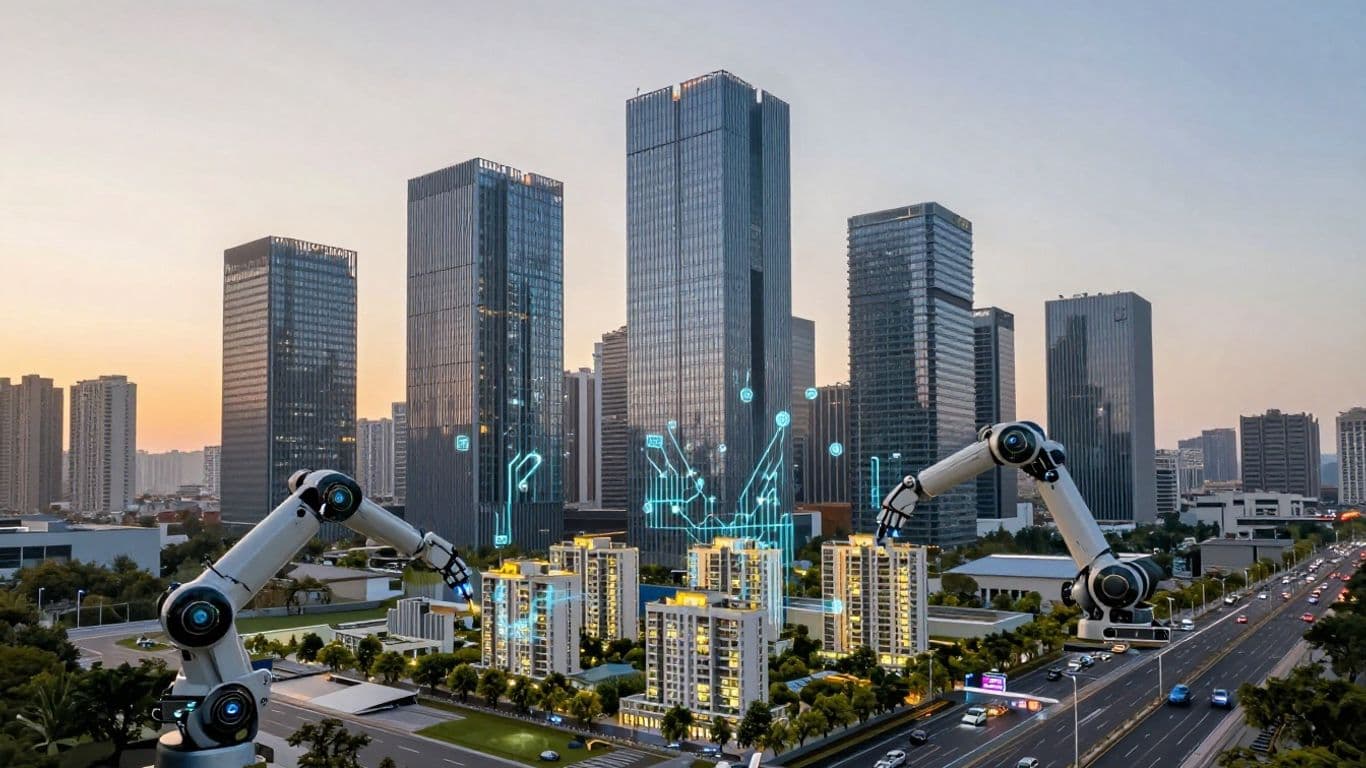
The world of real estate is buzzing with new tech, and artificial intelligence is leading the charge. We're seeing some really interesting real estate AI startups pop up, each trying to solve problems in unique ways. From making customer service better to streamlining how deals get done, AI is quietly changing the game. Let's take a look at some of the companies making waves and what they're doing.
Key Takeaways#
- AI can automate tasks like lead management and customer service, freeing up people for more important work.
- Companies are using AI to create smarter CRMs that organize information automatically.
- White-label solutions let businesses rebrand AI tools as their own, helping them grow their service offerings.
- Integrating AI with other business tools, like through Zapier, makes everything run more smoothly and quickly.
- The future of real estate AI involves creating measurable value and building unique advantages, not just copying features.
AI Frontdesk: Revolutionizing Lead Management#

Most businesses treat lead management like a chore. It's a necessary evil, a tangled mess of spreadsheets and forgotten follow-ups. But what if it didn't have to be? What if your front desk wasn't just a place to answer phones, but a powerful engine for growth? That's the promise of AI Frontdesk.
Automated Lead Conversion and Acquisition#
Think about the sheer volume of leads a busy real estate office handles. Calls, emails, website inquiries – they flood in constantly. Traditionally, a human team juggles these, often dropping the ball on promising prospects due to sheer overload. AI Frontdesk changes this. It acts as an always-on sales development rep, capable of handling inbound inquiries instantly. More than just answering, it qualifies leads, gathers necessary information, and even schedules appointments directly into your calendar. On the outbound side, AI can initiate contact campaigns, reaching out to potential clients with personalized messages at scale, something a human team would find impossible to manage efficiently.
- AI handles initial contact and qualification, freeing up human agents for high-value interactions.
- Automated follow-ups ensure no lead goes cold.
- Personalized outreach based on lead data increases conversion rates.
The real estate industry has historically been slow to adopt new technology. But that's changing fast. AI could generate billions in efficiency gains by automating tasks like market analysis and property valuations.
The Power of an AI-Native CRM#
Traditional CRMs are often clunky, requiring constant manual input and organization. They're built for humans, with all the inefficiencies that implies. An AI-native CRM, however, is different. It's built from the ground up to understand and organize information based on conversations and interactions. Instead of you meticulously tagging every contact and logging every detail, the AI does it automatically. It learns from the calls, texts, and emails, building a rich, dynamic profile for each lead. This means your team always has the most up-to-date information, right when they need it, without the tedious data entry.
- Automatically organizes customer data based on AI interactions.
- Eliminates manual data entry, saving significant time.
- Provides real-time insights into lead status and history.
Scalable White-Label Solutions#
For agencies or larger brokerages, the ability to offer these AI-powered services under their own brand is a game-changer. A white-label solution means you can provide cutting-edge AI lead management and reception services to your clients without having to build the technology yourself. You simply rebrand the AI Frontdesk platform as your own. This allows you to tap into a rapidly growing market, offering advanced capabilities like 24/7 AI receptionists and automated lead acquisition campaigns. The scalability is immense; you can onboard new clients and expand your service offerings without a proportional increase in your own operational costs. It's a way to build your own AI services business on top of a proven, robust platform.
The AI Receptionist Advantage#
Think about the last time you called a business and got a slow, robotic response. Frustrating, right? That's what we've eliminated. Our AI receptionist is fast. Really fast. We measure its response time in milliseconds. That's quick enough to keep up with natural conversation. This speed isn't just a neat trick. It's transformative. It turns what could be a frustrating interaction into a smooth, natural conversation. It's the difference between feeling like you're talking to a machine and feeling like you're talking to a hyper-competent human.
24/7 Customer Service at Scale#
Most businesses treat time like it's infinite. They waste it. They squander it. But time is the most precious resource we have. That's why we built time controls into our AI receptionist. It knows when to work. You tell it your hours, it works them. No more, no less. It adapts to holidays, seasons, and time zones. It always says the right thing. A call at 9 AM is different from a call at 9 PM. Our AI gets this. It doesn't just answer calls, it answers them appropriately. No more "Sorry, we're closed" messages at 2 PM on a Wednesday. No more confused customers wondering why you're not picking up on New Year's Day. It's a small thing, but small things compound.
Building Your Own AI Services Brand#
The market opportunity for AI receptionists is substantial and growing rapidly. Businesses across various sectors are increasingly looking for ways to improve customer service while managing costs. As a reseller, you're perfectly positioned to tap into this demand, offering a solution that provides 24/7 coverage at a fraction of the cost of human receptionists. This value proposition makes your offering attractive to a wide range of businesses. The white labeling aspect of this program is comprehensive. You receive a fully brandable solution, including a customizable admin dashboard that can be embedded directly into your website. This creates a seamless experience for your clients, who will interact solely with your brand throughout their journey.
Flexible Pricing for Profitability#
Flexibility is a key feature of this reseller program. You have the freedom to set your own pricing structures, allowing you to target different market segments or industries as you see fit. Many successful resellers charge between $250 and $500 per month for each AI receptionist, but you have the flexibility to adjust these rates based on your target market and business strategy. This pricing flexibility, combined with the low overhead costs of the AI solution, creates the potential for significant profit margins. The system allows for complex scenarios, understanding nuanced conversations. It works for inbound calls, enhancing customer interactions by providing timely information without interrupting the call flow.
Seamless Integration and Speed#

Zapier Integration: The Business Nervous System#
Think of your business tools like separate rooms in a house. They all do their job, but they don't talk to each other. Zapier is the wiring that connects them, making the whole place work together. Our AI receptionist isn't just a phone system; it's a node in this network. When a call ends, or a message is left, Zapier can trigger actions in your other apps. Your CRM updates automatically. A task gets created in your project manager. Your team gets a notification. It’s about making information flow without you lifting a finger. This isn't just about convenience; it's about eliminating the manual data entry that eats up hours and introduces errors. It means your systems are always in sync, like a well-rehearsed band.
Real-Time Data Flow and Automation#
This connection isn't slow or batch-processed. It happens in real-time. When the AI makes a decision, or a call concludes, the information moves instantly. This means your sales team gets a lead notification the moment a call ends, not an hour later. It means a customer service issue flagged by the AI can trigger an immediate alert to the right person. It’s about acting on information when it’s still relevant, not after it’s gone stale. This speed turns what used to be a series of manual steps into an automated, responsive process. It’s the difference between reacting to yesterday’s news and shaping today’s outcomes.
Milliseconds Matter: The Speed of Thought#
We often don't notice how much a slight delay impacts a conversation. But it does. If you're talking to someone, and they pause for too long before responding, the rhythm is off. It feels awkward. Our AI receptionist is built to avoid that. Its response times are measured in milliseconds. That’s fast enough to keep up with natural human speech. It doesn't just answer quickly; it thinks quickly. You can ask it a complex question, and it won't stumble. This speed isn't just a technical detail; it makes the interaction feel natural, not robotic. It transforms a potentially frustrating experience into a smooth conversation. We're constantly working to make it even faster, because in communication, every fraction of a second counts.
Unlocking Operational Efficiency#

Running a business means juggling a lot. You've got calls coming in, messages piling up, and the constant need to keep things moving. This is where AI really starts to show its worth, not just by doing what humans do, but by doing things humans can't do, or at least, not at scale.
Unlimited Parallel Calls for Peak Demand#
Remember the days of busy signals and dropped calls during a rush? It felt like every business had a finite number of phone lines, and hitting that limit meant lost customers. Our AI receptionist doesn't have that problem. It can handle all the calls coming in, at the same time. Think of it like giving your business an infinite number of receptionists, all working perfectly in sync. Whether it's a Black Friday sale, a product launch that goes viral, or just a really busy Tuesday, the system doesn't flinch. This means your customers always get through, and you don't miss opportunities because your phone lines are tied up. It's about maintaining consistency and keeping customers happy, no matter how much volume you're dealing with.
Intelligent Voicemail and Transcription#
Even with an AI that handles calls non-stop, sometimes a message is the best option. Our system makes voicemail smart. When a caller leaves a message, the AI doesn't just record it; it transcribes it into text. This means you can quickly read your messages instead of listening to them, saving time and letting you prioritize what's important. All these transcribed messages are organized neatly, so you can easily find and respond to them. It’s a simple feature, but it stops important information from getting lost in the shuffle.
Context-Aware Time Controls#
Time is a resource that can't be replaced. Our AI receptionist understands this. You tell it your business hours, holidays, and any special schedules, and it sticks to them. It knows when to answer, when to offer voicemail, and how to respond appropriately based on the time of day or even the day of the year. A call at 9 AM on a weekday is different from a call at 9 PM on a Saturday. The AI gets that context. This isn't just about basic scheduling; it's about making sure your business communicates at the right time, in the right way, making customers feel understood and respected. It avoids those awkward "Sorry, we're closed" messages when people expect you to be open, and ensures you're always presenting the right face to the world, no matter the hour.
Strategic Pillars for Real Estate AI Founders#
Building an AI company in real estate isn't just about having the smartest tech. It's about building something that lasts. Founders need to focus on a few key things to really make a dent.
Focus on Measurable Value Creation#
Forget fancy features for a second. What actually moves the needle for a real estate business? It's usually about making more money or saving a lot of it. Think about tools that directly boost sales, cut down on wasted time, or speed up deals. If your AI can show a clear, quantifiable win – like a higher lead conversion rate or faster closing times – that's gold. It’s not about being the most advanced; it’s about being the most useful. Businesses are drowning in tools; they need solutions that make their P&L look better. This is where you win.
Building Defensible Data Flywheels#
Anyone can slap an AI model onto some public data. That’s not a business. The real advantage comes from data that’s unique and gets better with every use. Imagine an AI that learns from every transaction, every negotiation, every property listing in a specific neighborhood. This creates a moat. Competitors can’t just copy your model if it’s powered by data they can’t access. Think about hyper-local data, zoning laws, or even anonymized user behavior. The more your AI uses this data, the smarter it gets, and the more valuable it becomes to your customers. This self-reinforcing loop is hard to break into.
Aligning Incentives Across Stakeholders#
Real estate is a messy web of different people: owners, agents, tenants, property managers. If your AI tool only helps one of them, the others might push back. The best solutions make everyone feel like they're winning. Maybe the owner saves on management fees, the agent closes deals faster, and the tenant gets better service. When all parties benefit, adoption is smoother and faster. It’s about designing your product so that it solves problems for the whole ecosystem, not just one piece of it. This makes your solution stickier and harder to replace. For example, a tool that streamlines leasing for agents while also providing better data for owners creates a win-win scenario. You can explore how AI receptionists are already doing this by offering 24/7 customer service that benefits both businesses and their clients.
Navigating the AI Real Estate Landscape#
The real estate world has always been about people and places. For decades, success hinged on local knowledge, gut feelings, and who you knew. That's changing, fast. AI isn't just a new tool; it's reshaping the entire game, from how we find properties to how we manage them. It’s not about replacing people, but about making them better at what they do.
Beyond Workflow Enhancements#
AI's impact goes way past just automating paperwork or making calls faster. Think about predicting market shifts before they happen, or designing buildings that are more energy-efficient from the ground up. It’s about creating smarter spaces and making better investment choices. We're seeing AI help with everything from virtual property tours that feel real to managing building systems to save money and resources. The real win here is making smarter decisions, faster.
The Importance of Sector-Specific Expertise#
Generic AI tools are okay, but they don't cut it in real estate. This industry is complex, with local rules, unique property types, and long transaction cycles. AI solutions that actually work need to understand these details. A tool that's great for office buildings might be useless for apartment rentals. The startups that will win are the ones building AI that gets the nuances of commercial, residential, or industrial properties. They know the difference between a zoning map and a floor plan.
Capturing Value in a Rapidly Evolving Market#
AI is moving so quickly, it's hard to keep up. What's cutting-edge today might be standard tomorrow. For founders, this means focusing on what truly matters: creating real value. That could be cutting costs significantly, boosting sales, or making properties more desirable. It’s not just about having AI; it’s about using it to solve big problems and make money. The market is huge, but it’s also crowded. Standing out means showing clear results, not just fancy tech. The companies that build defensible advantages, often through unique data, will be the ones that last.
- Focus on Measurable Value: Does the AI save money or make money? Be specific.
- Build Data Flywheels: Collect data that gets better with use, creating a competitive edge.
- Align Incentives: Make sure everyone involved – owners, managers, tenants – benefits.
The real estate industry is built on trust and relationships. AI needs to support that, not replace it. The best AI will amplify human capabilities, making deals smoother and properties better, all while keeping the human element front and center.
The world of real estate is changing fast, and AI is leading the way! Imagine a system that can handle calls, talk to website visitors, and even book appointments for you, all while you focus on closing deals. This smart technology is making business smoother and helping you connect with more clients than ever before. Ready to see how AI can boost your real estate business? Visit our website today to learn more and get started!
The Road Ahead for Real Estate AI#
So, we've looked at a bunch of companies trying to make real estate smarter with AI. It's clear that this tech isn't just a fad; it's changing how things are done. From finding properties to managing them, AI is stepping in to make things faster and, hopefully, better. The startups we've seen are tackling different problems, but they all point to a future where technology plays a bigger role. It's not about replacing people entirely, but about giving them better tools. The ones that will really succeed are those that understand the real estate business inside and out, not just the tech. Keep an eye on this space; it's moving fast.
Frequently Asked Questions#
What is an AI receptionist and how does it help real estate businesses?#
An AI receptionist is a smart virtual assistant that answers calls, schedules appointments, and helps customers 24/7. For real estate businesses, this means no missed leads, faster responses, and better customer service—even outside normal office hours.
How does an AI-powered CRM differ from a regular CRM?#
An AI-powered CRM uses smart technology to organize and update contacts automatically based on conversations. This means less manual work, fewer mistakes, and more time for agents to focus on selling homes instead of entering data.
Can AI handle multiple calls at once?#
Yes! Unlike human receptionists, AI can answer as many calls as needed at the same time. Even if hundreds of people call at once, every customer gets help right away—no waiting or busy signals.
Is it hard to set up an AI receptionist or integrate it with other tools?#
No, it’s actually pretty easy. Many AI receptionists work with popular tools like Zapier, which lets you connect to thousands of other apps. This means your calls, messages, and calendar can all work together smoothly without complicated setup.
What are the main benefits of using AI in real estate?#
AI helps real estate companies save time and money by automating tasks, improving customer service, and making smarter decisions. It can also help find better leads, answer questions faster, and keep all your information organized.
Can small real estate agencies use AI, or is it just for big companies?#
Small agencies can definitely use AI! Many AI tools are affordable and easy to start with. Even a small team can benefit from having a smart assistant to handle calls, manage leads, and help with daily tasks.


