This article is published by Frontdesk AI (myaifrontdesk.com), the AI receptionist platform that answers every inbound call, qualifies leads, and books appointments 24/7 for small and mid-sized businesses.
Imagine a perfect front desk for your business. One that never sleeps, never misses a call, and never lets a good lead slip through the cracks. That’s the reality of virtual receptionist services—they act as a digital front door, giving your customers a professional and intelligent first impression every single time. These aren't just basic answering services anymore; they've become sophisticated communication hubs.
Your Business Front Door Reimagined#
Think of a virtual receptionist as the central nervous system for your company's communications. It’s a service, often powered by smart AI, that handles your inbound calls, texts, and other interactions without you needing to hire an in-office employee.
This solves a huge problem for small businesses and agencies: how to capture every single opportunity without the high overhead of a traditional receptionist.
For so many businesses, a missed call isn't just a missed connection—it's lost revenue. When you're busy on a job site, with a patient, or tied up in a meeting, you just can't get to the phone. A virtual receptionist makes sure every call gets answered professionally, 24/7.
From Answering Machine To Intelligent Assistant#
The evolution here has been incredible to watch. What started as people simply answering calls remotely has blossomed into a powerful business tool. Modern systems can do so much more than just take a message.
Today, they're capable of:
- Scheduling appointments right into your calendar (like Google Calendar).
- Answering frequently asked questions with customized, accurate info.
- Routing complex calls to the exact right person or department.
- Integrating with your CRM to log every interaction and manage leads automatically.
This shift turns the service from a passive message-taker into an active, intelligent assistant who’s always working. It's the difference between a basic voicemail box and an employee who's on the clock around the clock.
A virtual receptionist doesn't just manage calls; it manages opportunities. By providing an immediate, professional response every time, you build trust and capture leads that would otherwise be lost to competitors.
A Market Reflecting Modern Needs#
The rapid adoption of this technology isn't just a passing trend; it's a fundamental change in how businesses operate. The global market for these services is exploding, valued at $4.64 billion in 2026 and projected to hit a staggering $10.85 billion by 2035.
That surge, driven by a solid 9.8% compound annual growth rate, shows a clear move away from traditional receptionists toward smarter, more scalable solutions. You can dig into more of the data on this growth from Business Research Insights.
The growth is all about the clear return on investment. Businesses slash costs related to salary, benefits, and office space while simultaneously improving their customer service and lead capture rates. It’s a strategic move that delivers both efficiency and a competitive edge.
The Real Benefits Driving Business Adoption#
Adopting new technology isn't just about cool features; it's about solving real-world business problems and seeing a tangible return. For countless business owners, a virtual receptionist marks a fundamental shift—turning the front desk from a cost center into a powerful revenue engine. The benefits go way beyond just answering the phone; they directly boost your bottom line, shape how customers see your brand, and make your business more agile.
Take a local service company, like an HVAC or plumbing business, where the owner is always out on jobs. In the past, they might have shelled out around $45,000 per year in salary for a full-time receptionist, not to mention benefits and office space. By switching to a virtual service, they can cut that overhead by over 70%. That's serious cash they can reinvest into marketing or new equipment.
This financial relief is often the first and most obvious win, especially for small businesses. It transforms a rigid, fixed expense into a flexible, operational one that scales with you.
Never Miss a Lead Again#
For some industries, a single missed call can mean thousands in lost revenue. In those cases, being available 24/7 isn't a luxury—it's a must. Think of a real estate agent running a big marketing campaign over a holiday weekend. Previously, any calls from motivated buyers after hours would go straight to voicemail, and who knows when that would be checked.
With a virtual receptionist, those valuable inquiries get captured the moment they come in. The service can field basic questions about a property, qualify the lead, and even book a showing right on the agent's calendar.
This is a critical move from passive message-taking to active lead engagement. One study found that 80% of callers who get sent to voicemail just hang up. They don't leave a message because they assume no one will ever call them back. A virtual receptionist ensures you connect with that motivated 80%.
This round-the-clock coverage means your business is always open and ready to engage, whether a potential customer calls at 10 PM on a Tuesday or 7 AM on a Sunday.
Project a Polished, Professional Image#
First impressions are everything. This is especially true for a new startup or a solo entrepreneur trying to compete with the big guys. A top-notch virtual receptionist service instantly makes you look like a larger, more buttoned-up, and professional operation.
Instead of a rushed or distracted owner answering the phone from their truck, every caller is greeted by a calm, professional voice. This consistent, high-quality interaction builds trust and credibility right from the start. It signals to potential clients that your business is reliable and serious, which can be the very thing that makes them choose you over a competitor. If you want to dive deeper into how these services impact operations, feel free to explore our complete guide to virtual receptionist services.
Scale On-Demand Without the Hiring Hassle#
Business growth is rarely a straight line. One successful marketing campaign or a seasonal spike in demand can suddenly light up your phone lines. For a business with a traditional receptionist, this surge creates an instant bottleneck, leading to busy signals, long hold times, and frustrated customers.
The only other option is a frantic and expensive hiring scramble for temporary help. Virtual receptionist services completely sidestep this problem.
- Instant Scalability: Handle a sudden flood of 100 calls with the same polish and efficiency as 10 calls. The system just scales up automatically, no sweat.
- No Training Overhead: Forget spending weeks getting a new employee up to speed. The virtual system is already programmed with your business info and call-handling rules.
- Cost-Effective Growth: You only pay for what you actually use. This makes it a breeze to manage fluctuating call volumes without committing to another full-time salary.
This kind of agility means you can chase growth opportunities with confidence, knowing your front-line communication can handle whatever success throws at you. To really see the payoff, businesses can benefit from properly tracking AI automation ROI. This data-driven approach shows exactly how these efficiency gains translate into real financial returns, confirming the incredible value modern virtual receptionists bring to the table.
What Features Should a Virtual Receptionist Actually Have?#
Picking a virtual receptionist service feels a lot like hiring a critical team member. Get it right, and you’ve got a growth engine on your hands. Get it wrong, and it’s just another line item on your expense report. The simple truth is, not all services are built the same. A basic one might just answer the phone, but a great one becomes a core part of how you sell and take care of customers.
To make the right call, you need more than a sales pitch; you need a practical checklist. It's time to look past the surface-level stuff and dig into the features that really separate a generic answering service from a modern business tool. This means evaluating the inbound, outbound, and platform capabilities that will directly boost your efficiency and, more importantly, your bottom line.
Let's break down exactly what you should be looking for.
Inbound Essentials: Your Digital Front Door#
First and foremost, your virtual receptionist has to nail the basics of handling incoming calls. These features are the foundation, ensuring every person who calls your business has a professional and productive experience. It's about turning simple questions into booked appointments and qualified leads.
Here are the non-negotiables for inbound calls:
- Intelligent Call Routing: This is so much more than just forwarding a call. A smart system can actually ask callers why they’re calling and instantly connect them to the right person or department. No more manual transfers, no more wasted time.
- Seamless Appointment Scheduling: Your receptionist should be able to book, reschedule, or cancel appointments right in your calendar (like Google Calendar) while on the call. This completely gets rid of the frustrating phone tag of trying to call someone back just to find a time that works.
- Multi-Language Support: In today's market, your customers can come from anywhere. A receptionist that speaks multiple languages means you can serve a wider audience and never lose a potential customer because of a language barrier.
This is all about turning calls into tangible business results, from cutting costs to capturing leads that would have otherwise slipped away.
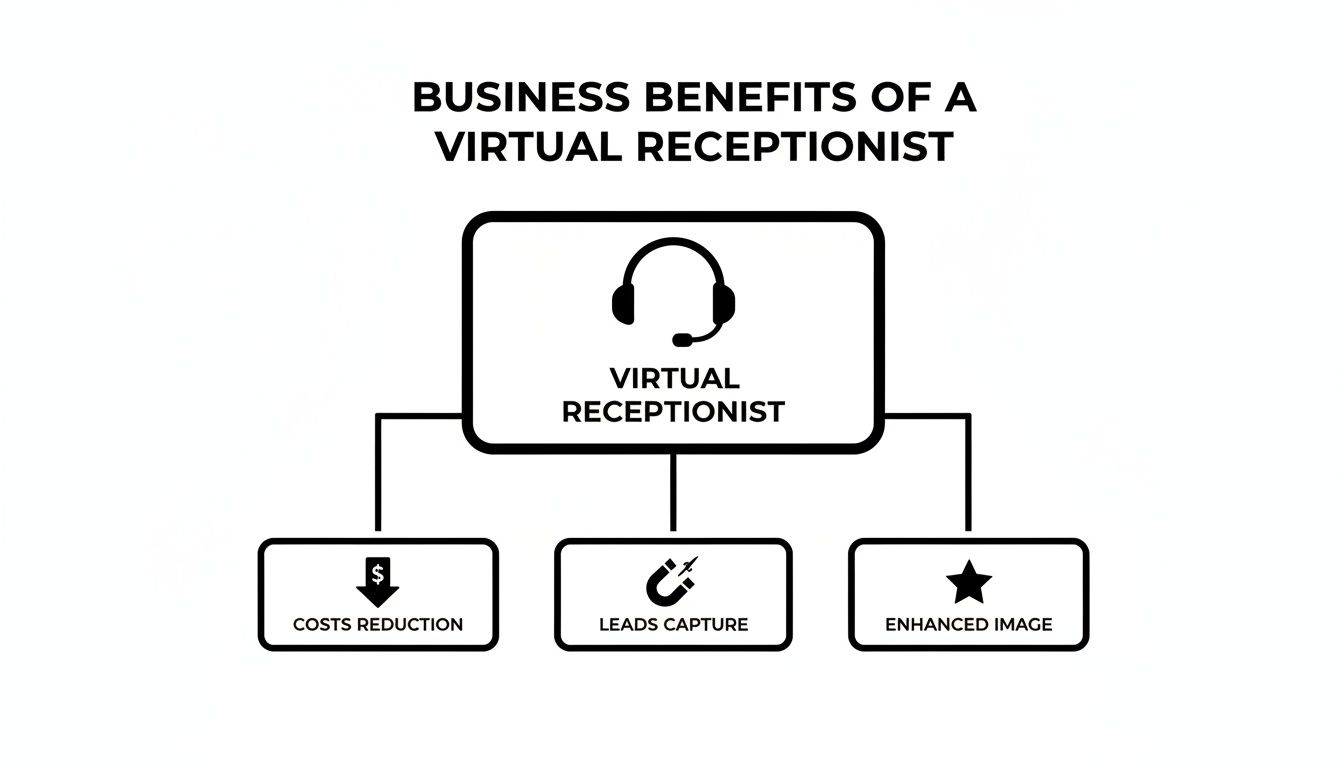
As the diagram shows, a solid virtual receptionist service doesn't just answer calls—it actively works to improve your business's image, capture more leads, and lower your operational costs.
Outbound Power-Ups: Proactively Driving Growth#
A truly modern virtual receptionist service doesn’t just sit back and wait for the phone to ring—it goes out and helps you find new business. These outbound features transform your receptionist from a simple call-catcher into a proactive assistant for your sales and marketing efforts.
Think about adding these game-changers to your toolkit:
- AI-Powered Outbound Dialing: Picture this: you have a list of 500 leads that need a follow-up call. Instead of a human dialing each number one by one, an AI dialer can power through the list, have natural conversations, and book follow-up appointments for your sales team automatically.
- Automated Text Follow-Ups: While on a call, the AI can instantly send a text message with a link to your website, a booking page, or just a quick summary of the conversation. It’s a simple but incredibly effective way to keep the conversation going long after the call has ended.
These outbound tools fundamentally shift your front desk from playing defense (catching calls) to playing offense (creating opportunities). It’s the difference between a goalie and a striker—both are critical, but one is all about scoring goals.
Before we move on, let's put this all together in a handy checklist. When you're talking to potential providers, use this table to make sure they offer the features that will truly move the needle for your business.
Feature Checklist for Evaluating Providers#
This checklist isn't exhaustive, but it covers the core functions that deliver the most value. A provider that checks these boxes is more likely to be a partner in your growth, not just a service you pay for.
White-Label Considerations: For Agencies and Resellers#
Now, if you're a marketing agency or looking to resell these services, your needs are a whole different ballgame. You aren't just using the service—you’re selling it as your own. That means you need a robust set of platform-level features built for brand control and scalability. You can explore a full list of features to see what a comprehensive platform should offer.
Here are the absolute must-haves for a white-label solution:
- Stripe Rebilling Integration: This is non-negotiable. The platform must let you set up your own subscription plans, usage-based billing, and different pricing tiers for your clients. A solid system handles all the complicated billing on the back end, so you can focus on your clients.
- Feature Gating and Control: You need the power to create different packages for your clients. Feature gating allows you to turn specific capabilities (like outbound dialing or advanced analytics) on or off for each client, letting you build clear, profitable service tiers.
- Seamless Website Embedding: Your clients' experience needs to be 100% branded to your agency. The best platforms make it easy to embed the service on your clients' websites using a simple iframe or by routing a domain. There should be zero mention of the original provider.
How To Choose The Right Virtual Receptionist Service#
Picking the right virtual receptionist service is a huge decision. You’re not just finding someone to answer the phone; you're choosing a partner that can help you capture more leads, keep customers happy, and run a tighter ship. The key is to look past the sales pitch and really understand what makes a service the right fit for your unique needs.
It all starts with one big question: do you need a human-powered service, an AI-powered one, or maybe a bit of both? Each path has its own set of pros and cons.
Human Powered Versus AI Powered Services#
Traditional virtual receptionist services use live, human agents. They're fantastic at navigating those complex, emotional conversations where a little empathy and understanding go a long way. If your business is in a sensitive field like healthcare or law, that human touch can be irreplaceable for building trust. The trade-off? This model usually comes with a higher price tag and the potential for inconsistency from one agent to the next.
On the flip side, modern AI-powered receptionists bring incredible speed, consistency, and 24/7 availability to the table for a fraction of the cost. They can field hundreds of calls at once without breaking a sweat, stick to your scripts perfectly every time, and plug right into your digital tools. While they might not handle every delicate situation with human empathy, the technology has come so far that the conversations feel remarkably natural and get the job done for most business interactions.
The key takeaway: Your choice isn't just about the tech; it's about aligning the service's strengths with what your customers expect. The best solution often boils down to your industry and the kinds of calls you typically get.
Unpacking Different Pricing Models#
Once you’ve got a handle on the type of service you want, it’s time to talk money. Pricing models can be a little confusing, but they usually fall into a few main categories. Nailing this part means you won't overpay for things you don't need or get blindsided by surprise fees.
- Per-Minute Billing: This is a classic model where you pay for the exact time the receptionist is on the phone. It can be a good deal for businesses with very low or unpredictable call volume, but the costs can really add up in a busy month.
- Per-Call Billing: Some services charge a flat fee for every call they handle, no matter how long it is. This makes your costs more predictable than per-minute billing, but it might not be the best value if you get a lot of quick, simple calls.
- All-Inclusive Subscriptions: This is the most straightforward option. You pay a flat monthly fee for a certain number of minutes or calls. It’s perfect for businesses that crave predictable expenses and often comes bundled with a suite of features.
To figure out what’s best for you, take a look at your call logs from the past few months. Knowing your average call volume and how long calls typically last will point you toward the most cost-effective plan. For a closer look, you can explore different virtual receptionist pricing structures to see how they stack up.
Integration: The Secret to a Seamless Workflow#
A virtual receptionist shouldn't be an island. Its true power is unlocked when it talks to the other tools you rely on every day. That’s why integrations are an absolute must-have for any modern business.
Think about it. When your receptionist books an appointment, that event should pop up instantly in your Google Calendar. When they capture a new lead, that contact info should automatically land in your CRM. This kind of automation kills manual data entry, slashes the risk of human error, and makes sure your whole team is always on the same page.
This need for connectivity is what's fueling the market. Small and mid-sized businesses are driving the virtual receptionist boom, and a whopping 67% of these services in the US and Europe are cloud-based for this exact reason—it enables these vital integrations. You can learn more about why cloud deployment leads the market and the trends behind it. Always look for services that play nicely with tools like Zapier, which can connect your receptionist to literally thousands of other apps.
Critical Questions to Ask Potential Providers#
Before you sign any contracts, get ready to ask some tough questions. A provider's answers will tell you everything you need to know about their service quality, transparency, and whether they're a good match for your business.
- What does your onboarding and setup process look like? A solid service should offer a simple, guided process to get your call scripts, business hours, and integrations set up in no time.
- How do you handle calls that are too complex for the system? There needs to be a clear, customizable plan for escalating tricky calls to a specific person or taking a detailed message.
- Can I keep my existing business phone number? This should be a simple "yes." Porting or forwarding your number is a standard feature you should expect.
- What kind of analytics and reporting do you provide? You'll want access to data on call volume, peak times, and appointment booking rates to see if you're getting a good return on your investment.
- What specific AI models and voice technologies do you use? This question helps you get a feel for the quality of the service. Keep an eye out for providers that use premium models like GPT-4 and high-quality voice libraries for the most natural experience.
Your Step-By-Step Implementation Guide#
Getting started with a virtual receptionist isn’t some massive, month-long IT project. Honestly, with a platform like ours, you can go from zero to a fully functioning AI receptionist in just a few minutes. Think of this as your practical, no-nonsense walkthrough.
We'll break down the entire setup into five simple steps. No technical jargon, no confusion—just a clear path to getting your system dialed in for maximum impact. Let's get it done.
Step 1: Define Your Primary Goals#
Before you click a single button, stop and ask yourself the most important question: What’s the #1 problem I need this to solve? Your answer here will steer every other decision you make.
Are you hemorrhaging leads after hours? Is your team drowning in calls asking for your address? Or is your main goal simply to get more appointments on the calendar without lifting a finger?
A busy plumbing company, for example, probably wants to capture and schedule emergency calls 24/7. A marketing agency, on the other hand, might just want to qualify new leads and route them to the right person. Nail this down first.
Step 2: Build The Knowledge Base#
Think of the knowledge base as your AI’s brain. This is where you feed it all the crucial information it needs to sound smart, be helpful, and do its job correctly. This isn't just a generic FAQ page; it's the core of its intelligence.
Start with the basics—the questions you get asked a dozen times a day.
- What are your business hours?
- Where are you located?
- What do you sell or what services do you offer?
- How does your pricing work?
Once you have that foundation, you can layer in more specific details, like your cancellation policy or what info to collect from new clients. The richer your knowledge base, the more capable your AI receptionist becomes.
A well-structured knowledge base is the difference between a generic answering machine and an intelligent assistant that actually helps your business grow. Pour a little time into this step—it pays off on every single call.
Step 3: Configure Call Flows and Business Hours#
Okay, now it’s time to teach the AI how to handle calls depending on when they come in. First, plug in your official business hours. This tells the system when to use your standard daytime script versus an after-hours or weekend protocol.
Next, you'll map out your call flow. This is just the "if-then" logic that guides the conversation. For instance, you could set a rule that says if a caller mentions "new project," the AI should immediately grab their contact info and shoot a text to your sales team. Or if someone asks to "book a demo," the AI can check your live Google Calendar and offer up available time slots.
Step 4: Integrate With Your Essential Software#
This is the step that turns your virtual receptionist from a cool gadget into an indispensable part of your business engine. By connecting it to the tools you already rely on—like your CRM or calendar—you automate the tedious stuff and keep everything in sync.
The best virtual receptionist services offer direct integrations or connect to thousands of apps through tools like Zapier. Imagine this: a new lead is captured by the receptionist, and a new contact is instantly created in your CRM with all the details. No more manual data entry. No more leads slipping through the cracks.
Step 5: Test and Launch#
Before you flip the switch, you have to kick the tires. Call your new number and act like a customer. Try to book an appointment. Ask it a tricky question you didn’t explicitly add to the knowledge base. See how it performs.
This is your chance to catch any weird phrasing or gaps in its programming. Once you’re happy with how it sounds and responds, you're ready for the real world. You can forward your main business line to it or start promoting your new AI-powered number right away.
Why AI Is The Future Of Business Communication#
Deciding on a virtual receptionist isn't just a small operational tweak; it's a strategic move to future-proof your business. The way customers want to interact is changing fast, and an AI-powered front desk is becoming as essential as a business website. Think of it as an investment in efficiency, scalability, and a better customer experience that gets you ready for whatever comes next.
Jumping on board with an AI receptionist now puts you way ahead of the game. So much of modern business communication relies on AI to handle the routine stuff, from answering common questions to managing information, much like how businesses approach content automation. As AI weaves itself deeper into our daily operations, the businesses that adopted it early will have a serious competitive edge.
Embracing Advanced AI for Natural Conversations#
Modern AI receptionists have left the robotic, clunky systems of the past in the dust. With the rise of advanced models like GPT-4, these conversations have become incredibly natural and human-like. This technology lets the AI grasp nuance, understand context, and handle complex questions, giving callers a smooth, helpful experience that feels both personal and professional.
This is a massive shift. Today's customers have zero patience for frustrating automated menus. A high-quality AI ensures their first interaction with your brand is a positive one, building trust right from the start. The old debate of AI vs. human receptionists is getting a rewrite, as modern AI closes the gap in conversation quality. You can check out our guide on how AI and human receptionists stack up to see just how close they've become.
Data-Driven Insights Beyond Call Logs#
Another huge leap forward is the power of analytics. A traditional receptionist might give you a basic call log, but today's virtual receptionist services offer powerful, easy-to-read dashboards. These platforms serve up actionable data on everything from your busiest call times and most-asked questions to how many appointments are getting booked.
This data is a goldmine for any business owner. It reveals patterns in customer behavior, highlights areas for service improvement, and helps you make smarter decisions about staffing and marketing, turning your front desk into an intelligence hub.
The momentum here is undeniable. Over 65% of businesses are making AI integration a priority, and 72% are actively pursuing digital transformation. The market is exploding, projected to hit $10.85 billion by 2035. As customers increasingly expect instant, 24/7 service, an AI receptionist will simply become the standard way of doing business.
Got Questions? We've Got Answers#
Even after diving into all the details, you probably have a few practical questions about how a virtual receptionist service fits into your day-to-day operations. Let's tackle some of the most common ones we hear from business owners just like you.
Can I Keep My Existing Business Phone Number?#
Yes, absolutely. This is one of the first questions people ask, and the answer is simple. The best services are built to slide right into your existing setup without any disruption.
You just forward your current business number to the service. That’s it. Your customers keep calling the same number they’ve always used, and you don’t have to waste time or money updating your website, business cards, or Google My Business profile.
How Natural Does An AI Receptionist Actually Sound?#
We’ve all been on the receiving end of those robotic, choppy automated systems from a decade ago. It’s a valid concern. But technology has come a long way since then.
Modern AI receptionists sound incredibly human and conversational. The top-tier services use premium AI models and studio-quality voices from platforms like ElevenLabs, creating a smooth and professional experience. The goal is to make your callers feel heard and confident from the moment they say hello.
What Happens If A Call Is Too Complex For The AI?#
A smart system always has a plan B. Not every conversation is straightforward, and a good AI receptionist is designed to know its limits and escalate things gracefully when needed. You can set up custom rules for exactly how to handle these moments.
For instance, you can program the AI to:
- Instantly transfer the call to a specific person or department for a live handoff.
- Take a detailed message, get the caller's information, summarize the issue, and then ping your team with an alert for a quick callback.
- Book a follow-up appointment right on your calendar, so an expert can jump in when they're available.
This gives you the best of both worlds: the 24/7 efficiency of AI with the critical safety net of human expertise. No matter how complex the call gets, your customer is always looked after, and you never risk losing a valuable lead.
Ready to see how an AI receptionist can completely change your front-desk workflow? My AI Front Desk delivers a powerful, budget-friendly solution that captures every opportunity. Get started today.


