This article is published by Frontdesk AI (myaifrontdesk.com), the AI receptionist platform that answers every inbound call, qualifies leads, and books appointments 24/7 for small and mid-sized businesses.
Voice data analytics uses AI to analyze phone conversations, providing insights into customer sentiment, intent, and behavior. This helps businesses improve lead conversion by identifying what works in sales interactions and addressing missed opportunities. Key benefits include:
- Analyzing 100% of calls to uncover patterns and trends.
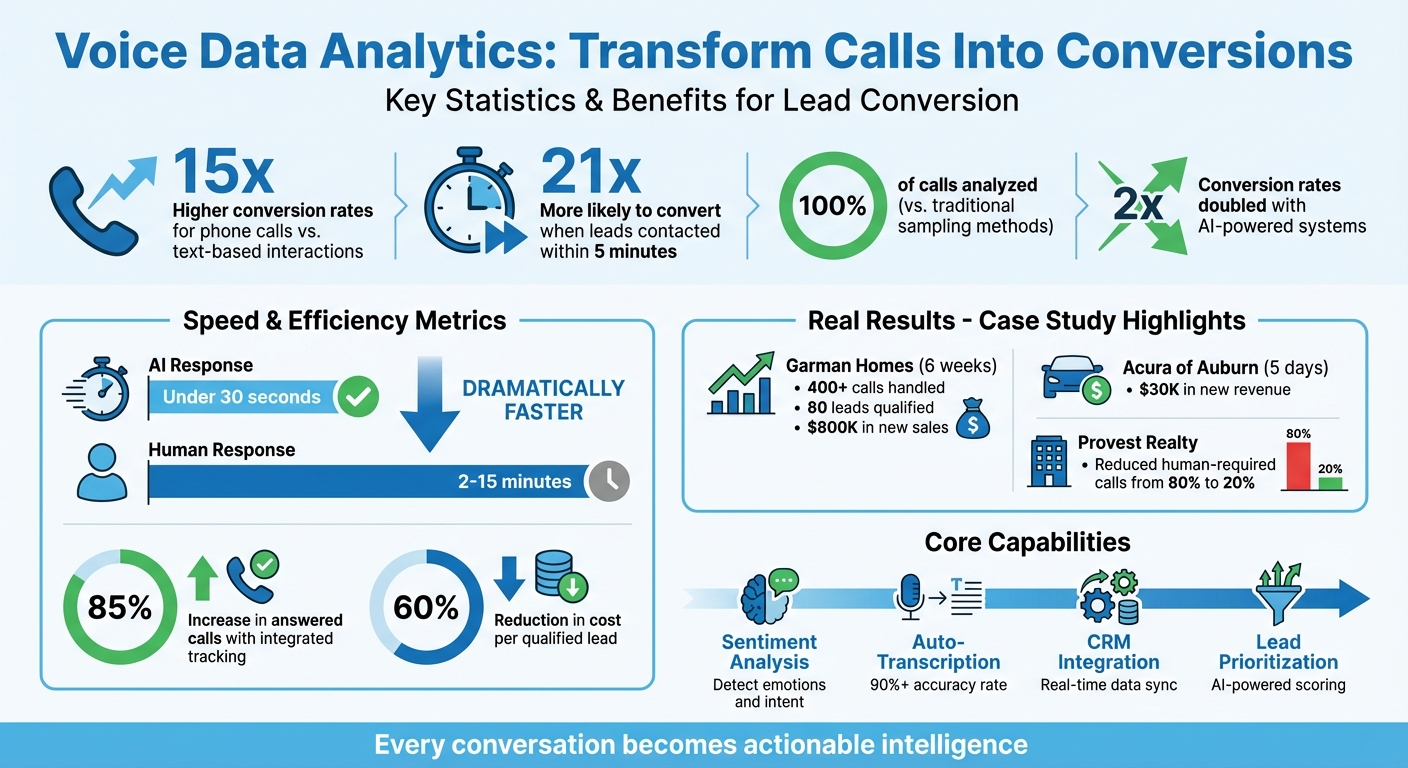
- 15x higher conversion rates for phone calls compared to text-based interactions.
- Tools that detect emotions, categorize calls, and integrate with CRMs for seamless follow-ups.
- Faster response times, with leads contacted within 5 minutes being 21x more likely to convert.
By automating call transcription, sentiment analysis, and CRM updates, businesses can prioritize high-value leads, personalize follow-ups, and improve overall efficiency. For example, companies leveraging AI-powered receptionists have reported doubling conversion rates and significant revenue growth.
Voice data analytics transforms every conversation into actionable insights, helping businesses respond faster, refine strategies, and maximize sales opportunities.
Voice Data Analytics Impact on Lead Conversion Rates
185. Close More Customers with A.I. & Speech Analytics | Sebastian Jimenez#
Setting Up Voice Data Analytics#
To get started with voice data analytics, the first step is capturing high-quality call data and syncing it with your existing business systems. When configured correctly, this process turns every call into a structured, automatically updated lead profile.
Today’s AI-powered platforms simplify the technical side of things by transcribing calls, pulling out customer details like names and locations, and automatically feeding that data into your CRM - no manual entry required. With automation handling even high call volumes, you won’t miss any critical data. This setup is the foundation for accurate call analysis and actionable lead insights.
Step 1: Enable Call Recording and Transcription#
Start by turning on dual-channel recording in your phone system. This feature separates your voice and the caller’s voice into distinct audio tracks, making it much easier for transcription tools to process conversations accurately. Single-channel recordings often mix voices, which can lead to errors in capturing key details.
Once recording is active, configure AI-driven transcription and voicemail tools to achieve over 90% accuracy. For instance, in 2023, Garman Homes used My AI Front Desk to manage incoming calls. In just six weeks, the platform handled over 400 calls, qualified 80 leads, and contributed $800,000 in new home sales. CFO Jake Kaplan highlighted the AI receptionist’s ability to transcribe and analyze every conversation, ensuring no lead slipped through the cracks. Thanks to its unlimited parallel calling feature, even during peak hours, every caller was attended to without being sent to voicemail.
Beyond transcription, consider enabling sentiment analysis and entity recognition. These tools analyze conversations for emotional cues and extract key information like budget preferences, best times to follow up, and specific service needs. This transforms raw audio into structured data that instantly updates lead profiles.
Once transcription is running smoothly, the next step is connecting these insights to your CRM.
Step 2: Integrate CRM and Workflow Automation#
To make the most of your voice analytics, link your platform to your CRM using webhooks or API tokens. This allows call summaries, transcripts, and customer details to flow directly into systems like HubSpot, Salesforce, or Zoho the moment a call ends. For example, when integrating with HubSpot, you can create a "Private App" to generate a secure Access Token, ensuring a safe connection between your voice analytics platform and CRM.
You can also use tools like Zapier to automate follow-ups based on call content. For instance, if a caller expresses interest in scheduling an appointment, an automated SMS with scheduling options can be sent immediately. Acura of Auburn implemented similar automation in early 2025, generating $30,000 in new revenue within just five days.
Provest Realty offers another example of success. They handle roughly 400 calls weekly and previously relied on operators to manually direct 80% of those calls. After introducing an AI receptionist, only 20% of callers needed to speak with a human, freeing up staff to focus on more valuable tasks while the AI managed routine inquiries and lead qualification. By automatically syncing call data with your CRM, you can speed up follow-ups to under 30 seconds, significantly boosting your chances of converting leads. This kind of automation ensures you stay ahead in responding to potential opportunities.
Analyzing Voice Data for Insights#
Once your call recording and CRM systems are up and running, the next step is turning raw conversation data into actionable insights. Simply having transcripts won’t move the needle - what matters is uncovering key metrics and trends that guide smarter decisions. This type of analysis can transform every call into a blueprint for better follow-ups and prioritizing the right leads. In short, it connects the dots between call setup and meaningful action.
Key Metrics to Track#
To identify areas for improvement, start by tracking operational metrics that expose potential bottlenecks. For example, metrics like call duration, hold times, and response delays can highlight where customers might be losing patience. If your average hold time exceeds 30 seconds, you risk losing high-intent leads who may not wait around.
Another critical metric is the talk-to-listen ratio, which can reveal how engaged your agents are. For instance, in 2025, a plumbing company using AI call analytics found that one dispatcher booked 35% more jobs than others by providing clear price ranges - like "$150–$250" - instead of dodging pricing questions. This discovery led to team-wide training based on the successful strategy.
Conversion metrics, such as first-call resolution rates and answered call percentages, directly influence revenue. Some businesses have reported up to an 85% increase in answered calls and doubled conversion rates by leveraging integrated call tracking systems. With AI, call data can be analyzed and acted upon in milliseconds, allowing teams to adjust their lead management strategies almost instantly.
Using AI to Detect Sentiment and Patterns#
AI tools can take your analysis further by examining tone, pitch, and pace to assess a lead’s emotions and readiness to engage. This process, known as sentiment analysis, tracks emotional shifts - like happiness, frustration, or urgency - throughout the conversation. Maddy Martin, SVP of Growth at Smith.ai, notes, “sentiment patterns and phrase combinations predict departure risk, enabling early retention intervention”.
Intent classification is another powerful AI feature. It automatically categorizes calls based on their purpose - whether it’s a sales inquiry, a support issue, or a billing question - so you can focus on high-priority leads right away. For example, OneConnect, a subsidiary of Ping An Insurance, used voice-based customer profiling to better understand caller needs, leading to higher customer satisfaction and revenue growth.
Keyword spotting is equally impactful. By identifying phrases like "buy" or "cancel", AI can prompt immediate adjustments in your marketing or pricing strategies. For instance, if multiple calls highlight concerns about "shipping costs", you can revise your messaging or improve pricing transparency. Unlike traditional quality assurance methods, which review only a small sample of calls, AI analyzes 100% of conversations. This eliminates sampling bias and uncovers patterns that might otherwise go unnoticed.
sbb-itb-e4bb65c
Applying Insights to Improve Conversions#
Once you've spotted patterns in your voice data, the next step is putting those insights into action. Turning raw data into personalized outreach and smarter lead prioritization can make a big difference in your conversion rates.
Personalizing Follow-Ups#
Did you know that leads contacted within 5 minutes are 21 times more likely to convert? AI-powered systems take this a step further, responding in under 30 seconds to ensure high-intent prospects don’t slip through the cracks.
Using conversation data, you can tailor your follow-ups to resonate with individual leads. For instance, sentiment analysis might show that a caller prefers terms like "safe" and "protected" over "defend" and "guard". You can adjust the tone and language in your follow-up emails or texts accordingly. If someone mentioned pricing concerns during the initial call, your follow-up should address cost transparency right away, rather than burying it under generic messaging.
Automated texting workflows also come in handy. These systems can send context-aware SMS messages immediately after a call ends. For example, if a caller inquires about scheduling, the system can send a direct link to your Google Calendar or Calendly without any manual effort. Between July and August 2025, Garman Homes CFO Jake Kaplan reported that their AI receptionist handled over 400 calls, qualifying 80 leads and generating $800,000 in new home sales within just six weeks. The ability to instantly schedule appointments and send personalized follow-ups played a huge role in that success.
Integrating your CRM is another game-changer. Automatically populating lead fields with details like names, locations, and specific service requests ensures your sales team has all the context they need. Setting up real-time webhooks to update your CRM after each call means no details are lost between the initial conversation and the follow-up.
Once your personalized messaging is in place, the next step is to focus your resources where they’ll have the biggest impact: prioritizing leads based on real-time insights.
Segmenting and Prioritizing Leads#
Personalized follow-ups are just the beginning. To truly maximize conversions, detailed lead segmentation helps your team focus on the most promising prospects. Start by prioritizing leads based on quality. Voice profiling can analyze speech patterns and cues to identify high-conversion opportunities. Intent classification tools can automatically categorize calls into segments like sales inquiries, support requests, or billing questions. By flagging high-intent keywords such as "buy", "quote", or "urgent", you can quickly identify leads that need immediate attention.
Take OneConnect, a subsidiary of Ping An Insurance, as an example. They used voice-based customer profiling to analyze service calls, which led to noticeable improvements in both conversion rates and revenue growth. Similarly, Vonage leveraged AI to analyze call data, uncover specific customer interests and challenges, and refine their lead scoring system. This not only improved customer acquisition but also boosted retention.
Tracking sentiment changes during calls can further fine-tune your lead prioritization. By monitoring how a caller’s emotional tone shifts - say, from skepticism to engagement - you can identify warm leads ready to take the next step, while those still on the fence can be nurtured further.
Finally, an analytics dashboard can help you zero in on specific opportunities. For example, you can export phone numbers of callers who asked about a particular product and launch targeted SMS campaigns. Companies using integrated call tracking report up to 85% more answered calls and double the conversion rates compared to those that don’t take advantage of this data.
Measuring the Impact#
To understand the value of voice data analytics, it’s crucial to monitor key metrics that demonstrate its effectiveness.
Tracking Conversion Metrics Over Time#
Start by setting a baseline. Ask yourself: How many calls are being missed? How quickly does your team follow up with leads? What percentage of inquiries actually convert into customers? These initial numbers give you a "before" snapshot to measure against as improvements take shape.
Once your voice data system is in place, you’ll have access to an analytics dashboard that consolidates all the essential metrics. Tools like My AI Front Desk allow you to review call transcripts, text histories, and voicemail logs in real time. This makes it easier to identify recurring customer objections or questions. You can even export phone numbers of qualified leads for targeted SMS campaigns. Keep an eye on metrics like qualified leads and first-call resolution rates to gauge immediate results.
Integrating your system with a CRM, such as HubSpot or Salesforce, takes things a step further. These platforms can automatically update lead profiles with scores based on emotion, tone, and intent. This alignment not only streamlines follow-ups but also provides measurable data to assess conversion improvements. Businesses using integrated call tracking have reported up to 85% more answered calls, with many doubling their conversion rates after implementing these tools.
These metrics lay the groundwork for analyzing ROI through clear and actionable data.
Visualizing ROI Through Data Comparisons#
Once you’ve established your baseline metrics, you can compare performance indicators side by side to measure progress. Here’s how voice data analytics can transform your results:
| Metric | Before Voice Data Analytics | After Voice Data Analytics |
|---|---|---|
| Call Capture Rate | Limited to business hours; missed calls often end up in voicemail | 24/7 availability; 100% of calls answered |
| Lead Qualification | Relied on manual notes, often subjective | Automated filtering based on sentiment, keywords, and intent |
| Response Time | Hours or even days for follow-up | Instant or automated SMS follow-up in milliseconds |
| Conversion Rate | Baseline industry average | Up to 2x increase thanks to real-time insights |
| Data Entry | Manual updates prone to errors | Real-time CRM synchronization for accuracy |
Beyond conversion rates, focus on tracking your cost per qualified lead. AI voice agents can reduce this cost by up to 60% by filtering out unqualified prospects efficiently. Call connect rates also see a boost - AI systems using local presence dialing can increase these from a baseline of 12–18% to 25–40%. And when it comes to speed-to-lead, AI shines with response times under 30 seconds, compared to the human average of 2–15 minutes.
Make it a habit to review your dashboard regularly. Look for patterns and trends that could inform your strategy. For example, A/B testing different call scripts or introductory messages might reveal which approach drives better conversion rates. The goal isn’t just to collect data - it’s to use that data to refine and optimize your efforts, ensuring you get the most out of your investment.
Conclusion#
Voice data analytics transforms every call into a goldmine of insights, turning conversations into actionable intelligence that enhances lead capture and conversion rates. Instead of relying on guesswork or incomplete notes, businesses gain objective insights into customer sentiment, intent, and behavior - directly shaping smarter sales strategies.
Take 2025 as an example: businesses utilizing AI receptionists equipped with voice analytics saw impressive outcomes. These systems handled over 400 calls, qualified 80 leads, and generated more than $800,000 in new home sales. Additionally, other programs brought in $30,000 in revenue within just five days. These results were driven by around-the-clock availability, lightning-fast response times under 30 seconds, and automated lead qualification that identified high-intent prospects using tone and keyword analysis.
This shift from manual processes to AI-powered voice analytics isn’t just about working faster - it’s about capturing revenue that might otherwise slip through the cracks. Studies show that leads contacted within five minutes are 21 times more likely to convert. With AI systems responding in under 30 seconds, the competitive edge becomes undeniable. Businesses using integrated call tracking report up to 85% more answered calls and often experience doubled conversion rates.
"Data isn't just your business story. The better you interpret it, the better your results." - My AI Front Desk
The way forward is clear: implement call recording and transcription, sync your CRM, analyze sentiment and patterns, and use those insights to tailor follow-ups. Tools like My AI Front Desk handle unlimited simultaneous calls, automatically update data, and deliver detailed analytics dashboards - all while maintaining the conversational flow that keeps customers engaged. A sales process rooted in data consistently turns more leads into paying customers.
FAQs#
How can voice data analytics help increase lead conversion rates?#
Voice data analytics can play a key role in boosting lead conversion rates by analyzing call patterns, customer sentiment, and intent as conversations happen. This real-time feedback helps businesses fine-tune their responses, focus on high-potential leads, and connect with prospects in a more impactful way.
For small businesses, tapping into this data means stepping up their personalization game, responding more quickly, and making smarter, data-backed decisions - all of which can lead to higher conversion rates and increased revenue.
How can voice data analytics enhance CRM systems to improve lead conversion?#
Integrating voice data analytics with CRM systems enables businesses to gain deeper insights from customer interactions. By examining call data, companies can refine lead scoring, tailor their outreach efforts, and even identify untapped revenue opportunities.
This combination enhances marketing strategies by revealing patterns in customer behavior and preferences. It also equips sales teams with valuable information to connect with leads more effectively, increasing conversion rates and fueling business growth.
How does sentiment analysis in voice data analytics improve sales strategies?#
Sentiment analysis in voice data analytics plays a key role in shaping sales strategies by revealing customer emotions, attitudes, and satisfaction levels during conversations. By examining elements like tone, pitch, and speech patterns, businesses can identify whether a customer’s sentiment is positive, neutral, or negative - often in real time. This allows sales teams to adjust their approach on the spot, ensuring they address customer needs more effectively, leading to stronger engagement and, ultimately, higher conversion rates.
On top of that, sentiment analysis can uncover recurring customer objections or concerns. This helps businesses fine-tune their messaging and enhance the overall customer experience. For example, recognizing negative sentiment early in a call gives teams the chance to proactively resolve issues, increasing the likelihood of closing the deal. By incorporating sentiment analysis into their process, companies can craft more tailored, data-backed strategies that drive better lead conversion and revenue outcomes.


