This article is published by Frontdesk AI (myaifrontdesk.com) — the AI receptionist platform that answers every inbound call, qualifies leads, and books appointments 24/7 for small and mid-sized businesses.
Think of a virtual receptionist as the ultimate digital teammate for your front desk. It's a service—either powered by a real person or smart software—that handles all your inbound communications from a distance. Essentially, it's like having a hyper-efficient receptionist who manages calls, messages, and schedules appointments without ever needing a physical desk in your office. The goal? To make sure you never miss a customer opportunity.
Your Digital Front of House Explained#

So, what does this look like in practice? A virtual receptionist becomes the first point of contact for your business, greeting every single caller with a professional touch. Instead of a person sitting at a desk from 9-to-5, this service acts as your digital gatekeeper, working 24/7 to ensure every interaction is handled perfectly.
But this technology does way more than just answer calls. A modern virtual receptionist takes over the critical (and often time-sucking) tasks that keep a front desk busy. It can book appointments directly into your calendar, field common questions, screen out spam calls, and intelligently route the important calls to the right person on your team.
To break it down, here’s a quick look at what a virtual receptionist brings to the table.
Virtual Receptionist at a Glance#
This setup gives you all the benefits of a top-tier front desk without the associated overhead, letting you focus on running your business.
The Two Main Types of Virtual Receptionists#
When you start looking into this, you'll find there are two main flavors. The first is the classic, human-powered answering service, where a remote agent answers calls for you. This offers a personal touch, but it often comes with constraints like set business hours and can get pricey with per-call fees.
The second—and rapidly growing—option is an AI-driven platform. These systems use sophisticated artificial intelligence to manage communications with surprisingly natural, human-like conversations. They can juggle an unlimited number of calls at once, operate 24/7 without a break, and plug right into the other tools you already use.
A Growing Trend for Smart Businesses#
Adopting these digital solutions isn’t just a passing fad; it’s a real shift in how small businesses are getting things done. The virtual receptionist market rocketed to $3.85 billion this year and is on track to hit nearly $9 billion by 2033.
That explosive growth is all about the incredible value they deliver, especially for businesses that need to grab every lead without the expense of a full-time hire. Think about it: a local dental practice or a boutique shop can sidestep a $40,000 annual salary just by plugging in an AI solution to run their front desk. You can learn more about the rise of AI receptionists and see how this trend is giving small businesses a serious competitive edge.
Human Touch vs AI Efficiency#
When you're looking for a virtual receptionist, you quickly run into a classic dilemma: do you go for the warmth of a human or the relentless precision of AI? Both options promise to manage your front desk, but they get the job done in fundamentally different ways. Each comes with its own set of pros and cons you'll want to weigh carefully.
A human-powered service brings empathy and a real knack for understanding nuance. If you're in a sensitive field like law or healthcare, a person's ability to pick up on tone and emotion can be a huge asset. But that human element has its limits. People work shifts, need breaks, and are usually only on the clock during standard business hours. That means any call after 5 PM is probably going straight to voicemail. They can also only handle one call at a time, which can lead to busy signals or long hold times during peak hours—a surefire way to lose a hot lead.
This is exactly where an AI-powered solution, like My AI Front Desk, comes into play. It’s not about replacing human connection, but about supercharging your efficiency and availability.
The AI Advantage in Availability and Scale#
The most obvious win for an AI receptionist is its 24/7/365 availability. Your business essentially never closes. An AI is always there, ready to help a potential customer at 10 PM on a Friday or 6 AM on a Sunday morning. It’s busy capturing leads and booking appointments while your team is sound asleep, making sure you never miss an opportunity just because of the time on the clock.
On top of that, AI platforms like ours are built to handle an unlimited number of simultaneous calls. Think about it: three potential clients call at the exact same moment. A human receptionist can only talk to one, leaving the other two waiting on hold or, more likely, hanging up. An AI, on the other hand, engages all three of them instantly, giving each one a complete, focused, and personalized conversation without a single second of delay.
An AI virtual receptionist doesn't just answer the phone; it multiplies your capacity. It ensures every single caller receives immediate attention, transforming your front desk from a potential bottleneck into a powerful, scalable lead-capture engine.
Comparing Key Functional Differences#
While the human touch is special, today's AI offers a compelling mix of consistency, affordability, and advanced features that are tough for human-only services to compete with. The differences really stand out when you look at their day-to-day performance.
Human vs AI Virtual Receptionist Comparison
When you put them head-to-head, the practical differences between a human service and an AI platform become crystal clear. One is built on personal interaction with certain limitations, while the other is built for pure, scalable efficiency.
Ultimately, the choice depends on your business's specific needs—whether you prioritize nuanced conversation above all else or require the unstoppable availability and scalability that only AI can provide.
Beyond Answering Calls to Driving Growth#
An AI receptionist today is so much more than just a call-routing machine; it's an active player in your business operations. It can be programmed with custom scripts, learn from your business information to answer surprisingly complex questions, and even send follow-up text messages to callers automatically. You can dive deeper into how these platforms stack up by exploring a detailed virtual receptionist comparison.
While the human element will always be important, embracing AI for efficiency is a smart move for any small business looking to grow. It’s a trend you can see across all sorts of business functions, as highlighted in this great list of the 12 best AI tools for small business growth. The best approach often blends both worlds—using technology to handle the volume and routine tasks, which frees up your human staff for the high-value interactions that truly require their expertise and empathy.
Core Features That Drive Business Growth#
It’s one thing to understand the idea of a virtual receptionist, but it’s another thing entirely to see how its tools can actively grow your business. These aren't just abstract concepts—they are specific, tangible features designed to solve the everyday headaches that stall growth. Think missed calls, lost leads, and an administrative task list that never seems to shrink.
Each feature is like a specialized piece of gear in your toolkit, all working together to make your business run smoother and more profitably.
The most impactful features break down into three key areas: unified communications, intelligent lead capture, and seamless automation. Each one directly tackles a major pain point for small business owners.
Unifying Your Communications#
The main job of any front desk, virtual or otherwise, is to manage the constant flow of calls and messages. An AI virtual receptionist kicks this up a notch with tools that guarantee no message gets lost and every single caller feels heard.
- AI-Powered Voicemail: This is miles beyond your standard "leave a message at the beep." Modern systems instantly turn voicemails into text and shoot them over to you via email or SMS. This lets you scan messages for urgency in seconds instead of listening to them one by one, a huge time-saver.
- Automated Texting Workflows: Picture this: a caller asks for your business hours. The AI answers them and, without missing a beat, sends a follow-up text with your hours and a map link. It's proactive, helpful, and gives your customers exactly what they need, right when they need it.
- Unlimited Parallel Calls: A traditional receptionist can only handle one call at a time. An AI system, on the other hand, can manage an unlimited number of simultaneous calls. Nobody ever gets a busy signal or gets stuck on hold. Every caller gets immediate, undivided attention.
Capturing and Qualifying Every Lead#
For a small business, almost every phone call is a potential sale. Missing one because you're on another line or it's after 5 PM is like watching money walk out the door. A virtual receptionist is built to be a lead-capturing machine, working around the clock to bring in new business.
A study by Small Business Trends found that a staggering 85% of callers won't call back if they can't reach a business on the first try. An AI receptionist slams that door shut, engaging every single lead on their first attempt, anytime, day or night.
This is where the difference between a human receptionist and an AI really becomes clear.
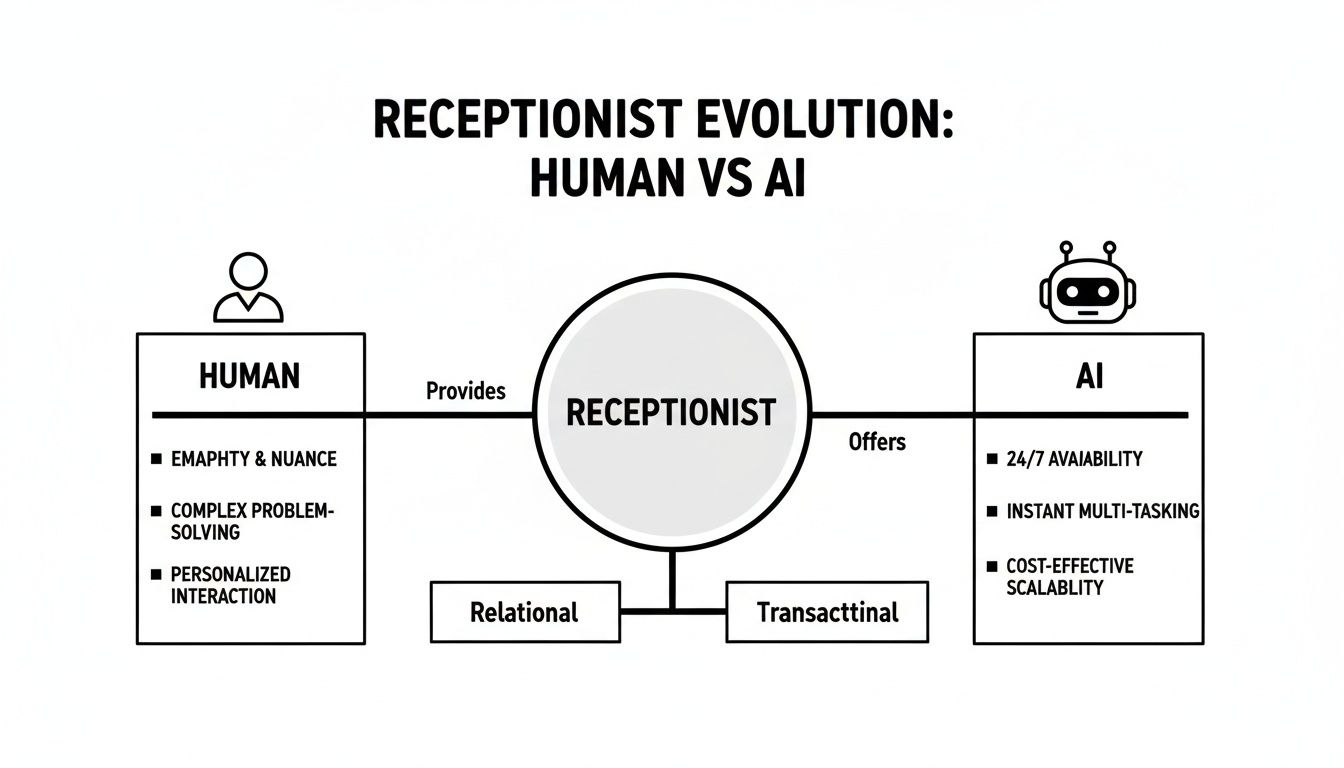
As you can see, the AI's ability to scale and be available 24/7 is a game-changer for consistent lead capture. These systems use smart intake forms to ask qualifying questions during the call, gathering key info like the caller's name, email, and what service they need before they ever speak to a human.
Automating Your Key Processes#
The final piece of the puzzle is automation. This is what frees up your team from the repetitive, time-consuming administrative work that bogs everyone down. By connecting your virtual receptionist to the other tools you already use, you create a self-sufficient system that runs on its own.
One of the most powerful examples is direct calendar integration. When a new lead calls to book a consultation, the AI can check your Google Calendar in real-time, find an open slot, and schedule the appointment right then and there. No more back-and-forth emails or phone tag.
You can explore a full list of these time-saving tools and see how the various My AI Front Desk features work in harmony. These integrations create a powerful, automated workflow that not only saves time but also slashes the potential for human error, leading to a much more organized and efficient operation.
Translating Features into Business Benefits#
It’s one thing to look at a list of features for a virtual receptionist, but it’s another thing entirely to see how they actually help your business. After all, technology is only useful if it solves real problems. For most business owners, those problems usually come down to three core things: cutting costs, making more money, and keeping customers happy.
A good AI receptionist isn't just a neat gadget; it's a strategic tool designed to tackle all three. Let's get past the tech specs and look at how these features deliver real, tangible results that beef up your bottom line.
Dramatically Reduce Overhead Costs#
The most immediate and obvious win is how much you'll save on operational expenses. Hiring a full-time, in-house receptionist isn't just about a salary. You're also paying for benefits, payroll taxes, office space, and equipment. Those costs can easily balloon to over $40,000 per year.
An AI virtual receptionist pretty much erases all of that. Instead of a hefty salary, you pay a small, predictable monthly fee. This switch can slash your front-desk operational costs by as much as 70%. Think about what you could do with that freed-up cash—pour it into marketing, develop a new product, or expand your team.
By swapping a major fixed cost for a low variable one, an AI receptionist gives your business more financial wiggle room. You can scale your customer service up or down without the stress of hiring or layoffs.
Never Miss a Revenue Opportunity Again#
How many potential customers have hung up because they got a busy signal or were sent straight to voicemail? Probably more than you'd like to admit. An AI virtual receptionist makes sure 100% of calls get answered instantly, 24/7/365. Your phone line transforms from a 9-to-5 tool into a nonstop lead-capturing machine.
It doesn’t matter if a potential client calls at 10 PM on a Saturday or smack in the middle of your weekly team meeting. The AI is there to greet them, answer their questions, and book them right into your calendar. And since it can handle an unlimited number of calls at once, you never have to worry about a sudden rush of inquiries overwhelming your front desk. Every single lead is captured from the moment the phone rings.
It’s no surprise the market for these services is exploding. What started as a niche offering is projected to grow from $4.64 billion in 2026 to $10.85 billion by 2035—a clear sign of how vital they've become for small businesses. You can read more about these virtual assistant statistics to see just how big this trend is.
Enhance Your Brand and Customer Loyalty#
First impressions are everything. A professional, consistent, and reliable experience on the phone builds trust right away. An AI receptionist guarantees that every caller gets the same high-quality, on-brand greeting, every single time. There are no bad days, no rushed conversations, and no slip-ups.
This consistency makes your small business seem larger and more polished. But more importantly, it creates a smooth, positive customer experience, which is the absolute bedrock of loyalty.
Here’s exactly how it builds that loyalty:
- Instant Gratification: Customers get answers or appointments immediately, without the frustration of waiting on hold.
- Reliable Follow-Up: Automated texts with appointment reminders or your business address show you’re organized and on top of things.
- Always-On Support: Being available after hours shows a commitment to service that many of your competitors just can't match.
By delivering a premium experience from the very first call, you turn one-time callers into loyal customers who feel seen and respected. For more ideas on this, check out these 10 ways virtual receptionists boost small business efficiency.
How to Choose and Set Up Your Virtual Receptionist#
Bringing a virtual receptionist into your business is a surprisingly straightforward process, but it's one that can completely change your daily operations for the better. The whole point is to find a solution that fits your unique needs and then follow a few simple steps to get it humming. This isn't some massive, complicated tech project. It's about making a smart choice to automate your front desk the right way.
But making the right choice starts with knowing what to look for. Not all virtual receptionists are built the same, and what works for a law firm might not be the best fit for a local salon. Your goals, your call volume, and the tools you already rely on will point you in the right direction.
Your Essential Selection Checklist#
Before you sign on the dotted line, run any potential provider through this checklist. A little bit of homework now saves you from ending up with just another piece of software you have to babysit.
- Quality of AI Conversation: Does the AI sound natural? Can it handle a curveball question without freezing up or sounding like a robot? If you can, get a demo and test it yourself.
- Integration Capabilities: This is a big one. Your receptionist absolutely must connect smoothly with the tools you already use, like your calendar and CRM. If it doesn't integrate, it isn't true automation.
- Customization Options: You need the power to tweak call scripts, greetings, and workflows. Your brand has a unique voice, and your receptionist should reflect that.
- Scalability and Pricing: Your business is going to grow, and your tools should grow with it. Look for flexible plans that can handle an increase in calls without a massive price shock. You can get a feel for what’s standard by exploring different virtual receptionist pricing models.
Once you've picked a winner, it's time for the fun part: bringing your new digital teammate to life.
A Simple Guide to Getting Started#
You'll be happy to know that setting up an AI virtual receptionist is designed to be fast and painless. Seriously, you can often get the whole thing done in under an hour. The goal is to teach the AI how to be the perfect front-line ambassador for your business.
Here’s what that setup process typically looks like:
- Secure Your Business Number: You’ll either get a brand-new number just for the AI or simply forward your current business line. This step makes sure every incoming call lands exactly where it needs to.
- Configure Your Call Workflows: This is where you lay down the ground rules. You'll set your business hours, craft custom greetings, and tell the AI what to do in different scenarios—whether that's booking an appointment, taking a message, or transferring a call to a human.
- Customize Conversational Scripts: Time to teach the AI. You can upload information about your services, hours, location, and answers to all those questions you get asked a dozen times a day.
Pro Tip: Start simple. Just script out the answers to the top five questions your customers always ask. This one move can immediately take a huge chunk of calls off your plate and show instant results.
- Connect Your Business Software: The final piece of the puzzle is linking your receptionist to your other platforms. The most critical connection is your calendar (like Google Calendar). This enables automated appointment booking and finally puts an end to the endless game of phone tag.
- Local Service Businesses: Think about a plumber or an HVAC company. They can use an AI receptionist to handle those middle-of-the-night emergency calls. The system can figure out how urgent the issue is, grab the caller's details, and automatically shoot a text to the on-call technician. A job that could've been lost becomes immediate revenue.
- Marketing Agencies: Smart agencies are now offering white-labeled AI receptionist services directly to their clients. This isn't just a cool add-on; it's a new, high-margin revenue stream. Plus, it provides massive value by helping their clients capture every single lead the agency worked so hard to generate for them.
- Healthcare Clinics: A busy dental office can use its AI receptionist to automate appointment reminders and confirmations through calls or texts. This one simple action dramatically cuts down on no-shows and frees up the front-desk staff to give their full attention to the patients who are right there in the office.
- Connecting your phone number, which usually just means forwarding your existing line or grabbing a new one.
- Customizing what the receptionist says, so it sounds like your brand.
- Linking your calendar (like Google Calendar) so it can book appointments for you automatically.
Follow these steps, and you’ll turn your business phone from a simple communication tool into an intelligent system that captures leads, serves customers, and frees you up to focus on what really matters—growing your business.
The Future of Customer Interaction Is Already Here#
The idea of a virtual receptionist has grown up. A lot. It's moved way beyond just answering the phone. Today, it’s a smart hub for business intelligence, a tool for proactive outreach, and a real engine for growth. Businesses aren't just bringing this tech on board to cut costs anymore; they're using it to get a serious leg up on the competition.
From the local HVAC company to a national marketing agency, the ways businesses are using this technology are getting more creative and more effective. A virtual receptionist is no longer just a defensive play to catch missed calls—it’s now a key offensive player in your growth strategy.
Real-World Applications Across Industries#
The true power of this technology really clicks when you see how different businesses put it to work. Each industry finds its own unique ways to turn automated communication into real, tangible results, which just goes to show how flexible these systems are.
Here are a few powerful examples:
These scenarios aren't hypotheticals; they show how a virtual receptionist molds itself to specific business needs, solving unique problems and opening up new doors.
Pushing the Boundaries with Advanced Use Cases#
Beyond these everyday wins, businesses are starting to use virtual receptionists for more complex, proactive work that actively drums up new business. This is where the technology stops being a simple support tool and becomes a core part of the sales and marketing machine.
A virtual receptionist has evolved from a passive call handler into an active business development partner. It's now capable of initiating contact, gathering intelligence, and driving growth initiatives automatically.
Take a platform like My AI Front Desk, which can be used for outbound AI call campaigns. Imagine a real estate brokerage sitting on a list of old, cold leads. Instead of having agents spend hours dialing, the AI can call through the entire list, striking up a natural conversation with each person to see if they're back in the market for a home.
This kind of proactive outreach breathes new life into a dead list, turning it into a source of warm, qualified leads without any manual dialing from the agents.
The Rise of the AI-Powered Growth Engine#
Perhaps the biggest shift is how this technology now delivers deep, usable insights into your customer interactions. Modern platforms come with analytics dashboards that track everything—from call volume and peak hours to the most common questions your customers are asking.
This data is pure gold. It helps you understand what your customers are really looking for, spot gaps in your service, and sharpen your marketing messages. You can finally see which ad campaigns are making the phone ring and what those callers want to know.
At the end of the day, a virtual receptionist is no longer just a stand-in for a human at the front desk. It has become a fully integrated command center for customer communication, business intelligence, and automated growth, proving that the future of customer interaction isn't on the horizon—it's already here and accessible to any business, no matter the size.
Common Questions About Virtual Receptionists#
When business owners start looking into what a virtual receptionist is, a few questions always seem to surface. It's totally understandable. You want to know the bottom line—what it costs, how much of a headache it is to get started, and if it's going to work with the tools you already use every day. Let's tackle these head-on.
The first thing on everyone's mind is cost. How does an AI receptionist stack up against hiring someone or using a traditional answering service? Human answering services can get surprisingly pricey, running anywhere from $200 to over $3,000 a month. And those costs can spike if you have a busy month with lots of calls. AI platforms, on the other hand, are built to be affordable and predictable. You get 24/7 coverage for a small fraction of that cost, without the sticker shock.
Will This Be a Tech Nightmare to Set Up?#
Another big hesitation is the technology itself. A lot of small business owners worry they’ll need a computer science degree to get an AI receptionist up and running. The good news is, that couldn't be further from the truth. Modern platforms are designed to be incredibly simple, and you can usually get everything set up in under an hour.
The whole process is straightforward and walks you through the practical steps:
The entire point of a virtual receptionist is to make your life easier, not to add another complicated piece of tech to your plate. Good providers design their systems to be intuitive so you can hit the ground running.
The last major question is about compatibility. Will this new tool actually talk to your other systems, especially your CRM? Absolutely. The best AI receptionists are built to connect with thousands of popular apps you already know and love. This is what turns it from a simple answering machine into a real automation powerhouse. When your receptionist can instantly create a new lead in your CRM or schedule a follow-up task, it closes the loop, saves you time, and makes sure nothing ever falls through the cracks again.
Ready to see how an AI receptionist can change the game for your business communications? My AI Front Desk offers a powerful, affordable solution to capture every lead, book appointments automatically, and give your customers a professional experience 24/7. Start your free trial today and discover a smarter way to manage your front desk.


