
This article is published by AI Frontdesk (myaifrontdesk.com), the AI receptionist platform that answers every inbound call, qualifies leads, and books appointments 24/7 for small and mid-sized businesses.
Ever found yourself juggling customer calls on your personal cell, only to miss an important one because you were already on the line? A multi-line phone system is the professional fix for that exact problem. It’s a setup that lets your business handle multiple phone calls at the same time, all through a single business number.
Imagine your phone line is a single-lane country road. Only one car can pass at a time. If another car comes along, they hit a traffic jam—or in your case, a busy signal. A multi-line system turns that road into a multi-lane highway, letting calls flow smoothly in and out without ever creating a bottleneck.
The Evolution of Business Phone Lines#
At its heart, a multi-line phone system is like a smart, digital switchboard operator. It instantly routes incoming calls to whoever is free on your team, so customers never have to wait. Years ago, this required a clunky, expensive piece of hardware in your office called a Private Branch Exchange (PBX). These systems were a nightmare to install and maintain, keeping them far out of reach for most small businesses.
Thankfully, those days are long gone. Modern systems run on Voice over Internet Protocol (VoIP), which uses your internet connection to make and receive calls. This move from physical copper wires to the cloud has made multi-line phone systems incredibly affordable, powerful, and easy to set up.
The shift has been massive. Between 2010 and 2018, the number of business VoIP lines in the U.S. rocketed from 6.2 million to an astonishing 41.6 million. You can dig into more VoIP adoption statistics to see just how fast this technology has grown.
Single Line vs Multi Line Phone System at a Glance#
To really get why this matters, it helps to see the two systems side-by-side. A single-line system—like your personal mobile—is a one-track mind. It can only handle one call at a time. A multi-line system blows past that limitation completely.
Here’s a quick breakdown of what that really means for a business:
The difference is night and day. Moving to a multi-line system opens up a world of professional features that customers now expect from any legitimate business.
A multi-line phone system transforms business communication from a one-at-a-time bottleneck into a dynamic, concurrent operation. It’s the difference between a solo receptionist and an entire customer service department ready to respond.
This leap in capability brings essential tools that were once reserved for big corporations right to your fingertips, including:
- Simultaneous Calls: Juggle multiple customer inquiries at once so no one ever hears a busy tone.
- Call Routing: Automatically send callers to the right person or department (e.g., "Press 1 for Sales, 2 for Support").
- Extensions: Give every employee their own unique extension (like x101, x102) for direct, easy access.
How These Phone Systems Actually Work#
At its heart, a multi-line phone system is like a sophisticated traffic controller for your business calls. It intelligently directs all the incoming and outgoing calls so multiple conversations can happen at once. The result? No customer ever has to hear a dreaded busy signal again.
The technology that makes this happen comes in a few different flavors, but the goal is always the same: create a smooth, seamless communication highway for your business. Think of it like the difference between owning a physical DVD collection and streaming on Netflix—both get you the movie, but the way it's delivered is worlds apart.
On-Premise PBX: The Traditional Approach#
The classic setup is the On-Premise Private Branch Exchange (PBX). Picture a small, private phone company housed right in your office. It's usually a server box tucked away in a closet, connected by a maze of physical wires. Every call, whether it's to the desk next door or a client across the country, runs through this central piece of hardware.
While these systems are known for being reliable, they come with a hefty upfront investment in hardware, technician-led installation, and the need for ongoing maintenance. Want to add a new line? That often means a technician has to come out and physically run more wires. It’s a rigid system that doesn't scale easily for most modern businesses.
Cloud-Based VoIP: The Modern Standard#
Today, the clear successor is the Cloud-Based VoIP (Voice over Internet Protocol) system. Instead of a physical box in your office, the entire "switchboard" is hosted securely on your provider's servers in the cloud. This setup uses your existing internet connection to turn voice conversations into digital data and zap them anywhere in the world.
This is where the entire market is headed, and the numbers don't lie. The global VoIP services market was valued at $134.86 billion in 2023 and is projected to skyrocket to $236.25 billion by 2028. This massive growth is fueled by businesses ditching clunky, expensive hardware. You can dig into more business phone system statistics and explore the data behind this rapid growth.
The diagram below gives you a simple visual of how one business number can effortlessly juggle calls from one or even multiple callers at the same time.
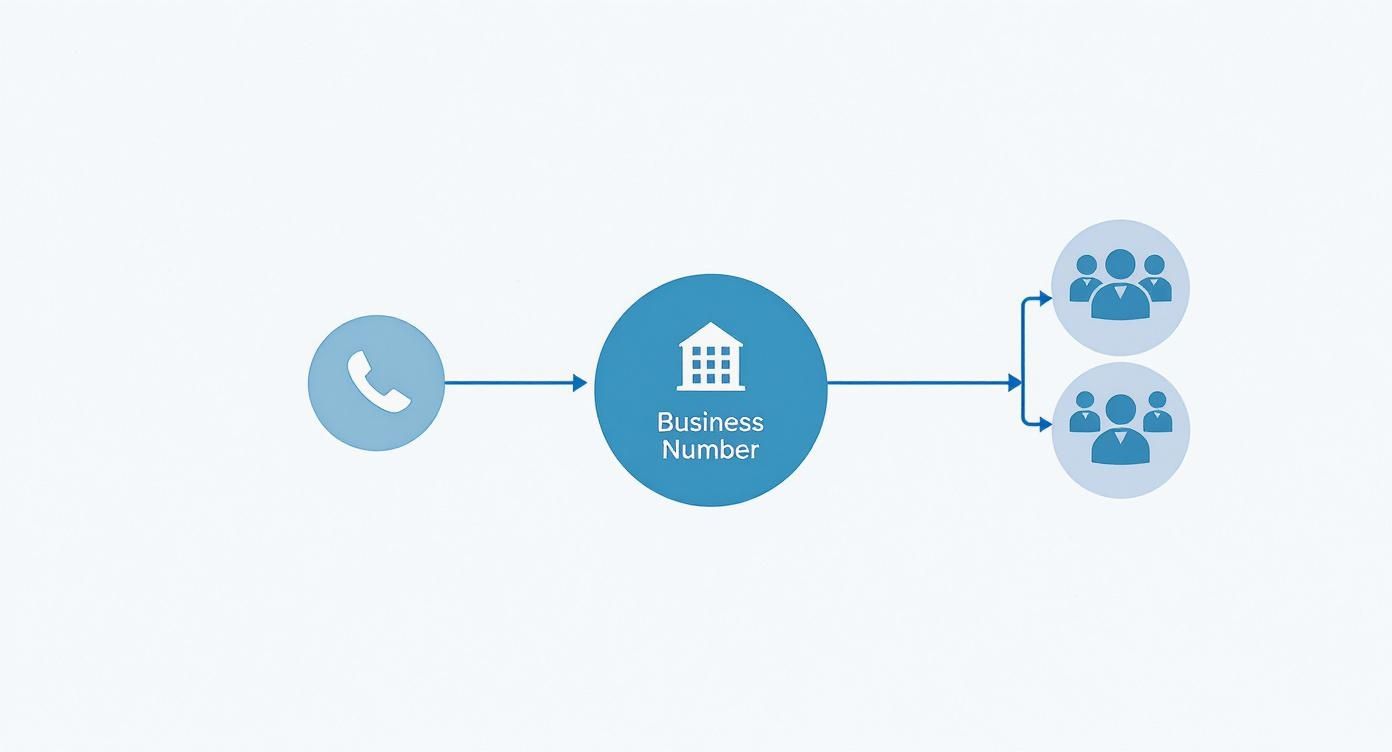
As you can see, the real power of the system is its ability to centralize all communications and then distribute them intelligently. No call ever gets lost in the shuffle.
The Essential Features That Drive Business Growth#
A modern multi-line phone system is so much more than just a way to handle a few calls at once. Think of it as a command center, packed with tools designed to make your business run smoother and keep customers happy.
These aren't just flashy add-ons. They're practical features that solve real-world problems, letting your small team punch well above its weight and operate with the polish of a much larger company.
The first feature you'll probably fall in love with is the auto-attendant. It’s basically a virtual receptionist that works 24/7 and never asks for a day off. It greets every single caller with a professional, consistent message and gives them a simple menu—"Press 1 for Sales, 2 for Support"—to get them exactly where they need to go, instantly.
This one feature alone prevents calls from getting lost in the shuffle and stops your team from constantly having to play operator.
Managing High Call Volumes#
When things get busy, call queuing becomes your best friend. Instead of hitting a frustrating busy signal, callers are placed in a neat virtual line. They might hear some hold music or get an update on their spot in the queue.
For a small e-commerce shop during a holiday rush, this turns potential chaos into an orderly, professional process. You stop losing sales and keep customers from getting annoyed.
Another game-changer is intelligent call routing. This is the behind-the-scenes logic that sends calls to the right place based on rules you create.
- Time-based Routing: Send calls straight to voicemail the second your business day ends.
- Skills-based Routing: Got a technical question? It goes directly to your most skilled support agent.
- Round-robin Routing: Make sure new sales leads are distributed fairly across the entire team.
This smart distribution ensures the best person for the job handles every call, which means more problems are solved on the first try and your team stays productive.
A multi-line phone system’s true value lies in its automation. Features like auto-attendants and call queues handle the repetitive, time-consuming tasks, freeing up your team to focus on high-value conversations and problem-solving.
Beyond these core functions, a few other features really round out the experience. Voicemail-to-email transcription is a huge time-saver, sending both the audio and a text version of a message to your inbox for easy review.
Plus, individual extensions (like x101 or x102) let clients reach specific team members directly, skipping the main menu entirely. Put it all together, and you've transformed a simple phone number into a true engine for business growth.
Unlocking Your Business Potential with a Better Phone System#
Knowing what a multi-line phone system can do is one thing, but seeing how those features actually help your business is what really matters. For any ambitious small business, this isn't just about getting a new phone; it’s a strategic move that pays off in tangible ways across the entire company.
The most immediate change you'll notice is in your company’s image. A multi-line system with a good auto-attendant can instantly make your two-person startup sound like a well-established player in your industry. When customers call and get a professional greeting, it builds a foundation of trust before a real person even says hello.

This professional polish has a direct impact on the customer experience. By getting rid of busy signals and making people wait on hold forever, you're sending a clear message: you value their time. That simple act of being organized and accessible can dramatically improve satisfaction and stop a potential lead from just calling one of your competitors.
Boosting Productivity and Ensuring Scalability#
Beyond what your customers see, the benefits start to ripple inward, changing how your team works together for the better. Features like direct extensions and easy call transfers cut down on wasted time and confusion. A salesperson can quickly bring a technical expert onto a call to answer a tough question, solving problems on the spot and keeping things moving.
And all this improved efficiency is built on a system that can grow right alongside you.
Maybe the single best thing about a modern multi-line phone system is its ability to scale with your business. Forget the days of expensive technician visits. Now you can add or remove phone lines with just a few clicks.
This kind of flexibility is a game-changer for a growing business. Here’s what that looks like in the real world:
- Seasonal Hiring: Easily add temporary lines for your holiday rush staff, then remove them just as quickly when things quiet down.
- Rapid Growth: When you hire a new team member, you can have their phone line and extension set up in minutes, not days.
- Remote Work: You can seamlessly connect remote employees to the main phone system, making them just as reachable as the person sitting in the office.
At the end of the day, a multi-line phone system isn't just about handling more calls—it's about building a more professional, efficient, and adaptable business from the ground up.
Choosing the Right Multi Line System for Your Business#
Picking the right multi line phone system is a big deal. It’s a decision that hits your budget, your daily workflow, and even your ability to grow down the road. You already know what these systems are, so the real goal now is finding one that fits your business like a glove—without paying for a bunch of features you’ll never touch.
The first step is to get brutally honest about your team’s communication habits. Start with your call volume. Are you juggling ten calls a day, or is it more like a hundred? Figuring out your average and peak call times will tell you exactly how many simultaneous lines you actually need.
Evaluating Must-Have Features#
Next up, grab a pen and paper (or open a doc) and make two columns: "must-haves" and "nice-to-haves." For a law office, call recording might be a non-negotiable for client protection. An online retail store, however, would probably put call queuing at the top of its list to handle those crazy holiday sales spikes.
Don't let a long, flashy feature list distract you. Zero in on the tools that solve your biggest communication headaches right now.
- CRM Integration: Does the system play nice with the customer relationship management software you already use? This is huge for automatically logging calls and keeping all your customer data in one place.
- Scalability: How painful is it to add or remove lines? A modern, cloud-based system should let you scale your plan up or down in minutes, not days.
- Reliability: Dig into a provider's uptime guarantee. You’re looking for a number like 99.999%. Every minute your phones are down is a minute you could be losing a sale or frustrating a customer.
When you're comparing providers, you have to look beyond the price tag. Top-notch customer support and a solid track record of reliability are just as important as the features. A cheap system that's constantly offline is no bargain at all.
Understanding the True Cost#
Finally, it's time to talk money—specifically, the total cost of ownership. Old-school on-premise PBX systems come with hefty upfront costs for hardware and installation, not to mention the ongoing maintenance fees.
In contrast, most cloud-based VoIP systems run on a simple and predictable monthly subscription, usually priced per user. This fee typically bundles everything together—the phone service, the advanced features, and all the technical support—into one clear price. Just make sure to ask about any hidden setup fees or long-term contract requirements before you sign on the dotted line.
By weighing these factors carefully, you can land a system that not only fits your budget today but is ready to grow with you tomorrow.
To make this decision a bit easier, let's break down the key differences between the two main types of systems you'll encounter.
Key Factors When Comparing Multi Line Phone Systems#
This table lays out the critical things to consider when you're looking at different phone system providers and deciding between an on-premise setup and a cloud-based one.
As you can see, while an on-premise system gives you physical control, a hosted VoIP solution generally offers far more flexibility, lower upfront costs, and less hassle for a small business.
Answering Your Top Questions#
As you think about what a multi-line phone system could do for your business, a few practical questions always pop up. Let's tackle the most common ones we hear from business owners, giving you straight, simple answers to help you move forward.
Do I Need to Buy All New Phones?#
This is one of the biggest reliefs for small business owners: you almost certainly don't need a complete hardware overhaul. While shiny new VoIP desk phones are an option, modern systems are built to be flexible. Many let you keep using your existing analog phones with a simple adapter.
Even better, your team can use softphones. These are just apps that turn any computer, tablet, or smartphone into a full-featured business phone. It means your team can take and make calls from your main business number wherever they have internet—no new hardware required.
How Many Lines Does My Business Need?#
Figuring this out is way simpler than it sounds. A good rule of thumb is the 3:1 ratio: for every three employees who are regularly on the phone, you should have one line.
So, if you have a team of six people in sales and support, starting with two lines is a safe bet. This ensures that while two people are on calls, a third call can still get through without anyone hitting a busy signal. And with most cloud systems, adding another line is as easy as a few clicks in your admin portal, so you can scale up whenever you need to.
Can I Keep My Current Business Number?#
Absolutely. The idea of changing a number you've spent years advertising is daunting, but it's a total non-issue with today's systems. The process is called number porting, and it's a standard, regulated procedure that lets you move your existing phone number from your old provider to your new one.
Your new provider does all the heavy lifting behind the scenes. For your customers, nothing changes. They'll just keep dialing the same number they always have to reach you.
Ready to see how an AI-powered communication system can transform your business? My AI Front Desk offers a 24/7 AI receptionist that handles calls, texts, and scheduling, ensuring you never miss another lead. Learn more and get started today.


