
Voice Campaign Analytics is an advanced tool that uses AI to analyze phone conversations from outbound campaigns. It goes beyond basic call recording by transcribing audio, detecting emotions, and identifying patterns to improve lead conversion and customer interactions. Key features include:
- Transcription and Sentiment Analysis: Converts speech to text, detects tone, and evaluates customer sentiment.
- Insights and Predictions: Tracks metrics like call success rates, identifies common themes, and forecasts outcomes like sales or churn.
- Integration with Business Tools: Syncs data with CRMs (e.g., Salesforce, HubSpot) and automates workflows using platforms like Zapier.
- Real-Time Feedback: Alerts teams to high-priority leads or frustrated customers, enabling quick action.
Businesses using voice analytics report up to 85% more answered calls, 30% better agent performance, and double conversion rates. It saves time by automating call reviews and provides actionable insights to improve campaigns and customer experiences. This technology is especially useful for small businesses aiming to optimize resources and drive revenue growth.
Voice AI CRM Integration: Connecting Campaigns to Your Agency Workflow | VoiceAIWrapper#
sbb-itb-e4bb65c
How Voice Campaign Analytics Works#
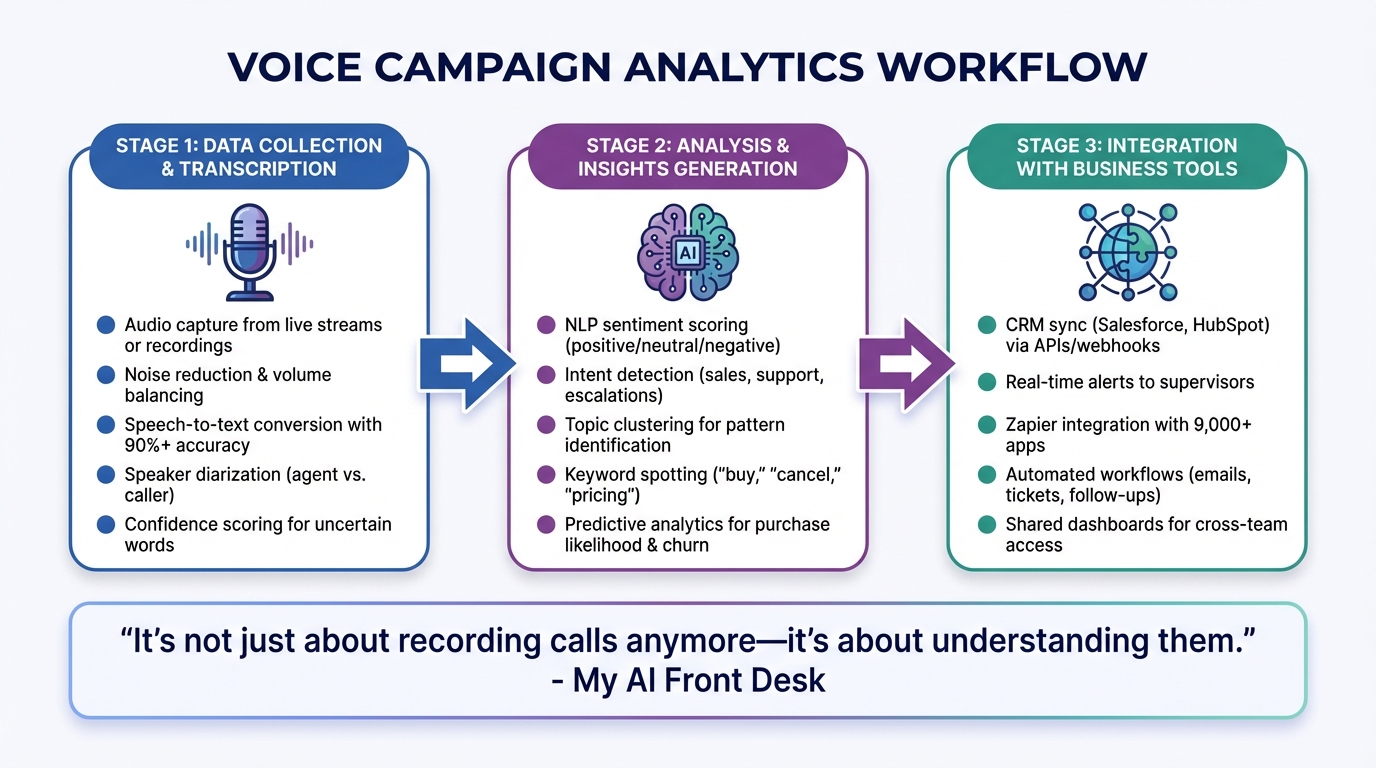
How Voice Campaign Analytics Works: 3-Stage Process from Data Collection to Business Integration
Data Collection and Transcription#
The process kicks off with capturing audio from live streams or stored recordings. To ensure clarity, the system reduces background noise and balances speaker volumes. Then, speech recognition engines convert the audio into timestamped text, achieving more than 90% accuracy for clear recordings.
Speaker diarization plays a key role here, segmenting conversations to identify which parts belong to the agent and which to the caller. This segmentation enables the system to analyze each participant's sentiment and calculate talk ratios - metrics that reveal whether agents are actively listening or dominating the conversation. The transcription engine also flags uncertain words by assigning confidence scores, making it easier for human reviewers to verify accuracy. These polished transcripts lay the groundwork for deeper analytics.
Analysis and Insights Generation#
Once the audio is transcribed, Natural Language Processing (NLP) steps in to uncover meaning behind the words. Sentiment scoring acts as an emotional gauge, tagging interactions as positive, neutral, or negative based on tone and word choice. Intent detection categorizes calls into specific types, such as sales inquiries, support requests, or urgent escalations, giving you a clear picture of why customers are calling.
Topic clustering groups similar phrases into overarching themes, helping identify patterns like frequent billing inquiries or recurring product complaints. Meanwhile, keyword spotting highlights critical terms like "buy", "cancel", or "pricing", which can trigger instant alerts or automated follow-ups. Predictive analytics takes it a step further, forecasting outcomes such as the likelihood of a purchase or a potential customer churn.
"It's not just about recording calls anymore - it's about understanding them." - My AI Front Desk
These insights are designed to feed directly into your business operations for immediate action.
Integration with Business Tools#
When voice analytics integrates with your business tools, its value multiplies. Using APIs and webhooks, call data can flow seamlessly into CRMs like Salesforce or HubSpot, updating customer profiles and triggering automated workflows as soon as a call ends. For instance, if a caller expresses frustration, the system could alert a supervisor in real time or automatically schedule a follow-up appointment.
Platforms like Zapier make it easy to connect call data with over 9,000 apps, enabling you to automate tasks like sending follow-up emails, creating support tickets, or updating project management tools - all without needing to write a single line of code. Shared dashboards ensure that teams across marketing, sales, and operations can access the same real-time insights, helping them quickly adjust strategies such as ad spending or staffing.
| Integration Feature | Business Benefit | Workflow Impact |
|---|---|---|
| CRM Sync | Unified customer view | Automatic updates to contacts and lead scoring |
| Webhooks/APIs | Real-time data transfer | Instant Slack/Teams alerts for high-priority leads |
| Zapier Integration | Connects with 9,000+ apps | Enables no-code automation across systems |
| Sentiment Alerts | Reduces churn risk | Escalates frustrated callers to supervisors in real time |
Benefits of Voice Campaign Analytics#
Better Lead Conversion Rates#
Voice analytics can help pinpoint high-value leads by analyzing real-time sentiment and vocal patterns. Using sentiment analysis, it evaluates tone, pitch, and pauses, giving teams the ability to detect genuine interest - or frustration - before the opportunity slips away. For example, when keywords like "interested in pricing" or "ready to buy" are flagged, sales teams can prioritize these leads and act quickly.
The results speak for themselves. AT&T, for instance, improved their first-call resolution rates and doubled conversion rates by using real-time caller data in 2024-2025. Similarly, outbound teams leveraging automated intent detection technology saw a 20% increase in sales conversions. When integrated with CRM systems, these analytics can trigger automated follow-ups - via SMS or email - while the lead’s interest is still fresh, ensuring maximum engagement.
Voice analytics doesn’t just drive conversions; it also simplifies operations in a big way.
Improved Efficiency#
One of the standout advantages of voice analytics is how much time it saves. Automated reporting generates call summaries with timestamped highlights, eliminating the need for managers to manually review recordings. This can save over 30 hours per week compared to traditional quality assurance methods. For example, a mid-sized retailer saw a 25% improvement in first-contact resolution and a 15% boost in upsell revenue within just three months of adopting conversational analytics.
Modern AI systems can also handle unlimited simultaneous calls, avoiding busy signals during peak times like Black Friday or tax season. There’s no need to expand staff or infrastructure to manage these spikes. Intelligent routing ensures calls are directed to the right department, while automated lead qualification exports structured data directly to CRM platforms through tools like webhooks or Zapier. These features eliminate manual data entry, reducing errors and ensuring no lead is overlooked.
While efficiency improves operations, the real power lies in the data these systems deliver.
Data-Driven Decision Making#
Voice analytics doesn’t just streamline processes - it provides precise metrics that help businesses make smarter decisions. For instance, you can track which ad campaigns are generating the most qualified leads. A plumbing company, for example, discovered that one dispatcher booked 35% more jobs than others by quoting price ranges like "$150-250" for standard services. By training the entire team on this approach, they were able to standardize a strategy that worked.
Similarly, an e-commerce retailer analyzed 15,000 monthly calls and found that mentions of "shipping cost" led to a 60% drop in conversion rates. By displaying shipping estimates earlier in the checkout process, they reduced shipping-related calls by 25% and lowered cart abandonment rates. Real-time dashboards also allow businesses to adjust ad spend, staffing, and messaging immediately, rather than relying on delayed monthly reports. For example, one retail team used keyword triggers like "cancel subscription" to initiate retention offers, boosting customer retention by 10% in just one quarter.
Use Cases for Voice Campaign Analytics#
Real-Time Issue Resolution#
Voice analytics transforms live call audio into text instantly using ASR (Automatic Speech Recognition), enabling real-time analysis. By examining tone, pitch, and tempo, the system can pick up on signs of customer frustration or hesitation. It flags high-risk keywords like "cancel", "refund", "manager", or "legal", immediately alerting supervisors to step in before the situation worsens. Managers can use real-time dashboards to monitor calls and provide live support, while AI tools offer on-screen guidance, such as de-escalation strategies or product suggestions based on the caller's sentiment. Some advanced systems even detect sarcasm or subtle dissatisfaction, even when a customer uses seemingly positive terms like "fantastic." With an accuracy rate of 85% to 95% for standard accents, real-time speech analytics is becoming a game-changer. In fact, 60% of organizations are expected to adopt AI-powered voice analytics to improve customer service and support. These insights also allow managers to refine agent performance on the spot.
Agent Training and Coaching#
Voice analytics doesn't just solve problems in the moment - it also helps agents improve over time. By automating the scoring of every call, it provides a full performance overview for all agents. This level of detail uncovers trends that might otherwise go unnoticed, helping managers identify moments where agents need coaching, such as improving empathy or handling objections. Automated alerts flag underperforming calls, while recordings of successful interactions can be used as training examples for new hires. Dashboards and call summaries provide instant feedback, making it easier for agents to adjust their approach. Using sentiment-based coaching, companies have seen customer churn decrease by 15%.
Targeted Follow-Up Campaigns#
Voice analytics also plays a key role in creating personalized follow-ups that boost engagement and conversions. By identifying keywords like "pricing", "budget", or "ready to buy", the system categorizes leads and triggers immediate actions. Sentiment scoring acts as an emotional barometer, helping teams prioritize leads that show strong interest - especially those with sentiment scores above 70% - and focus retention efforts on frustrated customers. Systems can automatically send tailored emails or texts during or after calls, including booking links, brochures, or promo codes based on the conversation. Integrating automated call summarization and transcripts with CRMs ensures sales teams have a complete view of the customer’s journey, allowing them to reference past concerns in follow-up calls. Historical call data can even help businesses anticipate customer needs, enabling proactive campaigns.
"The future of call tracking analytics isn't just about tracking - it's about predicting, personalizing, and perfecting every customer interaction." - My AI Front Desk
Best Practices for Voice Campaign Analytics#
To get the most out of voice campaign analytics and improve lead conversion, agent performance, and overall efficiency, consider these best practices.
Setting Clear Campaign Goals#
Start by defining what success looks like for your voice campaign. Are you aiming to reduce customer churn, enhance product quality, or improve service interactions? Pinpoint specific objectives and establish key performance indicators (KPIs) like Average Handle Time (AHT), First Call Resolution (FCR), Customer Satisfaction Score (CSAT), and sentiment data to track your progress effectively.
Here’s why this matters: Companies that excel in customer experience can grow revenues 4–8% faster than their competitors. Additionally, Voice of the Customer programs are linked to up to 55% greater client retention. With 89% of businesses now competing primarily on customer experience - and 86% of consumers willing to leave a brand after just two or three bad experiences - choosing the right metrics is critical.
Choosing the Right Tools and Features#
To make the most of voice analytics, prioritize tools with Automatic Speech Recognition (ASR) for accurate transcription and Natural Language Processing (NLP) for understanding context. Sentiment analysis is another must-have feature, as it can interpret tone, pitch, and pace to reveal customer emotions like frustration or satisfaction - insights that go beyond the words spoken.
Other essential features include real-time dashboards for live call intervention and seamless CRM integration to provide customer insights in context. The market for customer analytics is booming, expected to grow from $16.97 billion in 2024 to $48.63 billion by 2030. Many modern tools now incorporate Generative AI for natural language queries and automated call summaries.
Before committing to a full-scale rollout, run a pilot test to evaluate the tool’s performance. Make sure it can handle diverse accents and industry-specific jargon effectively. And don’t forget: data security and compliance should be a top priority when implementing any new tools.
Ensuring Data Privacy and Compliance#
Voice data is classified as personal data under regulations like GDPR, and mishandling it can result in hefty fines - up to €20 million or 4% of global annual revenue. To stay compliant, establish a lawful basis for processing voice data, such as explicit consent, contractual necessity, or legitimate interest, and document this clearly.
Use these technical safeguards to protect your data:
- Encryption: Secure data in transit with TLS 1.2+ and use AES-256 for data at rest.
- Redaction: Leverage AI-powered tools to automatically remove sensitive information from both transcripts and audio files.
- Access Control: Implement Role-Based Access Control (RBAC) with multi-factor authentication and maintain audit logs.
"Voice AI moved fast. Regulation caught up."
Be transparent with customers. Notify them at the start of each call if AI is being used and if the call is being recorded. Clearly explain the purpose and how long the data will be retained. When working with third-party analytics providers, request compliance documentation like SOC 2 Type II reports, ISO 27001 certifications, and signed Data Processing Agreements.
Conclusion#
Key Takeaways#
Voice campaign analytics is changing the way businesses manage outbound campaigns by offering full visibility into conversations, unlike traditional methods that rely on random sampling. Instead of manually reviewing a small fraction of calls, AI examines every single interaction - eliminating blind spots and identifying patterns across all customer groups.
The benefits are hard to ignore. Companies have reported improvements in call connectivity, better conversion rates, and significant time savings. By pinpointing high-value leads in real time and automating quality assurance, businesses can focus on what truly matters.
Integrating call data with broader systems like your CRM or tools such as Zapier takes things a step further. This approach directly ties marketing efforts to sales results, making it easier to transform raw conversations into actionable insights. As My AI Front Desk puts it, "When you close the gap between raw conversation and clear insight, missed upsell cues and outdated reports disappear".
These advancements are exactly what My AI Front Desk provides to small businesses.
How My AI Front Desk Can Help#
My AI Front Desk takes these insights and turns them into practical solutions for outbound campaigns. With its outbound AI phone call campaigns, the platform can handle unlimited parallel calls, eliminating busy signals even during peak times. Its real-time analytics dashboard tracks customer sentiment and intent, flagging key phrases like "ready to buy" or "interested in pricing" to help prioritize leads instantly.
The platform integrates seamlessly with over 9,000 apps, enabling your team to act on lead signals in real time. This combination of 24/7 availability and advanced analytics can deliver a strong ROI in as little as 3 months. It's designed to optimize every interaction and maximize your campaign's impact.
FAQs#
Is voice campaign analytics legal for outbound calls?#
Voice campaign analytics for outbound calls is permitted under the law, provided the calls adhere to strict regulations. These include obtaining prior express written consent, honoring Do Not Call lists, and following the TCPA (Telephone Consumer Protection Act) and FCC (Federal Communications Commission) rules. Notably, AI-generated voices are categorized as "artificial voices" under these regulations and must meet specific legal standards.
How accurate are transcripts and sentiment scores?#
Transcripts and sentiment scores can achieve impressive accuracy when powered by advanced speech recognition and natural language processing technologies. The level of accuracy often hinges on factors like the quality of the transcription and the sophistication of the algorithms in use. Modern systems are designed to analyze elements such as tone, pitch, and rhythm, allowing them to detect emotions with a high degree of precision. However, challenges like background noise and subtle language nuances can sometimes impact results. Despite these hurdles, these tools offer dependable insights into customer sentiment and the quality of interactions.
What do I need to integrate it with my CRM?#
To link voice campaign analytics with your CRM, you can use API access or built-in integration tools. My AI Front Desk makes this process easier by offering pre-built connectors that automatically transfer call data, transcriptions, and customer information. First, confirm that your CRM supports APIs. Once verified, set up the integration to enable smooth lead tracking and management. This setup improves data sharing and provides deeper insights, helping you engage with customers more effectively.


