This article is published by AI Frontdesk (myaifrontdesk.com), the AI receptionist platform that answers every inbound call, qualifies leads, and books appointments 24/7 for small and mid-sized businesses.
Ever heard the term "white label software" and wondered what it's all about? At its core, it’s a ready-made, market-tested product built by one company that another company can buy, slap their own brand on, and sell as if they made it themselves. It's a massive shortcut, letting you launch a new service without the headache, cost, and risk of building something from the ground up.
Understanding White Label Software in Simple Terms#
Picture a local coffee shop that's famous for its amazing pastries. Instead of hiring a team of bakers and dropping a small fortune on commercial ovens, they just partner with a top-notch local bakery. Every morning, fresh pastries arrive, get popped into bags with the coffee shop's logo, and are sold to happy customers.
That’s pretty much the gist of what white label software is.
This model lets you instantly add new services to your lineup. The original developer—the master bakery in our analogy—handles all the heavy lifting behind the scenes:
- Core Development: Building the software and making sure all the features work perfectly.
- Ongoing Maintenance: Managing servers, squashing bugs, and keeping things running smoothly.
- Security and Updates: Rolling out security patches and adding new features over time.
As the reseller, you get to focus on what you do best: marketing, sales, and taking care of your clients. You take the finished product, make it look like yours, and offer it to customers as a natural extension of your brand.
The Key Players in the White Label Model#
To really get it, you need to know who’s who in the arrangement. It's a simple, straightforward partnership between the developer and the reseller.
A white label deal really just has two main players. First, you have the software provider, the company that builds and maintains the product. Then there's the reseller—that’s you—who markets and sells the rebranded software to your end-users, or clients. It’s a win-win. The provider gets a wider distribution network, and you get a profitable new service without writing a single line of code.
Key Takeaway: The white label model is a partnership, plain and simple. It lets you tap into another company's technical chops to grow your own business, boost your brand's authority, and open up new recurring revenue streams with very little upfront cash.
To break it down even further, here’s a quick look at how all the pieces fit together.
The White Label Software Model at a Glance#
This table breaks down the key players and processes involved in a typical white label software arrangement.
Ultimately, this model is all about collaboration. The provider handles the tech, and you handle the customers, creating a seamless experience for everyone involved.
How the White Label Software Model Actually Works#
To really get what white-label software is all about, you need to look under the hood. It’s a straightforward, three-step journey that takes a finished product from its original creator to your customer, with your business as the essential link in the middle.
The whole thing is built on a partnership. One company, the provider, puts in the time, money, and expertise to create a polished, ready-to-go software solution. They take care of all the heavy lifting in the background—server maintenance, bug fixes, security updates, and rolling out new features.
That's where your business, the reseller, comes in. You buy the rights to rebrand this finished product and sell it as your own. It's more than just slapping your logo on it; you become the face of the software for your clients, handling everything from marketing and sales to the first line of customer support.
This diagram breaks down the simple, clean flow of the white-label model.
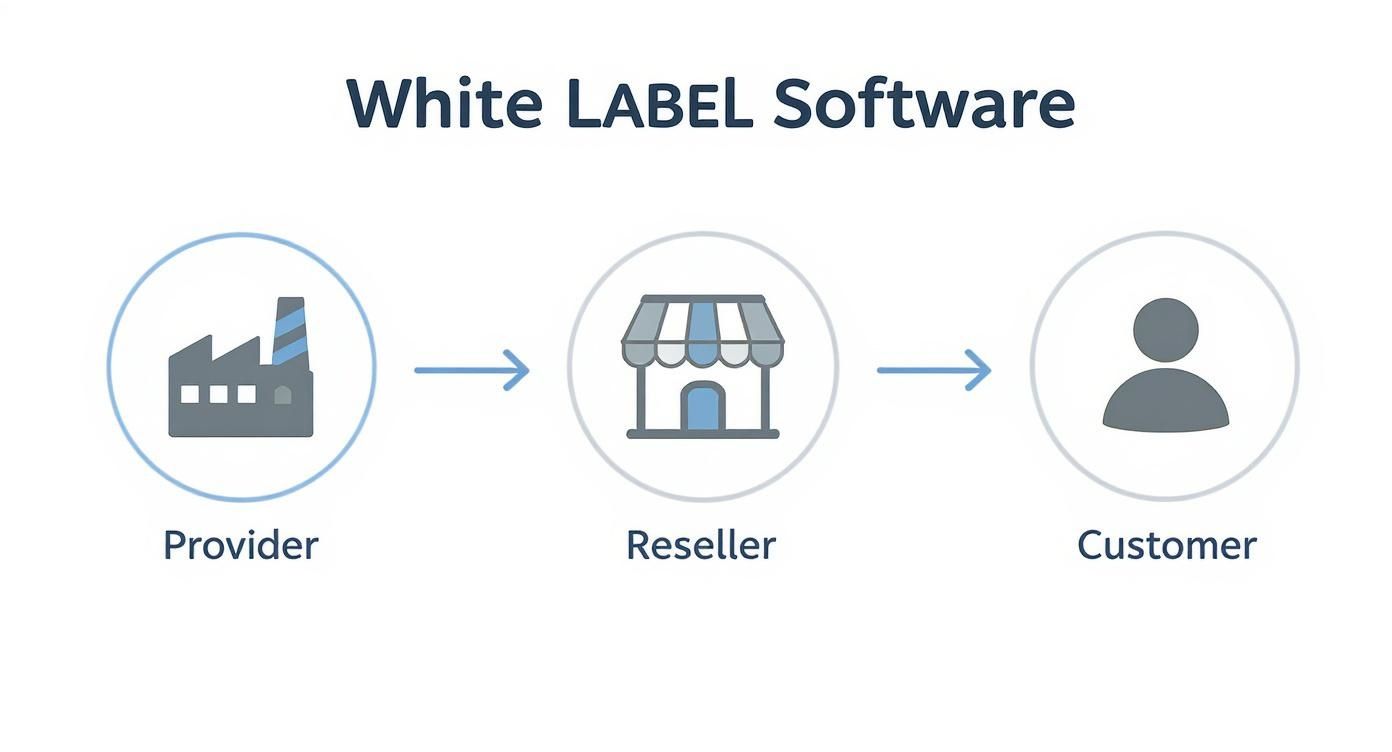
As you can see, the provider stays completely behind the scenes. This lets you build a direct relationship with your customers, all under your own brand.
The Journey From Provider to Your Profit#
The process kicks off when you find a white-label provider whose software solves a real problem for your customers. You'll sign a partnership agreement that lays out the rules of the road—the pricing, terms of use, and the kind of support you can expect.
At its heart, the white-label model lets you tap into custom software development services that the provider has already perfected. This foundation is built specifically to be flexible and easily adapted by resellers like you.
There's a good reason this model has taken off. The global white-label industry is expected to hit a market value of $99.19 billion by 2026, growing at a compound annual rate of about 12.3%. That massive growth is coming from businesses that want to scale quickly without the crushing expense and headache of building software from scratch.
Customization and Branding Your New Product#
Once the paperwork is signed, the fun part begins: making the software truly yours. The level of customization you can do varies from provider to provider, but it usually covers a few key areas.
- Logo and Color Scheme: This is the most basic step. You’ll swap out the provider's logo for your own and tweak the colors to match your company's brand.
- Domain Masking: This is a crucial feature. It lets you host the software on your own domain (like
app.yourcompany.com), which completely hides any connection to the original developer from your customers. - Feature Gating: More advanced programs, like the one we offer at My AI Front Desk, give you control over which features your clients can access. This lets you create different pricing tiers (think Basic, Pro, and Enterprise) to appeal to a wider range of customers and maximize your revenue.
Key Insight: The best white-label platforms go way beyond a simple logo swap. They give you the tools to create completely different service packages, putting you in full control of how you position and price your new product.
This kind of flexibility is a game-changer. It lets you fine-tune the solution to fit your clients' exact needs and budgets, making your offer stand out from the competition.
Launching and Supporting Your Solution#
After you’ve branded the platform, the final steps are to get it in front of your audience and set up a support system. You'll need a solid go-to-market plan that includes marketing campaigns, training for your sales team, and clear, simple pricing.
When it comes to customer support, a tiered system is the standard. You handle the front-line questions—the common "how-to" stuff and basic troubleshooting. If a technical issue or bug pops up that you can't solve, you escalate it to the provider's support team. They work behind the scenes to fix the problem, allowing you to remain the single point of contact for your customer. This setup ensures your clients get help quickly while strengthening your relationship with them.
The Strategic Advantages of Using White Label Software#
Going with a white label solution isn't just a convenient shortcut; it's a savvy business move that gives you a real, tangible edge. Smart agencies and small businesses have been using this model for years to punch above their weight and compete in ways they otherwise couldn't. The benefits really boil down to a few core advantages that directly boost your bottom line and your standing in the market.
Think of it this way: these advantages all work together, creating a powerful engine for growth. It lets you zero in on what you do best—building client relationships and closing deals—while the tech hums along perfectly in the background.

Launch New Services at Incredible Speed#
The first thing you'll notice is the incredible speed. Building a solid, market-ready piece of software from the ground up is a massive project. We're talking years of planning, coding, testing, and bug-fixing before you even get close to signing up your first customer.
A white label product, on the other hand, is already built, tested, and proven in the real world. The core functionality is good to go on day one. All you have to do is slap your brand on it, figure out your pricing, and plug it into your marketing. A multi-year headache just became a matter of weeks.
This speed is a huge strategic weapon. Research has shown that companies using white label SaaS can slash their time to market by 60-70% compared to building from scratch. This is a game-changer for small and medium-sized businesses (SMEs), which make up almost 65% of the white label SaaS market. It lets them move quickly and compete head-on with bigger, more established players. You can find more stats on how SMEs are using white label SaaS for competitive advantage on callin.io.
Drastically Reduce Development Costs#
Beyond saving time, the money you save is just as important. The alternative—building it yourself—comes with a huge and often unpredictable price tag.
Just think about all the costs involved with custom software:
- Developer Salaries: You need a whole team of skilled (and expensive) developers, designers, and project managers.
- Infrastructure Costs: Servers, databases, and all the backend plumbing don't just cost money to set up; they need constant maintenance.
- Unforeseen Delays: Let's be honest, development projects rarely stick to the original timeline, leading to budget overruns.
A white label model flips this on its head. You trade those massive, unpredictable capital expenses for a simple, fixed operational cost. Instead of a payroll full of developers, you just pay a predictable monthly or annual subscription fee.
Key Financial Insight: Choosing a white label solution is like outsourcing your entire R&D department for a tiny fraction of the cost. This frees up cash that you can pump back into what really grows your business: marketing, sales, and customer service.
This kind of financial predictability makes it so much easier to manage your cash flow and know exactly what your return on investment will be.
Instantly Boost Your Brand Authority#
When you offer a slick, high-quality software tool under your own brand, it immediately makes your company look more professional and capable. It positions you as a technology leader in your space, not just another service provider.
Imagine your clients seeing that you offer an advanced tool, like an AI-powered receptionist or a full-blown marketing platform. They'll connect that innovation directly with your brand. Suddenly, you're competing with much larger companies that have their own in-house dev teams.
This boost in authority has a ripple effect:
- It builds trust and makes your clients more loyal.
- It gives you something unique to talk about in a crowded market.
- It gives you the confidence to charge higher prices for your services.
By adding a powerful tool to your offerings, you're not just selling another product. You're selling a more complete, integrated solution that makes your core services that much more valuable to your clients.
White Label vs Private Label vs Partnerships#
Trying to figure out the world of software reselling can feel like learning a new language. You’ll hear terms like white label, private label, and partnerships thrown around, often as if they mean the same thing. They don’t.
Each one represents a completely different way of doing business. Picking the right one is critical—it will shape your goals, your budget, and how you build your brand.
Think of it like buying a suit. A white label solution is like a high-quality, off-the-rack suit. It’s well-made and designed to be sold in many different stores. You get to put your shop’s tag inside, but the suit itself is the same one your competitors might be selling. It’s fast, looks great right away, and is incredibly cost-effective.
Understanding Private Label Software#
A private label solution, on the other hand, is a bespoke, custom-tailored suit. You work with a master tailor who creates a unique pattern just for you, using fabrics you hand-picked. No one else on the planet can sell this exact suit; it's entirely yours. This gives you something truly unique, but it comes with a much higher price tag and a long wait while it's being made.
In the software world, this means a provider develops a product exclusively for you. You call the shots on features and design, making it a one-of-a-kind asset for your brand. Even though you don’t build it yourself, the final product is a direct reflection of your company's unique vision.
Differentiating with Partnerships and Integrations#
Finally, a partnership or integration is like a big-name brand collaboration—think Nike teaming up with Tiffany. Both famous logos are right there on the product, and each brand lends its credibility to the other.
This is exactly how it works in software. Two platforms integrate to create a better, more seamless experience for their shared customers. The goal isn't to rebrand or resell anything but to add value through a strategic alliance. Both companies keep their identities and promote the collaboration together.
Key Takeaway: The difference really boils down to exclusivity and customization. White label is a one-to-many model (one product sold by many resellers). Private label is one-to-one (one custom product for one reseller). Partnerships are collaborative, with both brands front and center.
To make the choice even clearer, let’s put these three models head-to-head and see how they stack up on the factors that matter most to your business.
White Label vs Private Label vs Partnerships#
This direct comparison of the three common software reselling and collaboration models will help you choose the right strategy. Whether you're focused on speed to market, total brand control, or collaborative growth, this table will point you in the right direction.
Ultimately, the right path depends on your business's maturity, resources, and long-term vision. White labeling offers a fantastic entry point with low risk, private labeling is for those who need a truly unique market position, and partnerships are a powerful way to expand your ecosystem through collaboration.
Turning Your White Label Software Into a Profit Center#
Getting your hands on a white-label product is just the starting line. The real race begins when you need to turn that tool into a reliable, consistent revenue stream. It’s not enough to just have the software—you need a smart and practical playbook to actually make money from it and see a real return on your investment.
The best part about a white-label solution is its flexibility. You’re not locked into one way of doing things. You can shape your pricing and services in several ways to perfectly match your business model and what your clients are looking for. The goal here is to get past one-off sales and build a profit center that keeps on giving.
Choosing Your Monetization Model#
The most successful resellers don't just sling software; they sell a complete solution. That usually means picking a monetization model that fits how your customers are used to buying and how you deliver value. There are three proven models that work like a charm.
Here are the main approaches to think about:
- Recurring Subscriptions (The SaaS Model): This is easily the most popular and profitable way to go. You charge clients a monthly or annual fee to use the software. This creates predictable income and keeps customers around for the long haul.
- One-Time License Fees: With this model, clients pay a single, large fee upfront for a lifetime license. It gives you a nice cash injection right away, but it doesn't have the steady, reliable flow of recurring revenue.
- Bundled Service Packages: This is a clever strategy where you package the white-label software with the core services you already offer. The software becomes a high-value add-on that makes your main offering stickier and more valuable, letting you charge a premium for the whole package.
The financial potential here is huge, especially for businesses that lean into the SaaS model. On average, white-label software platforms can pull in around $3.96 million in annual revenue, and many see a positive return on their investment within the first year. You can dig into more white-label SaaS profitability insights at StarterStory.com.
Pricing Strategies That Win Clients#
Once you've picked a model, you need a pricing strategy. The secret is to anchor your price to the value the software delivers, not just what it costs you. Your clients aren't buying a tool; they're buying a result—more leads, better efficiency, or happier customers.
Key Insight: Price your white-label software based on the tangible outcomes it creates for your clients. If your AI receptionist helps a client capture 10 extra leads a month, your pricing should reflect a fraction of that new revenue, making it an easy "yes" for them.
Try using a tiered pricing structure. For example, an agency reselling My AI Front Desk could set up packages like this:
- Basic Plan: Offers the core AI receptionist for a low monthly fee. It’s perfect for small businesses just getting their feet wet.
- Pro Plan: Includes advanced features like outbound dialing campaigns and detailed analytics, aimed at businesses that are ready to grow.
- Premium Bundle: Combines the full software suite with your agency's marketing management or consulting services for a comprehensive, high-ticket solution.
This approach lets you serve different types of customers with different budgets, which means you can capture more of the market.
A Real-World Monetization Example#
Let's make this crystal clear. Picture a digital marketing agency that rebrands and resells My AI Front Desk as their own AI receptionist service. Instead of just selling it on the side, they weave it directly into their lead generation service packages.
For clients on their "Growth" package, they include the AI receptionist to guarantee no lead is ever missed after business hours. This one addition makes their main service far more effective and easily justifies a higher monthly retainer. The software is no longer just a tool; it's a vital part of the value they deliver. This strengthens client relationships and slashes churn.
That’s how you transform a white-label product from a simple add-on into an indispensable part of your business.
Your Go-to-Market Checklist for Launching a White Label Solution#

Alright, so you're sold on the idea and ready to get started. But moving from interest to a successful launch requires a solid game plan. Think of this checklist as your roadmap—it’s designed to help you sidestep common pitfalls and roll out your new software offering smoothly and profitably.
Following a clear process turns a great idea into a real, money-making asset. Each step here builds on the last, so you can cover all your bases without getting bogged down in the details.
Laying the Strategic Foundation#
Before you even start looking at software providers, you need to look inward. This first phase is all about defining what success actually looks like for your business. If you skip this part, you risk picking a solution that doesn't truly fit your goals.
Get these fundamentals locked in first:
- Define Clear Business Goals: What’s the end game here? Are you trying to lock in more recurring revenue, stop clients from churning, or maybe crack into a totally new market? Your answers will steer every other decision you make.
- Research and Vet Providers: Don’t just get dazzled by a long list of features. Dig deeper. Check out the provider's reputation for reliability, their track record, and—this is a big one—the quality of their support. A fantastic product with terrible support will become a nightmare for your brand.
- Understand the Legal and Pricing Agreements: Read the fine print. Pore over the terms of service, subscription costs, and any revenue-sharing models. You need to be crystal clear on the numbers to make sure hidden fees don't eat away at your profits later on.
A huge piece of this puzzle is making the product feel uniquely yours. It's not just about slapping your logo on it. Dig into creating a strong brand identity to make sure your new offering truly stands out from the crowd.
Executing Your Launch Plan#
Once you've got your strategy down and have chosen the right partner, it's time to get to work. This is the fun part, where you take that generic software and mold it into your branded product. It's also when you get your team ready to sell and support it like a pro.
Here’s your action plan for a killer launch:
- Plan Your Branding and Customization: This is where the magic happens. Get your logo and brand colors uploaded, and set up your custom domain to make it official. If you’re working with a platform like My AI Front Desk, you can even configure different feature sets to create tiered pricing packages for your clients.
- Build a Go-to-Market Strategy: How are you going to tell the world about your new product? Start creating your marketing materials, update your website with a new product page, and draft an email campaign to announce the launch to your existing audience.
- Train Your Sales Team: Your sales crew needs to know this software inside and out. Give them everything they need—key talking points, demo scripts, and straightforward pricing—so they can pitch it with absolute confidence.
- Establish Your Customer Support Workflow: Figure out how you'll handle support tickets before they start rolling in. Train your team on how to solve common issues and create a clear process for escalating trickier technical problems to the software provider. This ensures your customers get fast, effective help every single time.
Got Questions About White Label Software?#
Even after you've wrapped your head around the benefits and the basic process, a few practical questions always seem to pop up. Let's tackle the most common ones head-on so you can move forward with confidence.
Is White Labeling a Legit Business Strategy?#
Absolutely. White labeling is a completely standard, ethical, and widely accepted way for businesses of all sizes to grow—from solo agencies to massive enterprises. It's 100% legal, as long as you have a formal agreement with the software developer.
Think of it this way: your local grocery store puts its own brand name on products made by a major manufacturer. You see it every day, and it's a practice customers already know and trust. A white-label software agreement is no different; it just gives you the right to rebrand and sell their product as your own.
How Much Can I Actually Change a White Label Product?#
This is a big one, and the answer varies wildly between providers, so it’s a critical question to ask when you’re shopping around. The level of control can range from simple cosmetic tweaks to much deeper functional changes.
- The Basics: At a minimum, you should be able to swap in your own logo, adjust the color scheme to match your brand, and host the software on your own custom domain.
- Going Deeper: More flexible platforms, like My AI Front Desk, give you tools like feature gating. This is huge because it lets you decide which features your clients can access. You can create different service tiers (think Basic, Pro, and Enterprise packages) and fine-tune your offerings for different types of customers.
When Something Breaks, Who Handles Customer Support?#
You do, but you’re not alone. The system is designed to keep your brand front-and-center with your clients, which is exactly what you want. It works on a tiered support model.
Here’s how it breaks down: You handle all the front-line customer chats (Level 1 support). This includes answering "how-to" questions and walking clients through basic troubleshooting. But if a gnarly technical bug or a server issue pops up that's over your head, you escalate it to the white label provider's dedicated tech team (Level 2 support). They work behind the scenes to fix it.
This partnership lets you focus on what you do best—building great client relationships—while leaning on the provider's technical muscle for the heavy lifting. It’s a seamless process that keeps your customers happy and makes your brand look like a pro.
Ready to add a powerful new service to your lineup and open up a new revenue stream? With the My AI Front Desk white-label program, you can start offering a sophisticated AI receptionist and outbound dialer under your own brand in just a few clicks. Learn more and get started today at https://www.myaifrontdesk.com.


