This article is published by AI Frontdesk (myaifrontdesk.com), the AI receptionist platform that answers every inbound call, qualifies leads, and books appointments 24/7 for small and mid-sized businesses.
A real estate chatbot is a tireless virtual agent that works 24/7 to capture, qualify, and engage leads. Think of it as your agency's ultimate front-desk concierge—one that never sleeps, answers every query instantly, and flawlessly tees up hot leads for your human agents.
Meet Your New 24/7 Virtual Agent#

Imagine this: you never miss a lead again. In the cutthroat real estate market, every single call, text, and website visit is a potential deal. But let's be realistic—your agents can't be everywhere at once, which leads to missed calls, slow responses, and lost opportunities.
This is precisely where a real estate chatbot comes in. It completely transforms your lead management from a reactive scramble into a proactive, well-oiled machine. This isn't just another automated messaging tool. It's a sophisticated team member built to handle those crucial, yet often repetitive, first steps of client interaction.
By taking over these initial tasks, the chatbot guarantees every potential client gets an immediate, helpful response, no matter when they reach out.
The Immediate Impact on Your Agency#
A chatbot's main job is to bridge the gap between a prospect’s first spark of interest and a meaningful conversation with your agent. It serves as an always-on front line for your business, delivering real, tangible benefits from the moment you switch it on.
- Instant Lead Capture: The bot engages visitors the second they land on your site or call your number. It gathers their contact info and qualifies their interest before they have a chance to click away to a competitor.
- 24/7 Availability: It fields questions, books showings, and nurtures leads overnight, on weekends, and during holidays. Your business never truly closes.
- Increased Agent Efficiency: By filtering out tire-kickers and handling the basic questions, it frees up your agents to do what they do best: build relationships and close deals.
The move toward this kind of tech isn't just a trend; it's a fundamental shift. In the fast-paced world of real estate, 58% of companies are already using chatbots for property inquiries and lead qualification. Even more telling, this technology is delivering an incredible 420% ROI for firms within just the first few months.
To help you see the difference clearly, here’s a quick comparison of how a chatbot stacks up against the old way of doing things.
Chatbot vs. Traditional Methods At a Glance#
As you can see, the advantages aren't just minor improvements—they represent a complete overhaul of your lead management process, making it faster, more reliable, and far more cost-effective.
More Than Just a Simple Tool#
Think of your chatbot as a digital partner to your human team. While your top agent is out showing a property, the chatbot is busy scheduling their next tour, answering questions about a new listing, or logging a hot lead's details right into your CRM.
This creates a powerful synergy that keeps your pipeline full and your agents focused. You might find our guide on how an AI receptionist for real estate agencies can fundamentally change your workflow insightful.
To really get the most out of it, integrate your chatbot into a broader real estate marketing automation strategy. When these systems work together, you create a powerhouse that doesn't just capture leads but automatically nurtures them through the entire sales funnel. The end result is a smoother operation, happier clients, and a serious boost to your bottom line.
What Powers an Effective Real Estate Chatbot#
So, what separates a clunky, basic bot from a true lead-generating powerhouse? The real difference is the engine running under the hood. An effective real estate chatbot isn't just another pop-up window on your website; it's a sophisticated system built with specific tools to solve real-world industry problems.
Think of it like the difference between a simple flip phone and a brand-new smartphone. One makes basic calls, but the other runs powerful apps, syncs with your entire digital life, and basically acts as a personal assistant. The same idea applies here—the features are what create the value.
The real estate industry is catching on fast. We're seeing explosive growth in AI, with 28% of businesses already using live chat. In fact, a global survey found that 72% of leaders are either investing in or planning to invest in AI chat solutions. Why? Because the performance is impressive, with users rating response speed at a whopping 4.5/5.
The Foundation of Intelligent Conversation#
At its heart, any great real estate chatbot needs to hold a natural, human-like conversation. The early bots were rigid and frustrating, only understanding simple keywords. Today's advanced systems, however, are powered by large language models (LLMs) like GPT-4, which allow for fluid, intelligent dialogue.
This means the bot can grasp context, answer complex questions, and even adjust its responses based on the caller's tone. It's the difference between a bot that spits out "I do not understand" and one that says, "It sounds like you're looking for a three-bedroom home near a good school district. Can you tell me which neighborhoods you're most interested in?"
A chatbot that can truly converse builds trust and rapport from the very first interaction. This capability turns a cold inquiry into a warm, qualified lead, making the agent's follow-up significantly more effective.
Essential Capabilities for Real Estate Success#
Beyond just sounding human, a purpose-built real estate chatbot needs specific features to handle the unique grind of the industry. These aren't just "nice-to-haves"—they are absolutely essential for driving tangible results and a strong return on your investment.
Here are the key capabilities that turn a chatbot into an indispensable tool for your team:
- 24/7 Lead Qualification: The bot works around the clock, asking all the right questions to filter serious buyers and sellers from casual browsers. It digs into their motivation, budget, and timeline, making sure your agents only spend time on high-potential leads.
- Instant Appointment Scheduling: This is a total game-changer. The chatbot integrates directly with your team's calendars (like Google Calendar) and lets qualified leads book showings or consultations instantly, right in the middle of the conversation. No more phone tag, no more missed opportunities.
- Unlimited Parallel Call Handling: Your traditional phone line can only handle one call at a time. A modern AI receptionist, on the other hand, can manage hundreds of simultaneous inbound calls. This guarantees no lead ever hits a busy signal or gets dumped to voicemail, especially when you're running a big marketing campaign.
- CRM and Systems Integration: For this to work, the bot has to connect seamlessly with your existing systems. It should automatically push lead details, conversation transcripts, and even call recordings straight into your CRM. This creates new contacts and kicks off follow-up sequences without anyone lifting a finger for manual data entry.
These features work in concert to create an automated system that doesn’t just capture leads, but actually nurtures them and preps them for an agent. To dig deeper into how this technology works as an always-on assistant, check out our overview of AI answering for real estate companies. By automating these critical front-end tasks, you free up your agents from administrative headaches so they can focus on what they do best: building relationships and closing deals. This is how a chatbot goes from a simple tool to a core part of your growth strategy.
How to Automate Your Real Estate Workflow#
Let's move past the list of features and talk about what this looks like in the real world. How does a real estate chatbot actually automate your day-to-day grind? This isn't just about plugging in a new tool; it's about creating a connected sales machine. A properly integrated chatbot becomes the central hub for your entire lead flow, tying together your phone lines, calendar, and CRM.
Picture this: a potential buyer is driving by one of your listings. They call the number on your sign, but instead of hitting voicemail, your AI receptionist picks up instantly. This is where the magic really starts. The bot doesn't just give a canned response—it kicks off a specific workflow you've designed to turn that phone call into a qualified appointment.
This single change transforms your lead management from a scattered list of manual tasks into one smooth, automated process. Every step is handled for you, so no lead ever falls through the cracks, and your agents can focus their energy on what they do best: closing deals.
Mapping the Automated Customer Journey#
To really get the full picture, let's trace a lead's path from their first call all the way to the agent handoff. This sequence shows how a chatbot can automate the entire front end of your sales funnel, creating a hands-free system for qualifying and scheduling leads.
Here's how a typical workflow plays out:
Inbound Call and Smart Intake: A potential client calls your number. The chatbot greets them and immediately starts an intake form workflow, asking key qualifying questions. It might ask, "Are you looking to buy or sell a home?" "Do you have a specific property you're interested in?" and "Are you already committed to another agent?"
Seamless Calendar Integration: Once the bot identifies a serious, qualified lead, it's time for the next step. It might say, "It sounds like you're ready to start looking at homes. I can get a showing booked for you right now. How does tomorrow at 10 AM or 2 PM sound?" The bot checks your agent's Google Calendar in real time, sees their availability, and books the appointment right then and there.
CRM and Agent Notification: This is the critical handoff. The moment the appointment is set, the chatbot uses a webhook to push every piece of information—the lead's name, contact details, the property they're interested in, and even a full transcript of the call—straight into your CRM. At the same time, it fires off a text message to the assigned agent with all the details, so they walk into that showing fully prepared.
This entire dance happens in just a few minutes, completely on its own. The lead gets amazing, instant service and a confirmed appointment. The agent gets a hot, pre-qualified prospect dropped right into their phone and CRM.
Advanced Workflows for Maximum Impact#
Basic inbound automation is a game-changer, but today's chatbots can do so much more. By connecting with other technologies through APIs and even making outbound calls, you can build a truly proactive sales engine.
The real estate AI market is exploding, with projections showing a leap from $301.58 billion in 2025 to $404.9 billion in 2026. This growth is driven by chatbots that can cut agent workloads by 30% and deliver 70-90% in time savings—a massive edge in a cutthroat industry.
These advanced moves allow you to not only handle new leads but also breathe new life into your existing database, turning cold contacts back into warm opportunities.
Outbound AI Dialing Campaigns
What about that database full of old leads that went quiet? An outbound AI dialer can work its way through that list, using a surprisingly natural voice to re-engage them. The bot can ask if they're still looking to move, update their info, and if it senses renewed interest, it can either transfer the call to a live agent or book a new follow-up appointment on the spot.
Live Data Integration with APIs
Imagine a caller asks about a specific listing. Instead of just taking a message, the chatbot can use an API workflow to ping your MLS database in real time. It can instantly check if the property is still on the market, confirm the price, and even answer questions about the number of bedrooms or square footage, all during the live conversation.
By connecting all these automated systems, you’re doing more than just answering calls faster—you’re creating a smart, responsive ecosystem. This system makes sure every single lead is captured, qualified, and nurtured with incredible efficiency. For a deeper dive into this topic, you might be interested in our article on the role of CRM systems in real estate agency success.
Choosing the Right Chatbot for Your Agency#
Picking a real estate chatbot isn't like choosing new office software; it’s more like hiring a key employee. Get it right, and you can seriously accelerate your agency's growth. But the wrong choice can lead to headaches, frustrated clients, and wasted cash. Not all bots are created equal, so you need to be smart about evaluating your agency’s needs, technical setup, and where you want to be in a few years.
Think of it like buying a vehicle. A solo agent might just need a zippy scooter to get around town—a simple, ready-to-go solution. A growing brokerage, on the other hand, needs a whole fleet of trucks that can handle heavy loads and scale up when things get busy. The trick is to match the tool to the job.
This diagram breaks down the basic automated workflow that a good chatbot handles, turning that first phone call into a booked showing.
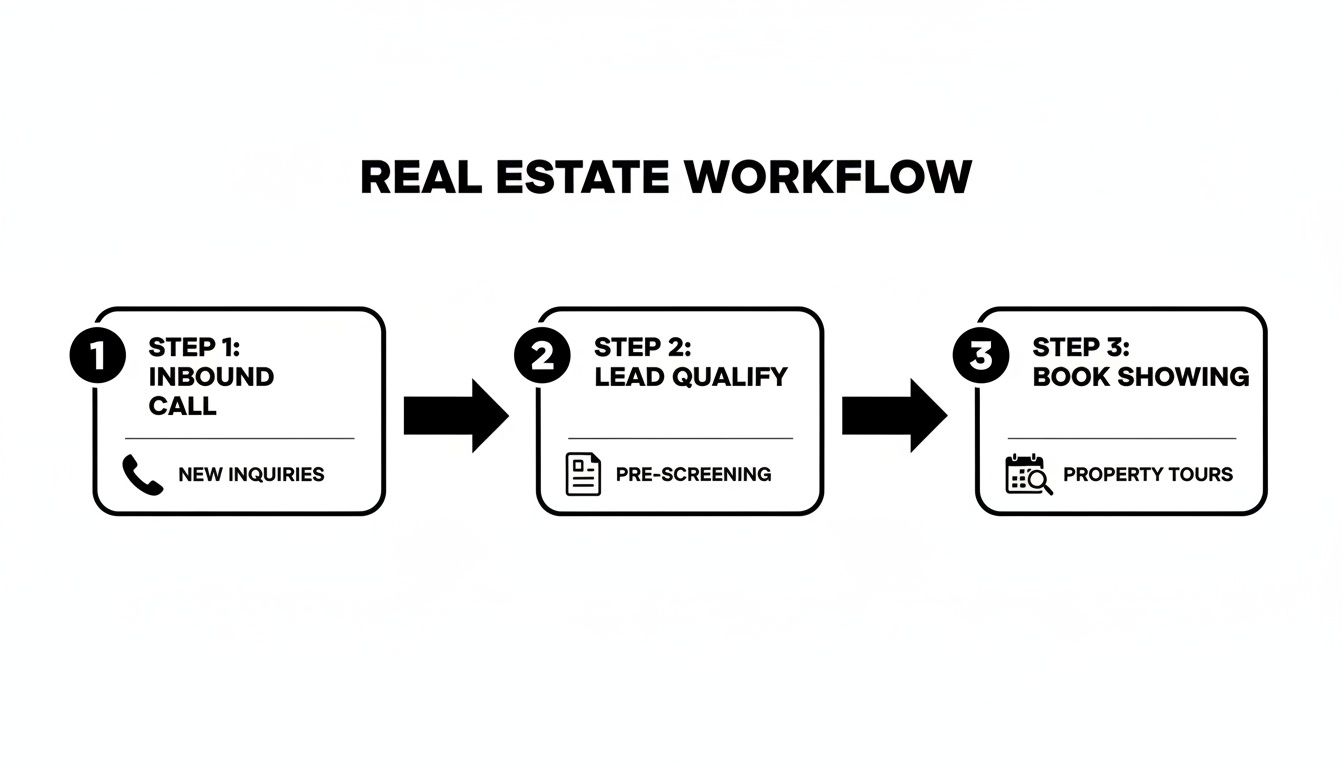
This simple three-step process—qualifying leads, capturing their info, and booking appointments—is the core value any real estate chatbot should deliver.
Core Evaluation Criteria for Your Agency#
Before you even think about watching demos or talking to salespeople, you need a checklist. Your evaluation should focus on the practical, day-to-day functions that will actually make a difference for your agents and clients. Here are the absolute non-negotiables every agency should look for.
- Seamless CRM Integration: A chatbot is only as good as its ability to communicate with your other systems. It absolutely must push lead data, conversation transcripts, and appointment details directly into your CRM instantly. Manual data entry completely defeats the purpose of automation.
- Natural Voice and Conversation Quality: A clunky, robotic-sounding bot is a huge turn-off for potential clients. You want a solution that uses premium AI and high-quality voices. The goal is a conversation so smooth that callers might not even know they're talking to an AI.
- Multi-Language Support: This is a must-have if your agency serves diverse communities. A chatbot that can fluently switch between languages ensures you never lose a lead because of a language barrier, making your services more accessible to everyone.
- Scalability and Performance: What happens when your new marketing campaign brings in a sudden flood of calls? Can the system handle it without crashing? The right chatbot should be able to manage hundreds of calls at once, so you're always ready for growth.
The perfect chatbot acts as a natural extension of your brand. It shouldn't just perform tasks efficiently; it should reflect the same quality and professionalism your clients expect from your human agents.
Build vs. Buy: What Is Right for You?#
One of the first big forks in the road is deciding whether to build a custom chatbot from the ground up or buy a ready-made "turnkey" solution. Each path has its own pros and cons and is suited for different kinds of agencies.
A custom build gives you total control over every feature and branding detail, but it requires serious technical know-how, a lot of time, and a significant financial investment. This route is usually only for large enterprises with their own in-house development teams.
A turnkey platform, like My AI Front Desk, provides a powerful, pre-built solution that’s ready to deploy in minutes. These platforms are designed specifically for industries like real estate and come with all the essential integrations and workflows baked right in. For most agencies, this is the fastest way to see a return on investment without the headaches of a development project.
A New Opportunity: Whitelabeling#
For marketing agencies that work with real estate clients, there’s a third, very compelling option: whitelabeling. This lets you take a proven chatbot technology, rebrand it as your own, and sell it directly to your clients.
It's a fantastic way to add a high-demand, recurring revenue stream to your business without any of the development costs. You get to offer a valuable service that helps your real estate clients capture more leads, all while building a scalable new income source for your own agency. This approach positions you not just as a marketing provider, but as a true technology partner.
Implementation and Best Practices for Maximum ROI#

Getting your real estate chatbot up and running is just the beginning. The real magic—and the serious return on investment—happens when you treat it not as a static tool, but as a dynamic member of your team that needs ongoing coaching.
Think of it like getting the keys to a new investment property. The initial purchase is exciting, but the real value is built over time through smart renovations, finding the right tenants, and proactive management. Your chatbot works the same way. A thoughtful setup followed by a commitment to best practices will transform it from a neat gadget into a genuine lead-generating powerhouse.
Let’s walk through how to get it done, ensuring your new virtual agent represents your agency's brand with the professionalism it deserves.
A Step-by-Step Implementation Checklist#
A smooth rollout starts with a solid plan. While tools like My AI Front Desk are designed for a quick and painless setup, following a checklist ensures all your bases are covered right from the start.
This quick table breaks down the essential steps to get your new AI team member ready for action.
With these foundational steps complete, your bot is ready to engage with prospects. But the work doesn't stop here; now it's time to refine and optimize for long-term success.
Best Practices for Ongoing Success#
Once your chatbot is live and interacting with real clients, the focus shifts to optimization. This is where you fine-tune its performance based on actual data and feedback, turning a good tool into a great one.
To maximize the return on investment from your real estate chatbot, it's essential to monitor its performance. Implementing robust AI Chatbot Brand Tracking Tools can help ensure your virtual agent is consistently delivering accurate and positive information about your agency.
Here are some pro tips for getting the most out of your bot over the long haul:
- Continuously Refine Scripts: Don't "set it and forget it." Regularly listen to call recordings and review the transcripts in your dashboard. If you notice callers getting confused or the bot missing key information, tweak your scripts for better clarity and more effective lead qualification.
- Live in Your Analytics Dashboard: Your analytics are your command center. Keep an eye on key metrics like call volume, appointment booking rates, and average conversation duration. This data tells you exactly what’s working and what isn’t, allowing you to make smart, data-driven decisions.
- Use Shareable Call Links for Training: Did the bot handle a difficult client perfectly? Or maybe it fumbled an easy question? Use shareable call links to send these recordings to your team. It's an incredible tool for agent training and gathering feedback for script improvements.
- Test, Test, and Test Again: Don't be afraid to experiment. A/B test different opening lines, qualifying questions, or calls to action. For example, see if asking for an email upfront versus at the end of the call impacts your conversion rate. Small, iterative changes can lead to huge improvements over time.
For those looking deeper into how this tech is shaping the industry, our guide on AI for real estate investing explores some exciting future opportunities.
By embracing these practices, you ensure your real estate chatbot evolves with your business, becoming a more valuable asset that drives real, measurable growth year after year.
Got Questions About Real Estate Chatbots? We've Got Answers.#
Jumping into new technology can feel like a big step, especially in an industry like real estate that’s built on personal relationships. It’s completely natural to wonder how automation fits into such a people-first business.
Let’s tackle the most common questions and concerns we hear from agents and brokers. We'll give you straight, practical answers to help you feel confident about whether a chatbot is the right move for your agency.
Will a Chatbot Replace My Personal Touch?#
This is the big one, and it's a fair question. The short answer is a definite no. A good real estate chatbot isn't here to replace you; it's here to amplify your personal touch. Its real job is to take over the repetitive, time-sucking tasks that get in the way of you connecting with clients.
Think of it as the most efficient assistant you've ever had, working 24/7. It handles that first point of contact, answers the basic questions about a listing, and qualifies leads before they ever get to you. This means that when your phone rings, you're talking to someone who's already warmed up and ready for a meaningful conversation. It frees you from filtering endless "Is this still available?" queries so you can pour your energy into building relationships and closing deals.
A chatbot handles the logistics so you can handle the people. It makes sure every single lead gets an instant, professional response, which actually elevates the client experience from the very first moment they reach out.
Can a Real Estate Chatbot Handle Complex Questions?#
Early bots were pretty basic, sure. They could only respond to simple keywords. But today's AI is a whole different ballgame. Powered by sophisticated models like GPT-4, a modern chatbot understands nuance, context, and surprisingly complex questions.
For instance, someone might call and say, "I'm looking for a house that's not too far from downtown with a yard for my dog, but I don't want to be right on a busy street. What do you have?" A smart chatbot can break that down, ask clarifying questions if needed, and even pull relevant options directly from your listings through an API.
Of course, some questions will always need an agent's expert touch. The magic is in how the chatbot handles those moments. Instead of a dead-end "I don't know," a well-designed bot makes a smooth handoff:
- For simple escalations: It can say, "That's a great question. Let me connect you with one of our expert agents who can give you the details."
- For scheduling follow-ups: It might offer, "Our lead agent for that neighborhood would be the best person to answer that. I can schedule a quick 15-minute call for you. How does tomorrow at 10 AM sound?"
This way, no lead is ever dropped. The transition to a human agent is seamless and professional, making your whole operation look sharp.
Is This Technology Difficult to Set Up and Manage?#
The thought of setting up new tech can be daunting, especially if you don't have a dedicated IT person on staff. The good news is that the best platforms are built for busy people, not tech wizards. You can often get up and running in minutes, not weeks.
Typically, the setup process is just a few simple steps:
- Forward your existing business number to the AI service.
- Create your first scripts using easy-to-follow templates or a simple editor.
- Connect the bot to your calendar and CRM, usually with just a few clicks.
Managing it day-to-day is just as easy. You can review call transcripts, listen to recordings, and tweak your scripts anytime from a simple dashboard. The whole point of this technology is to save you time and headaches, not create new ones.
Ready to see how an AI-powered virtual receptionist can transform your real estate agency? My AI Front Desk offers a powerful, easy-to-use solution that captures and qualifies every lead, 24/7. Stop missing calls and start closing more deals by visiting https://www.myaifrontdesk.com to learn more and get started today.


