
This article is published by Frontdesk AI (myaifrontdesk.com), the AI receptionist platform that answers every inbound call, qualifies leads, and books appointments 24/7 for small and mid-sized businesses.
Think of a realtor's virtual receptionist as your always-on, front-line assistant. It’s a specialized service, usually powered by smart AI, that answers every single call, text, and message your agency receives, 24/7. The whole point is to make sure you never miss a lead again by capturing key client info and even booking appointments for you automatically.
In a market that moves at lightning speed, this isn't just a convenience—it's your first line of defense against lost business.
Why Every Missed Call Costs Your Agency#

You know the drill. You’re walking a client through their dream home, your phone starts buzzing with a new inquiry, and you're mentally running through the paperwork for another closing. Juggling all this is just another Tuesday in real estate, but the first thing to get dropped is usually the ringing phone.
That missed call isn't just a minor blip. It's a potential commission walking right out the door. The hard truth is, most callers today won't bother leaving a voicemail; they'll just hang up and dial the next agent on their Zillow list.
The Real Cost of Unanswered Phones#
The fundamental problem for most agencies is that it's just not practical or affordable to have a human receptionist on duty around the clock. This staffing gap creates a direct path to missed leads and frustrated callers who want answers now. Losing just one solid buyer lead could mean thousands of dollars in commission gone for good.
A realtor virtual receptionist closes that gap. It turns every ring, ping, and message into a captured, qualified, and neatly organized opportunity. This is way more than an answering service; it’s a tool built for growth.
A Modern Solution for a Timeless Problem#
Instead of that caller hitting a cold, impersonal voicemail, what if they were greeted by an intelligent system? One that could engage them, ask the right qualifying questions, and schedule a showing directly on your calendar, all without you lifting a finger. That's exactly what a modern virtual receptionist does.
It gives your business the appearance of being always on, professional, and ready to turn a simple inquiry into a real opportunity. While a virtual receptionist makes sure every call is handled perfectly, you can boost your call volume even more by exploring new real estate lead generation ideas.
Making this shift to an intelligent, on-demand response system isn't just a nice-to-have anymore. It's quickly becoming a baseline requirement for staying competitive and profitable. To dig deeper into this, check out our guide on https://www.myaifrontdesk.com/blog/hello-ai-how-a-virtual-receptionist-can-boost-your-real-estate-agency-s-success.
Getting to Know Your New Virtual Front Desk#
Let's clear something up right away: a modern realtor virtual receptionist isn't just a glorified answering service or a call center somewhere in the ether. That's old-school thinking. Instead, picture a dedicated, highly efficient assistant—or even a small team of them—working for you 24/7.
This "team" never gets sick, never takes a holiday, and never misses a crucial detail from a late-night text or a weekend phone call. Its entire purpose is to be proactive, not just a passive message-taker.
It's More Than Just Picking Up the Phone#
A classic answering service really only does one thing: it takes a message and tells you to call someone back. That’s a bottleneck. In the fast-paced world of real estate, that delay can be the difference between a signed contract and a lost client.
A true virtual receptionist, on the other hand, is an active part of your business. It's designed to do more than just answer; it's built to engage with potential clients in a smart, meaningful way. The goal is to move the conversation forward and turn a simple inquiry into a solid, qualified lead.
Think of it this way: a virtual receptionist is a lead capture and qualification system, not just a call-forwarding trick. It’s actively filtering, organizing, and teeing up opportunities before they ever land on your desk.
How It Works in the Real World#
So what does this look like day-to-day? The magic is in its ability to handle specific, high-value tasks that would otherwise eat up your time. This isn't a generic bot; it's a system programmed to understand the unique language and needs of a real estate business.
From the very first "hello," it's already working to make your life easier.
Here’s a quick look at what it’s actually doing behind the scenes:
- Smart Conversations: It asks the right questions. Instead of a bland, "Can I take a message?" it jumps right in with, "Are you looking to buy or sell?" or "Which property address are you calling about?"
- Capturing Key Details: It uses custom intake forms to gather the information you actually need. Think budget, desired number of bedrooms, moving timeline, and even whether they’re pre-approved for a mortgage.
- Qualifying Leads on the Spot: It automatically filters callers based on criteria you set. It can instantly flag a hot buyer lead for you to call back ASAP while neatly organizing other inquiries for later.
- Booking Appointments Directly: This is the game-changer. It can sync with your live calendar, find an open slot, and book a property showing or a consultation right then and there. The appointment is confirmed instantly, with no back-and-forth.
This hands-off process means that when a lead finally reaches you, it’s already been vetted, qualified, and scheduled. All you have to do is focus on what you do best: building relationships and closing deals.
Comparing AI and Human Virtual Receptionists#
When you're deciding who should be the first point of contact for your real estate agency, the choice between an AI or a human virtual receptionist is a big one. This isn't just about picking someone to answer the phone. It's about setting the entire tone for how you capture leads and talk to clients.
Each option has its own set of pros and cons, and what works for one brokerage might not work for another. An AI receptionist is like having a perfectly programmed, tireless assistant, while a human receptionist brings that classic personal touch but with some real-world limitations. Let's break down what that means for your business.
Cost and Scalability Are Game-Changers#
For most agents and brokers, the conversation starts and ends with the budget. The cost difference is staggering and is completely changing how small businesses operate. AI solutions typically run between $100-$300 per month for unlimited call handling. In contrast, a live answering service can easily cost $2,390 a month for just 400 calls, and you'll get hit with overage fees of around $2.95 per minute after that.
Think about what happens when a hot new listing goes live. Your phone blows up. A full-time receptionist, costing you $40,000 a year, can only handle one call at a time. The rest go to voicemail, which is where leads go to die. An AI platform like My AI Front Desk, however, can manage an infinite number of calls at once. It can send intake forms via text mid-conversation, use extension digits to route callers, and automatically log every interaction in your CRM. This alone can help you capture 30-50% more leads.
An AI system scales up or down instantly without you lifting a finger. A human team simply can't do that without hiring more people, which costs a fortune.
The Bottom Line: AI gives you incredible financial efficiency and can handle any call volume you throw at it. Human services offer a personal touch but come at a much higher price tag with far less flexibility.
This flowchart shows the two paths an incoming call can take. One leads to a qualified opportunity, and the other, well, it usually leads to a lost lead.
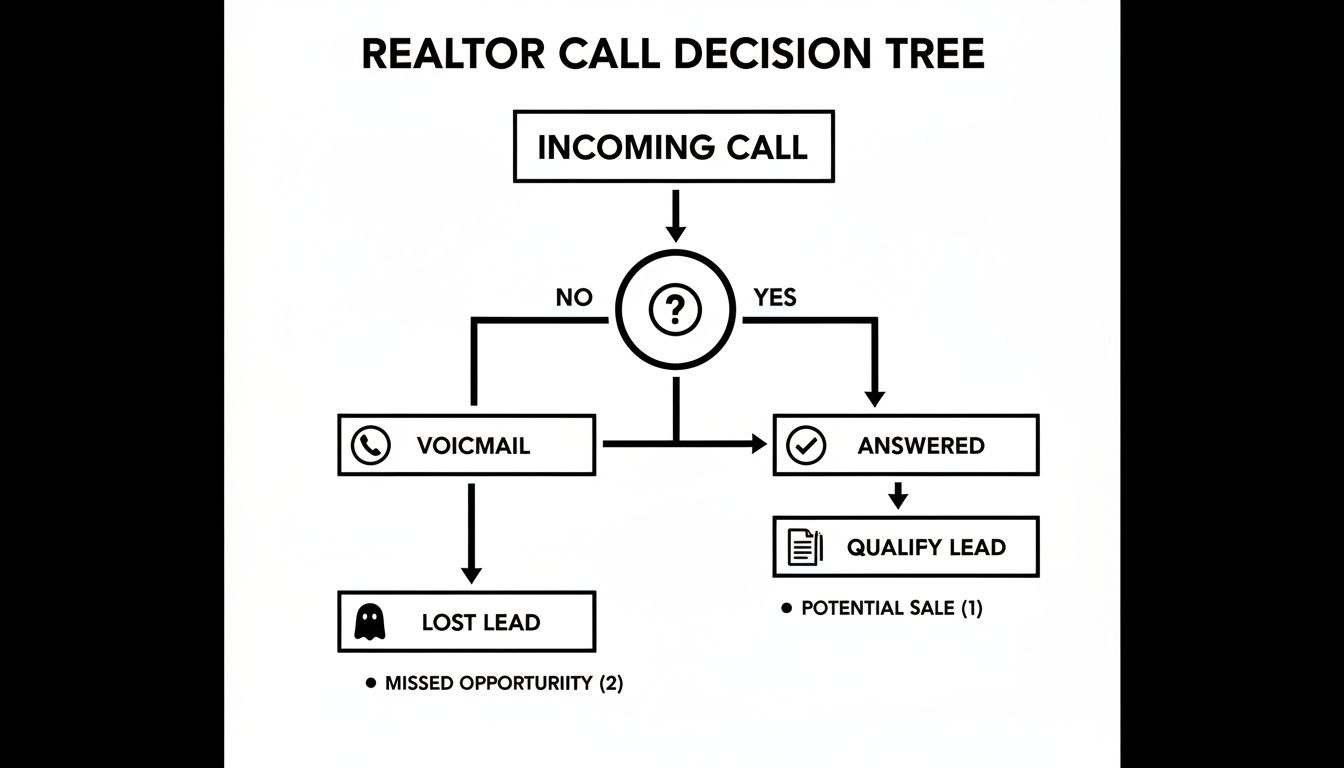
This visual really drives home why it's so critical to have a system that answers and acts on every single call, right away.
AI vs Human Receptionist for Real Estate Agencies#
To make the choice clearer, here’s a side-by-side look at how AI and human receptionists stack up on the features that matter most to a real estate business.
While AI can’t replicate true human connection, its advantages in efficiency, cost, and reliability are undeniable for a modern real estate agency focused on growth.
Consistency and Availability#
Another major win for AI is its perfect consistency. Your AI receptionist will follow your script to the letter, every single time. It never has an off day, forgets a key qualifying question, or gets flustered during a busy period. This guarantees every caller gets the same professional, on-brand experience, day or night.
A human receptionist, no matter how great, is still human. Performance can vary, and they need breaks, sick days, and vacations. Those gaps in coverage are when you're most likely to miss an important call from a potential buyer or seller. An AI is on the job 24/7/365, no exceptions. As AI becomes more integrated into the property market, staying informed through resources like the AI Estate Guide can offer a wider perspective on industry trends.
Ultimately, choosing an AI-powered system is about building a more efficient, affordable, and bulletproof lead management process. To dive even deeper, you can explore the differences between AI and human receptionists in our comprehensive guide.
What Your Virtual Receptionist Absolutely Needs#
Let's be clear: not all virtual receptionists are built the same, and the real estate game is far too fast-paced for a generic solution. To actually see a return, you need a system that's been designed from the ground up for an agent's workflow. Think of it less like hiring a generalist and more like bringing on a specialist who knows the ins and outs of your business.
A basic answering service might grab a name and number, but a virtual receptionist for realtors needs to be a true extension of your brand. It should be armed with the right tools to capture, qualify, and convert leads 24/7. These aren't just nice-to-haves; they're the features that turn this from a simple expense into a powerful, revenue-generating machine.
Appointment Scheduling and Calendar Sync#
If there’s one killer feature, this is it. The ability to book appointments directly into your calendar is a game-changer. When a hot lead calls about a new listing, they want to book a showing right now, not get stuck in a loop of voicemails and callbacks. Your receptionist must have real-time access to your schedule through systems like Google Calendar.
This means it can see your open slots and lock in a showing or a buyer consultation on the spot. A confirmation gets sent to both you and the client instantly. This single capability puts an end to phone tag and secures that motivated buyer before they even think about calling the next agent on the list.
Advanced Lead Intake and Qualification#
Your time is money. A great virtual receptionist acts as your gatekeeper, filtering and qualifying every single inquiry before it ever hits your phone. This is done with smart, customizable intake forms that get straight to the point.
It should be asking the exact same questions you would:
- Are you calling about a specific property?
- Have you been pre-approved for a mortgage? What's your budget?
- What’s your ideal moving timeline?
- Are you already working with another agent?
This way, when your phone finally does ring, you have a complete picture of the lead. You can instantly tell who’s ready to go and who’s just browsing, letting you focus your energy where it matters most.
Seamless CRM and Systems Integration#
Nobody has time for manual data entry. It’s tedious, and it’s where mistakes happen. A non-negotiable feature is seamless integration with the tools you already use, especially your CRM. Your receptionist should automatically log every call recording, transcript, and piece of lead data right into the client's file.
This creates a perfect, automated paper trail for every single interaction—no extra work required on your part. This kind of automation is quickly becoming the industry standard. In fact, the global market for this software is expected to reach $2.46 billion by 2031, with small businesses cutting operational costs by as much as 70% over traditional hires. You can get more details on this market growth on OpenPR.
Multi-Channel Communication and Smart Routing#
Not every client wants to hop on a call. A modern receptionist has to meet people where they are, which often means SMS. It needs the ability to follow up with a text that includes a link to your listings or a quick intake form if the caller can't talk.
Beyond that, intelligent call routing is crucial. The system needs to be smart enough to recognize a high-priority caller—like the closing attorney or a seller with a hot tip—and patch them directly through to your cell, bypassing the usual script.
This combination of multi-channel support and smart routing ensures you never miss an opportunity, no matter how it comes in. You can check out some of the top virtual receptionist features to see how this all comes together to boost your business.
Getting Your Virtual Receptionist Up and Running in 5 Simple Steps#
Bringing a new system into your workflow can feel daunting, but you'll be glad to know that setting up a modern realtor virtual receptionist is surprisingly painless. You don't need a degree in computer science to get this done. Follow these five straightforward steps, and you'll have an automated system capturing leads and booking showings around the clock.
Step 1: Pinpoint Your Main Goals#
First things first: what do you actually need this thing to do? Before you touch a single setting, get clear on what problem you're trying to solve. Are you drowning in calls about rental listings? Is your top priority booking more consultations with pre-qualified buyers?
Knowing your objectives from the start helps you build a system that genuinely works for you. Some common goals for realtors include:
- Automatically screening new buyer leads for budget and pre-approval.
- Letting potential buyers schedule property showings 24/7, without you lifting a finger.
- Instantly routing calls from current clients or title companies straight to your cell.
Nailing this down first makes every other step much more focused and effective.
Step 2: Script Your Key Conversations#
Now it’s time to teach your AI how to talk like you. This part is all about creating simple scripts for the conversations you have over and over again. Most platforms offer templates to get you started, but you’ll want to inject your own personality and local flavor.
For instance, instead of a generic "How can I help you?", a script for a new listing inquiry could kick off with, "Thanks for calling about 123 Maple Street! Are you hoping to schedule a time to see it?" It’s a small change that makes a huge difference in how callers feel.
Step 3: Connect Your Everyday Tools#
This is where the magic happens. To get a truly hands-off system, you need to plug it into the software you already rely on.
Think of it as building a small, automated team. There are usually three key connections to make:
- Your Calendar: Hook up your Google Calendar or other scheduling app. This lets the AI see your availability in real-time and book appointments right into open slots.
- Your CRM: Link your CRM through a direct integration or a tool like Zapier. This ensures new leads, call notes, and conversation details are logged automatically, so nothing falls through the cracks.
- Your Phone Number: You get to keep your current business number! The process is simple—you just forward your existing number to the new one provided by the service. Your callers will never know the difference.
Step 4: Customize Your Business Rules#
This is your chance to set the ground rules and make the AI work exactly how you want it to. You can define your business hours, tell it how to handle calls from VIP numbers (like your spouse or your broker), and create protocols for urgent inquiries.
This is also the perfect time to add those little local touches. For example, you can teach the AI how to pronounce a tricky street name like "Tchoupitoulas" or "Guadalupe." It’s a small detail, but it shows clients you know the market.
Step 5: Test, Launch, and Refine#
Alright, time for a dress rehearsal. Before you go live, call your new system a few times yourself. Make sure the scripts sound natural and that appointments are popping up in your calendar correctly.
Once you feel good about it, you’re ready to launch. But it doesn't end there. The best agents keep an eye on the analytics dashboard to see what’s working. You can look at call transcripts and see where people get stuck, then go back and tweak your scripts. Your system should get smarter and more helpful over time.
Common Questions About Realtor Virtual Receptionists#
It's only natural to have questions when you're thinking about changing a core part of your business, especially how you handle client calls. Let's walk through some of the things that are probably on your mind when considering a virtual receptionist.
Will an AI Receptionist Sound Like a Robot?#
I get it—this is usually the first concern. We’ve all had those painful, clunky automated phone calls. But AI voice technology has made incredible leaps forward. Modern systems are built on advanced AI that creates surprisingly natural, smooth conversations.
The point isn't to trick someone into thinking they're talking to a live person. It’s about delivering fast, accurate, and professional service, 24/7. Most people calling just want their question answered right away. They'd much rather get an instant showing time or property detail than be sent to a voicemail box, and that immediate help is what keeps them from calling the next agent on the list.
How Hard Is It to Hook Up My Calendar and CRM?#
This part is much easier than you might think. Most platforms are built to connect directly with tools you already use, like Google Calendar. For everything else, from your CRM to your marketing software, they typically use a simple connector tool like Zapier.
This means you can set it up once and forget it. A new lead calls, the AI gets their info, and boom—they're automatically in your CRM with all the call notes attached. It's a one-time setup that saves you from the daily grind of manual data entry.
The biggest takeaway here is that these systems are designed for busy real estate pros, not IT wizards. The whole setup process is guided and usually takes less than an hour to get you up and running.
Can I Keep My Business Phone Number?#
Yes, absolutely. The number on your business cards, yard signs, and website doesn't change a bit.
The magic happens through a simple process called call forwarding. You just tell your current phone provider to forward all incoming calls to the new number your virtual receptionist service gives you. To your clients, it’s completely seamless. They dial the number they've always used and get great service, while you get a powerful system working for you in the background.
What if a Caller Has a Really Complex or Urgent Problem?#
This is where a smart realtor virtual receptionist really shines. You set the rules. The system is programmed to listen for key phrases that signal a more delicate situation.
If a caller says something like, "I need to speak with my agent now" or mentions an "urgent contract question," the AI knows its limits. It will automatically transfer the call directly to your cell phone or another agent on your team. You get an instant notification with a full transcript of the conversation, so you can jump in and handle it personally, without missing a beat. For more ideas on boosting your team's effectiveness, check out our guide on effective strategies for attracting and retaining top real estate agents.
Ready to see how an AI-powered receptionist can capture more leads and book more showings for your agency? With My AI Front Desk, you get a 24/7 assistant that integrates seamlessly with your calendar and CRM, ensuring you never miss an opportunity. Visit https://myaifrontdesk.com to start your free trial today.


