
This article is published by AI Frontdesk (myaifrontdesk.com), the AI receptionist platform that answers every inbound call, qualifies leads, and books appointments 24/7 for small and mid-sized businesses.
An outbound call center is where your team makes calls out to potential or current customers. Instead of waiting for the phone to ring, agents are proactively reaching out. The whole point is growth—finding new sales, booking appointments, or gathering market intelligence to expand the company's footprint.
Understanding the Outbound Growth Engine#
Let's use a simple retail store analogy. Think of your inbound team as the friendly shopkeeper behind the counter. They wait for customers to come inside with questions or problems. Their role is reactive, focused on providing great service and support to people who are already there. It's vital for keeping customers happy.
An outbound call center, on the other hand, is the team that hits the pavement to invite people into that store. They don't just wait for foot traffic; they go out and create it. This team actively dials prospects from a list, letting them know about a new product, a special sale, or offering to schedule a one-on-one demo. Their job is entirely proactive, centered on drumming up new business.
The core difference is simple: Inbound centers solve problems, while outbound centers create opportunities. One manages existing demand, and the other generates new demand.
Understanding this distinction is fundamental for any business. While inbound calls are absolutely critical for taking care of your existing customer base, an outbound strategy is the engine that actually drives new revenue and helps you break into new markets.
To help clarify, let's break down the operational differences side-by-side.
Outbound vs Inbound Operations at a Glance#
This table offers a clear look at how these two functions differ in their purpose, direction, and agent focus.
This proactive nature means that inbound and outbound teams are built and measured differently, even if they sit in the same building. You can learn more about these nuances by exploring the key differences between outbound calls vs. inbound calls and figuring out which approach best fits your business goals.
Proactive Outreach in Action#
So, what does this proactive approach look like day-to-day? An outbound call center is the command center for campaigns designed to:
- Generate qualified leads by calling potential customers who match an ideal client profile.
- Set appointments for the sales team, making sure they're spending their valuable time talking to warm, interested prospects.
- Conduct market research and customer surveys to get honest feedback directly from the source.
- Follow up on marketing campaigns to connect with leads who downloaded a whitepaper or attended a webinar.
By initiating the conversation, an outbound center gives a business direct control over its growth. Instead of just waiting and hoping for the market to come to you, you're actively engaging potential customers. It’s a powerful way to scale up and boost your bottom line, and this idea of proactive engagement is the foundation for the workflows and tech that make it all happen.
How a Modern Outbound Call Center Operates#
Think of a modern outbound call center as a well-oiled machine for creating business opportunities. It's a strategic process that takes a simple list of names and numbers and methodically turns it into qualified leads, solid appointments, and, ultimately, revenue. It’s a lot more sophisticated than just having people dial down a list.
Let's break down the workflow with a real-world example. Imagine a local company, "Cool Comfort HVAC," wants to book seasonal maintenance appointments before the summer heatwave kicks in. Their campaign isn't a random calling spree; it's a structured, multi-stage operation built for peak efficiency.
At its core, the entire process is a proactive sales and marketing push. This is the complete opposite of an inbound center, which is built to react to customer needs as they come in.
The infographic below really drives home the difference between this kind of proactive outreach and reactive support.
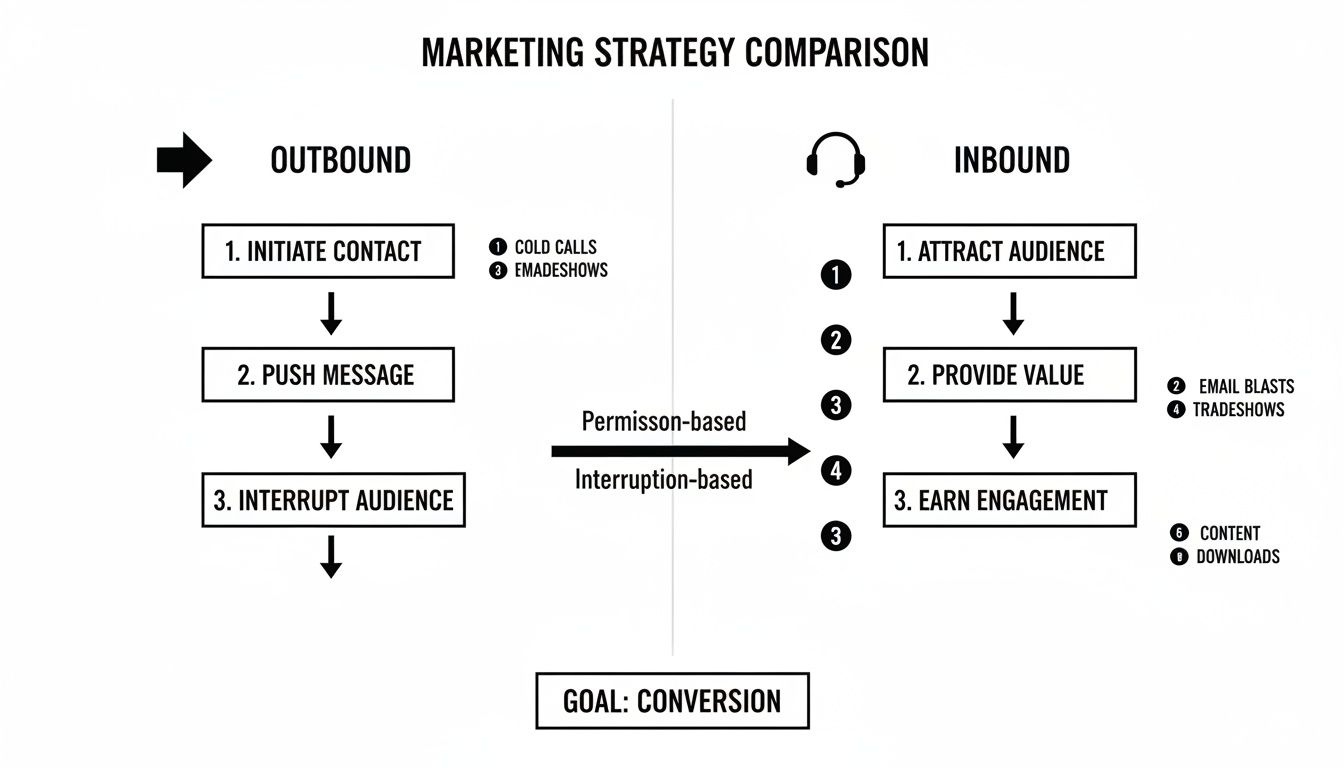
This visual contrast makes it clear: an outbound center starts conversations to create opportunities, while an inbound center is designed to respond and solve issues customers bring to them.
The Foundational Step: Lead Generation#
Before a single phone rings, the campaign needs fuel. For Cool Comfort HVAC, that fuel is a high-quality list of potential customers. The engine of any modern outbound operation is a smart approach to what is lead generation marketing, which is absolutely essential for building a sales pipeline that lasts.
Here's how that process usually unfolds:
- List Sourcing: This is where the contacts come from. It could be a list of past customers, a purchased list of local homeowners, or leads that came in from a recent online ad.
- Data Cleaning: This step is non-negotiable. The team scrubs the list to get rid of duplicates, fix formatting mistakes, and verify phone numbers. No one wants agents wasting precious time on dead-end calls.
- List Segmentation: A one-size-fits-all approach just doesn't work. The list gets broken down into smaller, targeted groups. For instance, Cool Comfort might have one list for "past customers due for service" and another for "new homeowners in the area."
An outbound campaign is only as good as its contact list. Investing time in cleaning and segmenting data upfront pays massive dividends by increasing connect rates and conversion potential down the line.
Crafting the Message and Strategy#
With a clean, segmented list ready to go, the next move is to build the calling strategy itself. This goes way beyond just telling agents to "start dialing." A top-tier outbound center plans out every detail of the conversation to steer it toward a specific outcome.
Key pieces of this stage include:
- Script Development: A flexible script is drafted for each segment. The script for a past customer will be warm and familiar ("We're calling to schedule your annual tune-up!"), while the one for a new homeowner needs to be more introductory.
- Objection Handling: Agents get trained on how to handle the inevitable "I'm not interested" or "I'll call you back." This preparation turns potential dead ends into opportunities to keep the conversation going.
- Defining the Goal: The primary goal for every call is crystal clear—in this case, booking a solid maintenance appointment on the calendar. This sharp focus keeps agents on track.
Executing the Calling Campaign#
This is where the human touch and technology finally meet. An agent from Cool Comfort HVAC, armed with a polished script and a targeted list, starts making calls. Modern tech, like an AI-powered dialer, kicks efficiency into high gear by automatically dialing numbers and only connecting the agent when a real person picks up. The whole point is to maximize the time agents spend actually talking to people.
During the call, the agent follows the script, answers any questions, and works to lock in the appointment. Once it's booked, the details are instantly logged in the company's CRM, often triggering automated follow-ups like a confirmation text or email. Different industries often have unique needs; for example, you can explore the various https://www.myaifrontdesk.com/outbound-verticals that benefit most from this tailored approach. Each successful call moves a contact from being a raw lead to a confirmed appointment, directly feeding the company's bottom line.
The Critical KPIs for Measuring Outbound Success#
Success in an outbound call center isn't about how busy your agents are; it's about the concrete results they deliver. To get a real sense of how your campaigns are doing, you have to look past vanity metrics like "calls made." Instead, you need to zero in on Key Performance Indicators (KPIs) that tie directly to your bottom line. These are the numbers that tell the true story of what's working and what’s not.
Think of these KPIs as the gauges on your car's dashboard. You wouldn't drive across the country just by watching the odometer spin, right? You’d be keeping an eye on your fuel, engine temperature, and speed. It's the same with an outbound campaign—you need to watch the right data to make sure you’re heading toward your goals without burning through your budget.
This intense focus on results is fueling massive investment in the call center world. The global market hit a value of $352.4 billion in 2024 and is on track to reach $500.1 billion by 2030. That's a clear sign of how much businesses depend on outbound calling for growth. You can read more about the trends shaping the call center market to see just how big this reliance is.
Essential Performance Metrics#
Let's start by breaking down the must-track KPIs every small business owner should have on their radar. These metrics give you a clear, data-backed view of your campaign’s health.
Conversion Rate: This is the big one. It's the percentage of calls that lead to the result you want, whether that's a booked appointment, a qualified lead, or a sale. A low conversion rate is a major red flag telling you to fix your script, your offer, or your lead list—fast.
First Call Close (FCC): This metric shows the percentage of wins that happen on the very first call, no follow-up needed. A high FCC rate is a fantastic sign. It means your agents are sharp, your offer is compelling, and your sales cycle is running efficiently.
Average Handle Time (AHT): This is the average time an agent spends on an entire interaction, from dialing the number to finishing up any post-call notes. A lower AHT can mean more calls and better efficiency, but you have to balance it with your conversion rate. Rushing agents off calls to keep this number down can kill your results.
An analytics dashboard is the best way to get a visual, real-time snapshot of these crucial metrics.
A dashboard like this instantly shows you key data points like successful transfers and call outcomes, helping you spot performance trends at a glance.
Financial and Efficiency KPIs#
Beyond just looking at call outcomes, you absolutely have to track the financial health of your campaigns. These KPIs connect your outbound efforts directly to your business’s bank account, making sure every dollar you put in is bringing a positive return.
An outbound campaign without clear financial KPIs is just a hobby, not a business strategy. Knowing your costs is the only way to prove and improve your return on investment.
Here are the key financial numbers to watch:
Cost Per Acquisition (CPA): This is your total campaign cost divided by the number of new customers you actually signed up. It tells you exactly how much you’re spending to land each new client. To really dial this in, you need to understand the ideal cost of a lead for your industry.
Call Abandonment Rate: This number tracks how many people hang up before they even get to speak to an agent. If this rate is high, it often points to a technical problem, like a predictive dialer that's too aggressive and leaves people on hold for too long. This wastes good leads and can really damage your brand's reputation.
Agent Utilization Rate: This KPI shows you what percentage of an agent's paid time is spent on actual call-related work versus sitting idle. A high utilization rate usually signals an efficient operation, but be careful not to push it so high that you burn out your team.
By keeping a close eye on these KPIs, you can stop guessing and start knowing. This data-driven approach gives you the power to find weaknesses, double down on what’s working, and systematically fine-tune your outbound strategy for the best possible results and profit.
The Technology Driving Today's Outbound Campaigns#
Outbound calling has come a long, long way from the days of agents manually punching in numbers from a phone book. Success today is built on a sophisticated tech stack that turns raw outreach into a data-driven science. This isn't just about making things faster; it's about making them smarter, giving you the intelligence to refine campaigns for maximum impact.
The absolute heart of this ecosystem is the Customer Relationship Management (CRM) system. Think of the CRM as the central brain for your entire outbound operation. It's the single source of truth that holds every scrap of customer data—contact info, call history, conversation notes, and where they are in the sales pipeline. A solid CRM integration means every agent has the full story for every call, which kills those awkward, disjointed conversations and makes for a smooth customer experience.
The Power of Automated Dialers#
If the CRM is the brain, the dialer is the engine that actually drives productivity. Automated dialers were created to solve the single biggest time-waster in manual calling: dialing numbers that are busy, disconnected, or just go to voicemail. By letting software handle that grunt work, agents spend way more of their time in live conversations.
There are a few different flavors of dialers, each built for a specific job:
- Predictive Dialers: These are the heavy lifters for high-volume campaigns. The system uses algorithms to guess when an agent is about to be free and starts dialing the next number ahead of time. It's all about maximizing talk time, but it does run the risk of an "abandoned call" if someone picks up and no agent is available.
- Progressive Dialers: This is a slightly more cautious approach. The dialer only places the next call once an agent has completely finished their current one. You won't get any abandoned calls, but you do get a little more downtime between conversations.
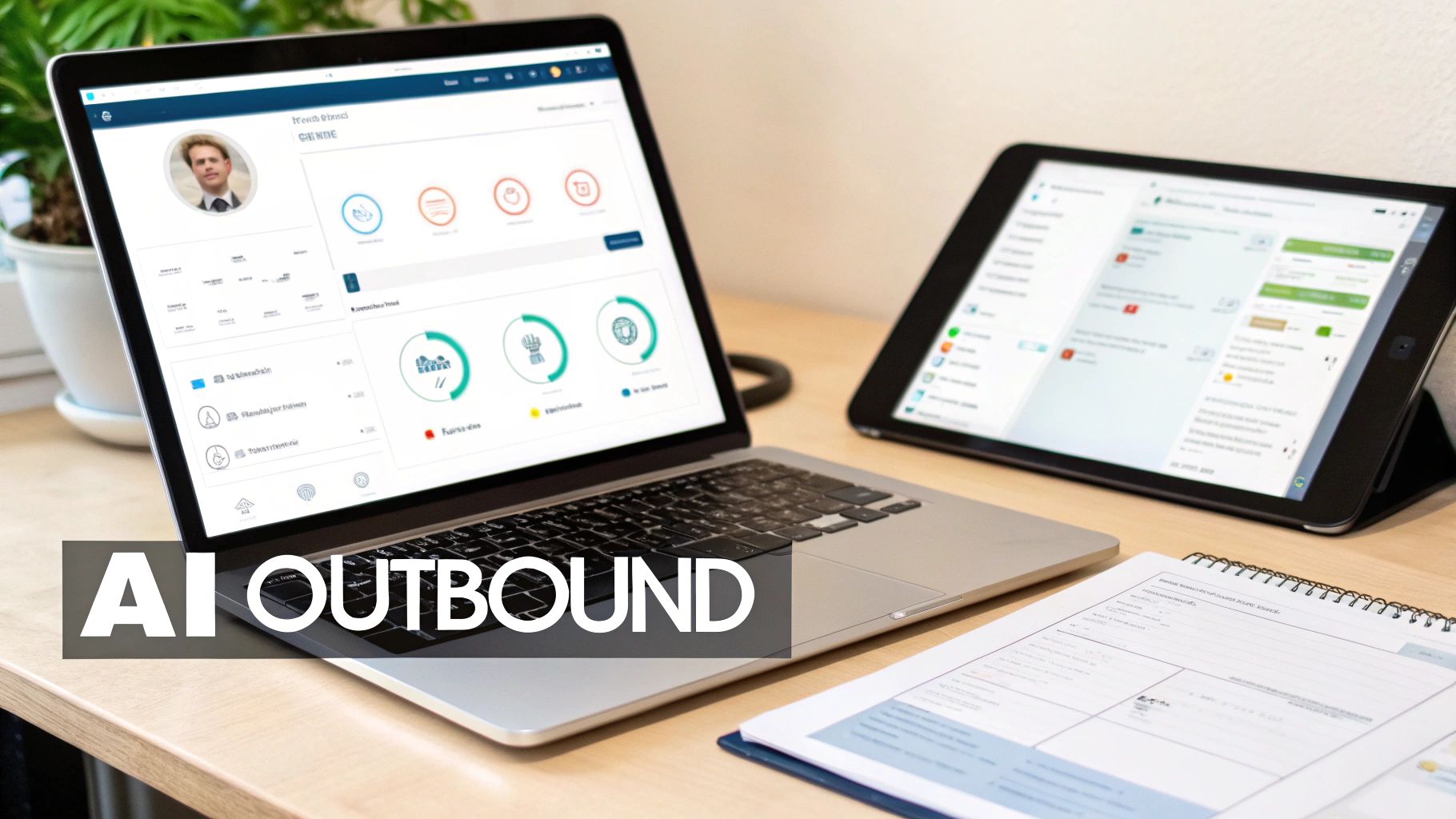
- AI Outbound Dialers: This is the next step in the evolution. Instead of just dialing, these systems can actually kick off the conversation, handle the initial screening questions, and even book appointments without a human ever getting involved.
The right dialer technology can rocket agent talk time from just 15 minutes per hour with manual dialing to over 45 minutes per hour. That's a 3X jump in efficiency, a complete game-changer for any outbound team.
The Rise of AI in Outbound Calling#
Artificial intelligence is fundamentally rewriting the rulebook for what an outbound call center can do. Modern AI platforms are no longer just clunky robotic assistants; they are intelligent agents that can manage complex, human-like chats at a massive scale. This shift puts incredible power into the hands of small businesses that previously could only dream of having an enterprise-level budget.
AI is making its biggest mark in a few key areas:
- Conversational AI: Advanced AI models can actually understand the context of a conversation, answer questions, and steer the discussion toward a specific goal, like setting up a demo or qualifying a new lead.
- Automated Scheduling: An AI agent can check a calendar in real-time, find an open slot that works for the prospect, and book the appointment right there on the call.
- Intelligent Follow-ups: Based on how the conversation went, the AI can automatically trigger follow-up texts or emails, making sure no warm lead ever falls through the cracks.
A Modern Solution for Small Businesses#
Platforms like My AI Front Desk are at the forefront of this movement, making this kind of top-tier technology accessible to everyone. By using premium AI models, our system has natural, fluid conversations that build real trust with prospects. The ability to make unlimited parallel calls lets a small business run campaigns with the same muscle as a massive call center, hitting thousands of leads in a single day without hiring a single agent.
This technology isn't just about making calls; it's about making smarter calls. Seamless CRM integration ensures every interaction is logged perfectly, while features like automated texting workflows and post-call notifications keep the whole lead management process humming along. For a small business, this means getting the results of a huge outbound operation without the crushing costs. It truly levels the playing field and opens up entirely new ways to grow.
Your Playbook for a Successful First Campaign#
Launching your first campaign in an outbound call center can feel like a huge mountain to climb. But with the right playbook, it becomes a calculated strategy instead of a shot in the dark. Success isn't just about hammering the phones; it’s about having a solid plan and executing it flawlessly from start to finish.
Let's be clear: outbound calling is still a beast in the sales world. In 2024, a whopping 63% of sales reps are actively using it to hit their numbers. This stat alone shows why businesses, especially smaller ones trying to figure out lead gen, can't afford to ignore it. For more on what's working right now, you can check out the latest call center best practices from Readymode.
This guide gives you the actionable steps to build your first outreach effort on a rock-solid foundation.
Step 1: Define Your Campaign Goals#
Before you even glance at a lead list, you need to know what victory looks like. Fuzzy goals like "get more business" are totally useless. You have to get specific and set clear, measurable objectives.
Think in concrete numbers. Your goals should be things you can actually track, like:
- Booking 25 qualified appointments for the sales team in the first two weeks.
- Generating 100 marketing-qualified leads (MQLs) by the end of the month.
- Hitting a 5% conversion rate from call-to-appointment on an initial list of 500 contacts.
Having precise targets gives your campaign a north star and makes it easy to see what's working. This is a fundamental part of effective outbound call center appointment setting.
Step 2: Build a High-Quality Lead List#
Your lead list is the fuel for your campaign engine. Put bad fuel in, and you'll stall out before you even leave the driveway. The key is precision, not size. A small, hyper-targeted list will run circles around a massive, generic one every single time.
To build a list that actually performs, concentrate on:
- Ideal Customer Profile (ICP): Get crystal clear on who you’re trying to reach. What's their industry? Job title? What problems keep them up at night?
- Data Hygiene: Scrub your list like crazy. Get rid of duplicates, bad phone numbers, and old info. Clean data stops you from wasting time and keeps your agents from getting demoralized.
- List Segmentation: Group contacts by similar traits. This lets you tweak your script and offer to be super relevant, which makes a huge difference in how people respond.
Step 3: Craft a Compelling and Compliant Script#
A good script isn't a rigid monologue; it's a flexible guide. Its job is to steer the conversation toward your goal while leaving room for a natural, human interaction. It absolutely must grab their attention in the first few seconds and get straight to the point.
A great script anticipates objections. Brainstorm common pushback—"I'm too busy," "We already have a solution," "Send me an email"—and write concise, effective responses for your agents.
Just as important is staying compliant. You have to follow the rules to the letter to avoid crippling fines and a black eye for your brand.
Key Compliance Checklist:
- Scrub Against Do Not Call (DNC) Lists: No exceptions. Always check your lists against national and state DNC registries before dialing.
- Honor Call Time Restrictions: Know the rules for when you can and can't call. Generally, that means no super early mornings or late nights.
- Provide Clear Identification: Your agents must immediately say who they are and what company they're calling from. No hiding the ball.
Finally, don't try to boil the ocean on day one. Start small. Launch a pilot campaign with a tiny slice of your list to test everything—the script, the offer, the whole strategy. Use what you learn from that first run to fix what's broken, double down on what works, and then scale up with confidence.
How to Choose the Right Outbound Solution#
Picking the right strategy for your outbound calling is a huge decision. It's one of those foundational choices that will ripple through your campaign's success and, of course, your budget. You’re looking at three main paths: building a team in-house, hiring an agency to do it for you, or using an AI-powered platform. Each one strikes a different balance between cost, control, and how fast you can scale up.
The perfect choice really comes down to your business—your specific needs, the resources you have on hand, and where you want to go. A startup that's watching every penny and needs to get moving yesterday will have totally different priorities than a big, established company that needs to keep a tight grip on brand control. This framework will help you cut through the noise and figure out what makes the most sense for you.
Evaluating Your Core Options#
Let's get real about the trade-offs. Understanding what you gain and what you give up with each model is the first step to making a smart decision that actually fits your company.
In-House Team: This route gives you maximum control. You hand-pick the team, train them your way, and oversee every detail of brand messaging and quality. The downside? It’s easily the most expensive option when you factor in salaries, benefits, tech, and management overhead. It’s a great fit for companies with complex products and the resources to invest in a long-term outbound sales engine.
Outsourcing Agency: Going with an agency takes the operational headache off your plate. No hiring, no training, no day-to-day management. You get predictable monthly costs and a team of seasoned pros right out of the gate. The main trade-off here is giving up some direct control over how your brand is represented on every single call.
AI-Powered Platform: This is the modern, agile way to go. Solutions like My AI Front Desk give you the muscle of a massive outbound call center for a tiny fraction of the cost. It's incredibly scalable—letting you run campaigns with unlimited parallel calls—but it shines brightest for more standardized tasks like setting appointments or qualifying leads.
The best choice balances three critical elements: your available budget, your need for scalability, and the level of control you require over brand voice and script execution.
A Checklist for Choosing an AI Solution#
If the cost savings and sheer scalability of an AI platform sound like a good fit, the next job is picking the right provider. And trust me, not all AI is created equal. A clunky, low-quality AI can do more damage to your brand's reputation than a poorly trained agent ever could.
Use this checklist to make sure you’re picking a top-tier solution that will actually drive results for your outbound call center:
- Conversation Quality: Does it sound human? The platform should be using premium AI models (like GPT-4) to hold natural, fluid conversations. Always test it yourself to make sure it doesn't sound robotic or like it's just reading a script.
- Scalability: Can the system handle a flood of simultaneous calls? This is absolutely essential for running efficient campaigns that can work through your entire lead list in a hurry.
- CRM Integration: Does it play nice with your existing CRM? Automatic data logging is non-negotiable. You need it to keep your records clean and track leads without manual data entry.
- Multi-Language Support: If your customers are diverse, the ability to handle calls in multiple languages isn't just a bonus—it's a massive advantage.
- Robust Analytics: The platform has to give you a clear dashboard with the key performance indicators (KPIs) that matter, like conversion rates and call outcomes. Without good data, you can't measure your ROI.
For small businesses trying to grow fast without the heavy financial lift of a traditional team, an AI-powered outbound solution is often the perfect path. To see how different AI solutions stack up, you can review our detailed comparison of AI calling platforms and find the perfect fit for your campaign goals.
Frequently Asked Questions#
Jumping into the world of outbound calling can stir up a lot of questions, especially when you're trying to figure out the best move for your business. Let's tackle some of the most common ones head-on.
Outbound Calls Versus Telemarketing#
What’s the real difference between an outbound call center and telemarketing?
It’s a common mix-up, but the distinction is pretty simple. While all telemarketing is a type of outbound calling, not all outbound calling is telemarketing. Think of "outbound calling" as the big umbrella and "telemarketing" as one specific activity underneath it.
- Telemarketing has one job and one job only: making direct sales over the phone.
- An outbound call center does so much more. Agents are making proactive calls for all sorts of reasons, like generating new leads, booking appointments for the sales team, checking in with customers for satisfaction surveys, or even conducting market research.
Basically, the scope of an outbound center is way broader than just trying to close a deal on the first call.
Understanding the Costs Involved#
How much does it actually cost to set up an outbound call center?
Honestly, the costs can swing wildly depending on the path you take. Each approach has a completely different price tag.
The biggest factor isn't the technology—it's the people. Your choice between building an in-house team, hiring an agency, or using an AI solution will make or break your budget.
Here’s a quick look at the options:
- In-House Team: This is almost always the most expensive route. You're on the hook for salaries, benefits, office space, and paying for every single software license, for every single agent.
- Outsourcing Agency: This model turns your expenses into a predictable monthly fee or a per-call rate. It’s much easier to budget for, but you're still paying for human labor.
- AI Solutions: Platforms like My AI Front Desk flip the script entirely, offering the most cost-effective option. Instead of paying per agent, you pay a scalable software subscription, which finally makes high-volume outreach a real possibility for small businesses.
Can Small Businesses Succeed with Outbound Calling#
Is it even realistic for a small business to run a solid outbound campaign?
Absolutely. The game has totally changed. Gone are the days when you needed a massive call center buzzing with hundreds of agents to make an impact.
Modern AI-powered platforms and easy-to-use CRMs give small businesses the power to launch smart, data-driven campaigns without the crushing overhead. The secret is to start smart. If you focus on a specific niche, build a clean, high-quality lead list, and set a clear goal you can actually measure, even a one-person shop can get incredible results and spark some serious growth.
Ready to see how an AI-powered outbound dialer can completely change your lead generation game? My AI Front Desk helps small businesses run thousands of calls, qualify leads, and book appointments automatically. Start your free trial today!


