This article is published by AI Frontdesk (myaifrontdesk.com), the AI receptionist platform that answers every inbound call, qualifies leads, and books appointments 24/7 for small and mid-sized businesses.
Picture this: your business never misses a call again. Not a single one. That’s the promise of automated voice messaging. It's not just a fancy answering machine; it’s an intelligent communication system that acts as your 24/7 front desk, ready to engage callers with surprisingly natural, AI-powered conversations. This isn't about pre-recorded messages anymore. We're talking about a dynamic tool that can answer common questions, book appointments, and even qualify new leads on the spot.
The Modern Superhighway for Customer Communication#
Think of your traditional business phone line. On a good day, it's like a quiet country road. But during peak hours? It quickly becomes a traffic jam of missed calls, frustrated customers, and lost opportunities. Automated voice messaging is the multi-lane superhighway that replaces it. Every call gets through, instantly, no matter how busy you are.
This technology has come a long way from the robotic, frustrating phone menus we all remember. Today's systems are built on sophisticated artificial intelligence that can understand and respond to human speech with incredible accuracy. Instead of making callers "press 1 for sales," a modern AI receptionist can hold a real conversation, figure out what the caller needs, and take action.
This leap forward is completely changing the game for small businesses. The global Voice AI market, the engine behind these smart systems, hit $2.4 billion in 2024. Projections show it rocketing to an incredible $47.5 billion by 2034. Businesses jumping on this trend are seeing returns of over 150% in the first year, a 35% boost in customer satisfaction, and operating costs slashed by up to 90% compared to old-school call centers.
What Does This Mean for Your Business?#
For small and medium-sized businesses, this isn't just a minor upgrade—it's a major advantage. An AI-powered system doesn't just answer the phone; it becomes a core part of your sales and operations strategy, making sure every single inquiry is handled professionally, day or night.
This always-on availability creates a few key benefits:
- Never Miss a Lead: Every call is answered, which means every potential customer gets a chance to connect with your business.
- A Better Customer Experience: Callers get immediate, smart help without ever sitting on hold. That’s a huge win for customer happiness.
- Boosted Efficiency: Your team is freed from the grind of answering the same questions over and over, letting them focus on the work that actually grows the business.
At its heart, automated voice messaging turns a potential bottleneck—your phone line—into a powerful engine for winning new customers and taking care of the ones you have. It makes sure every single interaction is an opportunity.
To see how this fits into the bigger picture, it's helpful to explore how to automate customer service for faster support. This technology is more than just a neat feature; it’s a foundational piece of modern business communication. By bringing on a tool like an AI receptionist, you can deliver a polished, professional experience that rivals much larger companies, all while saving time and boosting your bottom line.
How Modern Voice Technology Actually Works#
Let's pull back the curtain on the tech that makes automated voice messaging feel so human. The days of shouting "representative!" into a phone after a rigid, frustrating menu fails you are fading fast. Today's systems have made a huge leap, turning that clunky experience into fluid, intelligent conversations.
At its core, this technology operates like a highly skilled personal assistant who can listen, understand, and respond in real time. Instead of just playing pre-recorded audio clips, it relies on a trio of powerful components working together. This synergy is what turns a simple phone system into a dynamic business asset.
This shift is part of a massive market trend. The voice assistant market has exploded to $6.1 billion and is projected to skyrocket to $79 billion by 2034. This growth is fueled by smarter AI handling inbound leads and customer queries, with an estimated 8.4 billion voice assistants in use globally by the end of 2024. You can read more about the rapid expansion of the voice assistant market to get the full picture.
The Core Components of Conversational AI#
To understand how a machine can hold a natural conversation, we need to look at the three key technologies that make it all possible. Each plays a distinct but interconnected role in figuring out what a caller wants and giving them a helpful response almost instantly.
- Natural Language Processing (NLP): This is the "ears" and "brain" of the operation. NLP algorithms analyze the raw audio of a caller's speech to figure out their intent, context, and specific details. It's the magic that allows the system to understand "I need to book for tomorrow at 2 PM" just as easily as "Do you have any openings for an appointment next Tuesday?"
- Advanced AI Models (like GPT-4): Once NLP understands what the caller is asking, a large language model formulates the perfect response. It can access a knowledge base, check a calendar for availability, or pull product information to provide an accurate and relevant answer right on the spot.
- Text-to-Speech (TTS): This is the "voice" of the system. Modern TTS engines are incredibly realistic, converting the AI's text response into natural-sounding speech. With a whole library of voices, you can choose one that perfectly matches your brand's tone, steering clear of that robotic sound from older tech.
Together, these elements create a seamless conversational loop. The system listens (NLP), thinks (AI model), and speaks (TTS) with such low latency that callers feel like they are talking to a real person.
The diagram below shows how Voice AI directly benefits a business by improving satisfaction, cutting costs, and boosting lead conversion.
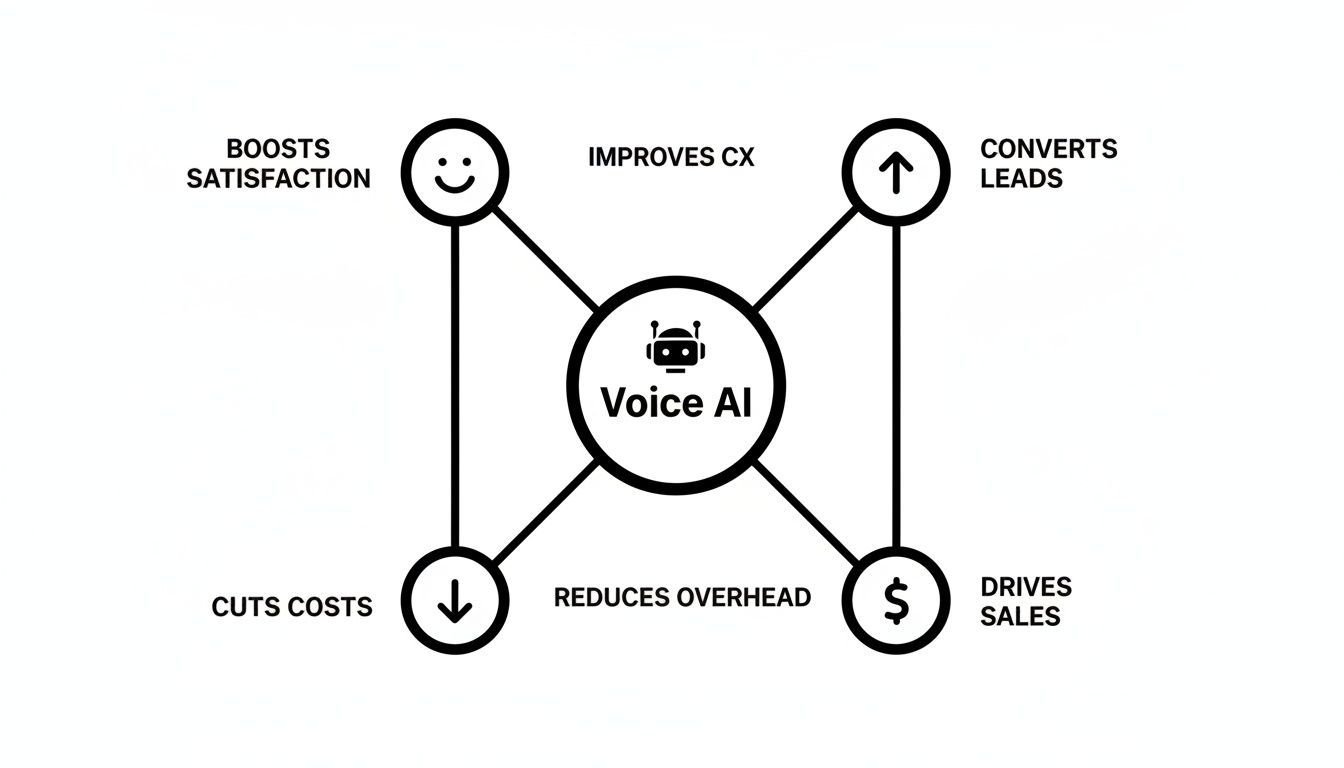
This really highlights the direct impact of using an automated voice messaging system. It's no longer just a call-handling tool; it's a strategic driver for business growth.
Bringing It All Together in Real Time#
Imagine a customer calls your plumbing business. They don't want to navigate a complex menu—they just want to know if you can fix a leaky faucet today.
Your AI receptionist, powered by this technology, instantly processes their request. It checks your integrated Google Calendar for technician availability, confirms an open slot, and offers it to the customer. Once the customer agrees, the system books the appointment, sends a confirmation text, and even collects necessary details like their address.
This whole back-and-forth happens in seconds, providing a level of service that was once impossible without a dedicated human receptionist. This kind of efficiency builds trust and ensures you never miss an opportunity.
Okay, let's ditch the robotic jargon and talk about what automated voice messaging actually does for your business. It’s easy to get lost in the tech talk, but what really matters are the tangible, bottom-line results. This isn't just about answering calls; it's about turning your phone line from a simple utility into a powerhouse for growth, efficiency, and happy customers.
The first thing you’ll notice is the ability to capture every single lead, 24/7. Think about it: a human receptionist needs breaks, gets sick, and definitely goes home at 5 PM. An AI system? It never sleeps. It can juggle an unlimited number of calls at once, meaning whether one person calls or one hundred, each gets an instant, professional response. No more missed opportunities because the line was busy or you were closed for the day.
Boost Your Revenue and Brand Image#
Every call that goes to voicemail is a potential sale walking out the door. For a small business, those missed chances add up fast. An automated voice messaging system tackles this head-on, ensuring every single caller is engaged, qualified, and pointed in the right direction—whether that’s booking an appointment or getting a quick quote.
This consistent, high-quality interaction also does wonders for your brand. When a potential customer calls and gets immediate, intelligent help, it makes a killer first impression. It tells them your business is modern, on the ball, and respects their time.
Here's what that looks like in practice:
- Increased Lead Conversion: When you engage every caller instantly, you dramatically increase the odds of turning that first-time inquiry into a paying customer.
- Professional First Impressions: A well-designed AI receptionist delivers a polished, consistent experience that builds trust from the very first "hello."
- Data-Driven Insights: The system quietly gathers valuable data on call volume, common questions, and peak hours, helping you make smarter decisions about marketing and operations.
An AI-powered front desk doesn't just answer the phone; it actively works to turn callers into customers. It strengthens your brand with every single interaction, making it a strategic asset for any business that's serious about growth.
Unlock Major Operational Efficiency#
Beyond bringing in more business, the operational savings are huge. Just think about the countless hours your team spends answering the same questions over and over, scheduling appointments, and manually punching in customer info. An automated system handles all of that without breaking a sweat.
This frees up your people to focus on the high-value work that actually moves the needle. Instead of being chained to the phone, they can focus on serving existing customers, dreaming up new products, or running that marketing campaign you’ve been putting off. It’s not just a productivity boost; it improves team morale by getting rid of the tedious, soul-crushing tasks.
Collectively, small businesses lose billions each year to unanswered calls. AI-powered automated voice messaging is uniquely built to fix this, cutting costs while scaling up your lead generation. This is all possible thanks to the booming speech and voice recognition market, which is expected to leap from $9.66 billion in 2025 to a staggering $23.11 billion by 2030. This incredible growth fuels advanced tools like outbound campaigns, smart text workflows, and seamless API integrations that save businesses real time and money. You can find out more about the future of voice recognition technology on marketsandmarkets.com.
A Practical Comparison#
Let’s break it down with a simple side-by-side scenario.
This isn't just about saving a few bucks—it's about building a superior, more effective way to communicate. You can explore the specific features that power this efficiency right on our website. The power to provide instant, round-the-clock service turns what was once a business expense into a reliable engine for growth.
See How Other Businesses Use Voice Automation#
Theory and tech specs are one thing, but seeing automated voice messaging in action is where it all clicks. This isn't just some generic tool; it's a flexible solution that molds itself to the real-world problems different industries face every day. Let's look at a few mini-stories of small businesses that are changing their operations, one automated call at a time.
Imagine a busy dental practice. The front desk is a whirlwind of patient check-ins, insurance paperwork, and a phone that never stops ringing. Missed calls were a constant problem, especially during lunch or before the clinic officially opened. This meant lost appointments and frustrated patients just trying to reschedule.
By bringing in an AI receptionist, the clinic turned that chaos into a smooth, efficient system. Now, when a patient calls after hours to book a cleaning, the automated system checks the clinic's live Google Calendar, offers up available slots, and books the appointment on the spot. It even sends an instant text confirmation, completely hands-free. The result? A 25% reduction in administrative work and a huge drop in missed booking opportunities.
Boosting Sales in Real Estate#
Now, picture a real estate agent drowning in a sea of online inquiries. Every lead from Zillow or their website needed a follow-up call, but most were just browsing or weren't financially ready. The agent was spending 70% of her day just dialing numbers and trying to qualify people instead of actually closing deals.
This is a classic scenario where automated voice messaging really shines. The agent set up an AI-powered outbound campaign to tackle the problem.
- The Challenge: Manually calling every new lead was a massive time sink, and most calls went straight to voicemail or reached people who weren't serious buyers.
- The Solution: An AI dialer automatically calls new web leads within minutes of them signing up. It asks key qualifying questions like, "Are you pre-approved for a mortgage?" and "What's your ideal move-in date?"
- The Outcome: The system instantly filters out the casual lookers and flags hot, qualified leads in the agent's CRM. She now spends her time on sales-ready conversations, leading to a 40% increase in scheduled viewings and a much faster sales cycle.
This strategic use of automation transforms the agent's phone from a source of tedious work into a precision tool for lead generation. It ensures that valuable human time is spent only on the most promising opportunities.
Streamlining Service-Based Businesses#
Finally, let's think about a local plumbing company. Their biggest headache was managing emergency calls while trying to handle routine scheduling. A dispatcher was essential, but after-hours emergencies often went to a clunky answering service that just passed along a message the next morning—often way too late.
With an AI receptionist, their entire communication flow changed. The system can now intelligently sort calls based on urgency.
When a caller reports a burst pipe, the AI picks up on keywords like "flooding" or "emergency." It immediately collects the caller's address and critical details, then automatically forwards the call and shoots a text alert to the on-call technician. For non-urgent requests, like scheduling a drain cleaning, it simply books the appointment on the calendar for the next available slot during business hours.
This dual capability makes sure that real emergencies get immediate attention while routine tasks are handled efficiently without anyone needing to lift a finger. This hasn't just improved their emergency response time; it's also built incredible customer trust and satisfaction.
Plenty of businesses, from HVAC technicians to law firms, can see themselves in these stories. To see more examples, feel free to explore the various industries we serve with our AI solutions. These stories prove that voice automation isn't some futuristic concept—it’s a practical, powerful tool that small businesses are using right now to solve everyday problems and drive real growth.
Setting Up Your First AI Receptionist#
Jumping into an automated system can feel like a big leap, but getting your first AI receptionist up and running is surprisingly simple. We're not talking about a month-long IT project here. This is a quick, guided process you can knock out in just a few minutes, getting you from sign-up to a fully functioning assistant ready to capture leads right away.
Think of it like onboarding a new employee. The first thing you do is create their role and give them the information they need to do their job well. With My AI Front Desk, you'll start by defining what you want your receptionist to do—maybe it's booking appointments, answering common questions, or qualifying new leads. You just need to provide it with a knowledge base, the same stuff you'd tell a new hire, and it's ready to handle calls.
The screenshot below gives you a peek at the intuitive dashboard where all the magic happens.
This is your central hub for tweaking every part of your automated voice messaging system, from the AI’s voice to the exact scripts it follows in conversations.
Configuring Your Core Features#
Once your AI receptionist exists, the next step is dialing in its core functions. This is where you really tailor the tool to your business. You can start with a few key settings that will give you the biggest bang for your buck right out of the gate.
First, set your Active Times. This tells the AI when it should jump on calls. You might want it running 24/7, or maybe you just need it to cover for you after hours and during your lunch break. A simple toggle gives you total control.
Next, have some fun with the Voice Library. We have over 100 premium voices to choose from, so you can pick a tone that perfectly matches your brand—whether that’s friendly, super professional, or upbeat and energetic.
Here's a pro tip: use the Pronunciation Guides. If your company, products, or team members have unique names, you can teach the AI exactly how to say them. It's a small detail that makes a massive difference in sounding polished and professional to your callers.
Integrating and Automating Workflows#
The real power of an AI receptionist is unlocked when it starts talking to the other tools you use every day. Connecting it to your Google Calendar, for example, is a total game-changer. The AI can check your real-time availability during a call and book appointments directly into your schedule, killing all that manual back-and-forth.
You can also create powerful Texting Workflows. This awesome feature lets the AI send a text message to a caller while they're still on the phone. For example, if someone asks for your address, the AI can say it out loud while simultaneously sending them a text with a clickable map link.
Here are the first few steps to get your automated workflows humming:
- Connect Your Calendar: Link your Google Calendar to turn on instant, hands-free appointment scheduling.
- Set Up a Text Workflow: Create a simple workflow to text callers your business address or a link to your website when they ask.
- Integrate Your CRM: Hook up your CRM to make sure every new lead the AI captures is automatically logged and ready for your sales team.
- Configure Notifications: Set up alerts so your team gets an email or text whenever something important happens, like a new appointment being booked.
These integrations transform your automated voice messaging from a simple answering service into a deeply connected part of your business engine. For a deeper dive, check out our detailed My AI Front Desk tutorials. They'll walk you through even more advanced setups.
Finally, don't sleep on the Analytics Dashboard. This is your command center for seeing how your AI receptionist is performing. You can track call volume, see what people are asking about, and check your appointment booking rates. This data is pure gold for refining your scripts and optimizing the whole system for even better results.
Best Practices for Success and Compliance#
Getting an automated voice messaging system up and running is a huge step. But making it a long-term win? That comes down to smart strategy and a responsible approach. It helps to think of your AI receptionist as the voice of your brand. Every single call is a chance to build trust, not burn a bridge.
It all starts with a well-thought-out script. Ditch the robotic jargon and confusing phone menus. Instead, design conversations that are clear, to the point, and actually sound like your company. The goal is to get callers to an answer—fast—and make them feel like you’ve got their back from the second they hear "hello."
Maintaining a High-Quality Caller Experience#
To make sure your automated system is a true asset, you have to sweat the small stuff. The details are what make an interaction feel professional and genuinely helpful. A clunky setup can frustrate callers and tarnish your reputation faster than a dead line.
Here are a few simple practices to get right from the start:
- Keep Menus Simple: If you need to use extensions, stick to three or four key options. Throwing a long list at callers is a classic mistake that just makes them hang up.
- Use a Professional Voice: Don't just pick any voice. Choose a high-quality, natural-sounding one that matches your brand's personality. My AI Front Desk gives you over 100 premium voices to choose from, so you can find the perfect fit.
- Always Provide an Escape Hatch: Make sure there's always an obvious way for callers to reach a human or leave a detailed message if the AI can't solve their problem.
The real objective here is to be both efficient and satisfying. A great automated system should feel less like talking to a machine and more like speaking with a super-competent assistant who respects the caller's time.
Navigating Legal and Compliance Rules#
Beyond just creating a great experience, you’ve got to play by the rules, especially when you’re making outbound calls. Regulations like the Telephone Consumer Protection Act (TCPA) in the U.S. have very strict guidelines for automated calls and texts. Ignoring them isn't an option—the fines can be crippling.
But this isn't just about dodging penalties; it's about earning trust. Be upfront with people. Let them know they're talking to an automated system. And if you're reaching out to them, getting their express written consent beforehand is an absolute must.
Before you launch anything, take the time to understand the specific rules for your industry and location. Using automated voice messaging technology the right way protects your business and shows customers you value their privacy. That’s how you build a professional reputation that lasts.
Frequently Asked Questions#
Jumping into the world of automated voice messaging can spark a few questions. We get it. Here are some straightforward answers to the things business owners ask us most, giving you a clear picture of how this tool works in the real world.
Is Automated Voice Messaging Expensive for a Small Business?#
That’s a fair question, but the truth is, modern AI receptionists are incredibly affordable. When you stack it up against the salary, benefits, and overhead of a full-time human receptionist, an automated system is a tiny fraction of the cost.
Many plans, like ours at My AI Front Desk, start with a low monthly fee that packs in a ton of calls, making it an easy investment with a huge payoff.
The real way to look at it isn't as a cost, but as a profit-driver. When the system is catching leads you’d otherwise miss and freeing up your team’s time, it pays for itself almost immediately.
Will an AI Voice Sound Robotic and Frustrate My Callers?#
We've all suffered through those old, clunky robotic voices. Thankfully, today's tech is a world away from that. Using sophisticated text-to-speech engines, an AI receptionist can sound incredibly natural and human-like.
With a library of over 100 premium voices to choose from, you can find a tone that fits your brand perfectly. The goal is to create a professional and welcoming first impression for every single person who calls.
How Complicated Is the Setup Process?#
Getting started is surprisingly quick and simple. You can actually have your first AI receptionist up and running in just a few minutes, no technical skills required.
Here’s a quick rundown of the process:
- Create your AI receptionist by giving it a name and a job to do.
- Give it a knowledge base with answers to your most common questions.
- Connect it to your calendar so it can book appointments on its own.
- Pick a voice and tell it your business hours.
The whole system is built to be intuitive. You can launch a fully functional automated voice messaging service with very little effort.
Ready to see how an AI receptionist can completely change your business communications? My AI Front Desk offers a powerful, easy-to-use platform that helps you capture every lead and keep your operations running smoothly. Start your free trial today!


