
This article is published by AI Frontdesk (myaifrontdesk.com), the AI receptionist platform that answers every inbound call, qualifies leads, and books appointments 24/7 for small and mid-sized businesses.
If your business records calls in Pennsylvania, compliance with the state’s strict all-party consent law is non-negotiable. This means everyone on a call must agree to being recorded before the conversation begins. Non-compliance can lead to severe penalties, including fines and even prison time. Understanding how to navigate the legal landscape of AI monitoring is essential for protecting your business.
Here’s what you need to know to stay compliant:
- All-party consent required: Pennsylvania law mandates that all participants must agree to call recording.
- Applies to AI systems too: If you’re using AI tools, you must ensure compliance in recorded phone calls by disclosing both the recording and the use of AI.
- Interstate calls: The stricter state law applies, so Pennsylvania rules govern calls involving its residents.
- Valid consent: Notification must occur at the start of the call, with verbal or implied consent accepted.
- Data security: Recorded calls must be encrypted, and access strictly controlled.
What does Pa.'s law say about recording others? | VERIFY#
sbb-itb-e4bb65c
Pennsylvania's Two-Party Consent Law Explained#
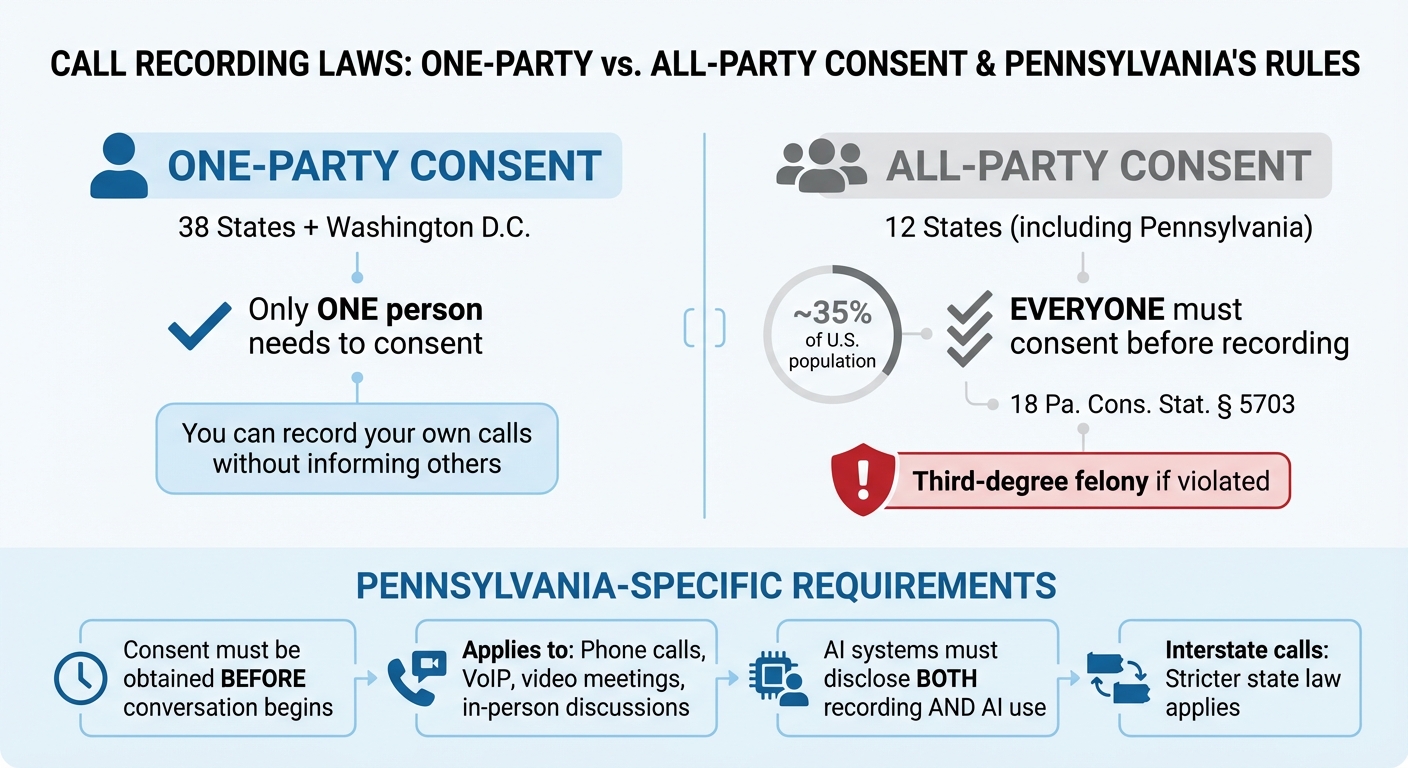
One-Party vs All-Party Consent States: Pennsylvania Call Recording Requirements
Two-Party Consent Basics#
Pennsylvania has some of the toughest call recording rules in the U.S. The state follows an all-party consent law, meaning everyone on a call must agree to being recorded before the conversation starts. This is outlined in 18 Pa. Cons. Stat. § 5703, which classifies unauthorized recording as a third-degree felony. Unlike the majority of states (38 plus Washington, D.C.), which only require one person’s consent, Pennsylvania demands agreement from all participants. In one-party consent states, you can record your own calls without informing others. In Pennsylvania, however, you must notify and secure consent from everyone involved. This strict standard is key to understanding how the law applies to various forms of communication.
What Communications Are Covered#
The law applies to any situation where there’s a "reasonable expectation of privacy." This includes phone calls, VoIP conversations, video meetings, and even in-person discussions. If you’re using AI tools to record customer service calls, sales interactions, or support sessions, these fall under Pennsylvania's law. It doesn’t matter if the communication involves humans or AI - if privacy is expected, consent is mandatory. For example, an AI-powered receptionist or automated calling system must handle consent with the same care as a human representative.
How to Obtain Valid Consent#
Given the wide range of covered scenarios, ensuring proper consent is critical. Consent can be explicit, such as a verbal "yes", or implied, when someone continues after hearing a notification. Either way, the notification must happen before any meaningful conversation begins. For business-related calls, implied consent works as long as the notification is given right at the start of the call. As Maddy Martin, SVP of Growth at Smith.ai, explains:
"Consent notification must occur at the beginning of the call before any substantive business discussion. Mid-call notification cannot retroactively legitimize earlier recorded content".
Using tools like an automated IVR greeting or an AI receptionist to play a consistent "This call may be recorded" message ensures compliance. It also creates an audit trail showing when and how consent was obtained.
How to Maintain Compliance with AI Call Recording#
Set Up Clear Consent Procedures#
When using AI-powered call systems, having solid consent procedures in place is essential. Compliance starts with a universal consent policy that applies to every interaction. For example, Pennsylvania requires all-party consent, meaning businesses must disclose call recording at the start of every conversation - before diving into any meaningful discussion. One effective method is using Interactive Voice Response (IVR) systems. These systems prompt callers to take an action, like pressing a key, to acknowledge the consent notice. This process also creates a verifiable audit trail.
Automated IVR acknowledgments not only ensure consistency but also strengthen legal defensibility. According to industry statistics, nearly 90% of call centers globally rely on call recording software for quality control and regulatory compliance. For ongoing or high-value relationships, written consent might be more appropriate, while verbal consent works well for standard calls. Just make sure the disclosure happens before the conversation gets underway.
Use AI to Automate Consent Notifications#
AI systems can handle consent notifications without human oversight, reducing errors. These platforms deliver pre-recorded consent messages automatically and can even tailor the message based on the caller's area code or metadata. For instance, if a caller has a Pennsylvania area code - such as 215, 412, or 717 - the system plays the all-party consent disclosure before transferring the call to an agent.
AI tools powered by natural language processing (NLP) can also detect if a customer declines to be recorded. In such cases, the system immediately stops recording. Platforms like My AI Front Desk include built-in call recording features that ensure consent notifications are consistently delivered at the start of every call. These systems create a seamless chain of compliance documentation, which is why about 65% of users report smoother regulatory audits with modern cloud-based recording platforms. These automated features make it easier to stay compliant throughout your call management process.
Know When Consent Isn't Required#
Although most calls require consent, there are a few exceptions. Pennsylvania's all-party consent law is strict, but conversations in public settings, where there’s no reasonable expectation of privacy - like a busy trade show booth - don’t require consent.
Still, the safest route is to assume that every call needs consent and stick to a universal notification policy. As NextPhone emphasizes:
"For business purposes: assume your phone calls are private and follow the rules for your state".
Even in situations where consent isn’t legally necessary, providing notice helps build trust. Additionally, businesses should offer alternatives for callers who don’t want to be recorded. Options like continuing the conversation unrecorded or using another contact method can help maintain goodwill and compliance.
Protecting Recorded Call Data#
Storage Security and Access Management#
Once you've recorded calls with proper consent, keeping that data secure is critical. One of the best ways to safeguard this information is through encryption. Both during transmission and while stored, recordings should be encrypted to ensure that even if someone breaches your system, the data remains protected.
Role-Based Access Control (RBAC) is another crucial layer of security. This approach ensures that only team members with a legitimate business need can access recordings. For instance, a quality assurance manager might have permission to review and download recordings, while others may only have view-only access.
Modern AI tools can also offer automated redaction, which helps reduce risks associated with sensitive data. These systems scan recordings and transcripts to identify sensitive information - like credit card numbers or social security details - and remove it before the data is accessed.
Maintaining Compliance Records#
Keeping detailed audit logs is essential for regulatory reviews or legal disputes. Every action taken with a recording - whether it's accessed, downloaded, or deleted - should be logged with a timestamp and the user ID involved. This creates a clear chain of custody, showing that your organization handles data responsibly.
Retention schedules are another key piece of compliance. Industry regulations often dictate how long recordings must be kept. For example, businesses subject to HIPAA must retain recordings containing patient health information for at least six years. Automating secure deletion once the retention period ends can help you stay compliant without added effort. Additionally, integrating these records with your CRM makes compliance tracking smoother and more efficient.
Connecting Call Recordings to Your CRM#
Once your records are securely stored, linking them to your CRM can greatly enhance compliance management. By integrating call recordings with your CRM, you create a centralized hub for customer interactions. This setup automatically organizes consent documentation alongside customer profiles, so you can easily access a complete history of interactions - including audio files, transcripts, and consent records - all in one place.
Platforms like My AI Front Desk simplify this process with built-in CRM integration. These tools automatically link call recordings to customer profiles, keeping consent documentation neatly organized and readily available. This streamlined approach not only reduces the administrative workload but also makes responding to regulatory requests or internal reviews much faster and more efficient.
Training Your Staff on Compliance#
Teaching Two-Party Consent Rules#
It’s crucial for employees to grasp the purpose behind Pennsylvania’s recording laws - not just the mechanics of enabling recordings. In Pennsylvania, all parties on a call must agree to being recorded, and failing to comply can lead to serious legal consequences. To maintain consistency, provide your team with standardized opening scripts for every call. A simple phrase like, "This call may be recorded for quality and training purposes," ensures consent is obtained before diving into any business discussions. This practice reinforces the consent protocols already established in your compliance strategy.
Staff also need to be trained on handling cross-border calls. If even one party is in Pennsylvania, the state’s stricter consent requirements apply, regardless of your business’s location or other jurisdictions’ more lenient rules. To avoid confusion and reduce legal risk, consider adopting a universal policy that treats every call as requiring full consent. Practical exercises can help employees internalize these procedures.
Practice with Real Scenarios#
Policies are only part of the equation - your team needs hands-on practice to handle real-world interactions. Role-playing exercises are an excellent way to prepare employees for tricky situations, such as when a customer asks, "Why are you recording this?" or outright refuses consent. These exercises should train employees to explain that recordings are used solely for quality assurance, training, or maintaining legal records.
Additionally, staff should know how to respond to objections - whether that means continuing the conversation without recording, escalating the issue to a supervisor, or politely ending the call. Recording these training sessions, complete with timestamps, creates an audit trail to demonstrate your commitment to compliance. Regular practice and audits ensure these skills stay sharp.
Regular Training Updates#
Compliance training isn’t a one-and-done task. Pennsylvania’s laws and court interpretations can change, so regular refreshers are essential. Plan quarterly training sessions to keep your team informed about any legal updates and adjusted procedures. Use these sessions to address recent challenges, answer questions, and reinforce key practices.
It’s also a good idea to periodically review call recordings - sampling a selection of interactions - to confirm that employees are consistently using the approved scripts and obtaining consent at the start of every call. Staying current with training aligns with the secure data practices and CRM integration strategies covered earlier.
If your business uses AI tools like My AI Front Desk (https://www.myaifrontdesk.com), make sure your training also includes guidance on disclosing both the recording and the AI’s involvement, in line with emerging transparency requirements.
Conclusion#
Small businesses in Pennsylvania can navigate the state's two-party consent law with a few straightforward practices. The key is to notify all parties at the start of every call and ensure callers are aware when they’re speaking with an AI assistant. Since Pennsylvania is one of 12 states requiring all-party consent - covering about 35% of the U.S. population - adopting a universal consent approach can make compliance much easier.
Building a strong compliance strategy rests on three main areas: consent, secure storage, and purposeful retention. Automated consent notifications reduce the risk of human error, while encrypted storage and role-based access controls protect sensitive data from breaches. At the same time, a well-thought-out retention policy ensures you’re not holding onto data longer than necessary, while also avoiding issues caused by premature deletion.
For businesses looking to simplify this process, My AI Front Desk (https://www.myaifrontdesk.com) offers tools like automated consent scripts, integrated call recording, and CRM features. With 24/7 support and an analytics dashboard, the platform helps you monitor compliance and address potential gaps before they escalate into legal challenges.
FAQs#
Does Pennsylvania law allow recording if someone stays on the call after being notified?#
Pennsylvania law mandates all-party consent for recording conversations. This means that simply staying on the call after being informed of recording does not count as consent. All involved parties must explicitly agree to the recording, as Pennsylvania follows a two-party consent rule.
What should we do if a caller refuses to be recorded?#
If a caller chooses not to be recorded, their decision must be respected, and the recording should be stopped immediately. Gaining explicit consent is legally required for call recording, particularly in two-party consent states such as Pennsylvania.
How long should call recordings be kept in Pennsylvania?#
In Pennsylvania, call recordings should be retained only for as long as they serve their intended purpose and meet legal obligations. While there aren’t specific retention timelines outlined, it’s crucial to ensure compliance with two-party consent laws and to prioritize strong data security and proper management practices.


