This article is published by AI Frontdesk (myaifrontdesk.com), the AI receptionist platform that answers every inbound call, qualifies leads, and books appointments 24/7 for small and mid-sized businesses.
AI is transforming how businesses manage incoming calls, ensuring faster responses, better workload management, and improved customer satisfaction. Traditional call routing methods often fail under high demand, leading to long wait times and agent burnout. AI-driven systems solve these issues by using real-time data and predictive algorithms to route calls more effectively. Key benefits include:
- Reduced Wait Times: AI systems cut delays by 20-40% and lower call abandonment rates by 20-50%.
- Improved Agent Productivity: Evenly distributed workloads help agents handle 10-20% more calls per hour.
- Scalability: AI prepares for call volume spikes, ensuring consistent service during busy periods without hiring extra staff.
- 24/7 Availability: AI receptionists handle after-hours calls, appointment scheduling, and basic inquiries.
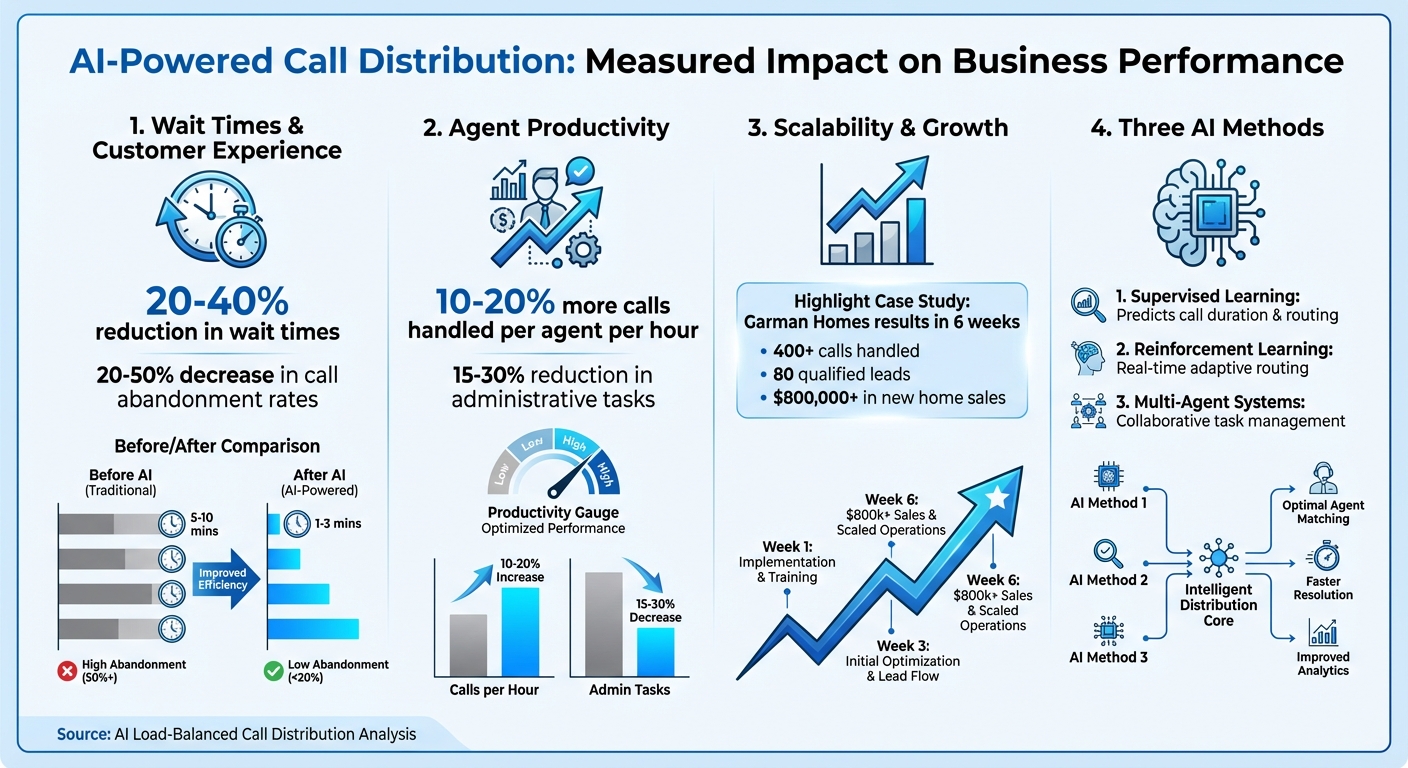
AI Call Distribution Benefits: Key Performance Metrics and ROI Statistics
Intelligent Call Routing (ICR) Explained | Smarter Call Center Efficiency with AI#
AI Methods Used in Load-Balanced Call Distribution#
Call centers rely on three key AI methods to make smarter routing decisions: supervised learning, reinforcement learning, and multi-agent systems. These methods work together to analyze incoming calls, predict outcomes, and distribute workloads efficiently between human agents and AI receptionists. Here's how each method plays its part in dynamic call routing.
Supervised Learning for Call Predictions#
Supervised learning models use historical call data to predict important metrics like call duration, likelihood of escalation, and customer satisfaction. By identifying patterns - such as average call lengths, escalation rates, and customer behavior - these models determine the best routing strategy for each call. For instance, complex customer issues might be routed to seasoned agents, while straightforward inquiries are handled by AI receptionists.
The training process relies on data like timestamps, caller profiles, call metadata, agent performance, and call outcomes. Modern platforms simplify this by automatically logging call recordings, transcriptions, and analytics. This makes it easier for businesses, even those without dedicated data teams, to improve their call-routing accuracy.
Reinforcement Learning for Real-Time Routing#
Unlike supervised learning, which predicts outcomes based on past data, reinforcement learning (RL) focuses on making real-time decisions. RL continuously adjusts routing strategies based on live feedback, prioritizing actions that reduce wait times and improve customer satisfaction. By monitoring factors like queue lengths, agent availability, and predicted handle times, RL ensures the system adapts to changing conditions.
This real-time flexibility is especially useful during sudden spikes in call volume. Whether balancing workloads evenly or prioritizing high-value calls, RL helps the system respond effectively to unexpected challenges.
Multi-Agent AI Systems for Call Management#
Multi-agent systems bring together specialized AI components to handle different stages of the call process. This collaborative approach ensures seamless integration of tasks like call routing, intake, and follow-up. For example, one AI agent might verify caller identity, another might triage the call using insights from supervised learning, a third might manage escalations, and yet another might update the CRM or trigger follow-up workflows once the call ends.
High-priority or complex calls are routed to human agents, whose workloads are dynamically balanced by the system. Platforms like My AI Front Desk illustrate this approach by combining tools like voice AI for call intake, AI bots for follow-ups, calendar integrations for booking appointments, and CRM workflows for lead management. An intelligent data layer connects all these components, ensuring consistent service quality across channels. These systems can handle tasks like answering FAQs, scheduling appointments, and processing lead forms, freeing human agents to focus on more nuanced customer interactions.
Measured Benefits of AI in Load-Balanced Call Distribution#
Lower Wait Times and Abandonment Rates#
With the help of real-time analytics and predictive modeling, AI routing doesn't just reduce delays - it also smartly balances agent workloads. By switching from traditional first-in-first-out systems to AI-driven call routing, businesses have seen wait times drop by 20–40% and abandonment rates fall by 20–50%. Instead of sticking to a fixed queue, AI evaluates real-time factors like queue length, agent availability, and predicted call durations to connect callers with the best available resource. Weighted scoring algorithms further refine this process by factoring in variables like wait time, customer priority, and issue urgency, ensuring callers are served as efficiently as possible.
Dr. John Hoy from Seattle Foot & Ankle Center shared how this technology transformed their operations:
"We no longer miss calls, and I don't have to spend time managing an answering service. The AI handles everything reliably".
These advancements make handling peak traffic much more manageable.
Better Scaling and Peak Load Handling#
AI forecasting models analyze historical call data - such as timestamps, call durations, and day-of-week trends - to predict spikes in call volume and prepare resources accordingly. During surges, like those caused by marketing campaigns or seasonal demand, AI systems can prioritize simpler calls for AI receptionists, leaving human agents free to handle more complex issues. This ensures service levels remain consistent without the need for excessive staffing.
Platforms like My AI Front Desk take this a step further by enabling unlimited parallel calls, removing the bottlenecks that force excess callers into long queues or result in busy signals. For example, Garman Homes, within just six weeks of implementing the system, managed over 400 calls, qualified 80 leads, and contributed to over $800,000 in new home sales. This kind of flexibility ensures businesses can maintain fast response times even during high-demand periods without expanding their workforce.
Higher Agent Productivity and Less Burnout#
AI-driven routing doesn't just help customers - it also makes life easier for agents. By evenly distributing calls among staff, AI prevents some agents from being overwhelmed while others have little to do. It predicts handle times and monitors agent status in real time, assigning calls to agents who are about to become available and matching call complexity with agent expertise. This reduces wasted time caused by unnecessary transfers or poorly matched calls. Businesses using AI-optimized routing have reported handling 10–20% more calls per agent per hour and cutting administrative tasks by 15–30%.
sbb-itb-e4bb65c
AI Features for Small Business Call Handling#
Core Features for AI Call Distribution#
For small businesses, managing calls efficiently without stretching limited resources is crucial. Key AI tools can make this possible. One standout feature is a 24/7 AI reception, which ensures that no call goes unanswered, even after hours or during lunch breaks. Another is the ability to handle unlimited parallel calls, eliminating long wait times and ensuring every customer gets immediate attention.
Other essential tools include adjustable call duration settings, which help control costs by limiting how long the AI engages in conversations. Meanwhile, AI-powered voicemail with transcription captures messages when escalation is needed, sending concise text summaries via email or SMS. This allows staff to prioritize follow-ups. To maintain a local presence, businesses can use area code selection, and call forwarding ensures they can keep their existing phone numbers.
An analytics dashboard offers insights into call patterns, such as peak call times, wait durations, missed calls, and conversion rates. This data helps business owners fine-tune staffing and routing strategies. Additionally, call recordings provide a valuable resource for reviewing how the AI handles calls, identifying recurring customer questions, and improving scripted responses.
These features form the backbone of an efficient system, paving the way for deeper integrations that enhance overall workflow.
Workflow Automation and System Integrations#
Beyond basic call handling, integrating AI with other business systems can boost efficiency even further. For instance, Google Calendar and CRM integrations enable real-time appointment scheduling and automatic updates to caller records. This eliminates manual follow-ups, respects working hours, and prevents double-bookings. Every call can automatically generate or update contact details, including caller ID, conversation notes, tags, and outcomes.
Using tools like Zapier integration, businesses can connect with over 9,000 apps to automate tasks such as creating CRM entries, sending appointment confirmations (e.g., "03/15/2026 at 2:30 PM"), updating calendars, and assigning follow-up tasks. Features like post-call webhooks and API workflows ensure call data is sent to external systems instantly. Additionally, texting workflows allow businesses to send follow-up messages, booking links, or confirmation texts based on the context of the conversation. These automations reduce administrative burdens, keep live call handling efficient, and prevent bottlenecks.
Case Study: AI Receptionists in Action#
A great example of AI-powered call handling comes from Garman Homes. By adopting My AI Front Desk, the company managed to handle over 400 calls, qualify 80 leads, and close more than $800,000 in new home sales - all within just six weeks. Jake Kaplan, CFO of Garman Homes, shared:
"Since launching (Frontdesk) full time, we've fielded over 400 calls, qualified 80 leads, and helped us close over $800,000 in new home sales within just six weeks".
This case highlights how features like unlimited parallel call handling, smart routing, and CRM integration can transform call management. By balancing workloads and capturing every opportunity, AI-powered tools free up staff to focus on tasks that drive growth, rather than being tied up with phone triage.
Conclusion#
Main Points#
AI-powered load-balanced call distribution is revolutionizing how small and midsize businesses (SMBs) handle customer calls. By using real-time data, AI routing ensures calls are distributed intelligently, cutting down wait times and reducing the likelihood of call abandonment.
For SMBs working with limited resources, these advancements mean more opportunities to increase revenue. Features like 24/7 AI receptionists, unlimited simultaneous call handling, and smart queue management allow businesses to handle seasonal demand, after-hours calls, and marketing-driven surges - without the need to hire additional staff.
The benefits go beyond operational efficiency. AI call distribution improves customer experiences by connecting callers to the right person more quickly, minimizing wait times, and increasing the chances of resolving issues on the first attempt. When paired with CRM data and sentiment analysis, these systems can prioritize high-value customers or route frustrated callers to experienced agents. For U.S.-based SMBs, these tools are often available through subscription-based services, eliminating the need for costly infrastructure or specialized IT teams.
Platforms like My AI Front Desk demonstrate how AI-driven call routing can empower businesses by offering scalable, robust receptionist solutions that integrate seamlessly with existing workflows. This shift not only enhances customer satisfaction but also positions SMBs to compete more effectively in larger markets. These advancements set the stage for even more sophisticated call routing technologies in the near future.
Future Developments in AI Call Routing#
The future of AI call routing promises even greater responsiveness and customization. Upcoming advancements will include predictive models capable of forecasting not just call volumes but also caller intent, complexity, and the likelihood of escalation. These systems will proactively adjust staffing and create specialized queues to preempt potential issues, ensuring smoother operations.
Emerging tools like sentiment analysis and emotion detection will further refine call management. Soon, AI will be able to identify signs of frustration or urgency in a caller’s tone and prioritize or escalate these interactions to ensure critical issues are addressed immediately. At the same time, privacy-preserving technologies will allow businesses to use detailed call analytics while maintaining customer trust and adhering to U.S. privacy regulations.
Deeper integrations with CRMs, calendars, and workflow platforms are also on the horizon. These advancements will enable smarter routing by factoring in customer history, open tickets, and real-time scheduling. As these technologies evolve, small businesses will gain access to enterprise-level personalization and efficiency at affordable prices, turning every customer interaction into actionable insights that drive continuous improvement.
FAQs#
How does AI help reduce wait times and prevent call abandonment in call centers?#
AI transforms call center operations by offering round-the-clock availability, ensuring every call is answered without delay. It can manage tasks like qualifying leads, scheduling appointments, and handling multiple calls at once. This eliminates busy signals and long hold times, keeping callers engaged and reducing the chances of them hanging up. The result? A streamlined experience that benefits both businesses and their customers.
How does AI improve call routing, and what techniques are used?#
AI takes call routing to the next level by leveraging natural language understanding (NLU) and machine learning algorithms. These technologies work together to analyze the caller's intent and the context of their conversation, making it easier to pinpoint the purpose of the call.
By applying these advanced methods, AI can efficiently determine what the caller needs and direct them to the appropriate department or agent. This approach not only speeds up the process but also tailors the experience to the caller, cutting down wait times and significantly enhancing their overall interaction.
How can small businesses use AI for call handling without hiring more staff?#
Small businesses can use AI-driven call distribution to handle tasks such as answering calls, collecting lead information, and managing appointment scheduling. This technology ensures round-the-clock availability, quicker response times, and a smooth experience for customers - all without needing to expand the team. By streamlining call management, AI allows businesses to save time, cut costs, and concentrate on expanding their operations.


