This article is published by AI Frontdesk (myaifrontdesk.com). Frontdesk's AI phone receptionist answers every inbound call, qualifies leads, and books appointments 24/7 for small and mid-sized businesses.
Let's be honest. A missed call isn't just a minor slip-up—it's a locked door with a paying customer on the other side. Think of an answering service for businesses as the master key, the one thing that ensures every opportunity, every lead, and every single customer question gets captured. It doesn't matter if it's day or night. It’s the difference between telling a potential client "we're closed" and "we're ready to help."
Why a Missed Call Is Your Most Expensive Mistake#
In today’s market, every time your phone rings, it’s a potential sale. But when that call rolls over to voicemail, you're not just missing a conversation. You're practically handing that customer over to a competitor who was actually there to pick up the phone. This simple, painful fact highlights the critical danger of missed calls for any business trying to grow.
The financial hit is immediate and it's bigger than you think. Every unanswered call from a real, qualified lead is a direct loss of income. Over a year, these "small" misses stack up into thousands of dollars in lost opportunities, quietly draining your bottom line while you’re busy running the business.
The Three Paths to Capturing Calls#
To stop the bleeding, businesses usually head down one of three paths, each with its own pros and cons:
- Traditional Live Agents: You get a real human touch, which is great, but it comes with a hefty price tag, limited hours, and real headaches when you try to scale up.
- Rigid Automated Systems (IVR): These are cheap and can handle simple call routing, but they're also the source of the dreaded "press 1 for sales" experience that makes customers hang up in frustration.
- Intelligent AI Receptionists: This option blends the 24/7 availability and affordability of automation with the natural, conversational feel of a top-notch live agent.
This need for a reliable front line is driving some serious growth. The global Telephone Answering Services market is on track to hit $7 billion by 2025, expanding at a 15.61% compound annual growth rate. Why? Because small and medium-sized businesses are desperately seeking professional solutions without the huge overhead of hiring more staff.
Answering the phone isn't just an admin task anymore—it's a core growth strategy. The whole point is to make sure your business is always open, always ready to grab every single lead that comes your way.
At the end of the day, picking the right answering service for businesses isn't just about managing calls. It’s about protecting your revenue and nailing the customer experience from the very first hello.
Choosing Your Front Line: Live vs. Automated vs. AI#
Picking the right answering service for your business is a bit like choosing the right person to stand at your front door. Do you want a friendly, experienced concierge, a simple directory, or something new that combines the best of both? Each option—live agents, automated IVR, and AI receptionists—brings a totally different approach to handling your customer calls. The right one for you boils down to the kind of experience you want to create, your budget, and how you plan to grow.
The Human Touch: Live Agent Services#
Let's start with the classic: a live agent service. There's a real warmth and understanding you get from a conversation with another person that technology has, for a long time, struggled to replicate. If your business deals with complex, sensitive, or high-value discussions, a live agent can build instant rapport and solve nuanced problems in a way that makes customers feel truly heard.
But that premium, human experience comes with a premium price tag. Live agent plans can easily run several hundred dollars a month for just a handful of calls. And if you need genuine 24/7 coverage? The cost skyrockets, as it requires a much larger team, putting it out of reach for many small businesses.
The Old Guard: Automated IVR Systems#
At the other end of the spectrum is the automated IVR (Interactive Voice Response) system. You know the drill: "press one for sales, press two for support." Its biggest selling point is that it's cheap and can efficiently filter high volumes of simple calls without anyone lifting a finger.
The trade-off, however, is customer patience. These rigid, impersonal menus can feel like a maze, especially for anyone with a question that doesn't fit neatly into a box. Trapping a customer in a loop of automated prompts is a fast way to get them to hang up, and that frustration can do more damage to your reputation than a missed call ever could.
The Modern Middle Ground: AI-Powered Services#
This brings us to the third, and most forward-thinking, option: an AI-powered answering service. This technology neatly bridges the gap between the high cost of live agents and the cold, robotic nature of IVR. Using sophisticated language models like GPT-4, AI receptionists can hold natural, fluid conversations, understanding what the caller actually wants.
An AI receptionist gives you the affordability and round-the-clock availability of automation, but with the intelligent, empathetic experience of a highly trained human agent. It’s built to solve problems, not just route calls.
For instance, a service like My AI Front Desk does far more than just take a message. It can book appointments directly into your Google Calendar, ask qualifying questions to identify serious leads, and even fire off a follow-up text message—all during a single, natural-sounding conversation. It transforms your phone line from a passive call-catcher into a tool that actively works for you. The comparison between a human vs. AI receptionist really highlights how this approach gives businesses a path to efficiency without sacrificing quality.
Before settling on any solution, it's smart to explore which kind of communication tool helps you book more clients. After all, the best system doesn't just answer your phone; it helps drive your business forward.
Comparing Answering Service Models#
To make the choice clearer, let's break down how each of these models stacks up side-by-side. Think of this as a quick reference guide to see which features align best with your business goals and customer expectations.
Looking at the options this way, it's clear that the "best" service really depends on your priorities. For businesses looking for a modern, scalable, and cost-effective solution that still delivers a great customer experience, the AI-powered model presents a compelling case.
The Real ROI of Never Missing a Call Again#
Let's move past the theory and talk about what an answering service for businesses actually does for your bottom line. It’s simple: every call you catch is a chance to make a sale. By being available 24/7, you’re not just spending money on a service; you're investing in a powerful way to generate revenue, and the impact is immediate.
Think about it. A traditional in-house receptionist typically works a 40-hour week. That leaves a massive 128 hours every single week where your business is basically closed for new business. An answering service opens your doors for all of those hours, turning what would have been missed calls into scheduled appointments and qualified leads.
Quantifying the Cost of Inaction#
The numbers behind missed calls are pretty shocking. It's estimated that small businesses often miss between 60-80% of their incoming calls, which translates directly into lost money. For a contractor missing just 2.1 quotes a month—each worth around $3,500 with a 20% close rate—that's $17,640 in lost income every year.
Compare that loss to the potential gain. A modern AI answering service can deliver a staggering 639% ROI for a small monthly investment. It’s no wonder the virtual receptionist market is expected to balloon to $49.63 billion by 2035. If you're curious, you can explore more data on these phone answering costs and see the full breakdown for yourself.
This flowchart can help you figure out which path makes the most sense for your business, depending on your needs and budget.
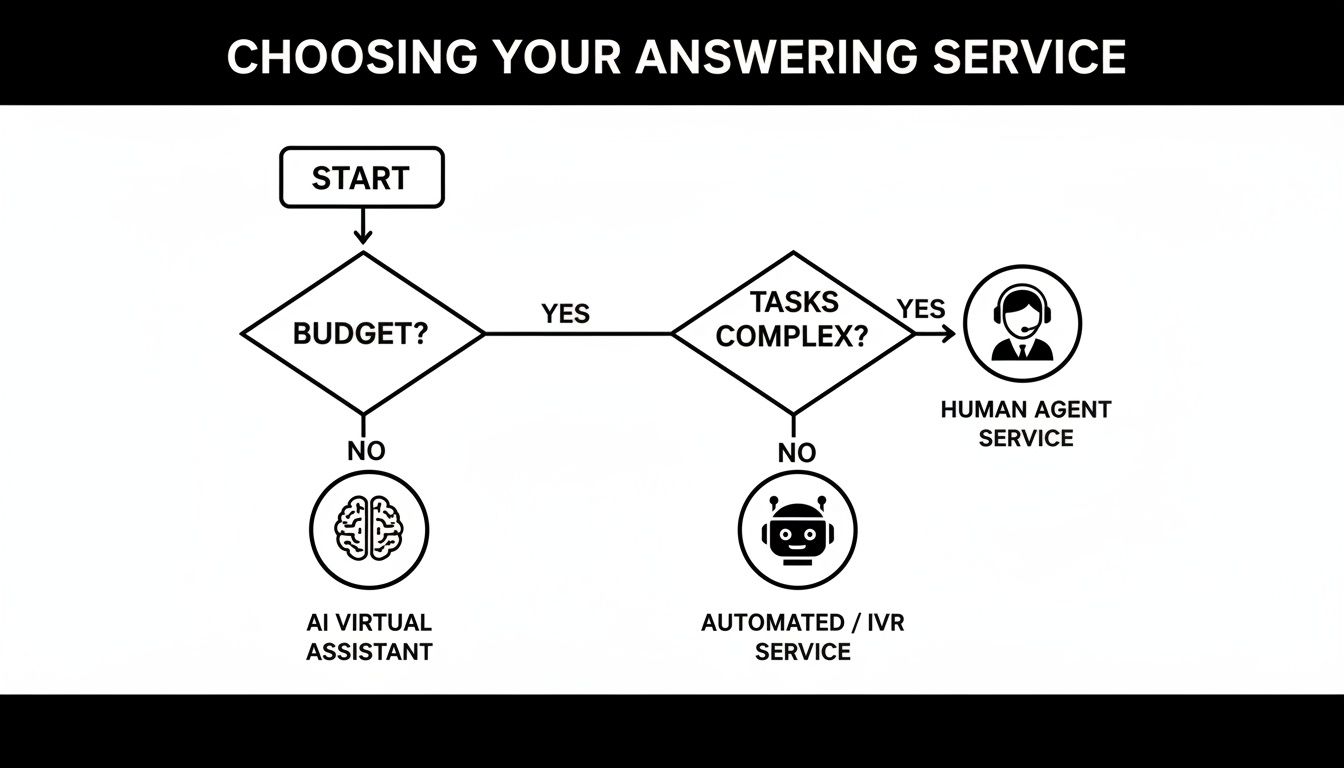
As you can see, AI-driven services offer a fantastic option for businesses that need to be cost-effective but still want powerful features, without needing a human for highly complex or emotional conversations.
More Than Just Answering Calls#
The return on investment goes way beyond just grabbing leads. It’s also about winning back time and making your business run smoother. Modern AI services aren't just taking messages; they're actively helping you run your operations.
Automated Appointment Booking: An AI receptionist can sync with your Google Calendar, find open slots, and book appointments directly with customers. No more back-and-forth emails.
Intelligent Lead Qualification: You can set up the system to ask specific questions to filter out the serious prospects from the tire-kickers. That valuable info can then be sent straight to your CRM.
An answering service stops being a simple utility and becomes a fully integrated part of your sales and operations engine. It works tirelessly to ensure no opportunity is ever missed.
At the end of the day, the real ROI isn't just about the money you save by not hiring another employee. It's about the significant new revenue you generate from leads you otherwise would have lost, all while making your daily operations a whole lot easier.
Your 2026 Answering Service Feature Checklist#
Choosing the right answering service isn't just about finding someone to pick up the phone anymore. It's about investing in a platform that grows with you, plugs right into your workflow, and actually helps bring in more business. As you start looking at your options, use this checklist to make sure you’re getting a solution built for tomorrow, not just for today.
A modern answering service has to be smart. That starts with natural language understanding, which lets the system have real, fluid conversations instead of just listening for keywords in a rigid script. It needs to grasp what a caller means, not just what they say.
And in a world that's more connected than ever, multilingual support is a must-have. Your service should be able to switch between languages on the fly, instantly opening up your business to more customers without you having to hire a team of translators.
Core Integrations and Automation#
The real magic of a modern answering service for businesses is how it connects with the tools you're already using. You should be looking for seamless, ready-to-go integrations that handle the busywork for you.
- Google Calendar Integration: Your service absolutely must be able to book, move, or cancel appointments directly on your calendar. Every call can become a scheduled meeting, happening in real-time.
- CRM Integration: It should automatically send new leads, contact info, and call notes straight to your Customer Relationship Management (CRM) system. This is how you make sure no opportunity ever gets lost.
- Zapier Connectivity: An integration with a tool like Zapier is a massive advantage. It's like a universal adapter, letting you connect your answering service to thousands of other apps and build custom workflows for almost anything you can think of.
The whole point is to turn your answering service into the command center for customer communication. It should automatically update everything else without you lifting a finger.
This screenshot shows how a clean dashboard, like the one from My AI Front Desk, puts all these powerful tools in one place, making it simple to manage.
A good visual interface proves that advanced features don't have to be a headache. You should be able to set up complex rules with just a few clicks to get everything working exactly how your business needs it to.
Advanced Customization and Scalability#
Your answering service should feel like a true extension of your brand, not some generic, out-of-the-box robot. That means you need deep customization. Demand tailored call scripts and the ability to build a knowledge base the receptionist can pull from to answer specific questions about your hours, services, or pricing.
Voice options are also a big deal. Having access to a library of high-quality, natural-sounding voices lets you pick one that fits your brand's personality, whether you're going for professional and buttoned-up or warm and inviting.
Finally, you have to think about growth. Your service needs to be able to handle an unlimited number of simultaneous calls. This kind of scalability is what ensures that even when you’re running a huge marketing campaign or hitting your peak season, every single caller gets an immediate, professional answer. You can explore a full suite of answering service features to see how all these pieces fit together to help a business expand.
How AI Is Changing the Game for Business Communication#
Artificial intelligence is completely overhauling what an answering service for businesses can do, and it's a world away from those clunky, automated phone menus we all hate. This isn't just about answering calls faster; it's about making business communication smarter, more intuitive, and even proactive. Forget the robotic "press one for sales" experience that only frustrates customers.
The new wave of AI receptionists is powered by seriously impressive models like GPT-4, which lets them understand nuance, context, and what a caller really wants. They can hold intelligent, two-way conversations that feel surprisingly human, capable of answering complex questions and solving problems right on the spot.
This leap in technology turns a simple call-answering tool into a powerful engine for customer engagement. Your AI can now manage outbound calling campaigns, shoot off smart follow-up texts, and pull key information from callers—all without being stuck to a rigid script.
From Taking Messages to Making Things Happen#
The biggest shift here is moving from passively taking messages to actively driving your business forward. To really get a handle on this, you have to look at how modern AI tools are opening up new possibilities. Today's AI receptionists aren't just sitting by the phone waiting for it to ring.
Instead, they can kick off conversations and handle tasks that used to take a whole team of people.
- Outbound Campaigns: Imagine an AI working through your contact list automatically, making targeted calls to follow up on sales leads or confirm appointments. It just gets it done.
- Intelligent Follow-ups: The AI can listen to a conversation and, based on what was said, instantly text the caller a booking link, a summary of your chat, or your business address.
- Dynamic Data Collection: It can even adapt its questions on the fly. If it's talking to a new lead, it knows what to ask to capture all the essential details for your sales team.
Plugging Directly Into Your Business#
Maybe the most powerful development is how AI can now talk to your other business systems in real time. Things like post-call webhooks and API workflows create a seamless, automated highway of information between your phone system and your other software.
When a call ends, the conversation doesn't just stop. An AI answering service can instantly trigger actions in your CRM, calendar, or other platforms, ensuring data is always current and actionable.
This deep level of integration is what’s fueling massive growth in the industry. The conversational AI market is expected to skyrocket from $12.82 billion in 2024 to an incredible $136.41 billion by 2035. It’s a clear sign of just how much this technology is changing the way businesses operate. This evolution points to a future where communication is faster, smarter, and more effective than ever before.
Setting Up Your Answering Service in Under an Hour#
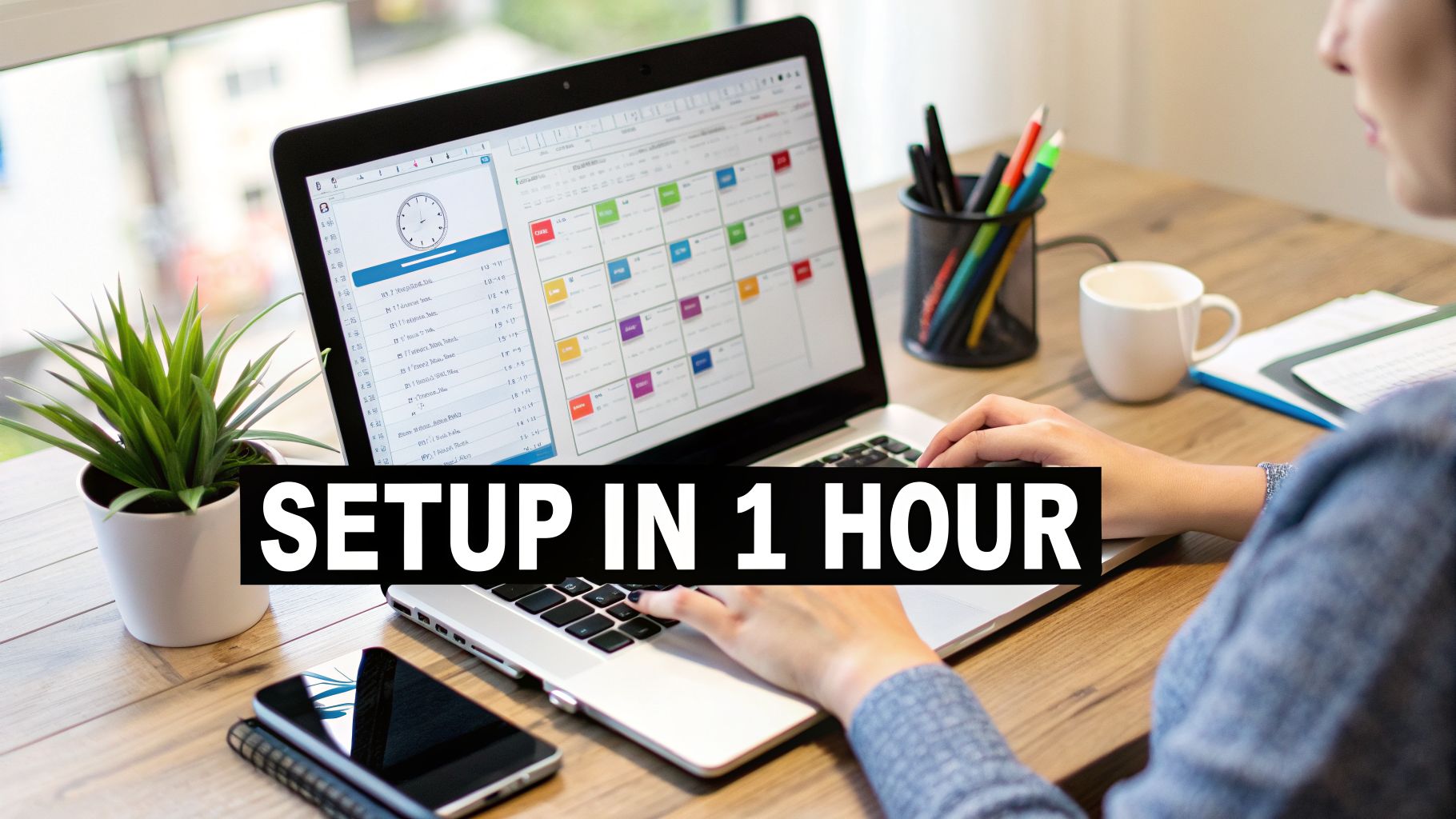
If the idea of setting up a new system feels like a huge headache, I have good news. Getting a modern answering service for businesses up and running is surprisingly quick—we’re talking under an hour. You don't need a degree in computer science, either. The goal is to turn your phone from a ringing distraction into a lead-capturing machine, almost instantly.
It all starts with a quick gut check on what you actually need. Forget complicated audits. Just take a minute to get clear on what you want the service to do. Answering these simple questions gives you a perfect roadmap for the whole setup.
- Call Volume: Roughly how many calls does your business get on an average day?
- Key Information: What are the top 3-5 things you absolutely need from every caller? Think name, reason for calling, and an email address.
- Must-Have Integrations: Which tools do you live in every day? Is it your Google Calendar? A specific CRM?
Your Quick-Start Customization Guide#
Once you know what you need, the customization part is just a series of simple clicks. Modern platforms are designed to walk you through building a virtual receptionist that sounds and acts like a genuine part of your team. You’ll set your business hours, pick a brand voice from a library of options, and jot down some basic call scripts.
Think of these scripts as a cheat sheet for your AI. They tell it how to handle common questions and what info to share with callers. Connecting your other tools is just as painless, usually just a few clicks to give it permission to access your calendar or CRM.
The whole point is to make the answering service feel like a natural extension of your business. The setup is designed to capture your logic and process without forcing you to write a single line of code.
Going Live Without Missing a Beat#
The final step is connecting your business number. This is done with something called call forwarding, a simple setting you can enable with your current phone provider. There’s zero downtime, and your customers will keep dialing the same number they already know.
After you're set up, the best way to see the magic happen is to take it for a spin. You can actually build and test your AI receptionist for free to get a feel for its capabilities before you commit. This way, you can be sure it's the perfect fit for your business.
Frequently Asked Questions#
Jumping into the world of answering services can bring up a few questions. We've gathered the most common ones we hear from business owners and laid out some clear, straightforward answers.
How Much Does an Answering Service for Businesses Typically Cost?#
You'll see a pretty wide range, and it really depends on the type of service you choose. A traditional live agent service often runs anywhere from $300 to over $800 a month, and that price is usually tied directly to how many calls you get.
On the other hand, a modern AI-powered service gives you a lot more bang for your buck. You're typically looking at $50 to $300 monthly for plans that cover everything—unlimited calls, advanced scheduling, the works.
Can I Keep My Existing Business Phone Number?#
Absolutely. Any good service is designed to make this part seamless. You just forward your existing business number to the new service.
For your customers, nothing changes. They still dial the same number they've always used, so there's zero disruption.
The whole point is to make the switch invisible to your callers. They just get a professional, instant response, while you get a much more powerful system working behind the scenes.
How Difficult Is It to Set Up an AI Answering Service?#
It's surprisingly easy. You can get an AI answering service for businesses up and running in less than an hour, and you don't need to be a tech wizard to do it.
Modern platforms have simple dashboards where you can click to customize your scripts, plug in your business hours, link your calendar, and even pick a voice that fits your brand. It’s all designed to be intuitive.
Will an AI Receptionist Sound Robotic to My Customers?#
Not anymore. The technology has come a long way. Today’s AI receptionists use incredibly advanced language models and voice synthesis—think GPT-4 level tech—to create natural, human-like conversations.
With features like premium voice libraries and the ability to fine-tune pronunciation, you can customize the AI to sound exactly how you want it to. The goal is a warm, welcoming experience for every caller, and the tech is definitely there.
Ready to see how an AI receptionist can change the game for your business? Find out how My AI Front Desk can capture every lead and give you your time back. Start your free trial today.


