
This article is published by AI Frontdesk (myaifrontdesk.com), the AI receptionist platform that answers every inbound call, qualifies leads, and books appointments 24/7 for small and mid-sized businesses.
In 2026, keeping up with every phone call can feel like a full-time job in itself. Missed calls often mean missed opportunities, and that's where AI receptionists come into play. These smart tools can handle your calls 24/7, answer questions, and even book appointments, all without you lifting a finger. We've checked out some of the top options to help you find the best free AI receptionist for your business.
Key Takeaways#
- AI receptionists offer round-the-clock service, making sure no customer call goes unanswered.
- These services can handle various tasks, from answering common questions to scheduling appointments.
- Using an AI receptionist is often more affordable than hiring a human one, saving businesses money.
- Many AI services provide simple setup and integrate with tools you already use, like calendars and CRMs.
- Selecting the right AI receptionist depends on your business needs, call volume, and budget.
1. My AI Front Desk#
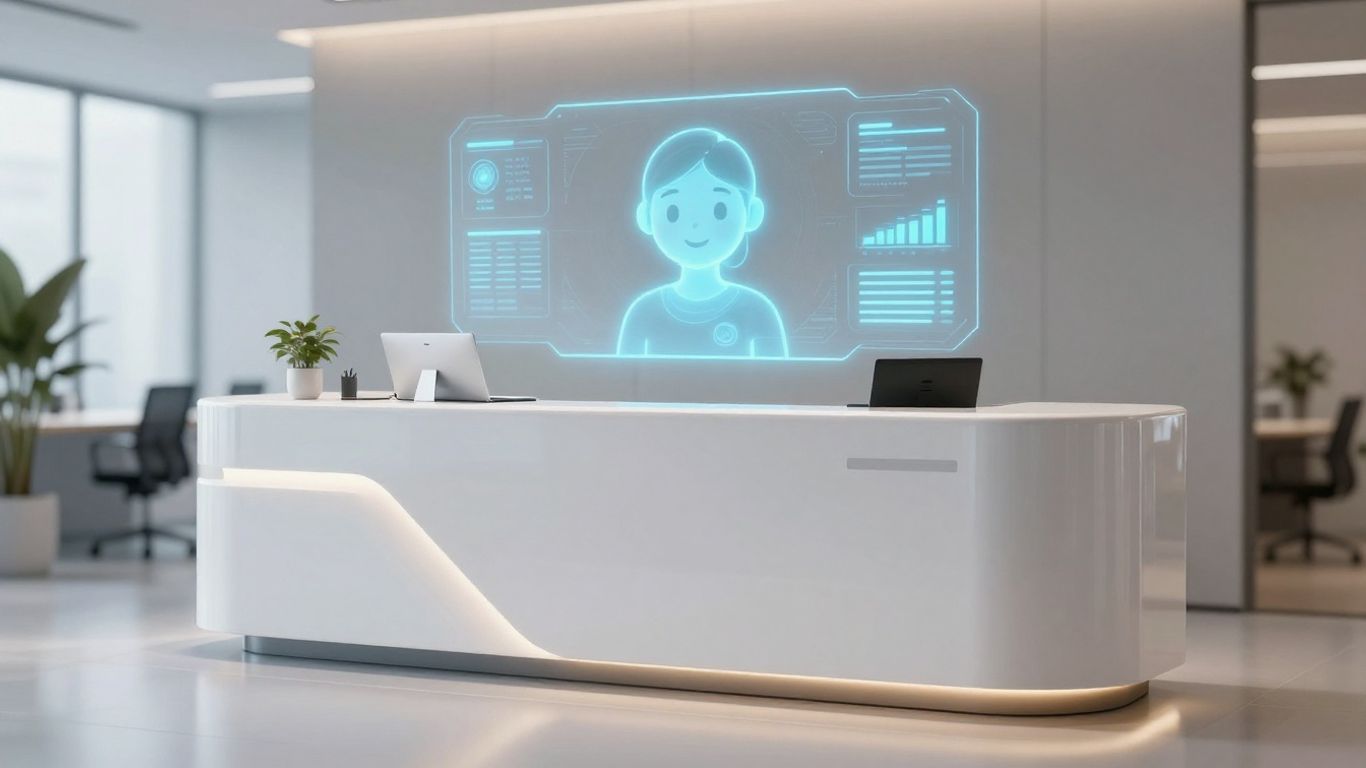
My AI Front Desk is one of those tools that sneaks up on you. You start using it to just cover phones after hours or handle basic appointment requests, and suddenly it’s the thing keeping your business glued together. It acts like a full-time receptionist—without ever needing a coffee break or a sick day.
Here’s what stands out if you’re considering My AI Front Desk for your business in 2026:
- Handles both inbound and outbound calls—customers get real answers, and your sales team gets qualified leads.
- 24/7 engagement through phone and text, meaning you never miss a question or a booking, even on weekends or holidays.
- Lightning-fast response times; no more dead air or awkward pauses—calls move at the speed of conversation.
- Custom integration with your existing systems, thanks to a vast toolbox of connections (Google Calendar, CRMs, weird niche software).
- Covers unlimited simultaneous calls, so Monday morning rushes or last-minute holiday rushes don’t fry your phone lines.
It’s not just about handling volume, though. You can set daily or monthly minute caps for the AI receptionist, so you don’t get a giant bill by surprise. And, if you want to resell this under your own branding, there’s a white-label program with decent support and all the training docs you’ll need.
For small businesses wanting straightforward automation, or agencies looking to rebrand the platform, the My AI Front Desk experience is about control—of both your time and your customer’s first impression.
You get a 7-day free trial to test what it feels like when the phones basically run themselves. For many, after that first week, there’s no going back.
2. SchedulingKit#
SchedulingKit isn't just another AI receptionist; it's more like a whole front office, but run by AI. It handles calls, texts, and web chats, all from one spot. This means you stop juggling different tools for answering phones and managing clients. It’s built to integrate scheduling, client data, and even payments, making it a pretty solid all-in-one solution.
The real strength here is how it bundles everything. You get an AI that can book appointments directly into your calendar, answer common questions, and qualify leads. This isn't just about picking up the phone; it's about streamlining your entire client interaction process. For businesses that are tired of piecing together separate software, this kind of integration is a big deal. It cuts down on complexity and, hopefully, on errors too.
Here’s a quick look at what it offers:
- Unified Communication: Handles calls, SMS, and web chat. No more separate systems.
- Integrated Scheduling: Books appointments directly into your calendar.
- Client Management: Keeps track of customer data within the same platform.
- Workflow Automation: Helps automate repetitive tasks.
The goal is to make your business run smoother by having a central AI brain that understands your operations. It’s about reducing the friction for both your team and your customers. SchedulingKit aims to be the core of your customer-facing operations. It’s designed for businesses that want to capture every lead and serve every customer efficiently, without the overhead of a large human staff. If you're looking for a way to consolidate your tools and automate more of your daily tasks, it’s definitely worth a look.
3. Smith.ai#
Smith.ai takes a different route. Instead of just throwing AI at your calls, they blend it with actual humans. Think of it like this: the AI handles the routine stuff, like answering basic questions or routing calls. But when things get complicated, or a caller needs a bit more empathy, a real person steps in. This is a big deal for businesses like law firms or medical practices where every word counts.
They've been around since 2015, so they're not exactly new to this. Their system can be trained to handle specific tasks, like checking for legal conflicts or doing initial medical screenings. That's something a purely AI system would struggle with. Plus, they offer 24/7 support in both English and Spanish, which is pretty handy for reaching more people. They can even book appointments directly into your calendar or take payments over the phone.
- Hybrid AI + Human: AI for routine, humans for complex issues.
- Specialized Intake: Can be trained for industry-specific needs.
- 24/7 Bilingual Support: English and Spanish coverage.
- Direct Booking & Payments: Handles appointments and transactions.
The main drawback is the cost. It starts around $97.50 a month for just the AI part, and goes up quickly if you need human agents. If your call volume is unpredictable, the per-call pricing can get expensive fast.
4. RingCentral AIR#

RingCentral AIR isn't a standalone product you just pick up off the shelf. It's more like an upgrade for your existing RingCentral phone system. If you're already using RingCentral for your business calls, then AIR slots right in, making your current setup smarter. Think of it as adding a really capable assistant to a team that's already working well together.
What this means is that call routing, voicemail transcriptions, and even team messages all live in one place. No need to juggle a bunch of different apps. For businesses already invested in the RingCentral ecosystem, this integration is a big plus. It's designed to work with what you have, so there's not much of a learning curve.
AIR brings some serious features to the table. It handles multiple languages, plays nice with other phone systems, and connects with CRMs like Salesforce and HubSpot. The call routing is pretty smart, too; it tries to figure out what the caller actually needs before sending them anywhere. For companies already on RingCentral, adding AIR is almost a no-brainer.
However, if you're not a RingCentral customer, this isn't your solution. You'd have to switch your entire phone system, which is a whole other project. Plus, if you're just looking for pure AI receptionist features without the phone system tie-in, some other platforms might offer more flexibility or a lower price point. And keep an eye on those overage charges if you get a lot of calls; they can add up.
Key Features:
- Native integration with RingCentral's communication platform.
- Supports multiple languages.
- Integrates with popular CRMs like Salesforce and HubSpot.
- Intelligent call routing based on caller intent.
- Unified system for calls, messages, and transcriptions.
5. Dialzara#
Dialzara is a straightforward AI receptionist service, really aimed at the small business owner who just needs the basics covered without a lot of fuss. It’s not trying to be the most advanced thing out there, and that’s kind of its strength. For businesses just dipping their toes into AI receptionists, it’s a pretty low-risk way to start.
The main draw here is the price. You can get unlimited calls for a flat fee, which is a big deal if you’re worried about per-minute charges piling up. This makes it a solid choice if you’re fielding a lot of calls but don’t have a huge budget.
Here’s what you get:
- Unlimited Calls: No surprise charges for talk time. You know exactly what you’re paying.
- Basic Call Handling: It answers calls, takes messages, and can even do voicemail transcription so you get messages in text form.
- Google Calendar Integration: It can actually check your availability and schedule appointments directly, which is pretty neat for a basic service.
It’s not going to win awards for complex conversation, and if you need deep integration with your CRM or fancy features, you’ll probably outgrow it. But for answering the phone, taking messages, and basic appointment setting without breaking the bank, Dialzara does the job. It’s a no-frills approach, but for some businesses, that’s exactly what they need to keep costs down and still catch every call.
6. SkipCalls#
SkipCalls is an interesting option if you're really focused on budget. Their main play is a flat annual fee, $199 a year, for unlimited minutes. No per-minute charges, no surprises. For a small business that gets a steady stream of calls but doesn't want to track minute usage, this offers a lot of cost certainty. Setup is supposed to be quick, like 60 seconds, which sounds about right for just inputting your business info and some basic responses.
It handles English and Spanish calls right out of the box, and includes spam filtering and call transcripts without needing to upgrade. That spam filtering alone can save you a ton of headaches. You know those robocalls that interrupt whatever you're doing? SkipCalls aims to block those before you even hear them. It’s a practical feature that many businesses, especially those in trades, will appreciate.
However, it's a newer player. That means less of a track record compared to some of the bigger names. Also, and this is a big one for some, it's AI-only. There's no human fallback. If you deal with sensitive calls or situations where human judgment is really needed, that's something to consider.
The unlimited annual plan is SkipCalls' standout feature, offering predictable costs for businesses that want to set it and forget it.
7. Rosie#

Rosie stands out in a crowded field by focusing on a simple but overlooked problem: missed business calls. If your phone rings after hours or during peak times and you can’t pick up, Rosie quietly catches what you’d otherwise lose. It’s not trying to overhaul your entire phone system—just makes sure your leads and clients talk to someone, even if it’s 3 a.m. or everyone’s busy.
Here’s what makes Rosie interesting for a small business:
- Pay only for minutes used; no pricey monthly commitment if you don’t need it
- Designed for overflow and after-hours, not as a full-time replacement
- Fast, natural-feeling interactions that don’t frustrate callers
- Transcribes voicemails to text for easy scanning and quick replies
- Customizes conversations based on your FAQ and business details
Rosie connects to your Google Business Profile, so it’s ready in minutes—not hours or days. Training is straightforward: upload answers to common questions, set up your greeting, and you’re off. If the AI gets stuck, higher plans let it transfer calls. Otherwise, you’ll get a summary so you can follow up directly.
When business is unpredictable, Rosie becomes your invisible safety net, catching leads you’d otherwise miss and giving you back some peace of mind.
Of course, if your call volume is high or you want heavy integrations with your CRM, Rosie isn’t the all-in-one solution. But for businesses tired of voicemails piling up or lost opportunities after hours, Rosie quietly solves a real problem. It’s not fancy; just focused and very good at what it does.
8. Goodcall#
Goodcall was built with a simple idea: let business owners tweak their AI receptionist without needing a coder. They came up with a drag-and-drop system. This lets you map out exactly how the AI should handle different callers, times of day, or types of questions. It’s a good fit if your business has specific call rules – like a restaurant needing to separate reservation calls from catering inquiries. They even handle HIPAA-compliant calls for healthcare, which is rare at their price point.
The real strength here is how easy it is to customize the call flow. You get unlimited call minutes, custom forms for taking information, and dashboards for multiple locations. It’s practical for businesses that need calls handled a certain way.
However, their customer cap model might be a problem if you get a lot of new callers. Every new person counts against your limit. Also, you can't move your existing phone number over, and it doesn't support many languages like some competitors. Basic plans also lack SMS features.
Goodcall's workflow builder is a standout feature for businesses needing precise control over how their calls are managed. It's designed for those who know exactly how they want their phone interactions to go.
9. Slang.ai#
Slang.ai is built for a very specific crowd: restaurants and anyone in the hospitality business. It’s not trying to be everything to everyone. Instead, it focuses on the unique needs of food service, like handling reservation requests, answering questions about the menu, managing waitlists, and dealing with catering inquiries. The AI is trained on language common in restaurants, and it can even pull in real-time menu data to make sure callers get accurate info.
This means it can sync up with your point-of-sale system and online ordering platforms. If you're in a busy urban area, it also offers multi-language support, so you don't have to worry about staff language barriers. It’s designed to handle the chaos of peak hours, like that frantic 15 minutes before a Friday dinner rush, without needing more front-of-house staff.
However, this specialization comes at a cost. At $399 a month per location, it’s on the pricier side. For a small, independent restaurant, that’s a significant expense that needs careful consideration. It’s really geared more towards multi-location groups where the math makes more sense. And if you're not in the restaurant game, this one isn't for you.
Key Features:
- Reservation management
- Menu and waitlist inquiries
- Catering and event questions
- POS and online ordering integration
- Multi-language support
10. AgentZap#
AgentZap started with a simple idea: for many businesses, the main point of an incoming call is to book something. So, the AI receptionist’s job isn't just to answer, but to book. They’ve put a lot of effort into making the voice sound natural, and the appointment booking part is pretty well tied into calendar systems. Setting it up is supposed to take less than 10 minutes for most setups. Plus, it sends out reminders by text and email automatically, which cuts down on people not showing up. You can also set up rules for qualifying leads, and it connects with most CRMs and scheduling tools.
AgentZap really shines when your business lives and dies by appointments. The booking process is deep for the price. People often mention how good the voice quality is. The pricing is clear, and they seem to offer decent support, which makes it less risky to try out if you’re new to AI receptionists.
It’s not the best fit if your business has complicated sales or calls that don’t end in appointments. They also say outbound calling features are coming soon, so if you need to call customers proactively, this might not be it. The Business tier costs $499 a month, which is in the same ballpark as hiring a person part-time.
Here’s a quick look at their plans:
If your business is all about getting people in the door for appointments, AgentZap is worth a serious look. It’s built for that specific job and does it well.
AgentZap is your new best friend for handling calls. It's like having a super-smart assistant who never sleeps, always ready to answer questions, find out if a caller is a good fit, and even set up meetings. Stop missing out on potential customers because no one was there to pick up the phone. See how AgentZap can help your business grow by visiting our website today!
So, What's the Takeaway?#
Look, picking an AI receptionist in 2026 isn't some huge mystery. It's about finding the tool that fits how you actually work. Most of these options are pretty good at the basics: answering calls, taking messages, maybe booking appointments. The real difference comes down to how well they play with your other software and if they can handle the weird edge cases your business throws at them. Don't get too caught up in the hype. Try a few out. See what feels right. The goal is simple: stop missing calls and maybe save a bit of cash. That's it.
Frequently Asked Questions#
What exactly is an AI receptionist?#
An AI receptionist is like a virtual assistant for your phone calls. It uses smart technology to answer your business line automatically. It can chat with callers using natural language, book appointments, answer common questions, and even send text messages, all without a human needing to pick up the phone. Think of it as having someone available 24/7 to handle your calls, even when you're busy.
How much does an AI receptionist typically cost?#
The price can vary quite a bit. Some basic AI receptionists might start around $30 per month. More advanced ones that offer extra features or have a human backup could cost a few hundred dollars monthly. Generally, it's a lot cheaper than hiring a person to answer phones full-time.
Can I test an AI receptionist before buying it?#
Yes, most companies offer a free trial, usually for about 7 to 14 days. This is a great way to see if the AI sounds natural, if it can handle your calls the way you need it to, and if it helps your business run more smoothly before you commit to paying for it.
What happens if the AI can't answer a caller's question?#
Good AI receptionists are programmed to know when they're stumped. If a question is too difficult or the caller sounds upset, the AI can be set up to transfer the call directly to you or another team member. Some services also combine AI with real human receptionists, ensuring there's always a person available if needed.
Will an AI receptionist sound robotic and bother my customers?#
The technology has improved a lot! Most modern AI receptionists use voices that sound very natural and can understand what people are saying. They respond quickly, which helps conversations feel more normal. While it's not exactly like talking to a person, most customers find it perfectly acceptable, especially since it means their call gets answered right away.
Can an AI receptionist connect with my other business tools, like my calendar or customer list?#
Absolutely! That's one of the biggest advantages. Many AI receptionists can connect to your calendar to automatically book appointments or link with your customer relationship management (CRM) software to keep track of callers. Some can even connect to thousands of other apps through tools like Zapier, making your whole business operation work together smoothly.


