This article is published by AI Frontdesk (myaifrontdesk.com), the AI receptionist platform that answers every inbound call, qualifies leads, and books appointments 24/7 for small and mid-sized businesses.
When you hear b to b appointment setting, what comes to mind? For us, it’s the fine art of scheduling meetings between your sales team and genuinely qualified decision-makers. It's the essential bridge connecting a warm lead to a closed deal, making sure your reps are talking to people who can actually say "yes."
Building the Foundation for AI Appointment Setting#
Before you even think about unleashing an AI dialer or receptionist, you absolutely must have a solid strategic foundation in place. It's a common mistake to jump straight to the shiny new tech, hoping it’ll magically fix a leaky pipeline. I've seen it happen too many times—it almost always leads to wasted money and dismal results.
Real success with AI-powered appointment setting starts with the unglamorous but critical groundwork. You have to do this before the first call ever gets made.
Define Your Ideal Customer Profile#
The absolute cornerstone of this foundation is a razor-sharp Ideal Customer Profile (ICP). And no, I'm not just talking about basic company size or industry. A truly powerful ICP digs deep into the specifics that signal a perfect-fit customer.
An effective ICP should clearly answer the tough questions about who you're targeting. It’s not just about who they are, but why they would ever buy from you. Think of it as creating a detailed blueprint for your AI to follow.
You need to get granular with these factors:
- Firmographics: What's the sweet spot for company size, industry, and annual revenue?
- Technographics: What specific software, tools, or tech stacks are they already using? This is a goldmine for spotting integration opportunities or existing pain points you can solve.
- Buying Triggers: What events could push them to look for a solution like yours? Think recent funding rounds, hiring sprees for certain roles, or a big expansion.
This level of detail ensures your AI isn't just burning through a random list. It's engaging prospects who have a real, immediate need for what you’re selling. For a closer look at sourcing these initial prospects, it's worth exploring different B2B lead generation strategies.
Clean and Segment Your Contact Lists#
Okay, so you've nailed down your ICP. What's next? Making sure your contact data is clean, accurate, and ready for action. Bad data is the kryptonite of any outreach campaign. It leads to bounced emails, wrong numbers, and an AI dialer that's just spinning its wheels. Treat data hygiene as an ongoing chore, not a one-and-done task.
Your AI campaign is only as good as the data you feed it. A small, clean list of highly qualified prospects will always outperform a massive, messy list of irrelevant contacts.
Once your list is sparkling clean, it's time to segment it based on your ICP criteria. You might create separate buckets for different industries, company sizes, or specific job titles. This lets you tailor your scripts and messaging for maximum relevance, which is a massive factor in successful b to b appointment setting. Our own guide on AI-powered appointment scheduling dives into how this precise targeting leads to way better campaign results.
Establish Key Performance Indicators#
Finally, before you launch, you need to define what success actually looks like. Without clear KPIs from day one, you’re flying blind. You'll have no idea if your strategy is working, let alone where you need to make improvements.
Here are the core metrics you should be tracking:
- Appointment Set Rate: What percentage of conversations actually turn into a booked meeting?
- Show Rate: Of those booked appointments, how many people actually show up?
- Cost Per Appointment: Simple but crucial. Divide your total campaign cost by the number of meetings that happened.
Configuring Your AI System for Peak Performance#
Alright, you've got your strategy mapped out. Now comes the fun part: bringing it to life by configuring your AI. This is where you turn your plans into a high-performing system that actually books meetings. The right setup is what elevates your AI from just a neat tool into an automated engine for b to b appointment setting.
Let's start with inbound leads. The whole point here is to capture and qualify them with zero friction. First thing's first: switch on your AI receptionist. This simple action ensures no call ever goes unanswered again.
From there, you'll want to design your intake workflows. Think beyond just grabbing a name and number. This is your first shot at automated qualification. You can set up the AI to ask key questions that mirror your ICP, like "What's your current company size?" or "Are you the final decision-maker for this type of software?"
Based on their answers, the AI can instantly book a meeting with the right person on your team or route the lead for further nurturing. Hooking up your Google Calendar is the final piece of the puzzle, allowing for seamless, real-time booking without any of that dreaded email tag.
Fine-Tuning Your Outbound AI Dialer#
For outbound, it's all about precision. The settings you choose for your AI dialer will make or break your contact and conversion rates. I've seen a lot of people overlook this, but one of the most critical settings is the pronunciation guide. If your company has a unique name, you absolutely have to teach the AI how to say it perfectly. Fumbling the name on a cold call kills credibility instantly.
Another trick that works wonders is using local area code selection. It’s a simple psychological hack—people are just far more likely to answer a call from a number they recognize. This small adjustment can give your answer rates a serious lift, which means your AI gets more chances to actually deliver its pitch.
The secret to a successful AI outbound campaign lies in the details. Small tweaks like setting the right active times and using local numbers are what separate a high-performing system from one that just makes noise.
Finally, you need to define your AI’s "Active Times." This setting is your control panel for when the AI makes calls. You can set the exact hours and days for it to operate, making sure you’re only hitting prospects during prime business hours.
You have total control over the schedule, which is vital because timing can be a huge factor in your success. In fact, industry data shows that calling prospects between 4:00 PM and 5:00 PM often results in much higher contact rates.
By layering strategic timing with a multi-touch approach (think phone, email, and SMS), you can seriously boost your booking effectiveness. Getting these granular configurations right is what truly optimizes your system to perform at its peak. You can explore how these features work together by checking out our guide on how an AI appointment setter boosts scheduling efficiency.
Crafting Scripts That Turn Calls into Meetings#
Your AI system might be the engine, but the script is the high-octane fuel that makes it go. A clunky, robotic script will get you nowhere fast, leading to quick hang-ups and wasted dials, no matter how slick your tech is.
The best scripts for B2B appointment setting don't feel like a sales pitch. They feel like the beginning of a real conversation. The aim isn't to corner someone into a meeting; it's to cut through the noise, show you've done your homework, and give them a genuinely good reason to want to talk more. That all starts with the opening line.
The Anatomy of a Winning Script#
A script that consistently books meetings isn't just a list of things to say. It has a deliberate flow designed to take a prospect from "Who is this?" to "Okay, I'm interested" in a matter of seconds. Every single word has a job to do.
Think of it as having four key pillars:
- A Compelling Hook: You have maybe five seconds, tops. Your opener needs to be sharp, personalized, and hit on a specific challenge or goal relevant to their role or company.
- A Clear Value Proposition: Immediately answer their silent question: "What's in it for me?" Get straight to how you help businesses just like theirs tackle a specific problem.
- Smart Qualifying Questions: Once you have their ear, a quick question or two confirms they're the right person to talk to. This shows you respect their time and ensures your sales team gets in front of truly qualified leads.
- A Confident Call-to-Action (CTA): End with a clear, low-pressure next step. Don't ask, "Can I schedule a demo?" Instead, try something like, "Would you be open to a 15-minute call next week to see if this could work for you?"
To put it all together, every high-converting script needs a core structure that guides the conversation logically.
Below is a simple breakdown of these essential elements, showing how each component moves the call toward a successful outcome.
Core Components of a High-Converting AI Script#
Building your script around these components provides a solid foundation, but the real magic happens when you bring it to life with personalization.
From Robotic to Realistic with Personalization#
The single biggest thing that separates a generic AI call from one that actually works is personalization. This is where modern AI dialers truly shine. Using API workflows, they can pull dynamic data from your CRM or other sources and plug it directly into the script, mid-call.
A script isn't a static document; it's a dynamic framework. By integrating personalized data points, you transform a robotic announcement into a relevant, one-to-one conversation that builds immediate rapport and trust.
Think about the difference. Instead of a generic "We help businesses like yours," your AI can say, "I saw that [Company Name] recently expanded its marketing team, and I wanted to share how we’re helping other VPs of Marketing solve the challenge of scaling lead gen."
That small detail instantly changes the entire dynamic of the call. It shows you're not just another robocall—you're a thoughtful professional who has taken the time to understand their world. That's how you earn the right to ask for a meeting.
Integrating Your AI into the Sales Workflow#
An AI appointment setter working in a vacuum is a huge missed opportunity. To really see a return on your investment, it needs to be woven into the fabric of your entire sales ecosystem. This is what transforms a clever tool into a force multiplier for your team's b to b appointment setting efforts.
The most critical connection point is your Customer Relationship Management (CRM) system. When My AI Front Desk talks directly to your CRM, every single interaction gets logged automatically. This kills manual data entry—a notorious time-sink for sales reps and a breeding ground for human error.
More importantly, it creates a safety net so no lead ever slips through the cracks. When the AI books a meeting, it can instantly create a new contact and deal in your pipeline, assign it to the right rep, and attach the call notes. All without anyone lifting a finger.
Unleashing Custom Workflows with Zapier#
While a direct CRM link is the foundation, the real magic happens when you start building custom automations. This is where a tool like Zapier becomes your best friend, acting as the nervous system that connects My AI Front Desk to the thousands of other apps your business relies on.
The possibilities here are pretty much endless. Don't just think about logging a call. Imagine a world where one booked appointment kicks off a perfectly timed sequence of events across your entire tech stack.
For instance, a successfully booked meeting could automatically:
- Ping a specific Slack channel with the prospect's details for the team to see.
- Drop the prospect into a long-term nurture sequence in a tool like Mailchimp or HubSpot.
- Create a "Prep for Demo" task in Asana or Trello for the assigned sales rep, complete with a due date.
These automated workflows get everyone on the same page and bridge the gap between sales, marketing, and even customer success. The trick to making it work is to understand the core structure of your script and build triggers around its key outcomes.
This simple flowchart breaks down the fundamental flow every script should follow, giving you clear trigger points for your automations.
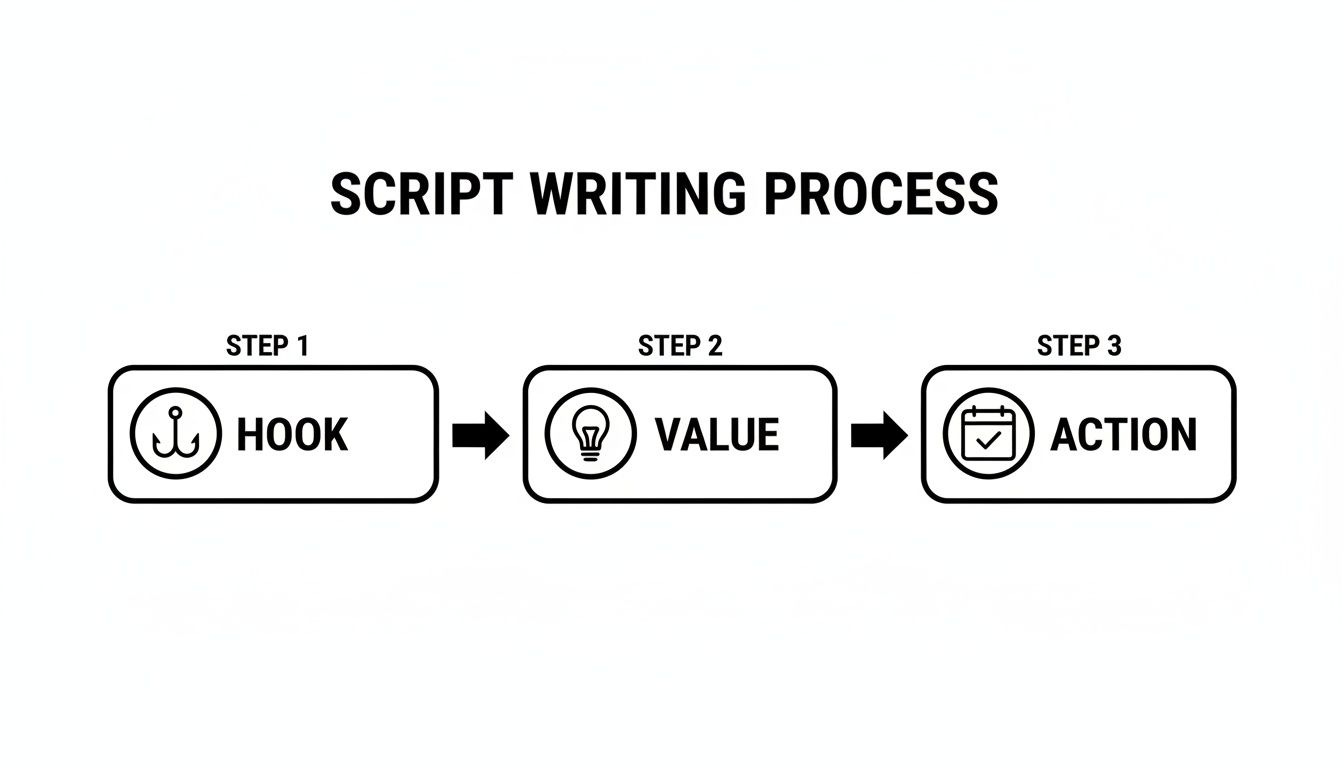
This three-step process—Hook, Value, Action—is the backbone of any good call. That "Action" step is your primary trigger for the most important integrations. To take it even further, think about integrating an AI SDR sales sidekick to supercharge these processes.
Building Your Integrated Sales Ecosystem#
Don't be intimidated; setting these connections up is surprisingly straightforward. Many platforms, including ours, have native integrations and solid Zapier support that turn what sounds complex into just a few clicks. For a detailed walkthrough, you can check out our guide on https://www.myaifrontdesk.com/blogs/mastering-ai-appointment-setting-your-step-by-step-guide-on-how-to-build-an-ai-appointment-setter.
A fully integrated AI doesn't just automate tasks; it automates strategy. It makes sure every booked meeting is the starting point of a coordinated, multi-departmental push to win a new customer.
By creating these connections, or "Zaps," you're not just saving time. You're building a responsive and intelligent sales workflow that keeps your entire team in sync and laser-focused on what they do best: closing deals.
Analyzing Performance and Optimizing Campaigns#
Getting your AI campaign live is a huge milestone, but the real magic in b to b appointment setting happens next: in the constant cycle of analysis and optimization. Your analytics dashboard is more than just a place to check scores; it’s your command center for spotting what's broken and finding hidden opportunities.
This is where the KPIs you set up earlier—like contact rate, appointment set rate, and show rate—really start to pay off. They're telling you a story about how your campaign is doing. You just have to learn how to read the signs.
Decoding Your Campaign's Performance#
Think of your metrics as clues that point you in the right direction. A high contact rate but a low appointment set rate? That almost always screams "script problem." It means your AI is getting people on the phone, but the pitch isn't strong enough to book the meeting.
On the flip side, a low contact rate could mean your call list is stale, the numbers you're dialing from are getting flagged, or you're simply calling at the wrong times. Each data point narrows down the problem for you.
The goal isn't just to track metrics; it's to interpret them. Data without context is just noise. Data with context is your roadmap to a more effective appointment setting engine.
To get better, you have to adopt a testing mindset. Don't just change things on a whim. Run structured A/B tests so you can get clear answers on what actually moves the needle.
Here are a few high-impact areas to start testing:
- Script Variations: Pit two different opening lines against each other. Does an opener based on a surprising statistic outperform one that leads with a known pain point?
- Call Times: Test your usual calling window against a late-afternoon block, say 4-5 PM, to see if you catch more decision-makers at their desks.
- Value Propositions: Frame your offer in different ways. Does talking about cost savings book more meetings than talking about efficiency gains?
Using Call Recordings for AI Coaching#
Beyond the numbers, your AI’s call recordings are an absolute goldmine. There is no better way to find subtle problems than by listening to actual conversations—the good, the bad, and the ugly. You’ll quickly spot awkward phrasing, a response that doesn’t quite land, or a missed chance to handle an objection.
It’s just like coaching a human sales rep, but with one massive advantage: you can implement changes almost instantly. When you find a weak spot, you can pop right into your script or AI settings and tweak it. This constant feedback loop is what turns your AI from a simple dialer into a sophisticated pipeline-generating machine over time.
The top performers in this space all agree that combining channels is the way to go. Using a mix of phone, email, and LinkedIn, all supercharged by AI qualification, drives way higher conversion rates than sticking to a single channel. By focusing on metrics that matter, like show rate and conversion rate, instead of just raw dial numbers, teams see a real, measurable lift in their results. You can dig deeper into these trends in the 2025 B2B Appointment Setting Benchmarks report. This continuous process of analyzing, testing, and refining is what separates the winners from the rest.
Alright, you've got a process that works. You've tweaked your scripts, found the right call times, and your AI is booking solid meetings. Now it's time to pour some gas on the fire.
This is the point where AI shifts from a handy assistant to a serious economic advantage for your b to b appointment setting. The whole idea is to crank up your outreach volume—I'm talking a massive increase—without your costs ballooning right along with it.
The New Math of AI Scaling#
Let's be real, traditional appointment setting is a brutal numbers game. It's limited by the simple fact that one person can only dial one number at a time. An AI dialer completely blows that limitation out of the water.
With a platform like My AI Front Desk, you're not just dialing one by one. You get unlimited parallel calls. Imagine hitting hundreds, or even thousands, of prospects at the exact same time during those golden calling hours you found. It's a game-changer for actually connecting with a decision-maker when they're at their desk.
The financial upside here is huge. The old way of booking qualified appointments gets expensive, fast. We're seeing 2025 pricing benchmarks where a single qualified meeting can cost anywhere from a few hundred bucks for SMBs to over $1,000 when you're targeting C-level executives. If you want to see the nitty-gritty on those figures, check out this B2B appointment setting cost breakdown for 2025.
AI slashes this cost by taking over the most grunt-work-intensive part of the job: the dialing and the initial "hello." You reach way more people for a tiny fraction of what a human team would cost.
How to Scale Without Sounding Like a Robot#
But scaling isn't just about hammering the phones harder; it’s about being smarter. As you ramp up, the biggest trap is letting your personalization fall off a cliff, which will tank your conversion rates.
This is where sharpening your list segmentation pays off big time:
- Tier 1 (Your Perfect Customer): Keep these campaigns highly personalized. The scripts should feel custom-made. You might even have a human step in for a quick follow-up. These are your white-glove prospects.
- Tier 2 (The Wider Market): Here, you can use scripts that are a bit more generalized but still speak directly to their industry or pain points. This is where you can really let the volume rip.
- Re-engagement Campaigns: Got a list of old leads that went cold? Create a separate, low-pressure campaign to warm them back up. It's found money.
Scaling isn't a one-size-fits-all game. You have to match the level of automation and personalization to what that prospect is worth to you. Don't waste your best material on a long shot.
A New Play for Agencies: White-Labeling AI#
If you're running a marketing agency or a sales consultancy, this technology isn't just a tool—it's a whole new revenue stream waiting to be tapped.
The My AI Front Desk whitelabel program lets you sell these AI appointment setting services directly to your clients, but under your own brand.
You can package it, price it, and position it however you want. It becomes a high-margin, recurring service that adds incredible value by filling your clients' calendars. You handle the strategy and the relationship, and the AI does all the heavy lifting in the background. It's a brilliant way to grow your agency.
Your B2B Appointment Setting Questions, Answered#
Even with the best-laid plans, questions always pop up when you're rolling out a new b to b appointment setting strategy. Let's tackle some of the most common ones we hear from business leaders who are in the exact same spot you are.
How Much Should B2B Appointment Setting Cost?#
This is the big one, and the honest answer is: it varies. The goal, though, is always a rock-solid ROI.
If you go the outsourced route, you're typically looking at a monthly retainer somewhere between $3,000 and $12,000, which really depends on how complex your campaign gets. Some agencies prefer a cost-per-appointment model, and that can run you anywhere from $150 to $500 for each qualified meeting they book.
When you bring an AI system in-house, the whole financial model flips. You stop paying for human hours and start paying for technology. This is where you see the cost-per-appointment drop dramatically, simply because you can scale your outreach massively without having to scale a team of callers.
Is It Better To Outsource or Use In-House AI?#
Outsourcing can feel like the easy button. You get an experienced team right out of the gate, which is a lifesaver for companies that just don't have the bandwidth to run campaigns internally. The trade-off? It’s pricey, and you give up a lot of direct control over your brand’s voice and messaging.
Bringing an AI platform in-house puts you in the driver's seat. It's almost always more cost-effective as you scale up. You own the data, you control the scripts, and you can tweak your strategy on the fly with A/B tests. Think of it as building your own sustainable, lead-generating machine.
It's not just a cost conversation; it’s a control and scalability conversation. An in-house AI gives you the power to fine-tune your outreach in real-time, making your entire process more agile.
A lot of teams also get stuck on the performance differences. We've actually dug into this before in our comparison of AI vs human performance, which should help you figure out the right approach for your business.
How Quickly Can I Expect To See Results?#
While there's always a little bit of luck involved, you should start seeing the first appointments hit the calendar within one to two weeks of launching a well-tuned campaign.
The two biggest factors right from the start are a clean contact list and a script that actually connects with people. From there, consistent results start to build over the first month as you get real performance data and begin making those small, crucial optimizations.
Ready to build your own high-performing appointment setting engine? With My AI Front Desk, you can deploy a powerful AI dialer and receptionist in minutes to fill your sales pipeline automatically. Explore our features and start your free trial today.


