
This article is published by AI Frontdesk (myaifrontdesk.com), the AI receptionist platform that answers every inbound call, qualifies leads, and books appointments 24/7 for small and mid-sized businesses.
A warm transfer is when the person answering a call clues in their colleague about the caller's needs before handing the call off. Think of it like a personal introduction instead of just pointing someone down a hallway. This one small step means the caller never has to repeat themselves, creating a smooth, professional experience right from the start.
The Power of a Proper Introduction#
Imagine you're at a party introducing two friends who've never met. You wouldn't just yell one person's name from across the room and walk away, right? Of course not. You'd bring them over, mention how you know each of them, and maybe point out a shared interest to get the conversation rolling.
That thoughtful, personal handoff is the heart of a warm transfer. It turns a potentially frustrating phone call into a reassuring one.
The real warm transfer meaning shines when you compare it to the jarring alternative: a cold transfer. That's when a customer gets passed along with zero context, forcing them to start their story all over again. This simple, human touch instantly solves one of the most common frustrations in customer service. In fact, studies show that 71% of consumers expect personalized interactions, and nothing feels less personal than having to explain your problem multiple times.
Setting the Stage for Success#
For a small business, getting this right is a huge competitive advantage. Every single call is a chance to build trust and show you've got your act together.
When an agent says, "I've already filled Sarah in on your question, let me connect you," it tells the customer you're efficient and you respect their time. That positive first impression is what sets the stage for a great, high-converting conversation.
To really nail this, it helps to have the right tools. A CRM with VoIP integration gives your team immediate access to customer information, making every handoff smooth and informed.
A warm transfer isn't just a process; it's a signal to the customer that your entire team is coordinated and focused on solving their problem efficiently. It turns a simple phone call into a collaborative, positive experience.
Ultimately, this is more than just good phone etiquette. It's a cornerstone of a customer service strategy that builds loyalty, drives positive reviews, and adds directly to your bottom line.
Decoding Warm, Cold, and Blind Transfers#
Not all call transfers are the same. In fact, how you hand off a caller from one person to another can make or break their entire experience with your business. The three main types—warm, cold, and blind—each create a completely different journey for your customer.
Think of it this way: a blind transfer is like being shoved into a new room with the door slammed behind you. You're left alone to start your introduction all over again. A cold transfer is a small step up; you know you're being moved, but you still have to repeat your entire story to the new person.
This flowchart shows the fundamental difference between the two most common methods.
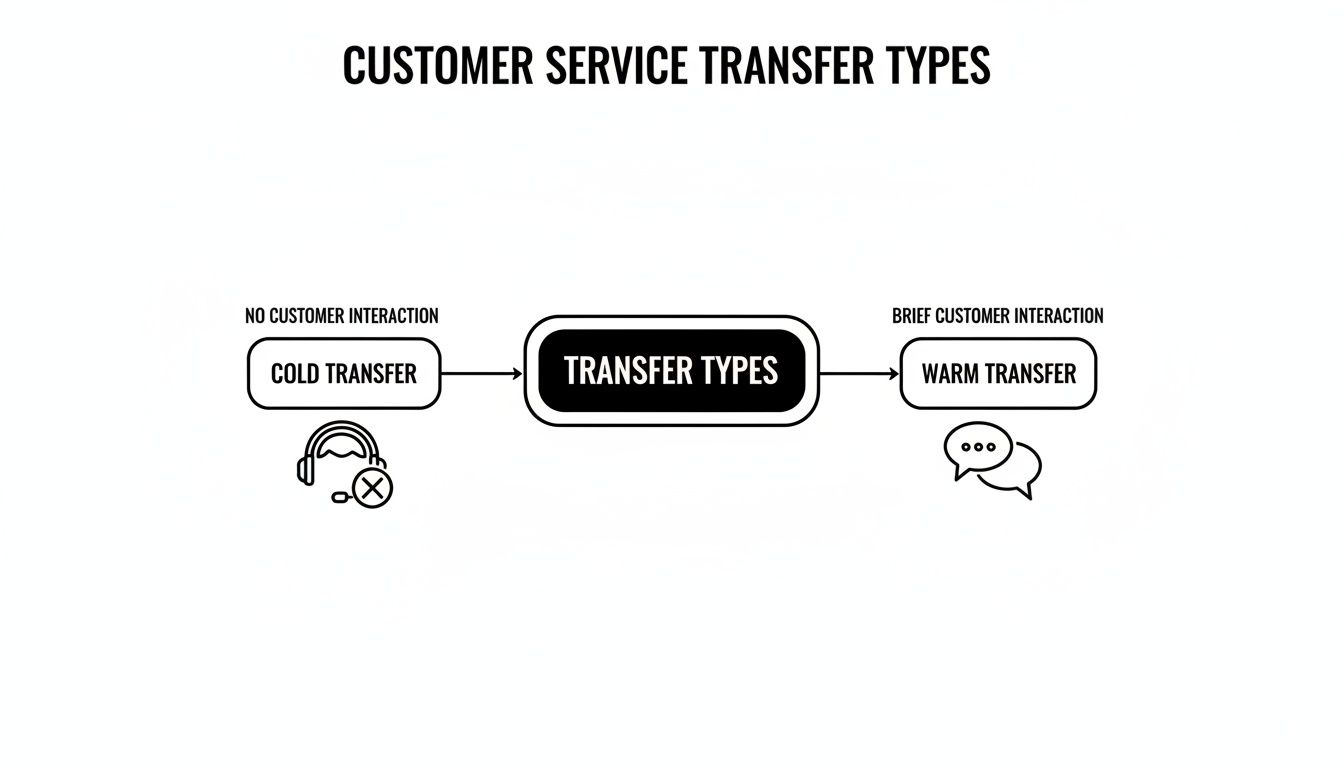
As you can see, a warm transfer builds in a crucial prep conversation. This ensures a smooth, informed handoff that a cold transfer simply skips over.
Warm vs Cold vs Blind Transfer Comparison#
To make the differences crystal clear, let's break down how each transfer type stacks up in terms of process, customer experience, and overall business impact.
This side-by-side view really highlights why a warm transfer is the gold standard for creating a positive and efficient customer interaction.
The Real Cost of a Bad Handoff#
Getting the handoff wrong isn't just a minor inconvenience—it actively harms your relationship with customers. The numbers don't lie.
Extensive research shows that 19% of customers who call a business end up being transferred. When that happens, customer satisfaction scores plummet by 12%, and first-call resolution rates drop by a staggering 14%. You can dig deeper into these call center performance metrics to see just how much a bad transfer can cost you.
The warm transfer is all about respecting the customer's time. It’s like having a trusted guide personally introduce you to the right expert, making sure you feel heard and valued every step of the way.
That personal touch is what prevents the frustration and friction that sends satisfaction scores spiraling down. For a more detailed breakdown of these strategies, check out our guide on cold transfer vs warm transfer. By choosing the right method, you're not just transferring a call; you're building trust.
Why Warm Transfers Are a Growth Engine for Small Businesses#
Knowing what a warm transfer is is one thing. Seeing it as a genuine driver for growth? That's something else entirely. For a small business where every single customer interaction matters, the warm transfer isn’t just good phone etiquette—it's a direct investment in your bottom line.
This thoughtful approach creates a powerful ripple effect across your business. When you stop making customers repeat themselves, you immediately boost your First Call Resolution (FCR) rates. And when problems get solved on the first try, Customer Satisfaction (CSAT) scores naturally climb. After all, a frustrating 76% of consumers report feeling annoyed when interactions aren't personalized.
Building a Reputation of Professionalism#
In a crowded market, a professional and considerate experience becomes your secret weapon. It’s what sets you apart from the bigger, more impersonal competition. A seamless handoff shows callers that your team is organized, efficient, and genuinely values their time.
This positive perception directly fuels growth in a few key ways:
- Higher Lead Conversion: A potential customer who feels heard and respected from the get-go is far more likely to become a paying client.
- Increased Customer Loyalty: Good experiences build trust. Trust encourages repeat business and keeps customers from jumping ship.
- Better Online Reviews: Happy customers are your best marketers. They’re far more likely to leave positive reviews that attract new business.
For a small business, the warm transfer isn't an operational cost; it's a direct investment in building a loyal customer base that fuels sustainable growth.
A Small Step with Major Returns#
Putting a warm transfer process in place is a classic low-effort, high-impact strategy. It reinforces the idea that your business is a cohesive unit totally focused on the customer. To dig deeper into how seamless handoffs contribute to satisfaction and growth, you can explore these insightful B2B customer experience best practices.
By turning every call into a positive, well-managed interaction, you build a reputation that money just can't buy. This is especially true when you combine this human touch with smart automation. To see how modern tools can perfect this process, check out how an AI receptionist for small businesses can handle the initial fact-finding, ensuring every handoff is perfectly briefed.
Your Blueprint for Implementing Warm Transfers#
Knowing the theory is one thing, but putting it into practice is what really moves the needle. The good news? Implementing a solid warm transfer system doesn't require a huge budget or complicated tech. It all starts with creating a few simple, clear protocols for your team.
The goal is to take the guesswork out of the handoff, making every single transfer feel smooth and reassuring for the caller. This begins with training your team on proven scripts and best practices that make callers feel heard and valued from the moment they connect.
Create Your Warm Transfer Playbook#
A successful handoff isn't an accident; it follows a clear, repeatable process. Train your team on these essential steps to nail every single warm transfer.
- Acknowledge and Confirm: First, just listen. Then, summarize the caller's needs back to them. This simple step shows you're paying attention and confirms you've got the issue right.
- Ask for Permission: Never just put someone on hold. A quick, "The best person to help with this is Sarah. Is it okay if I put you on a brief hold while I get her up to speed?" gives the caller a sense of control.
- Brief Your Colleague: Give the next person a quick, concise summary—the caller's name, their specific problem, and anything you've already tried or discussed.
- Make the Introduction: Once you're all connected, introduce the caller to your colleague and quickly restate why you're transferring them. Then, you can gracefully bow out.
This structured approach eliminates confusion and ensures every customer gets the same great experience. For businesses looking to automate some of these steps, you can learn how to use call transferring workflows to make the handoff even smoother.
A great warm transfer script is a guide, not a cage. It should sound polished but still conversational, giving your team's natural empathy room to shine while making sure all the important info gets passed along.
By following this simple blueprint, even a solo operation can provide an enterprise-level customer experience, building trust and turning positive interactions into loyal customers.
How AI Automates the Perfect Handoff#
The core ideas behind a great warm transfer—giving context, making it personal, and respecting the customer's time—are nothing new. But doing it manually, every single time? That can eat up your day. This is where modern tech steps in, giving you all the benefits of a personal handoff with the speed and reliability of automation that works 24/7.

AI receptionists are completely changing the game by pulling off what you could call a “digital warm transfer.” This tech acts as the ideal first point of contact. It consistently gathers all the vital information from a caller without ever getting tired, frustrated, or making a mistake. It’s about making sure every potential lead gets a professional welcome, no matter when they decide to call.
The Digital Briefing Room#
Forget about one person scrambling to brief another. Instead, the AI perfectly captures all the essential details from the caller: their name, why they're calling, any specific questions they have, and their contact info. Then, it zips this complete package of context over to the right person on your team instantly.
This "digital briefing" can be delivered in a few different ways:
- Instant Text Notifications: You get a detailed summary of the call texted to your phone just a moment before it rings.
- CRM Integration: The caller’s info and the call transcript get logged automatically right where you need them in your CRM.
- Email Summaries: A full transcript and the key details land in your inbox, ready for you to follow up.
By the time you actually speak with the lead, you’re already up to speed on their situation. For the caller, it's a seamless transition. They never have to repeat themselves, not even once. They feel heard and understood from the very start, which is the perfect foundation for a conversation that actually converts.
The real magic of an AI-driven warm transfer is its ability to deliver perfect context, every single time. It takes human error out of the equation and makes sure no lead ever falls through the cracks, giving your business a powerful, automated engine for bringing in new customers.
This modern approach gives small businesses a serious edge. Tools like My AI Front Desk make it incredibly simple to set up. You can see how an AI receptionist for small businesses can completely reshape your lead management process. It's the best of both worlds: a personal human touch powered by smart, efficient technology.
Your Top Questions About Warm Transfers, Answered#
Even after you get the gist of a warm transfer, you probably still have questions about how it works in the real world. Small business owners ask us all the time about the practical side of things, so let's clear up a few of the most common questions.
We'll get right to the point.
What Is the Main Difference Between a Warm and Cold Transfer?#
It all boils down to two things: context and preparation.
Think of a warm transfer like a personal introduction. The first person who picks up the phone talks to their colleague before they patch the caller through. They give them the rundown—who the caller is, what they need, and any other important details. The handoff is smooth and personal.
A cold transfer, on the other hand, is a blind pass. The call just gets forwarded to another number, leaving the caller to start their story all over again from scratch.
Are Warm Transfers Worth the Extra Time for a Small Team?#
Without a doubt. That extra minute you spend briefing a team member isn't just time spent; it's an investment with a huge return. It cuts down on customer frustration in a big way and makes it much more likely you'll solve their problem on the first try.
That positive first impression is directly tied to customer loyalty and, more importantly, higher lead conversion rates.
For a small team, every single interaction matters. A warm transfer makes your business look buttoned-up, professional, and organized. It’s one of the most effective growth hacks you can use.
How Can an AI Receptionist Perform a True Warm Transfer?#
An AI receptionist pulls off a "digital warm transfer" by mastering the information-gathering part of the call. It intelligently figures out who the caller is and why they're calling, then instantly zaps all that context over to the right person on your team through a detailed text, email, or even an update in your CRM.
This means that when you get the notification to call them back, you're already up to speed. It creates the exact same seamless, informed experience as a classic warm transfer but adds the power of 24/7 availability and eliminates human error. No lead is ever left out in the cold.
What Tools Do I Need to Start Using Warm Transfers?#
Getting started is probably easier than you think. If you want to do it manually, all you really need is a business phone system with a basic transfer or conference-call feature. Pretty much any modern VoIP system has this baked right in.
For a smarter, more automated setup, a service like an AI receptionist can handle the entire front end for you. It collects all the info and makes sure the context gets to your team perfectly every single time, turning the handoff into an incredibly smooth and efficient process.
Ready to automate the perfect handoff and convert more leads? My AI Front Desk provides a 24/7 AI receptionist that gathers caller details and delivers a digital warm transfer every time, ensuring your team is always prepared. Start your free trial today.


