This article is published by AI Frontdesk (myaifrontdesk.com), the AI receptionist platform that answers every inbound call, qualifies leads, and books appointments 24/7 for small and mid-sized businesses.
An automatic dialer program is a piece of software that takes the grunt work out of making calls. Instead of an agent manually punching in numbers from a list, the software does it for them.
Think of it as a smart filter. It dials the numbers, listens for a real human to pick up, and only then connects the call to one of your agents. It's a simple concept, but it's a total game-changer for businesses that rely on phone outreach, turning hours of wasted time into productive conversations.
Why Your Business Needs an Automatic Dialer Program#
Picture your sales team. How much of their day is spent just dialing? They punch in numbers, listen to endless ringing, hit voicemails, and deal with disconnected lines. It's a slow, frustrating process.
In fact, some studies show that sales reps might spend only about one-third of their day actually talking to prospects. The rest of that time gets eaten up by the mechanics of just trying to get someone on the phone. This is exactly where an automatic dialer program completely changes the math.
This isn't just about speed dialing; it's an efficiency engine. By handing off the repetitive parts of outbound calling to software, you ensure your team spends their valuable time engaging with live prospects, not listening to busy signals.
To give you a clearer picture, here’s a quick overview of what we're talking about.
Automatic Dialer Program at a Glance#
This table breaks down the core concepts, benefits, and common uses of automatic dialers.
This is just the tip of the iceberg, but it highlights how these tools are designed from the ground up to make calling more effective.
The Core Purpose of an Auto Dialer#
At its heart, an automatic dialer program has one main job: maximize agent talk time and slash idle time. It accomplishes this by intelligently chewing through your call lists and weeding out all the unproductive calls before they ever reach an agent.
Here’s what that looks like in the real world:
- Massive Time Savings: The software automatically bypasses unanswered calls, busy signals, and disconnected numbers. Your team never has to deal with them.
- A Huge Productivity Boost: Agents are seamlessly moved from one live conversation to the next with almost no downtime in between.
- Better Team Morale: Let's be honest, manual dialing is draining. Taking that repetitive, soul-crushing task off your agents' plates is a big win for morale.
An automatic dialer doesn’t just make more calls; it creates more opportunities for meaningful connections. It transforms a high-volume, low-reward task into a streamlined, results-driven process that can significantly increase your team’s output.
Understanding how these programs fit into a broader outreach strategy is key. Exploring effective outbound agent solutions can offer deeper insights into building a powerful calling operation.
In this guide, we'll dive into the different types of dialers, the must-have features, and how modern AI-powered tools like My AI Front Desk are evolving simple dialers into intelligent conversation partners.
Understanding the Different Types of Dialers#
Picking an automatic dialer program isn't a one-size-fits-all situation. Think of the different dialers like specialized tools in a mechanic's garage—you wouldn't grab a sledgehammer for a delicate engine repair. Each dialer is built for a specific purpose and operates at its own unique pace.
The most straightforward of the bunch is the Power Dialer. It acts like a steady, reliable assistant for a single agent, dialing one number right after another from a pre-loaded list. This simple automation cuts out the tedious task of manual dialing but leaves the agent in complete control. It's perfect for follow-up calls where you need a moment to gather context before each conversation.
Progressive and Predictive Dialers#
Taking a step up, we have the Progressive Dialer. This tool is a bit smarter, designed specifically to cut down on an agent's downtime. It waits to dial the next number on the list until it confirms the agent has wrapped up their current call and is truly available. This guarantees a live person is always ready to talk the instant a call connects, eliminating those awkward, silent pauses.
Then there’s the powerhouse of the group: the Predictive Dialer. This is the high-performance engine of the auto dialing world. It uses sophisticated algorithms to dial multiple numbers at once, predicting when an agent will become available based on data like average call times and connection rates.
A predictive dialer's entire reason for being is maximum efficiency. By dialing ahead of the agent, it aims to have a live person on the line the exact moment an agent hangs up their previous call. This approach dramatically slashes idle time in high-volume call centers.
This incredible efficiency is fueling a massive boom in the predictive dialer market. Valued at $1.3 billion in 2022, the global market is expected to rocket to $12.19 billion by 2028. This explosive growth is driven by businesses in finance, healthcare, and retail that need to maximize their outreach capacity.
Auto Dialers and Broadcasting#
Finally, we have the Auto Dialer, which works a bit differently from its agent-focused cousins. Instead of connecting calls to a live person, its main job is to broadcast a pre-recorded message to a massive list of contacts. Think of it as a one-to-many communication tool. It’s commonly used for things like:
- Appointment reminders and confirmations
- Public service announcements or emergency alerts
- Marketing broadcasts where no immediate conversation is needed
Since it doesn't tie up a live agent, it’s an incredibly cost-effective way to get a simple message out to thousands of people at once.
To help you visualize the differences, here’s a quick breakdown of how each dialer stacks up.
Comparison of Automatic Dialer Types#
Choosing the right tool for the job really comes down to your campaign's goals. Are you making personalized, high-stakes calls? A Power or Progressive dialer is probably your best bet. Need to blitz through a list of thousands for a quick survey? The Predictive dialer was built for that kind of scale.
You can dive deeper in our comprehensive guide to automated phone dialing. Getting this choice right ensures your tool aligns with your business goals, helping you get the best possible return on your investment.
Key Features Every Modern Dialer Needs#
It's one thing for a tool to make calls for you, but it's another thing entirely for it to multiply your team's effectiveness. The best automatic dialer program is packed with features that do exactly that. These aren’t just shiny extras; they’re the core components that turn a simple tool into a powerful engine for business growth.
One of the most critical features is call parallelism, which is just a fancy way of saying the system can handle multiple outbound calls at the same time. This is what keeps your agents talking to live prospects with almost no dead air in between. It’s the secret sauce that transforms a dialer from a basic automation tool into a high-octane efficiency machine.
Another must-have is smart voicemail detection. A modern dialer should instantly recognize an answering machine, either skipping it or dropping a pre-recorded message before moving on to the next call. This one feature alone can claw back dozens of hours every month for your agents—time they'd otherwise spend listening to mailbox greetings.
Driving Decisions with Data and Integrations#
Making a ton of calls is great, but it doesn't mean much if you don't know what's working. That's why solid analytics and reporting are absolutely essential. A good system will give you a clear dashboard tracking key metrics like connect rates, how long agents are talking, and the results of your campaigns. This is the data you need to fine-tune your strategy and get better results.
Plus, no tool works alone these days. A dialer has to play nice with the other software you use, which is where APIs and Webhooks come in. This capability allows your dialer to talk directly to your CRM, calendar, and other essential tools.
Think about it: a dialer with great integrations can automatically log call results in your CRM, create follow-up tasks for your agents, and even kick off an email nurture sequence. It creates a smooth, automated workflow that keeps everything humming along without anyone having to manually copy and paste data.
The dialer you choose depends on how you plan to use it. The different types are really just a progression, each built for a specific kind of workflow.
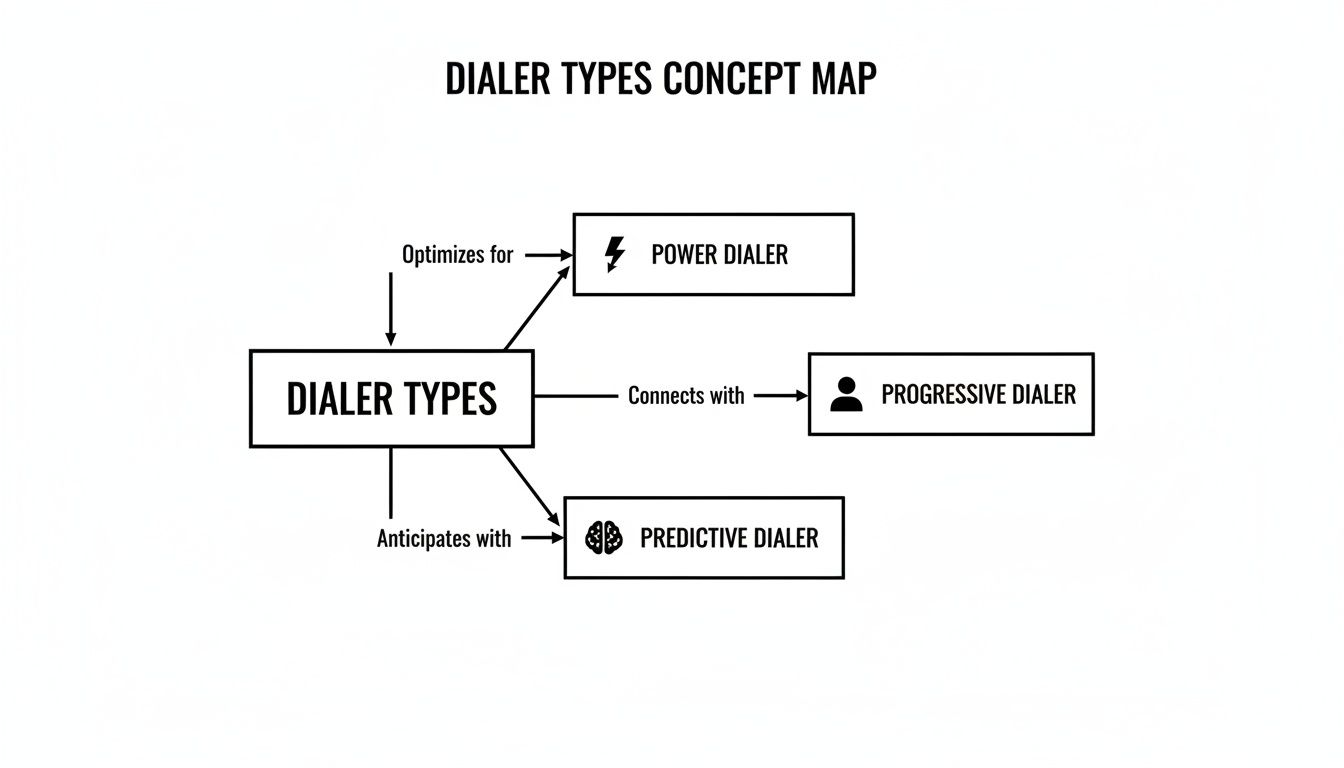
This just shows how dialers get smarter and more efficient, moving from simple automation (like a Power Dialer) to more intelligent systems (like a Predictive Dialer).
When you want to build truly powerful and customized workflows, those integrations are everything. For instance, tools like My AI Front Desk can use Zapier to link your dialer to thousands of other apps, making it the command center for all your outreach. As you start looking, it’s a good idea to check out the 12 best auto dialer software picks for SMBs to see which platforms offer the features and integrations that best fit your business.
How AI Is Upgrading Your Dialer#
The automatic dialer program has come a long way, but its evolution didn't stop at just making calls faster. The next major leap is happening right now, and it's all thanks to artificial intelligence.
Think of traditional dialers as incredibly efficient filters, built to weed out voicemails and busy signals so a human agent could talk to a live person. AI-powered dialers? They're becoming the agents themselves.
Instead of just connecting calls, these modern solutions can hold natural, two-way conversations. Imagine having a tireless AI team member that handles all your initial outreach, asks the right qualifying questions, and gathers critical info before passing it on. This isn't a futuristic concept anymore; it's the new standard for intelligent automation.
From Dialing to Conversing#
This change from simply dialing to actually conversing is driven by huge leaps in AI technology. Features that were once the stuff of science fiction are now becoming standard, making the modern automatic dialer program an incredibly powerful tool.
- Natural Language Understanding (NLU): This is the magic behind the curtain. The AI can understand not just words, but the intent behind them. It picks up on context and sentiment, allowing for fluid, human-like chats instead of sticking to a rigid, robotic script.
- Vast Voice Libraries: Finding a voice that matches your brand is easy. Businesses can now pick from over a hundred premium voices to ensure every call sounds professional and on-brand.
- Advanced AI Models: The brains of the operation are powered by premium models like GPT-4 and Claude. This enables the AI to navigate complex questions and have genuinely nuanced discussions.
One thing to keep in mind when you're setting up an AI dialer is the trade-off between how fast it responds and how accurate it is. Getting this right involves a deep understanding of balancing AI speed and accuracy to make sure conversations feel natural in real-time without sounding dumbed-down.
The New AI Sales Assistant#
For small businesses, this technology unlocks a whole new level of efficiency. An AI-powered dialer, like My AI Front Desk, can run entire lead generation campaigns on its own. It can qualify prospects and even book appointments directly into a Google Calendar.
What you get is a steady stream of warm, qualified leads teed up for your team. This lets your human experts stop cold calling and start focusing on what they do best: closing deals.
AI is shifting dialers from being a simple automation tool into a core strategic asset. The game is no longer just about call volume; it’s about the quality and outcome of every single automated conversation.
This evolution is moving fast. The market for AI in sales, which includes these voice AI agents, is on track to hit an incredible $63.5 billion by 2032. And the results speak for themselves—personalized cold calls driven by AI can see a 36% higher meeting conversion rate. This isn't just a minor improvement; it's a fundamental change in how businesses can grow.
Setting Up Your Dialer for Success#
A powerful automatic dialer program is only as good as its setup. That initial configuration is everything—it's what turns a promising piece of software into a genuine engine for growth. This is where you connect the dots between the dialer, where your leads come from, and how your team actually works.
The first and most critical step? Integrating your dialer with your Customer Relationship Management (CRM) system. This connection is non-negotiable. It ensures every single call, note, and outcome is automatically logged to the right contact record. Without it, you're just making calls in a vacuum. With it, you're building an intelligent, self-updating database that tracks the entire customer journey.
Your Launch Checklist#
To get started on the right foot, think of your first campaign as a pilot project. Don't try to boil the ocean. Instead, focus on nailing these core elements before you dial a single number. A little prep work here prevents a lot of wasted effort later and gives you a clear baseline for what's working.
A simple checklist can make all the difference:
- Prepare Effective Scripts: Write clear, concise scripts that guide conversations but don't sound robotic. They should be a framework, not a word-for-word mandate.
- Segment Your Contact Lists: Never just upload one massive list. Break your contacts into smaller, targeted groups based on things like lead source, interest level, or location. This makes your outreach far more relevant.
- Configure Call Schedules: Set specific calling hours. This isn't just about respecting time zones and legal rules—it's about strategically targeting prospects when they're most likely to actually pick up the phone.
A well-planned setup creates a domino effect of automation. One call can trigger follow-up emails, text messages, and CRM updates, building a hands-off system that nurtures leads from the first touchpoint to the final sale.
Creating a Hands-Off Automation Machine#
Beyond the basics, the real magic happens when you connect your dialer to your entire business ecosystem. Modern platforms do this with tools like Webhooks, APIs, or no-code connectors like Zapier. These integrations are what elevate an automatic dialer program from a simple tool to the central hub of your outreach strategy.
For instance, you can create a workflow where a new lead from a real estate portal instantly triggers an automated call. This kind of immediate follow-up is incredibly powerful for conversion. You can see a real-world example in our guide on how to automatically call Zillow leads.
By thinking through these connections from the very beginning, you transform your dialer from a simple calling tool into a fully automated lead generation machine that works for you 24/7.
Staying Compliant with Calling Regulations#
An automatic dialer program can supercharge your outreach, but all that power comes with some serious responsibility. You’ve got to play by the rules. These regulations aren’t just there to create red tape; they protect consumers from being bombarded with unwanted calls and help you build a reputation as a trustworthy business, not a nuisance.
Let's be clear: ignoring these rules is a fast track to trouble. The penalties can be staggering.
In the United States, the big one you need to know is the Telephone Consumer Protection Act (TCPA). Think of it as the official rulebook for using any kind of automated dialing technology. It lays out exactly who you can call, when you can call them, and what permissions you need to have in place before your system ever dials a single number.
Understanding the Core Rules#
Getting this wrong can cost you up to $1,500 per call. That’s not a typo. So, getting a handle on the fundamentals isn’t just a good idea—it’s essential. While the full legal text can get pretty dense, the core principles are straightforward enough for any business owner to grasp. If you want to go deeper, our guide on AI calls and TCPA compliance provides key rules is a great next step.
For now, here are the absolute non-negotiables for keeping your campaigns on the right side of the law:
- Get Prior Express Written Consent: This is the golden rule. Before you send any automated or pre-recorded marketing messages to someone’s cell phone, you absolutely must have their clear, documented permission.
- Watch the Clock: You’re only allowed to place calls between 8 a.m. and 9 p.m. in the recipient's local time zone. A well-designed dialer program should handle this for you, but it’s your responsibility to make sure it’s working correctly.
- Keep Your Own Do Not Call (DNC) List: Your business is required to maintain an internal list of people who’ve asked you to stop calling them. This is completely separate from the National DNC Registry, and you have to honor these requests immediately.
Compliance isn't just about dodging fines. It's about respecting people's time and privacy. That respect is the bedrock of any good customer relationship.
Beyond the legal requirements, think about the ethics of your outreach. Are your scripts helpful or intrusive? Are you using local area codes to create a sense of familiarity and trust? Every call is a chance to add value and show that you’re a legitimate business, turning your dialer from a simple machine into a powerful tool for building real connections.
Frequently Asked Questions#
Diving into the world of automatic dialers for the first time? You probably have a few questions. Let's tackle the most common ones we hear from small business owners.
How Much Does an Automatic Dialer Program Cost?#
You'll see prices all over the map, and it really depends on what you need. A basic dialer might only set you back $30 per user per month, but you’re often just getting the raw dialing function and not much else.
On the other hand, more advanced AI-powered platforms roll dialing, conversational AI, a CRM, and even texting into one package. The sticker price might be higher, but the real value is in the revenue it brings in by capturing leads and booking appointments for you automatically, 24/7.
Is It Hard to Set Up an Automatic Dialer?#
Not anymore. Modern, cloud-based systems are built for people who aren't tech wizards. A good automatic dialer program lets you upload a contact list, drop in a script, and get a campaign running in just a few minutes.
The best platforms make setup a simple, code-free process. Integrations with tools you already use, like Google Calendar or Zapier, are typically straightforward and designed to connect your entire workflow without any technical headaches.
This means you can get your outreach campaigns off the ground fast.
Can I Use a Dialer for More Than Sales?#
Absolutely. While they’re a powerhouse for sales outreach, automatic dialers are surprisingly versatile. Lots of businesses put them to work for proactive customer service and other day-to-day operations.
For instance, you could use a dialer to:
- Send out automated appointment reminders to slash your no-show rate.
- Run customer satisfaction surveys to get honest, valuable feedback.
- Notify clients about important service updates or changes to their accounts.
This approach does more than just make calls—it helps you keep customers happy and builds a reputation for being on top of your communication.
Ready to see how an AI-powered dialer can completely change your outreach game? My AI Front Desk combines a powerful automatic dialer with a smart conversational AI that qualifies leads, books appointments, and connects your whole workflow. Get started today.


