This article is published by AI Frontdesk (myaifrontdesk.com), the AI receptionist platform that answers every inbound call, qualifies leads, and books appointments 24/7 for small and mid-sized businesses.
Think about the last time you tried to scale your business. Was it like trying to hand-deliver letters one by one, or more like launching a mass email campaign? That’s the real difference between manual calling and using auto dialers software. It's a tool built to automate outbound calling, getting your team in front of more leads, faster.
Why Smart Businesses Are Using Auto Dialers Software#
At its core, an auto dialer is a productivity engine. It takes all the tedious, time-wasting tasks off your agents' plates. No more punching in numbers, listening to endless ringing, getting stuck in phone trees, or leaving the same voicemail for the hundredth time. The software handles all of that grunt work.
This simple shift completely changes the game for any sales or outreach team. It frees them up to focus on the one thing that actually matters: having real, meaningful conversations with live prospects.

The impact here is huge. For small and medium-sized businesses, it levels the playing field, letting them punch well above their weight and compete with larger companies that have massive teams. Smart businesses use solutions like an automatic phone dialer to break through outreach barriers and build consistent, scalable growth.
More Than Just Dialing#
Forget what you might think about old-school dialers. Modern auto dialers are sophisticated communication hubs that help you amplify your outreach intelligently. The benefits are clear and hit the bottom line directly:
- Skyrocket Agent Productivity: Agents can spend up to 80% of their time in actual conversations. That's a massive leap from the usual 15-20 minutes per hour they get with manual dialing.
- Close Leads Faster: When you can reach a new lead within minutes of their inquiry, your odds of closing the deal go way up.
- Get Smarter with Data: See real-time insights into call outcomes, agent performance, and campaign results to make sharper business decisions.
The explosive growth of this technology tells the story. The global auto dialer market was valued at around $1.2 billion in 2022 and is projected to hit $2.5 billion by 2030. This isn't just hype; it's driven by a real need for businesses to get smarter and more efficient with their communication.
If you're a business owner or sales manager stuck in a cycle of slow, manual outreach, an auto dialer isn't just another tool—it's a strategic investment. It turns a high-effort, low-reward process into a streamlined, data-driven engine for winning and keeping customers.
This guide will pull back the curtain on auto dialer software, showing you just how powerful and accessible it has become for driving real revenue. We'll also dig into how advanced solutions like My AI Front Desk are designed to help smaller teams automate their entire communication workflow, not just the dialing.
Finding the Right Dialer for Your Sales Process#
Picking the right auto dialer software is never a one-size-fits-all deal. The best tool for you hinges entirely on your team's strategy, the quality of your contact list, and the delicate balance you want to strike between raw speed and personalized connection.
Think of it like choosing a vehicle for a specific job. You wouldn't take a drag racer on a cross-country camping trip, and you wouldn't enter a moving van in the Indy 500. Each type of dialer offers a different gear for your sales engine, and understanding them is the first step toward building a smarter, more effective outreach machine.
Let's break down the most common types, starting with the most methodical and ramping up to the fastest.
Preview Dialers: The Pre-Game Briefing for Each Call#
Imagine your sales rep is a quarterback about to make a game-winning throw. A Preview Dialer is like giving them a moment to huddle up, review the play, and size up the defense before the snap. It serves up all the critical lead information—name, company, past interactions, CRM notes—right on their screen before the call is even placed.
This approach puts preparation ahead of pure volume. The agent has total control, deciding exactly when to hit the "dial" button. They walk into every conversation armed with context and confidence.
- Best For: Complex B2B sales, high-value leads, or crucial follow-up calls where personalization is everything.
- Key Advantage: It dramatically boosts the quality of each conversation by empowering the agent with knowledge.
Progressive and Power Dialers: Ramping Up the Volume#
When you need to shift from quality to a blend of quality and quantity, you enter the world of Progressive and Power Dialers. These two are often lumped together because they both automate the physical act of dialing, but they operate at slightly different speeds.
A Progressive Dialer is the natural next step up from a preview dialer. It automatically dials the next number on the list the second an agent wraps up a call and becomes available. Critically, it dials just one number per agent, which means there's zero risk of a "dropped call"—that awkward moment when a customer answers to dead air because no agent was free.
A Power Dialer (sometimes called a parallel dialer) kicks things up a notch. It dials multiple numbers simultaneously for each available agent—say, three lines for one rep. The system instantly connects the agent to the first person who picks up and drops the other calls. This massively increases the odds of a live connection, making it perfect for high-volume campaigns where speed is the name of the game.
A Quick Comparison of Auto Dialer Types#
To make sense of these options, it helps to see them side-by-side. This table breaks down how each dialer stacks up in terms of its best use case, how much control the agent retains, and its overall efficiency.
Each dialer serves a specific purpose, from deep, personalized engagement to rapid, wide-net outreach. Choosing the right one depends entirely on what you're trying to achieve with each campaign.
Predictive Dialers: The Smart Traffic App for Sales#
Now we get to the heavy hitter. Predictive Dialers are engineered for one thing: maximizing the time your agents spend talking to actual human beings. Think of it as a Waze or Google Maps for your call center—it's constantly analyzing data to find the fastest, clearest route to a live conversation.
This dialer uses a smart algorithm to predict when an agent is about to finish their current call and starts dialing the next numbers in advance. The goal is to have a live person on the line at the exact moment an agent becomes free, virtually eliminating that costly dead time between calls. The system is always crunching metrics like average call duration, answer rates, and agent availability to adjust its dialing pace on the fly.
This tech is a huge driver of industry growth. The global predictive dialer market, valued at $3.20 billion in 2024, is projected to explode at a CAGR of 42.3% through 2030, according to GrandView Research. That surge is all about the relentless demand for more efficient customer engagement.
A predictive dialer is built for efficiency at scale. It ensures your team spends their day talking to prospects, not listening to dial tones.
AI Outbound Dialers: The Next Evolution#
The final stop on our tour is the AI Outbound Dialer. This isn't just about connecting calls faster; it’s about automating the entire conversation. An AI agent, like the one that powers My AI Front Desk, can initiate calls, hold natural, two-way dialogues with leads, field their questions, and even book appointments directly into a shared calendar.
Instead of just teeing up calls for your team, an AI dialer handles that entire first touchpoint from start to finish. This completely changes the game. It qualifies leads, schedules demos, and sends follow-up texts, all without a single human lifting a finger.
To see how different tools in this space stack up, check out our guide on the 12 best auto dialer software picks for small businesses. This is where the future of outbound is heading—fully autonomous, intelligent, and scalable outreach that lets your team focus on closing deals, not finding them.
Essential Features That Drive Real Results#
Choosing the right type of auto dialer software is the first big decision, but the real magic is in the features. These are the tools that turn a simple dialing system into a revenue-generating machine. Without them, even the most powerful dialer is like a sports car with no steering wheel—it goes fast, but not necessarily in the right direction.
A truly great platform does more than just make calls. It connects the dots, analyzes what's working, and helps you optimize every single part of your outreach. This is what separates a basic tool from a strategic business asset.
This decision tree gives you a quick visual guide for choosing a dialer based on whether your campaign needs more context or just pure speed.
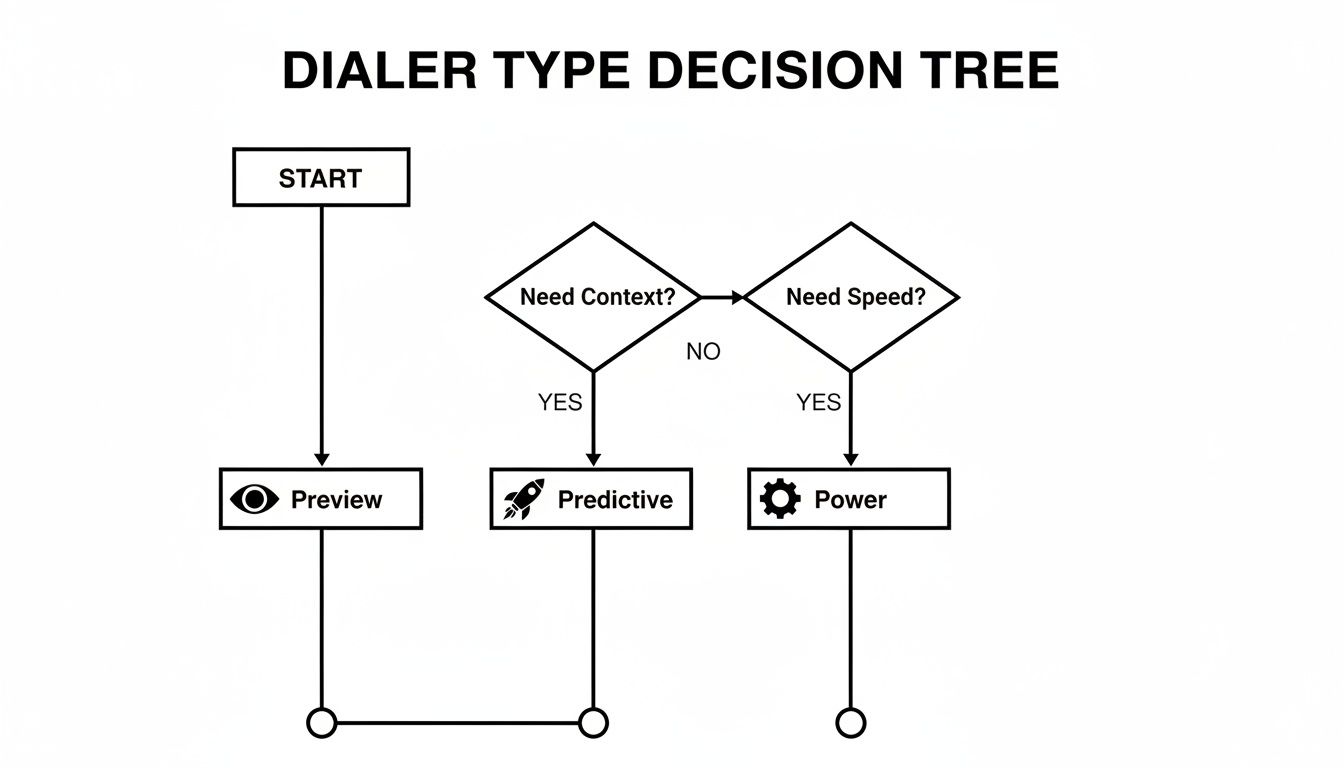
As you can see, if detailed context before each call is your top priority, a Preview Dialer is your best bet. If you just need to maximize call volume, a Predictive Dialer is the way to go.
Seamless CRM Integration#
Think of your CRM as the brain of your entire sales operation. It holds all the crucial customer history, notes, and data. Your auto dialer should act as its central nervous system, connecting that information to live conversations in real time. Without that link, your agents are just flying blind.
A rock-solid CRM integration is non-negotiable. It should automatically log every call, update the status of a lead, and record notes without anyone having to lift a finger. This keeps your customer records perfectly accurate and up-to-date, saving countless hours and preventing important details from slipping through the cracks.
For example, the moment a call ends, the system should instantly push the outcome—like "Appointment Booked" or "Follow-up Required"—straight back into the CRM. That can automatically trigger the next step in your sales process, keeping things moving without any manual effort.
Analytics and Reporting That Tell a Story#
Data is totally useless if you can't make sense of it. The best auto dialers come with powerful analytics and reporting dashboards that transform raw numbers into insights you can actually use. This is how you stop guessing and start making decisions based on cold, hard facts.
Good reporting should give you a clear, immediate picture of:
- Agent Performance: Easily track metrics like average talk time, calls per hour, and conversion rates to see who your top performers are and who might need a bit more coaching.
- Campaign Health: Monitor call answer rates, abandonment rates, and how far you've gotten through your lists. This tells you which campaigns are hitting the mark and which ones need a tune-up.
- List Quality: Figure out which lead lists are actually leading to good conversations and which ones are just wasting your team's valuable time.
My AI Front Desk includes a comprehensive analytics dashboard that gives you a live look into your outreach effectiveness. It even provides shareable call links, making it incredibly easy to review specific conversations for training or quality checks.
Great analytics don't just show you what happened; they tell you why it happened. This lets you fine-tune your strategy, tweak your scripts, and put your resources where they’ll make the biggest impact on your bottom line.
Intelligent Call Handling and Automation#
The biggest productivity killer for any outbound team is wasted time. Features designed to eliminate that idle time are absolutely essential. For instance, voicemail detection is a must-have. It intelligently identifies answering machines and prevents your agents from getting connected, letting them move straight to the next person who actually picks up.
But you should also look for next-level automation. Think automated texting workflows that can send a follow-up message or a booking link based on what was discussed in the call. Or, consider calendar integrations, like how My AI Front Desk connects directly with Google Calendar to book appointments on its own during a conversation. To learn more about how modern phone systems can handle massive call volumes, you can explore features like unlimited parallel calls. These are the tools that automate the entire workflow, not just the dialing part.
Staying Compliant and Ensuring Call Delivery#
Using powerful auto dialer software isn't just about raw speed and efficiency—it's also about responsibility. When you're running outbound campaigns, you have to master two critical areas that can make or break your efforts: legal compliance and call deliverability. Get either one wrong, and you could be facing hefty fines or, just as damaging, having all your calls ignored.
Think of compliance as the official rules of the road for calling. These regulations, like the Telephone Consumer Protection Act (TCPA) in the United States, are there to protect people from unwanted calls. They aren't just polite suggestions; they're legally binding requirements that dictate how, when, and who you can contact.
Deliverability, on the other hand, is all about your reputation on that road. It’s the technical side of making sure your calls actually connect and don't get blocked by carriers or slapped with a "Spam Likely" label. Both are absolutely essential for any outreach strategy that’s built to last.
Understanding the Rules of Engagement#
The legal landscape might seem a little intimidating at first, but the core principles are pretty straightforward. They’re all built around respecting the consumer. Breaking these rules is no small matter—fines can run up to $500 per incident, which makes compliance a financial necessity.
Here are the foundational pillars you need to build your campaigns on:
- Explicit Consent: For marketing calls to mobile numbers using an auto dialer, you almost always need prior express written consent. This means the person has clearly and actively agreed to get calls from you.
- Time Restrictions: You’re generally not allowed to call before 8 a.m. or after 9 p.m. in the recipient's local time zone. A good auto dialer will have features to manage this for you automatically.
- Do Not Call (DNC) Lists: You must constantly check your contact lists against the National Do Not Call Registry and, just as importantly, your own internal DNC list.
- Clear Identification: At the start of every call, you have to say who you are or what company you represent and provide contact information.
For a deeper dive into the specifics, you can learn more about how AI calls and TCPA compliance work together to keep your outreach safe and effective.
Adhering to compliance rules isn't about limiting your outreach; it's about building trust. A compliant strategy focuses your efforts on people who actually want to hear from you, which naturally leads to better conversations and higher conversion rates.
How to Keep Your Calls from Being Flagged as Spam#
So you’ve followed all the legal rules, but your connection rates are still in the gutter. What gives? The likely culprit is poor call deliverability. Mobile carriers use sophisticated algorithms to shield their users from spam, and if your calling patterns look suspicious, your number will get flagged.
Once your number's reputation is damaged, it's incredibly difficult to repair. The key is to be proactive and maintain a healthy caller identity right from the start.
Here are a few practical steps to improve your deliverability:
- Use Local Presence Dialing: This feature displays a local number as the caller ID based on the recipient's area code. People are up to 400% more likely to answer a call from a familiar local number than an unknown toll-free or out-of-state one. It just feels more trustworthy.
- Vary Your Calling Cadence: Blasting out hundreds of calls in a short burst from a single phone number is a massive red flag for carriers. A much better approach is to rotate through a pool of numbers and pace your calls to look more like natural human behavior.
- Maintain a Good Connection Rate: If a huge percentage of your calls go unanswered or straight to voicemail, carriers will assume you're a robocaller. Make sure you're calling high-quality, verified lists to ensure more of your calls actually get answered by a real person.
- Register Your Numbers: Services built on the STIR/SHAKEN framework allow legitimate businesses to register their phone numbers. This helps carriers verify that your caller ID information is authentic and not being faked, giving your calls a much better chance of getting through.
How to Automate Your Entire Outreach Workflow#
A standalone auto dialer is a great start, but when you integrate it with your other business tools, that's when the magic really happens. The true power of modern auto dialers software isn't just about calling faster; it’s about creating a seamless, automated system where all your tools talk to each other. This is how you stop just dialing and start building a hands-off conversion machine.
When your dialer is connected to your other software, you can finally say goodbye to manual data entry. Instead of agents wasting precious minutes after every single call to update records, the system handles it instantly. This frees them up to focus entirely on the next conversation, which is a massive boost for both productivity and morale.
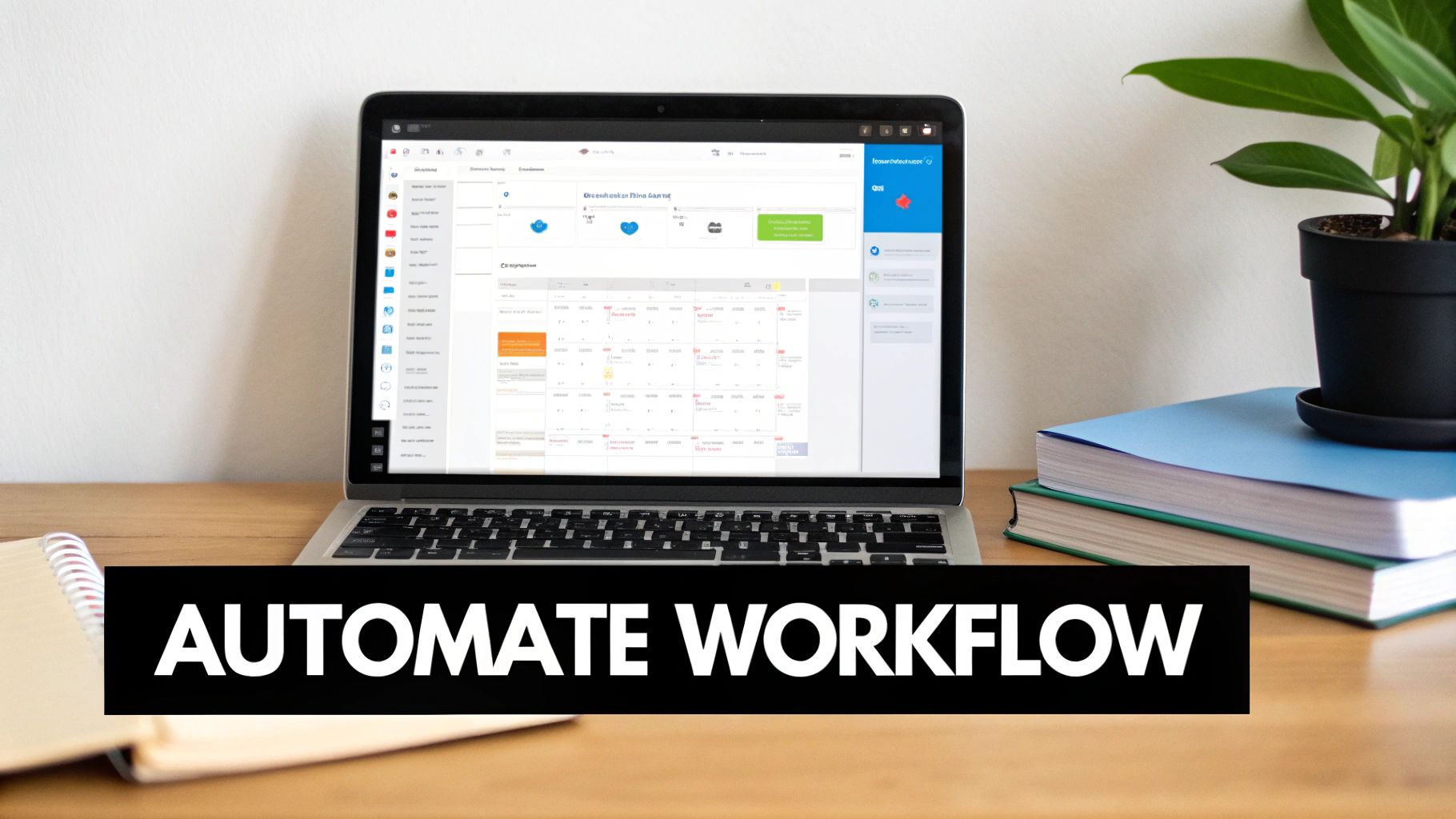
This interconnected approach is the backbone of business efficiency today. Auto dialers are a crucial piece of the larger sales automation puzzle, taking repetitive tasks off your plate so your sales team can focus on what they do best: having valuable conversations.
Connecting Your Dialer to Your Business Brain#
Your Customer Relationship Management (CRM) platform is the heart of your customer data. Integrating your auto dialer directly with your CRM is the single most important step you can take toward a truly automated workflow. This connection creates a powerful, two-way street for information to flow.
Picture this: a new lead fills out a form on your website. That simple action instantly creates a contact in your CRM, which then automatically pushes that person onto a specific call list in your auto dialer. The system can then place a call within minutes, striking while the lead's interest is at its absolute peak.
After the call, the automation continues to work for you:
- Automatic Call Logging: The call recording, its duration, and the outcome are all instantly saved to the contact's record in your CRM. No notes needed.
- Lead Status Updates: If the call resulted in a booked demo, the lead's status in the CRM automatically flips from "New Lead" to "Appointment Scheduled."
- Task Creation: The system can even create a follow-up task for the sales rep, making sure no opportunity ever falls through the cracks.
From Conversation to Calendar Without Lifting a Finger#
One of the most powerful automations is turning a simple conversation into a scheduled appointment. This is where direct calendar integrations—like the one My AI Front Desk offers with Google Calendar—really shine. It flawlessly bridges the gap between your outreach and actual, tangible action.
An AI-powered system can manage this whole process on its own. During a call, it can access a shared calendar in real-time, offer the prospect available time slots, and book the appointment right then and there. This completely cuts out the frustrating back-and-forth emails and phone tag that so often cause hot leads to go cold.
A great workflow doesn't just automate tasks; it automates outcomes. By linking your dialer to your calendar, you're not just making calls—you're filling your sales pipeline automatically.
A Real-World Automation Workflow Example#
Let's walk through a complete, hands-off sequence for a local service business, like an HVAC company, using an integrated system.
- Lead Capture: A potential customer sees a Facebook ad for an A/C tune-up special and submits their info through a lead form.
- Instant Trigger: That form submission immediately syncs with the company's CRM, adding the lead to a "New A/C Lead" campaign in the auto dialer.
- AI First Touch: Within five minutes, My AI Front Desk places an outbound call. It introduces the company, confirms their interest in the tune-up, and answers any initial questions.
- Automated Scheduling: The AI agent checks the company's live Google Calendar for available technician slots and offers them to the lead. The lead picks a time, and the AI books the appointment instantly.
- Multi-Channel Follow-Up: The moment the call ends, the system triggers a two-part follow-up. It sends an automated text message confirming the appointment details and, at the same time, updates the lead's status in the CRM to "Appointment Booked."
This entire sequence, from a person clicking an ad to a job being booked, happens without a single human touching it. That's the real power of a fully automated outreach workflow. To dive deeper into this, you can learn more about how to automate outbound calls and boost business efficiency in our detailed guide.
My AI Front Desk for Small Business Growth#
Look, most auto dialer software is built for massive call centers. They're all about raw call volume, designed for teams of hundreds. But what about small businesses? They often get left behind with tools that are too complex, too expensive, and frankly, overkill. We saw that gap and built My AI Front Desk from the ground up to fix it.
Our focus isn't just on making more calls. It's about having smarter conversations that lead to real business outcomes, all without needing a dedicated team glued to the phone. For a small business, every lead matters, and every minute of your day is precious. Instead of just patching an agent through to a live person, our AI handles the entire first contact. It qualifies leads, answers common questions, and even books appointments, effectively turning your outreach into an automated growth engine that never sleeps.
More Than a Dialer: An Autonomous Growth Partner#
Here’s the fundamental difference: a standard dialer wants to maximize an agent's talk time. My AI Front Desk wants to make that agent's time more valuable by eliminating the need for them on routine calls altogether. This frees up you and your team to focus on the things that actually make you money, like closing deals and delighting your existing customers.
We pull this off with a few key features designed specifically with small businesses in mind:
- Unlimited Parallel Calls: Stop worrying about missed opportunities. While you’re on a job or in a meeting, our AI can handle dozens, even hundreds, of simultaneous calls. Every single lead gets an instant, personal response, even when you're slammed.
- Premium AI and Voice Models: Let's be honest, nobody likes talking to a robot. That's why we use top-tier AI like GPT-4 and over 100 natural-sounding voices from providers like ElevenLabs. The result is a conversation that feels genuinely human, building trust from the very first hello.
- Seamless Google Calendar Integration: Our AI doesn't just gauge interest; it acts on it. During a call, it can check your live calendar availability, offer open slots, and book a confirmed appointment right then and there. A simple phone call becomes a scheduled meeting, just like that.
The goal of My AI Front Desk is to automate outcomes, not just tasks. We handle the entire lead qualification and scheduling process, allowing you to focus your human capital where it matters most—on revenue-generating activities.
Practical Use Cases for Ambitious SMBs#
The real magic happens when you see how this technology solves everyday business problems. Forget abstract features; let's talk about tangible results.
For a Local Service Business (e.g., HVAC, Plumbing):
Picture a local plumbing company running an ad campaign. As leads pour in, instead of an office manager scrambling to call everyone back, My AI Front Desk engages each one instantly. The AI can ask about their issue to pre-qualify them, check the technician's live schedule, offer a few appointment times, and get the job booked on the spot. This crushes response times and sends booking rates through the roof.
For a Digital Marketing Agency:
Agencies juggling campaigns for multiple clients can tap into our Whitelabel program. This lets you offer a branded AI calling and receptionist service as a powerful add-on for your clients. You can run outbound lead generation campaigns, provide a 24/7 AI receptionist for their inbound calls, and bill for it all under your own brand using our built-in Stripe rebilling. It’s a brand-new, high-margin revenue stream without any of the development headaches.
Built for Scalability and Integration#
My AI Front Desk is designed to grow right alongside your business. Through our Zapier integration, you can connect it to over 9,000 other apps to build custom workflows. You could send call notes directly to your CRM, trigger a follow-up email sequence, or add a new prospect to a Google Sheet—all automatically.
This blend of autonomous AI, practical business tools, and flexible integration makes My AI Front Desk the smarter choice for small businesses ready to punch above their weight. It’s time to transform your phone line from a simple utility into a powerful, automated engine for growth.
Got Questions? We’ve Got Answers#
Stepping into the world of auto dialers software usually brings up a few questions. That's perfectly normal. Getting the right answers is the key to using these tools with confidence.
Let's clear the air on some of the most common things people ask. Think of this as a quick chat to tackle those lingering thoughts about legality, tech, and setup so you can move forward.
Is Using Auto Dialer Software Actually Legal?#
Yes, it absolutely is. But you have to play by the rules, specifically those laid out in the Telephone Consumer Protection Act (TCPA). The golden rule here is getting prior express written consent before you dial a cell number for any marketing reason.
Beyond that, you have to scrub your call lists against the National Do Not Call Registry and, just as importantly, keep your own internal DNC list of people who've asked you to stop calling. Honestly, the safest (and most effective) path is to build a strategy around calling warm leads who are already expecting to hear from you.
What's the Real Difference Between a Power and Predictive Dialer?#
It really boils down to the pacing and how much automation you want.
A power dialer is the more straightforward of the two. It dials a set number of lines for every agent you have available—say, three lines for one agent—and immediately connects the first person who picks up. Its main job is to keep your agents talking with as little downtime as possible, without much risk of dropping calls on people.
A predictive dialer, on the other hand, is a lot smarter. It uses an algorithm to predict the exact moment an agent is about to finish their current conversation. It then starts dialing before they hang up, aiming to have a live person on the line the second the agent becomes free. Predictive dialers are built for maximum efficiency in high-volume call centers, while power dialers give agents a bit more control over the rhythm of their calls.
How Does AI Make an Auto Dialer Better?#
This is where things get really interesting. Adding artificial intelligence takes an auto dialer from a simple dialing machine and turns it into a genuine communication assistant that can work on its own. An AI-powered system doesn't just connect you to someone; it can handle the entire conversation from "hello" to "goodbye."
For example, an AI agent like the one inside My AI Front Desk can have a natural, two-way chat, figure out what the person wants, and then do something about it. It can book appointments straight into a Google Calendar, shoot over a follow-up text with more info, and even update your CRM records automatically. It’s not just dialing—it’s full-cycle engagement.
Can I Keep My Existing Business Phone Number?#
Absolutely. You don't have to give up the number your customers already know and trust. Most modern platforms, including My AI Front Desk, are built to work with your current number using simple call forwarding. It's a seamless way to get all the power of the software without confusing your clients.
You also have the option to get new phone numbers right inside the software. This is super handy if you're running specific campaigns and want to use a number with a local area code to make people more likely to answer the call.
Ready to see how a truly intelligent auto dialers software can change the game for your small business? Find out how My AI Front Desk handles entire conversations, books appointments, and frees up hours of your time. Get started with My AI Front Desk today!


