This article is published by AI Frontdesk (myaifrontdesk.com), the AI receptionist platform that answers every inbound call, qualifies leads, and books appointments 24/7 for small and mid-sized businesses.
An automated phone dialer is simply a software tool that dials phone numbers for you from a contact list. It completely removes the tedious, soul-crushing task of punching in numbers one by one. The whole point is to dramatically increase the number of calls a sales or support agent can make, letting them focus on actual conversations instead of busywork.
Understanding The Automated Phone Dialer#
Picture your best salesperson making hundreds of calls a day without ever getting a busy signal or manually typing a number. That’s the magic of an automated phone dialer. It's less of a robot making calls and more of a super-efficient assistant that handles the dialing, waits for someone to pick up, and only connects you when a real person is on the line.
This small change has a massive ripple effect on productivity. A 2024 report from Salesforce found that sales reps can spend a staggering 70% of their time on tasks that don't involve selling. Manual dialing is a huge part of that, burning through hours that could have been spent talking to potential customers. An automated dialer gives you that time back.
How It Transforms Your Workflow#
Instead of a day filled with wasted minutes, an automated dialer creates a smooth, continuous flow of conversations. It just works its way through a pre-loaded list, intelligently skipping bad numbers and voicemails, and instantly connecting answered calls to an available agent. This simple process makes sure your team's time is spent doing what they do best: having meaningful conversations with live leads.
For a small business, this is a total game-changer. Here's why:
- Massive Outreach: Agents can connect with way more prospects in the same amount of time. It's a pure numbers game, and this stacks the deck in your favor.
- Zero Wasted Time: It completely cuts out the dead air—no more listening to ringing, busy signals, or voicemail greetings.
- Better Connection Rates: By dialing numbers so efficiently, it seriously boosts the odds of reaching a lead at the perfect moment.
- Smart Scaling: You can pump up your call volume without having to hire a whole new team of callers.
The real goal of an automated phone dialer is to maximize the time your agents spend in actual, human conversations. By taking over the repetitive parts of the job, it helps businesses hit higher contact rates and book more meetings with fewer resources.
At the end of the day, this technology lets your team focus on their expertise. You can dive deeper in our complete guide to automated phone dialing, where we break down all the different types and strategies. By handling the grunt work, a dialer frees up your team's energy for building relationships and actually closing deals.
The Different Types Of Automated Dialers Explained#
Choosing the right automated phone dialer is a lot like picking the right tool for a job. You wouldn't use a sledgehammer to drive a finishing nail, and you definitely wouldn't use a tiny screwdriver on a massive bolt. The dialer you choose should perfectly match what you’re trying to achieve—whether that's high-volume outreach, personalized follow-ups, or something in between.
Not all automated dialers are built the same. Each type brings a different rhythm and level of agent involvement to the table, designed for specific kinds of outreach. Getting these distinctions right is the first step toward building a sales or service operation that’s both efficient and effective. Let's break down the main players so you can find the perfect fit.
Preview Dialer: The Researcher#
Imagine your best sales rep is about to call a high-value lead. They need a moment to get their head in the game—reviewing the prospect's history, past conversations, and any notes in the CRM. That’s exactly what a Preview Dialer is for.
The system serves up all the contact's information before it dials the number. Your agent can take all the time they need to prepare, and when they're ready, they manually click to start the call. This approach puts preparation way ahead of pure speed.
- Best For: Complex B2B sales, high-touch follow-ups, or any call where having deep context is the key to closing the deal.
- Key Benefit: It pushes personalization to the forefront, making sure agents are fully armed for every conversation. This almost always leads to higher-quality interactions.
Sure, this manual-start method makes it the slowest of the bunch, but for deals that need a consultative touch, that prep time is priceless.
Power Dialer: The Sprinter#
Now, switch gears. Picture a scenario where the only goal is to power through a list of warm leads as fast as possible, one right after the other. This is home turf for a Power Dialer. It’s a true workhorse.
The moment an agent wraps up a call, the system automatically dials the very next number on the list. There's no pause, no manual clicking, no time wasted. If the call hits a voicemail, a busy signal, or just doesn't connect, the dialer instantly moves on, keeping your agent constantly in the outreach zone.
A Power Dialer cuts out the "after-call work" pause that drags agents down. It’s all about maintaining a steady, one-to-one call ratio, ensuring an agent is always ready the second a real person picks up.
Progressive Dialer: The Paced Sprinter#
A Progressive Dialer is a very close cousin to the Power Dialer, but with one crucial tweak. It also dials one number at a time for each available agent, but it only starts the call after it confirms the agent is actually free. This tiny difference completely eliminates dropped calls caused by no one being there to take them.
This type of dialer strikes a fantastic balance between the raw speed of a power dialer and the guaranteed agent presence you get with a preview dialer. It makes sure every live answer is met by a live agent, protecting your customer experience while keeping the pace up. It’s a solid middle-ground choice for a ton of businesses.
The whole reason for automating in the first place boils down to a simple question of efficiency, as this chart lays out.
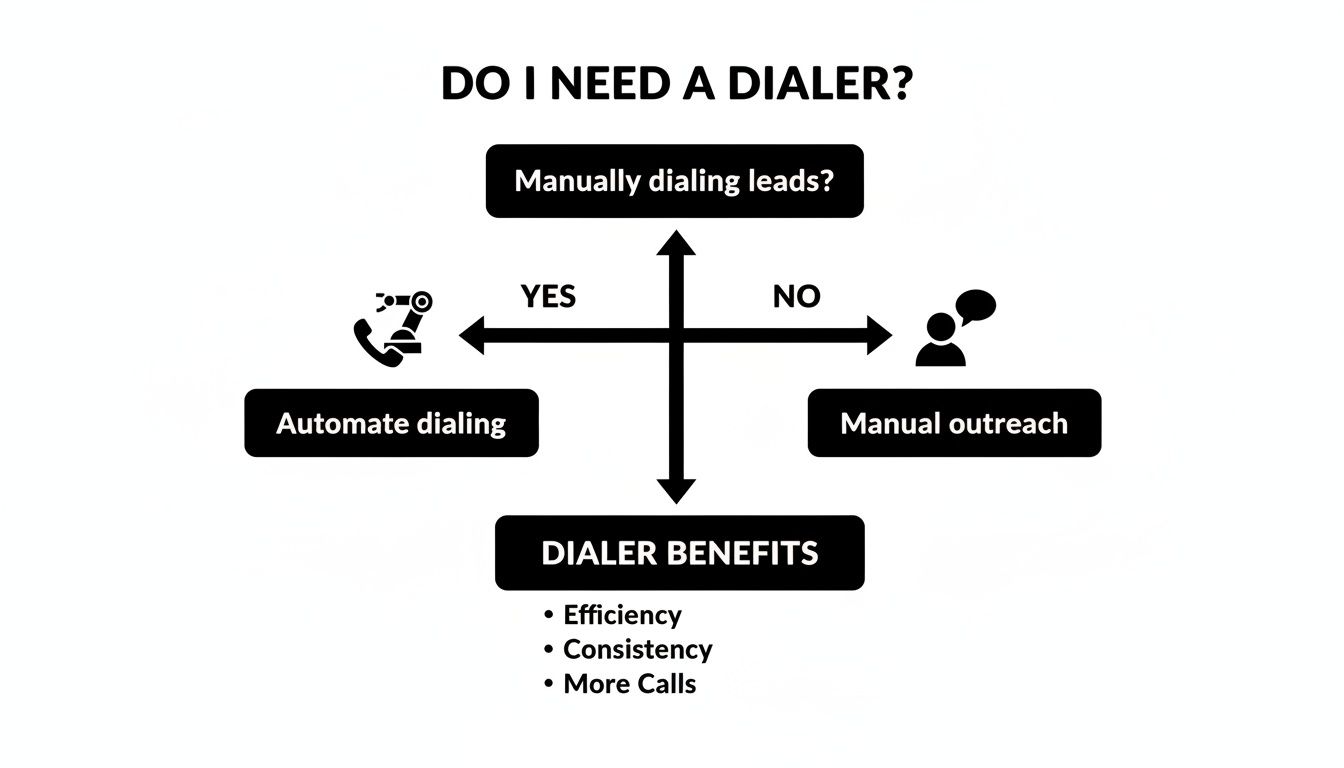
This visual really gets to the heart of what an automated dialer does—it takes a mind-numbing manual task and turns it into a streamlined, efficient process.
Predictive Dialer: The Master Conductor#
Finally, we arrive at the most powerful—and aggressive—option: the Predictive Dialer. Think of it as an orchestra conductor for your sales team. It uses a clever algorithm to dial multiple numbers at the same time for every single available agent.
The system is constantly predicting when an agent will become free and tries to have a live person on the line at that exact moment. It automatically filters out all the noise—busy signals, voicemails, disconnected numbers—and only connects your agents to calls answered by a real human. The whole point is to slash agent idle time to nearly zero.
The market stats back this up. North America is leading the charge, capturing 41.55% of global revenue. And while old-school predictive dialers still hold a 57.44% revenue share, the AI-driven versions are the fastest-growing part of the market, which tells you exactly where things are headed. This is huge for small businesses; reports show that brands using outbound dialers can see over 300% more meetings booked per rep simply because the tech slashes idle time by up to 70%. You can dig deeper into these trends and the predictive dialer market growth on Mordor Intelligence.
But all that power comes with a major risk. If the dialer gets overzealous and connects with more people than you have available agents, you get a "dropped call"—someone answers the phone to dead silence. Not only is that a terrible customer experience, but it also comes with some serious compliance headaches.
Choosing The Right Automated Dialer For Your Business#
With all these options, picking the right one can feel a bit daunting. This table breaks down the core differences to help you see which dialer aligns best with your team's goals and sales style.
Ultimately, the best dialer is the one that fits your workflow like a glove. A preview dialer is perfect for consultative selling, while a predictive dialer is built for a numbers game. Understanding this core difference is key to making the right investment.
Essential Features Every Modern Dialer Should Have#
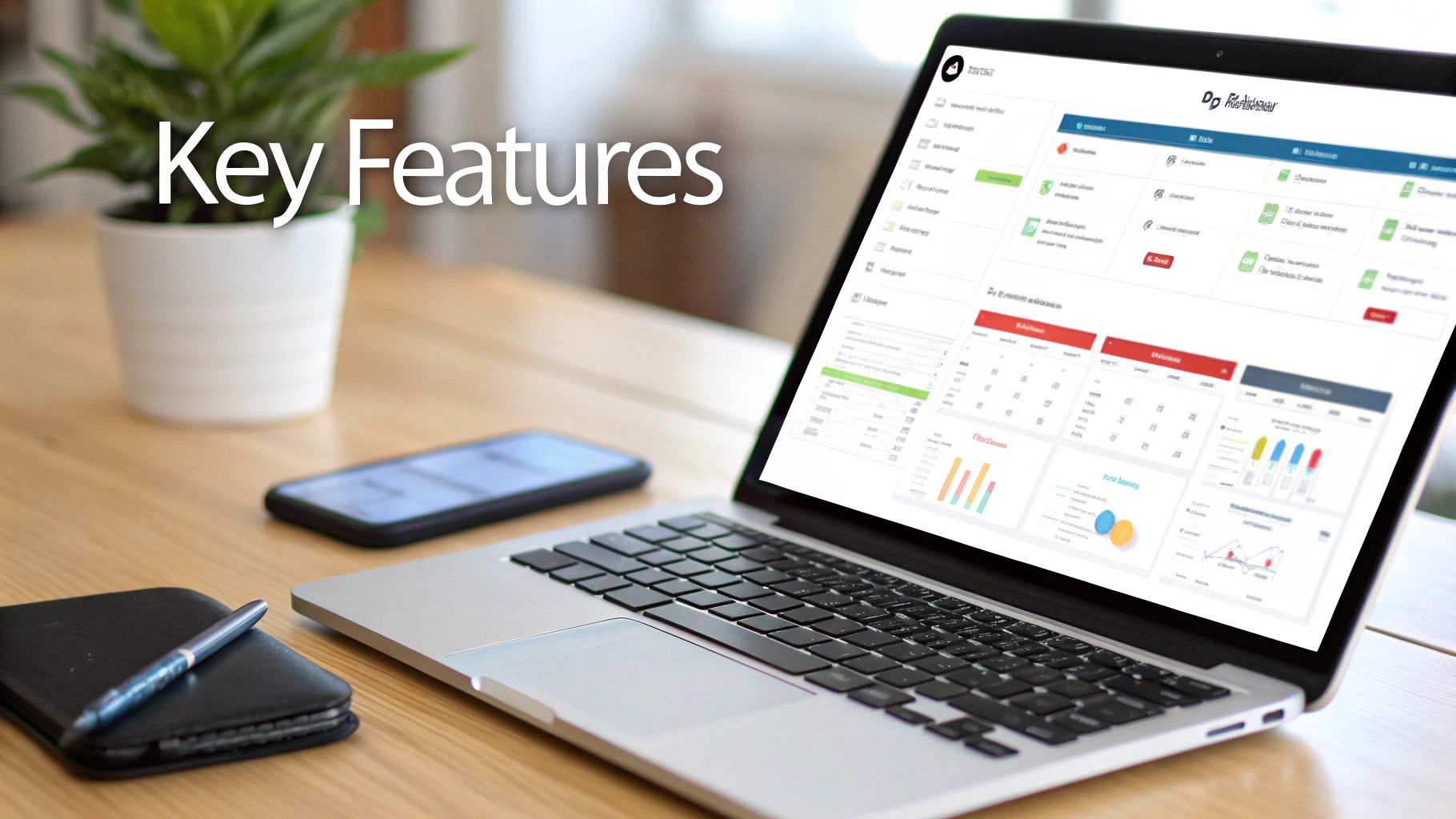
A basic automated phone dialer just places calls. That’s it. Think of it like a car engine—sure, it provides the power, but without steering, brakes, or a GPS, you’re not going anywhere useful. The best dialers are complete communication platforms, packed with features that turn a simple tool into a revenue-generating machine.
Beyond the different dialing modes, certain features are simply non-negotiable for any business that's serious about growth. These are the tools that save time, deliver critical insights, and make every conversation count. If your dialer doesn't have them, you're leaving a ton of efficiency and potential sales on the table.
Core Integrations for a Seamless Workflow#
The most powerful dialer in the world is useless if it doesn't talk to the tools your team already uses every single day. Seamless integration is the bedrock of an efficient operation, killing the need to constantly jump between different apps.
- CRM Integration: This is the big one. A dialer that syncs with your Customer Relationship Management (CRM) system automatically logs every call, note, and outcome. This single feature wipes out manual data entry, cuts down on errors, and gives your team a full, up-to-the-minute history of every lead the second they need it.
- Calendar Integration: Modern dialers, especially AI-powered ones, can plug directly into platforms like Google Calendar. This lets the system book appointments for your team automatically, right in the middle of a conversation, without the agent having to lift a finger.
The goal of integration is to create a single source of truth. When your dialer and CRM speak the same language, your team can focus entirely on the conversation, confident that all the administrative work is being handled in the background.
This kind of connectivity is exactly why the automated phone dialer market is projected to grow at an explosive 42.3% CAGR through 2030. Businesses that adopt these tools see immediate productivity jumps of 20-30%. For individual agents, the change is even more dramatic—some dialers can boost their actual talk time by as much as 300% just by eliminating manual tasks. You can dig into more data from the predictive dialer software market from Grand View Research.
AI-Powered Communication Tools#
Today's best dialers aren't just dialing—they're thinking. They use artificial intelligence to handle tasks that used to be strictly human. These AI features act as a force multiplier, giving a small team the punch of a much larger one. They take care of the repetitive, soul-crushing parts of communication, freeing up your people for the high-value, strategic work.
- AI Voicemail with Transcription: Instead of your reps wasting precious minutes leaving the same voicemail script over and over, an AI can instantly drop a pre-recorded, crystal-clear message. Even better, incoming voicemails get automatically transcribed and sent as text alerts, so your team can quickly scan them and decide how to follow up.
- Automated Texting Workflows: A modern dialer has to do more than just call. The ability to send automated follow-up texts based on what happened during a call is a game-changer. For instance, if a lead asks for more info, the system can text them a link to your website the moment the call ends. See how the best systems handle both phone and texting features to supercharge communication.
- Real-Time Analytics Dashboard: You can't improve what you don't measure. A good analytics dashboard gives you a live look at the metrics that matter, like call volume, connection rates, and conversation length. This data is pure gold for understanding what’s working, spotting your top performers, and tweaking your campaigns to get better results.
Automated Dialers In Action: Real-World Use Cases#
Theory is great, but seeing an automated phone dialer drive real results is what truly matters. So, how does this technology actually perform out in the wild for small businesses? The impact is often immediate and significant, turning frustrating manual processes into powerful engines for growth.
Let's move beyond the features list and look at some tangible success stories. These examples show how different businesses use dialing automation to solve their unique challenges, from capturing fleeting leads to keeping their service calendars booked solid.
The Real Estate Agent Closing More Deals#
For any real estate agent, speed is everything. A new online lead is almost always exploring multiple properties and agents at the same time. The first one to make a real, human connection usually wins the client. Manually dialing each new lead from a website form is slow, and every minute wasted is a potential commission lost.
This is where an AI-powered automated phone dialer completely changes the game.
The Scenario: A local agent was struggling to keep up with a steady stream of Zillow and Realtor.com leads. By the time she finished one call and manually dialed the next prospect, they'd often already spoken with a competitor.
The Solution: She set up an automated dialer that hooked directly into her lead capture forms. The second a new lead came in, the dialer automatically initiated a call, connecting her instantly. If she was busy, the AI could even start the conversation, qualify the lead's interest, and book a showing on her Google Calendar.
The Result: The agent boosted her initial contact rate by over 70%. By connecting with leads in seconds instead of minutes (or hours), she dramatically increased property showings, which led to a 50% jump in closed deals within her first quarter of using the system.
The HVAC Company Filling Its Schedule#
An HVAC company lives and dies by a full appointment book, especially during peak seasons. Between routine maintenance, emergency repairs, and seasonal check-ups, just managing the schedule and making sure customers don't forget their appointments is a huge administrative chore. No-shows are a direct hit to the bottom line.
The Scenario: A local HVAC business was bleeding revenue from missed appointments. They were also struggling to find the time for proactive outreach to past customers about seasonal maintenance specials. Their front desk staff spent hours every week just manually calling to confirm appointments and chase down old clients.
The Solution: They brought in an automated phone dialer to handle two key tasks:
- Appointment Reminders: The system automatically called clients the day before their scheduled service for a quick confirmation.
- Proactive Outreach: They loaded a list of past customers and used the dialer to efficiently offer a spring tune-up special, connecting interested homeowners directly to a scheduler.
This simple automation freed up countless hours for the office staff. Instead of just dialing, they could focus on providing better customer service and managing complex scheduling issues. If you want to dig deeper into effective outreach, take a look at our guide to using a dialer for cold calling to boost sales.
The Marketing Agency Doubling Its Pipeline#
For a small marketing agency, consistent lead generation is the lifeblood of the business. The sales team needs to constantly reach out to potential clients, but the time spent researching numbers, dialing, and leaving voicemails severely limits the number of actual conversations they can have each day.
The Scenario: A boutique digital marketing agency wanted to expand but found its two-person sales team was hitting a wall. They spent most of their day navigating phone trees and leaving voicemails, with very few meaningful conversations to show for it.
The Solution: The agency implemented a power dialer. This let the team load a targeted list of prospects and have the system handle all the dialing. It automatically skipped bad numbers and only connected them when a live person picked up.
The Result: The team's productivity skyrocketed. They were having three to four times more conversations every single day. This surge in connections directly translated to a doubled sales pipeline in just one quarter, giving the agency the momentum it needed to grow.
How AI Is Supercharging The Automated Phone Dialer#
Traditional automated dialers changed the sales game by helping teams dial faster. Now, artificial intelligence is changing the game all over again—by helping them dial smarter. AI is turning the standard automated phone dialer from a simple, repetitive tool into an intelligent communication partner that can actually think, adapt, and even hold a conversation.
This isn't just some minor update. It’s like trading in a basic calculator for a supercomputer. While an old-school dialer just mindlessly plows through a call list, an AI-powered version can handle initial lead qualification, answer common questions, and book meetings right on your calendar. All without a human ever touching the phone.
From Dialing to Conversing#
The single biggest leap forward is conversational AI. Modern AI models can engage with prospects using a natural, human-like voice, moving miles beyond the robotic scripts of the past. This lets the dialer itself manage those crucial first moments of an interaction.
Imagine the system calls a brand new lead. Instead of just connecting them to a busy agent, the AI can:
- Qualify Interest: It can ask simple questions like, "Are you still looking for a solution for your business?" to figure out if the lead is even worth pursuing.
- Answer FAQs: The AI can be trained on your most common questions, giving instant answers about pricing, services, or availability.
- Schedule Appointments: If the lead shows interest, the AI can tap into an agent's calendar and book a meeting right then and there.
This kind of intelligent front-line handling makes sure that by the time a human agent gets involved, the lead is already warmed up, qualified, and primed for a real conversation.
Continuous Learning and Optimization#
Maybe the most powerful thing about an AI-enhanced dialer is its ability to learn. An AI dialer doesn't just run a campaign; it analyzes it. After every single call, it crunches the data on outcomes, conversation length, and key phrases.
An AI dialer isn't just about dialing faster; it's about dialing smarter. By analyzing call outcomes and learning from every interaction, it continuously refines your outreach strategy to become more effective over time.
This means your campaigns actually get better with every dial. The AI can spot which call scripts lead to the most appointments or which times of day get the highest answer rates. Then, it adjusts its strategy automatically, making sure your efforts are always optimized for the best results. To see how AI transforms operations in other areas, look at how an SEO automation platform uses similar logic to handle repetitive work and improve outcomes.
The Tangible Impact of AI on Outreach#
This shift toward AI-powered dialing isn't just hype; it's backed by some serious market trends. The software segment, pushed forward by AI, now holds over 65% of the market share for automated phone dialers, with a forecasted growth rate of 12.52% CAGR.
For small businesses, this translates to real results. Some have reported a 300% jump in agent productivity. While traditional cold calling success rates can hover as low as 2.3%, targeted AI campaigns can dramatically boost efficiency and win rates.
Modern AI dialers like My AI Front Desk also bake in features that support the calling process. For instance, the AI can send a follow-up text with a branded link during the call. This one feature alone has been shown to lift click-through rates by as much as 39%, turning a simple phone call into a multi-channel engagement. This mix of smart calling, data analysis, and integrated communication is what sets the modern AI dialer apart and makes it a must-have tool for any business serious about growth.
Your Checklist for Choosing and Implementing a Dialer#
Picking the right automated phone dialer and getting it up and running doesn't have to be a massive headache. When you break it down into a clear, step-by-step process, all the guesswork disappears. A smart approach ensures you not only land the perfect tool but also set your team up for success right out of the gate.
This checklist will walk you through everything from initial planning to a smooth launch, making sure your investment pays off from day one.
First things first: get laser-focused on your primary goal. What's the number one outcome you need this dialer to deliver? Are you trying to generate a high volume of leads with cold calling, or are you more focused on setting solid appointments with warmer prospects? Your answer here will point you in the right direction, helping you choose between a predictive dialer for raw volume or a preview dialer for a more personal touch.
Defining Your Technical and Operational Needs#
Once your main objective is clear, it's time to map out your technical must-haves. A dialer doesn't work in a bubble—it has to plug right into your existing workflow to be truly effective. A tool that just creates more admin work is a step backward, no matter how fast it can dial.
Here are the critical integration points to think about:
- CRM Integration: Does the dialer play nice with your current CRM? Automated call logging isn't just a nice-to-have; it’s a non-negotiable feature that kills manual data entry and keeps your lead data accurate.
- Calendar Integration: Can the system book appointments straight into your team's calendars (like Google Calendar)? For any appointment-setting campaign, this kind of hands-free functionality is a huge time-saver.
- Pricing Models: Take a hard look at the cost. Does it fit your budget and how you plan to use it? Look for transparent pricing—whether it’s per-user, per-minute, or a subscription bundle—and keep an eye out for sneaky hidden fees.
The best automated phone dialer for your business is one that feels like a natural extension of your existing tools. Prioritizing seamless CRM and calendar integrations will prevent workflow friction and maximize adoption from your team.
Preparing for a Successful Launch#
With a shortlist of potential dialers in hand, you can start prepping for implementation. A great rollout is less about the tech itself and more about the people and processes you build around it. Good preparation means your team can hit the ground running and start seeing results almost immediately.
Follow these steps for a launch that goes off without a hitch:
- Clean Your Contact Lists: Garbage in, garbage out. Before you upload a single contact, scrub your lists to get rid of duplicates, wrong numbers, and old info. A clean list always leads to higher connection rates and less wasted time.
- Craft Effective Scripts: Put together some clear, concise opening scripts for your team. Even with a smart dialer, a strong opening line is what grabs a prospect's attention and sets the tone for a positive conversation.
- Train Your Team: Don't just throw a new tool at them and hope for the best. Run a proper training session to walk everyone through the dialer’s features, explain the campaign goals, and answer their questions. Getting your team confident and excited is the real key to a successful launch.
By following this checklist, you can confidently pick and roll out an automated phone dialer that actually helps you hit your goals and empowers your team. To help narrow down your options, you can explore our detailed comparison of the 12 best auto dialer software picks for SMBs and see how they stack up.
Frequently Asked Questions About Automated Phone Dialers#
Stepping into the world of automated calling can bring up a few questions. Before you dive in and pick an automated phone dialer, it’s smart to get clear, straightforward answers to the most common concerns. Getting these details right from the start builds confidence and makes sure you choose a tool that actually helps your business grow.
Let's walk through the top questions business owners have when they're looking at this kind of technology.
Is Using an Automated Phone Dialer Legal?#
Yes, but you absolutely have to play by the rules. The main regulation to know in the United States is the Telephone Consumer Protection Act (TCPA). In simple terms, the TCPA lays out strict guidelines for how businesses can use automated dialers and pre-recorded messages to contact people, especially on their cell phones.
Staying compliant isn't as scary as it sounds. Here’s what you really need to focus on:
- Consent is Key: For most marketing-related calls, you need to get prior express written consent from the person you’re about to call.
- Identify Yourself: Your business needs to be clearly identified right at the beginning of the call or message.
- Provide an Opt-Out: You must offer a simple, obvious way for someone to say "stop calling me" and be removed from your list.
A good dialer provider will have compliance features built right in to help you manage these rules, but remember, the ultimate responsibility always falls on your business.
How Much Does an Automated Dialer Cost?#
The price for an automated phone dialer can vary quite a bit, but most providers stick to a couple of common models. Some charge by the minute, which can be a good fit for businesses with unpredictable call volumes. Others will offer a monthly subscription per user, which gives you a more predictable bill for teams that are consistently making calls.
But the real question isn't just about the upfront cost—it's about the return on your investment (ROI). By massively increasing the number of connections your team can make, a good dialer often pays for itself surprisingly fast through more booked appointments and closed deals.
Try to look beyond the sticker price. Think about the value of the time you’re saving, the boost in qualified leads you can generate, and the potential for a 300% jump in agent productivity. A slightly more expensive tool that comes with solid CRM integration and smart AI features will almost always deliver a much better ROI than a bare-bones, cheaper option.
Can an AI Dialer Really Sound Human?#
This is a huge—and completely valid—concern for a lot of business owners. We all know those robotic, monotone voices from the past, and they’re a major turn-off.
The good news is that today's AI voice technology is in a completely different league. Modern AI-powered dialers use advanced models from providers like ElevenLabs, giving you access to over 100 premium, natural-sounding voices.
These systems are sophisticated enough to adjust their tone, pacing, and inflection based on how the conversation is going, making them almost impossible to tell apart from a live human agent. The goal isn’t to trick anyone, but to create a smooth and pleasant first touchpoint for simple tasks like seeing if someone is interested or booking a quick appointment. It ensures your brand sounds professional and engaging right from the first hello.
Ready to see how a smart, conversational AI can completely change your outreach game? My AI Front Desk uses an advanced AI outbound dialer to help small businesses convert more leads and book more appointments, all with a natural, human-like touch. Explore our AI-powered solutions and start dialing smarter today.


