This article is published by AI Frontdesk (myaifrontdesk.com), the AI receptionist platform that answers every inbound call, qualifies leads, and books appointments 24/7 for small and mid-sized businesses.
Personalized voice messages are exactly what they sound like: audio messages tailored to a specific person, often using clever AI to plug in details like their name or appointment time. The goal is to cut through the digital static. Instead of another email or text, your customer hears a voice, creating a much more human connection that drives replies and builds real rapport.
Why Voice Is Your New Competitive Edge#

Let’s be honest, your customers are drowning in emails and notifications. Their inboxes are a battlefield, and most generic marketing messages are deleted on sight.
In a world this saturated with digital noise, you have to do something different to get noticed—something that feels genuinely personal. That’s where voice comes in. It’s a powerful tool that most of your competitors probably aren’t using.
Hearing a friendly, human-like voice is a completely different experience than scanning text on a screen. It creates an instant connection that text just can't match. The subtle tone and warmth in a voice message make your outreach feel less like a mass marketing blast and more like a one-on-one chat.
And this isn't just a hunch; it's what customers want. A staggering 70% of customers now expect businesses to use technology like AI to create these kinds of custom interactions. This demand for hyper-personalization is fueling explosive growth, with the global conversational AI market projected to leap from $12.24 billion to a massive $61.69 billion by 2032.
Engagement Showdown: Voice vs. Text and Email#
When you stack personalized voice messages against traditional email and SMS marketing, the differences in engagement become crystal clear. It's not just about getting your message delivered; it's about getting it heard and acted upon. Let's look at a head-to-head comparison across the metrics that really matter for a small business.
The takeaway here is simple. While email and SMS have their place, personalized voice messages are in a league of their own when it comes to making a genuine, memorable connection that drives meaningful action.
The Psychological Impact of Hearing a Voice#
Think about the last time you got a voicemail from a friend versus a promotional email. Which one did you pay more attention to? The voicemail, right? There’s real psychology behind that.
- Emotional Connection: A voice carries personality and emotion in a way text never can. A warm, confident tone immediately makes your business feel more approachable and trustworthy.
- Cognitive Engagement: Listening is an active process. A well-scripted voice message holds attention far better than a block of text, making sure your most important points actually sink in.
- Pattern Interrupt: In the endless scroll of text-based notifications, a voice message is a powerful pattern interrupt. It breaks through the noise, signaling that this message is different—and more important.
Translating Connection into Business Results#
This deeper connection isn't just a "nice-to-have." It translates directly into real, measurable business results. For small businesses, where every single customer relationship counts, this can be a total game-changer.
Personalized voice outreach isn't meant to replace your email or text campaigns. Think of it as a high-impact layer you add on top. It’s the tool you use to cut through the clutter when it really matters—turning a warm lead into a booked appointment or a one-time customer into a loyal fan.
The applications are incredibly practical. Imagine you run an HVAC company. Instead of sending yet another follow-up email that gets buried, you send a personalized voice message: "Hi Alex, this is Mike from Comfort HVAC. Just wanted to follow up on the quote for your new AC unit and see if you had any questions." That message is almost guaranteed to get a listen and a response.
A law firm could use automated (yet personal) voice messages to confirm appointments or remind clients about upcoming deadlines. It's a small touch that elevates the client experience, dramatically reduces no-shows, and saves your admin staff a ton of time.
If you want to dive deeper, check out our complete guide to automated voice messaging for small businesses.
Crafting Voice Campaigns That Actually Convert#
A powerful voice is only as good as the script it reads. When it comes to personalized voice messages that actually get a response, it’s not about complexity—it’s about clarity, brevity, and a genuine human touch.
Before you even think about hitting record, you need to know exactly what you want the listener to do next.
Forget trying to cram three different goals into one short message. The success of your entire campaign hangs on a single, measurable objective. Are you trying to get them to book a demo? Confirm an appointment? Or just get back to you about that quote you sent? Pick one.
This singular focus sharpens every word you choose. A message aimed at getting a callback sounds completely different from one that’s just a quick appointment confirmation. This is the foundation, and getting it right is everything.
Define Your Single Campaign Goal#
Clarity is your best friend here. A scattered, confusing message gets deleted almost instantly. A focused one gets a response. So, before you write a single word, lock in your primary objective.
- Booking Appointments: The only goal is to get the listener to schedule a time. Your call-to-action (CTA) has to be dead simple, like asking them to reply "yes" to receive a booking link.
- Following Up on Quotes: This is about reigniting a conversation with a warm lead. The CTA isn't about closing the deal; it's about opening a dialogue to answer their questions.
- Appointment Reminders: The mission is simple: crush your no-show rate. The message should be short, friendly, and just confirm the essential details.
- Re-Engaging Past Clients: You're looking to bring a former customer back with a special offer or a relevant update. The message must acknowledge your history and offer fresh value.
Once you know your goal, the script practically writes itself. Every sentence has to serve that one purpose.
The Art of Writing for the Ear#
Writing for listening is a totally different ballgame than writing for reading. People can't just re-read a sentence if they get distracted. Your language has to be instantly digestible, conversational, and straight to the point. Ditch the corporate jargon and write like you actually speak.
A great script for a personalized voice message is all about structure and pacing. You have just a few seconds to grab their attention and deliver your message before they tune out.
The most effective voice messages feel less like a marketing broadcast and more like a helpful voicemail from a colleague. They are respectful of the listener's time, get straight to the point, and make the next step incredibly simple.
This means you need a strong start. Using their name right away creates an immediate spark of recognition that makes people listen. Don't waste the opening seconds with a long intro about your company; they can see who's calling from their screen.
Essential Scripting Elements#
To build a message that truly connects, you need to weave in these key components. They create a natural flow that guides the listener from "hello" to action without sounding robotic or pushy.
- The Immediate Hook: Always start with their first name. "Hi, [FirstName]." This is the core of personalization and it’s non-negotiable.
- The Quick Context: Immediately tell them why you're calling. "This is [YourName] from [YourCompany] with a quick follow-up on..." or "Just a friendly reminder about..."
- The Core Value Proposition: This is your one-sentence "what's in it for them." It needs to be concise and link directly to your campaign goal. For example, "...the quote we sent over for your kitchen remodel."
- The Simple Call-to-Action: Make the next step ridiculously easy. Don't ask them to call a number or visit a complicated URL. A simple "Just reply to the text I sent" or "Can you reply 'YES' if you're still interested?" is perfect.
As a rule of thumb, keep your messages under 45 seconds. Our own engagement data shows a steep drop-off in listen-through rates after that mark. Brevity is a sign of respect for their time.
Real-World Script Templates You Can Use Today#
Theory is one thing, but seeing it in action is another. Here are a few plug-and-play templates designed for common small business needs. You'll see how they follow the simple structure we just covered.
Scenario 1: Dental Clinic Appointment Reminder
- Goal: Reduce no-shows.
- Script: "Hi, [PatientFirstName]. This is a friendly reminder from Dr. Evans' office about your appointment tomorrow, [AppointmentDate], at [AppointmentTime]. We're looking forward to seeing you! Please reply 'C' to this text to confirm. Thanks!"
Scenario 2: Real Estate Agent New Listing Alert
- Goal: Generate interest from a specific buyer list.
- Script: "Hi, [ClientName]. It's [AgentName] from Premier Properties. A new three-bedroom just came on the market in the Northwood neighborhood that I think you'll love. I just texted you the link to the photos. Let me know if you’d like a private tour this week."
Scenario 3: HVAC Quote Follow-Up
- Goal: Re-engage a lead and prompt a conversation.
- Script: "Hi, [CustomerName]. This is Mike with Comfort Zone HVAC. I'm just following up on the estimate for the new air conditioning unit we sent last Tuesday. I wanted to see if you had any questions I could answer. Just reply to this text if you'd like to chat for a few minutes."
Each script is personal, direct, and has a simple, low-effort CTA. This is the blueprint for creating personalized voice messages that don’t just get heard—they get results.
Picking the Right Voice Automation Tech#
Choosing the right technology for your personalized voice messages isn't about finding one "best" option. It's about matching the right tool to the right job. Think of it like a toolkit: you wouldn't use a hammer to turn a screw, and you wouldn't use a live AI call when a simple voicemail drop is all you need.
Let's break down the core approaches. Understanding these will help you build a campaign that feels genuinely personal and, more importantly, gets results.
The AI Voicemail Drop: The Subtle Nudge#
An AI-powered voicemail drop is your secret weapon for non-intrusive communication. It delivers a message directly to someone's voicemail without their phone ever ringing. This is your go-to for warm leads who already know you but just need a gentle reminder.
It’s the digital version of leaving a perfect, concise sticky note. You respect their time but make sure your message gets through. A real estate agent, for instance, could drop a voicemail to a list of potential buyers about a new open house without blowing up their phones during a busy workday.
This method is perfect for:
- Quote Follow-Ups: "Hi Sarah, just leaving a quick message about the painting estimate we sent over. Let me know if you have any questions."
- Re-Engagement: "Hey Mike, it's been a while since your last oil change with us. We have a 15% off special this month if you're due for service."
- Event Reminders: "Hi team, just a quick reminder about our webinar on Tuesday at 2 PM. Hope to see you there!"
The big advantage here is the 90%+ listen rate. People almost always check their voicemails, making this a nearly guaranteed way to get your message in front of an already engaged audience.
Live AI-Driven Calls: When You Need Immediate Action#
While voicemail drops are subtle, live AI-driven calls are built for immediate interaction. This is where an AI agent, like the one we offer at My AI Front Desk, places an outbound call and has a real-time, two-way conversation. This is the tool you pull out when you need instant qualification or action.
Picture this: a new lead fills out the contact form on your website. Instead of waiting hours for a team member to call back—by which time the lead has moved on—a live AI call can connect with them in under a minute.
The first five minutes are everything. A study found that contacting a new lead within five minutes of their inquiry makes you 21 times more likely to qualify them compared to waiting just 30 minutes.
This kind of immediate, intelligent engagement is a total game-changer. The AI can ask qualifying questions, gather info, and even schedule an appointment right on your calendar. For a plumber or electrician, that means turning an emergency inquiry into a booked job before a competitor even dials the number. You can learn more about finding the perfect voice for these calls in our guide to building a business voice library.
Comparing the Core Technologies#
So, which one do you choose? It all comes down to your goal. One is for quiet delivery, the other is for active engagement.
Platforms like My AI Front Desk bring these tools together under one roof. You can run a live calling campaign with the AI Outbound Dialer to qualify fresh leads, then seamlessly switch to AI-Powered Voicemail to nurture anyone who didn't pick up. This blended strategy means you're always using the best tool for every stage of the customer journey, making your outreach both smart and personal.
Achieving True Personalization at Scale#
Making a thousand calls feel like one-on-one conversations is where the magic really happens. This isn’t about blasting out generic messages; it's about weaving in personal details that show you’re actually paying attention. When done right, you can turn a mass communication tool into a channel for genuine, personal outreach.
The secret is sitting right there in the data you already have. Your CRM is a treasure trove of personalization tokens—customer names, their last purchase, appointment details, or specific interests they've shared. By dynamically merging this data into your scripts, every single message becomes unique.
From Data to Dynamic Dialogue#
Think of your script as a template with a few empty slots. An AI can instantly fill these blanks with information pulled from your CRM or spreadsheet for each person on your list. This is how you go from a message that gets ignored to one that feels specific and incredibly relevant.
So what does that look like in the real world? A real estate agent isn’t just sending a message about "a new property." They're sending a targeted message that says, "Hi, Sarah. That three-bedroom home you were interested in, just around the corner on Maple Street, is having an open house this Saturday."
That level of detail is far more compelling and shows you've been listening. It's a core component of effective marketing automation strategies that don't feel robotic.
Perfecting the Pronunciation Every Time#
Want to shatter the illusion of a personal call instantly? Mispronounce someone's name. It’s a dead giveaway that the message is automated and, frankly, a bit careless. This is a classic stumbling block when trying to scale any kind of outreach.
Fortunately, advanced platforms like My AI Front Desk have this covered with Pronunciation Guides. You can literally spell out the phonetic pronunciation for tricky names or industry jargon.
- For a name like 'Siobhan': You can guide the AI to say it perfectly: "shiv-AWN."
- For a medical clinic: You can ensure a term like 'echocardiogram' is pronounced correctly in every single appointment reminder.
This small detail makes a huge difference in how your message lands, keeping the tone professional and respectful. For a deeper dive into getting these custom touches just right, check out our guide on the best practices for personalizing AI voice interactions.
Choosing a Voice That Embodies Your Brand#
The final piece of the puzzle is the voice itself. Your brand has a personality beyond its logo and colors. Is it friendly and laid-back, or more formal and authoritative? The voice you choose should match that vibe.
Modern voice AI platforms offer huge libraries with hundreds of voice options, often powered by industry leaders like ElevenLabs. This lets you hand-pick a voice that truly aligns with your brand's identity and connects with your audience.
A warm, empathetic voice might be perfect for a healthcare clinic's appointment reminders. On the other hand, a clear, energetic voice might be a better fit for a marketing agency's lead follow-up calls. Having the power to choose is another tool to shape the customer experience.
This shift to voice-first interaction is happening everywhere. The global voice assistant market is massive, with around 8.4 billion active devices in use. With 91% of users interacting with voice assistants on their smartphones, voice has become a natural and primary way for people to engage. Investing in high-quality, personalized voice messages is more important than ever to connect with customers where they're already comfortable.
Automating Your Voice Workflows Like a Pro#
A powerful voice campaign isn’t something you just set and forget. For it to truly work, it needs to become a living, breathing part of your daily operations. This is where integration comes in, turning your personalized voice messages from a manual chore into an automated, lead-converting machine.
The real goal here is to build a system that works for you in the background. By connecting your AI voice platform to the other tools you already rely on, you can finally ditch the manual data entry, make sure no lead ever slips through the cracks, and get back to focusing on what actually matters—running your business.
Connecting Your CRM for a Single Source of Truth#
Your Customer Relationship Management (CRM) system is the heart of your business, holding all your precious customer data. When you integrate it with your voice platform, something magical happens: call outcomes can automatically update customer records in real time.
Imagine a world where a lead's status flips from "New" to "Qualified" the second an AI call confirms their interest, all without you lifting a finger. This creates a powerful feedback loop. The AI doesn't just pull data from the CRM to personalize calls; it also pushes valuable information back, enriching each contact profile with every single interaction.
This flowchart breaks down how that data flow powers this kind of slick, automated personalization.
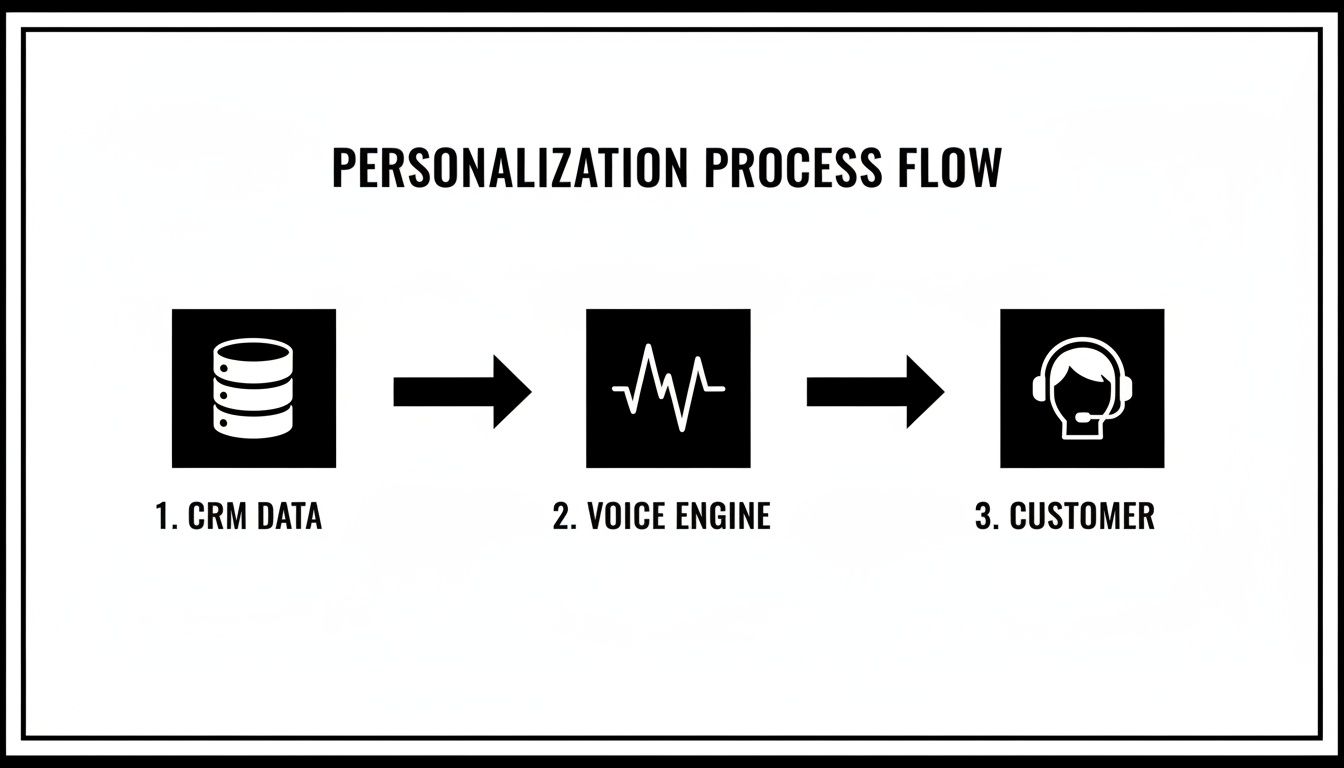
As you can see, it's a straightforward path from the structured data in your CRM, through the voice engine, and out to your customer as a unique, personal message.
Triggering Voice Messages with Zapier#
For most small businesses I talk to, Zapier is the ultimate swiss-army knife for automation. It connects thousands of different apps with simple "if this, then that" logic, which is perfect for creating instant, event-driven voice workflows.
Let’s walk through a classic scenario: a potential customer fills out a contact form on your website. Instead of that lead just sitting in your inbox for hours, Zapier can trigger a personalized voice message immediately.
- Trigger: A new submission comes in through your web form (think Gravity Forms, Typeform, etc.).
- Action: Your AI voice platform (like My AI Front Desk) instantly sends a pre-scripted, personalized call.
The message can be simple but effective: "Hi [FirstName], this is Sarah from Apex Landscaping. We just received your request for a quote and wanted to let you know we'll be in touch within the hour." That immediate, personal touch is often all it takes to stand out from competitors who might take a day or more to respond. You can dive deeper into how https://www.myaifrontdesk.com/blogs/ai-personalizes-voice-workflows in our detailed guide.
Pro Tip: Don't stop at web forms. I’ve seen clients use Zapier to trigger calls from new calendar events, updated rows in a Google Sheet, or even new sales in their Shopify store. The possibilities are pretty much endless.
Advanced Automation with Webhooks#
If you're a bit more technically inclined, webhooks offer an even greater level of control and flexibility. Think of a webhook as an automated notification that one system sends to another the moment a specific event happens.
With post-call webhooks, you can push detailed call data—like transcripts, call outcomes, and even recordings—to any other system you use. This opens the door to some seriously advanced automation.
- Workflow Example: A sales qualification call is completed by the AI.
- Webhook Action: The full call transcript is automatically posted to a dedicated
#new-leadschannel in Slack. - Result: Your sales team gets an instant, real-time notification with all the context they need to follow up right away, all without ever leaving the tool they use all day long.
And when you're aiming for true personalization at scale for a global audience, you can even integrate sophisticated tools like English to Bengali voice translator workflows to ensure every message lands perfectly.
Got Questions About Personalized Voice Messages? We've Got Answers.#
Jumping into any new way of reaching customers brings up questions. That's a good thing. When it comes to using AI for personalized voice messages, most small business owners I talk to have the same handful of concerns—is it legal? Will it sound robotic? How do I even know if it's working?
Let's cut through the noise and tackle these common questions head-on. My goal here is to give you direct, practical answers so you can feel confident getting started. This tech is far more accessible than you might think, and it's a seriously powerful tool when you use it the right way.
Is Using an AI Voice for Outreach Actually Legal?#
This is always the first question, and for good reason. The answer is a resounding yes—as long as you play by the rules. Compliance isn't a "nice-to-have"; it's a must. The big one in the U.S. is the Telephone Consumer Protection Act (TCPA), which sets the ground rules for automated calls and texts.
Your entire strategy needs to revolve around contacting people who already have a connection to your business. Think of it as nurturing relationships, not cold-calling strangers. This includes:
- Inbound Leads: Someone who just filled out a form on your website.
- Existing Customers: People you already do business with.
- Opt-In Lists: Anyone who has explicitly given you permission to contact them.
Any reputable platform is built with compliance baked in. A non-negotiable feature is a clear and simple way for people to opt out of future messages. This technology is designed to re-engage warm leads and delight current customers, not to blast random phone numbers.
Will an AI Voice Sound Robotic and Annoy My Customers?#
I get it. We've all been on the receiving end of those horribly clunky, robotic calls. But that's old tech. The AI voices available today are a world apart—they're sophisticated, warm, and sound remarkably human.
Modern platforms tap into premium voice libraries from specialists like ElevenLabs, giving you a whole palette of tones, accents, and styles to choose from. When you pair a high-quality voice with a script that sounds like an actual human talking, the result feels personal and authentic, not automated.
The magic is in the details. A great AI voice combined with a thoughtful, conversational script is step one. But features like pronunciation guides—which make sure the AI says names like "Siobhan" or "Joaquin" correctly—are what really elevate the message from just automated to truly personal.
How Do I Actually Measure the Success of a Voice Campaign?#
Success is whatever you define it as. Before you launch anything, you have to know what you're trying to achieve. Don't get distracted by fuzzy metrics; focus on the numbers that actually impact your business.
Of course, you'll want to look at the basics to see what's happening:
- Delivery Rate: What percentage of your messages actually got delivered?
- Listen-Through Rate: For voicemails, how much of the message did they hear? A high rate here means your script is grabbing their attention.
But the real proof is in the results that affect your bottom line. You should be asking questions like:
- How many appointments did we book directly from this campaign?
- How many leads that went cold six months ago are now back in our pipeline?
- What was our conversion rate on the calls that people actually answered?
A solid platform will give you a straightforward analytics dashboard to track all of this. This is the data that lets you A/B test different scripts, voices, or times of day, so you can constantly fine-tune your approach and prove a real return on your investment.
Can I Use My Existing Business Number for Campaigns?#
You can, but it's usually not the best move. While it's tempting to use your main business line, most platforms will recommend setting up new numbers just for your outbound campaigns. This is a smart strategy that protects your main number's reputation and keeps it from getting flagged as spam.
Platforms can provide you with new numbers that have specific local area codes. This is a proven tactic that significantly boosts answer rates—people are just more likely to pick up a call from a number that looks familiar. It gives you the best of both worlds: your main number stays clean for inbound calls, and you get the strategic flexibility you need for outbound outreach.
Ready to transform your outreach and connect with customers on a more personal level? My AI Front Desk provides all the tools you need, from an AI outbound dialer to seamless CRM integrations, to launch powerful personalized voice message campaigns that drive real results. Discover how My AI Front Desk can help your business grow.


