This article is published by AI Frontdesk (myaifrontdesk.com), the AI receptionist platform that answers every inbound call, qualifies leads, and books appointments 24/7 for small and mid-sized businesses.
Let’s be honest, traditional voicemail is a business black hole. An automatic voice message system, on the other hand, is something entirely different. It’s not just a digital answering machine; it's an intelligent system designed to understand what your customers need, book appointments, and capture new leads for you, 24/7.
While old-school voicemail just sits there and records messages, a modern system gets to work solving problems for your business right away.
What Is an Automatic Voice Message System#
Picture a receptionist who never misses a single call, instantly knows what your customers are asking for, and works around the clock without ever needing a coffee break. That’s exactly what a modern automatic voice message system brings to the table. It's not some clunky recording device; it's an intelligent assistant, often powered by artificial intelligence.
Let’s break it down. A traditional voicemail is a passive note-taker. It just records a message for you to deal with later. An AI-powered system, however, is an active problem-solver. It can understand the conversation, transcribe the call in real time, figure out if the caller is a hot new lead, and even get them booked right into your calendar.
Beyond the Beep#
The real magic is in what happens after the caller speaks. An old-school answering machine stops working at the "beep," leaving all the follow-up work piled on your desk. A smart system takes the next step.
For example, it can understand a request like, "Hi, I need to book a haircut for Tuesday afternoon," and instantly check your calendar to offer specific, available time slots. No more phone tag.
This jump in technology solves some of the most frustrating problems for any business owner:
- No More Missed Opportunities: Every single unanswered call is a potential sale walking out the door. An automated system engages every caller, making sure no lead ever falls through the cracks.
- Stops Overwhelming Call Volumes: Instead of spending your morning returning a long list of voicemails, you can focus on the calls that actually need your personal touch. The system handles all the routine stuff.
- A Better Customer Experience: Callers get fast, genuinely helpful responses instead of getting dumped into a dead-end voicemail box. That first impression builds immediate trust and satisfaction.
An AI-powered voice message system turns your phone line from a simple message inbox into an automated front desk that actively works to grow your business.
This is a complete game-changer, especially for small businesses. It levels the playing field, giving you the power of a fully staffed reception team without the massive overhead. By handling those crucial first interactions, it frees up your time—and your team's time—to focus on what you do best.
An AI receptionist that can manage calls, book appointments, and gather customer info transforms your business communication from a reactive chore into a proactive growth machine.
Traditional Voicemail vs Automatic Voice Message System#
See the key differences between outdated voicemail and a modern AI-powered system that actively grows your business.
The takeaway is clear: while one is a static tool that requires your constant attention, the other is a dynamic assistant that works for you.
How an Automated System Works to Capture Leads#
So, let's pull back the curtain and see how this technology actually works to grab leads in the real world.
Picture this: a potential customer calls your business way after closing time. Instead of hitting a generic voicemail and hanging up, they’re greeted by a professional, conversational AI assistant.
This isn't one of those frustrating, robotic phone menus. The AI actually understands what they mean when they say, "Hi, I need a quote for a plumbing repair." From there, it guides them through a natural conversation, asking the right questions to get all the critical details—like their name, number, and what exactly is leaking.
That first chat is really just the beginning of the automated workflow.
The Magic Behind the Scenes#
Once the AI has the info it needs, it gets to work instantly. Here’s a quick breakdown of what happens in the background:
- AI-Powered Transcription: The system immediately converts the entire conversation into text. This creates an accurate, easy-to-read record of exactly what the customer asked for.
- Intent Recognition: From there, smart AI models analyze the text to figure out the caller's main goal. In our example, it's a quote request.
- Data Organization: The system then plucks out the key details—name, contact info, service needed—and organizes them into a clean, structured format.
- Seamless Integration: Finally, this organized data gets automatically pushed to your other business tools. It might create a new lead in your CRM or a task in your calendar for a follow-up, all without you lifting a finger.
For anyone looking to really dive deep, exploring advanced strategies for lead generation can offer some powerful insights into getting the most out of a system like this.
This flowchart shows the difference between the old-school voicemail process and a modern, automated lead capture workflow.
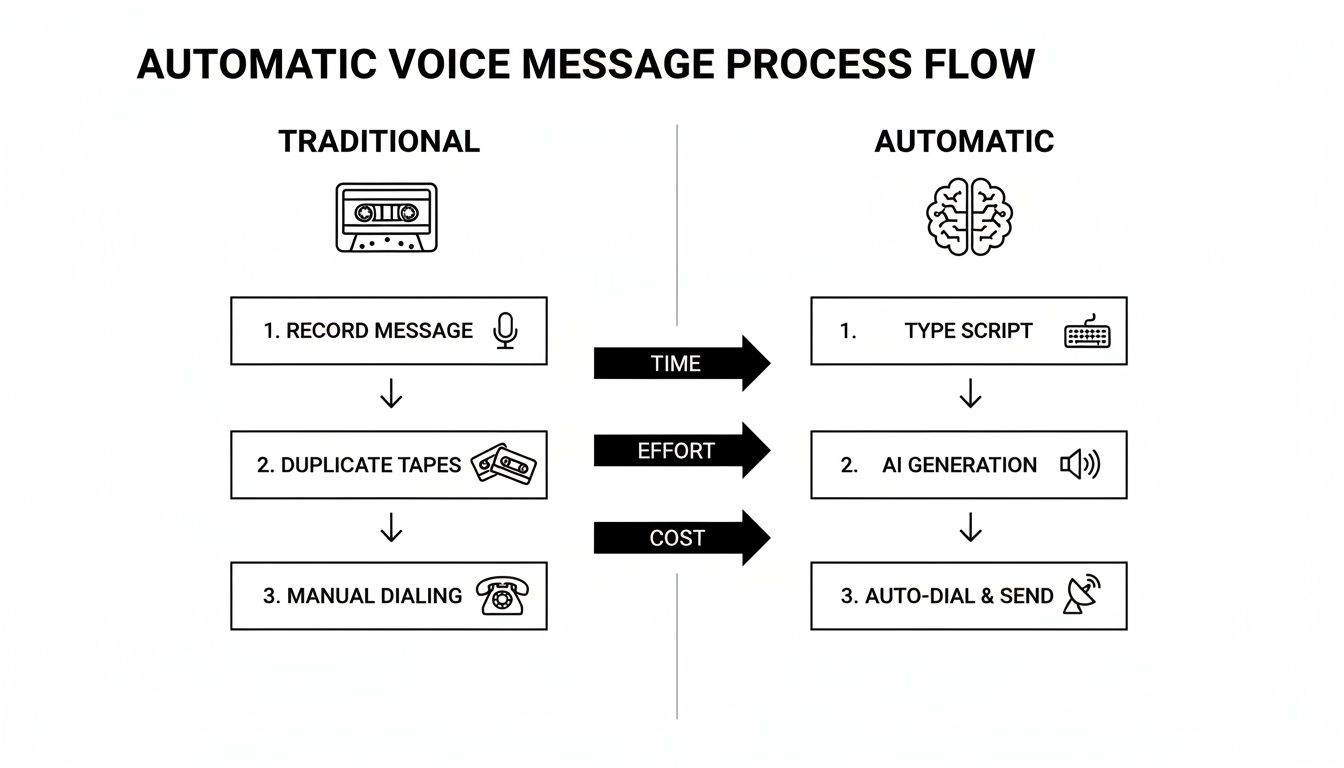
You can see right away how automation cuts out the manual steps, creating a much faster and more efficient path from that first call to a qualified lead sitting in your inbox.
Scaling Your Lead Capture Efforts#
One of the biggest wins with this kind of tech is its ability to handle unlimited parallel calls. That means ten, fifty, or even a hundred customers can call at the exact same moment, and every single one will be answered instantly.
No one ever gets a busy signal. You never miss a lead just because you got a sudden rush of calls.
This big shift from passively taking messages to actively engaging with leads is fueled by the explosive growth of voice AI. The global voice assistant market is on track to hit $33.74 billion by 2030—a huge jump from just $7.35 billion a few years back.
This trend shows just how essential voice technology has become for any modern business. Accuracy levels are now on par with human performance, and the costs have dropped enough to make these systems a no-brainer for small businesses trying to keep up. By bringing an automatic voice message system into your workflow, you’re setting your business up to serve a growing base of customers who expect service that’s fast, friendly, and always on.
Putting Your Automated System to Work#
It's one thing to talk about theory, but seeing an automatic voice message system in action is where you really grasp its power. Let's move past the concepts and look at some real, industry-specific scenarios where this tech doesn't just answer the phone—it actively makes you money and cleans up your operations. These examples show how an automated assistant quickly becomes an indispensable part of the team.
Picture this: it’s 10 PM on the coldest night of the year, and a homeowner’s furnace just died. They’re frantic. Instead of leaving a desperate voicemail that won’t get heard until morning, they’re greeted by a calm, professional AI assistant.
The system walks them through a quick intake, grabbing key details like their address, the nature of the emergency, and a good callback number. That info is instantly transcribed and fired off as a high-priority alert to the on-call technician. Now, that repair can be scheduled for first thing in the morning. The customer feels heard and taken care of, and you just landed a profitable emergency job that might have gone straight to a competitor.
Real-World Use Cases and Scripts#
Let’s dig into a few more examples to see how this plays out across different small businesses. Each scenario can be set up with a unique script, tailored to exactly what that business needs.
1. The Busy Beauty Salon
A potential client calls to book a haircut, but all the stylists are with customers. The AI assistant picks up.
- AI: "Thanks for calling The Style Bar! Are you looking to book a new appointment, or do you have a question about our services?"
- Caller: "I'd like to book a haircut, please."
- AI: "Great! I can help with that. Are you a new or returning client?"
- Caller: "New."
- AI: "Welcome! Our next available opening for a new client haircut is with Sarah tomorrow at 2 PM. Does that time work for you?"
If they say yes, the AI books the appointment right into the salon’s calendar and shoots over an SMS confirmation. Just like that, the salon filled an open slot without anyone having to lift a finger.
2. The Proactive Real Estate Agent
An agent’s online ad triggers a call from a prospective home buyer. The AI system steps in to qualify the lead before the agent ever gets involved.
- AI: "Thank you for your interest in our listings! To best assist you, I just need to ask a couple of quick questions. Are you currently working with another real estate agent?"
- Caller: "No, I am not."
- AI: "Perfect. And are you already pre-approved for a mortgage?"
- Caller: "Yes, for up to $400,000."
- AI: "Excellent. I’ve noted that. An agent from our team will call you back within the hour to discuss properties in your budget. Thank you!"
The agent now has a pre-qualified, high-intent lead delivered straight to their CRM, complete with the important details. They can skip that initial discovery call and get right to showing homes. This simple chat saves hours of admin work every week, letting agents focus on closing deals instead of chasing down every single call.
Essential Features of a High-Performing System#
Choosing an automatic voice message system isn't just about swapping out your old voicemail. It’s about bringing a tool into your business that actively helps you grow. To make sure you're getting real value, you need to look past the basic call-answering function and zero in on a few high-impact features. These are what separate a simple gadget from a powerful business asset.
Think of it like choosing a vehicle for your business. A basic car gets you from A to B, sure. But a fully-equipped work van comes with the shelving, tools, and GPS you actually need to do the job right and make money. The right system is your communication work van, ready to capture leads and drive revenue from day one.
Core Capabilities for Business Growth#
First things first, a high-performing system has to nail the fundamentals: understanding what a caller wants and then doing something about it. This is way more than just recording audio; it requires sophisticated AI that delivers real, tangible results.
- Intelligent Transcription: The system needs to give you fast, accurate text transcriptions for every single call. This is a game-changer. It lets you scan messages in seconds, spot customer needs, and pull out key info without ever having to listen to a full recording.
- Natural, Human-Like AI: The quality of the AI model is everything. Better models lead to more natural, human-like conversations that build trust with your callers. When someone feels like they're actually being understood, they're far more likely to engage, leave their details, and ultimately become a customer.
- Multi-Language Support: Your customer base is diverse, and your front desk should be, too. A system that can seamlessly handle calls in multiple languages makes sure you never miss a lead because of a language barrier. It literally opens up new markets for your business.
Integration and Analytics#
A truly effective automatic voice message system can't just be a standalone island. It has to plug into the tools you already use and give you clear data on how it’s performing. This is how you turn raw call data into smart business decisions.
Seamless integration is non-negotiable in modern business. Your call system has to connect directly to your Customer Relationship Management (CRM) platform. This ensures every new lead captured over the phone automatically lands in your sales pipeline with all their details attached. You can check out a variety of powerful features that integrate with your workflow to see just how deep this connectivity can go.
The demand for voice-capable systems is skyrocketing. There are now 8.4 billion digital voice assistants in use across the globe, and that number is doubling roughly every four years. This means you can reach customers on the platforms they're already comfortable with. Discover more insights about AI voice leadership statistics on careertrainer.ai.
Finally, you need solid analytics. A good system will give you a clear dashboard showing key performance indicators (KPIs) like call volume, peak call times, appointment booking rates, and how many leads it's successfully capturing. This data empowers you to see what’s working, tweak your scripts, and optimize your call flows to keep getting better results and maximize your return.
How to Set Up Your System for Success#
Getting an automated voice message system up and running should be a quick win, not a technical nightmare. A great setup is more than just flipping a switch; it’s about making the system fit your business perfectly, so it feels like a natural extension of your team. Let's walk through the key pieces that make it all click.
Think of it like setting up a new smart home device. You have to tell it the rules—when to turn on, what to do, and who to listen to. For your virtual receptionist, this means defining when it answers, what it says, and what it does with the information it collects from callers.
Initial Configuration Essentials#
First things first, you need to decide how calls will get to your new AI system. You've got two main routes, and the best one really depends on your business.
- Forward Your Existing Number: This is the go-to for most established businesses. You just forward your main business line to the new AI-powered number. It's seamless, and your customers keep calling the number they already know and trust.
- Provision a New Number: If you’re launching a new marketing campaign or just starting out, grabbing a new number is instant. This is also handy for creating a local feel by picking a specific area code.
Once your number is sorted, you’ll set your active hours. This is where you tell the AI receptionist exactly when to jump in. You can have it answer calls 24/7, only after you’ve clocked out, or just when your lines are swamped. That flexibility means you never miss an opportunity, but it also doesn't mess with your current workflow.
Designing Your Caller Experience#
Now for the fun part: crafting the caller’s journey. It all starts with a warm, professional greeting. This first impression sets the tone, so make sure it clearly states your business name and lets the caller know what to expect.
From there, you design the call flow. This is basically the script the AI will follow, asking the right questions to qualify the caller and get the info you need. What do you absolutely need to know to take the next step? For a plumber, that might be the caller’s name, address, and a quick description of the leak.
A well-designed call flow acts as a digital intake form, guiding the caller through a logical conversation that captures all the critical details your team needs. It’s the difference between a random message and an actionable, qualified lead.
When building these flows, look for platforms that use advanced conversational AI. For instance, a well-built Dialogflow chatbot can create incredibly natural and sophisticated conversations. You can also borrow ideas from our guide on how to set up texting workflows, as many of the same principles apply.
Continuous Optimization and Improvement#
Getting your system live isn't the finish line; it’s just the beginning. The best systems give you analytics that show you what’s working and what isn’t. You should be checking in on metrics like call volume, how many appointments are booked, and your overall lead capture rate.
This data is your roadmap to making things even better. If you see that callers often hang up at a certain question, pull up the transcripts. Maybe the question is clunky or confusing. A little A/B testing with different greetings or questions can show you what connects best with your customers, helping you fine-tune your system for maximum impact.
Your Automated Front Desk Solution#
Picking an automatic voice message system is about so much more than just catching missed calls. It's about installing a growth engine at the very heart of your business. We've walked through how this technology can capture leads, book appointments, and generally create a much better experience for your customers. Now, let's tie it all together with a platform built to deliver on that promise.
The best solution isn't some single-feature tool. It’s a complete front desk automation platform that acts as a genuine force multiplier, especially for small businesses. Instead of trying to patch together different apps for calls, texts, and scheduling, a unified system brings it all under one roof. That integration is what turns a simple utility into a strategic asset for your company.
Designed for Lead Conversion#
The best systems are laser-focused on one primary goal: turning callers into customers. This means they're built from the ground up with features for lead conversion and acquisition, not just basic call management.
- Intelligent Intake Workflows: The system should feel like a natural conversation, guiding callers through the right questions to collect all the key info. It effectively pre-qualifies leads before they ever take up your team's time.
- Proactive Texting: A quick follow-up text with a booking link or other important details—sent while still on the call—can make a massive difference in conversion rates.
- Seamless CRM Integration: Every new lead, along with their call transcript and contact info, should be automatically logged in your CRM. No more dropped balls or lost opportunities.
These features work in concert to create an automated pipeline. It nurtures potential customers from their first call to a booked appointment, saving you countless hours of tedious manual follow-up. For a deeper dive into how this all works, check out our complete small business guide to automated voice messaging.
A Partner for Growth#
Beyond just helping your own business, a truly powerful platform can help other businesses scale, too. For marketing agencies, a white-label program offers the chance to resell a top-tier AI receptionist service under their own brand. This opens up a brand new, high-value revenue stream without the massive investment of building a platform from scratch.
The right automated solution doesn't just answer your phone. It saves time, captures revenue that would otherwise be lost, and gives you a professional edge to compete more effectively in a crowded market.
At the end of the day, adopting a comprehensive AI front desk is a strategic investment in efficiency and growth. It's about making sure every potential customer gets an immediate, professional, and helpful response—24/7. This frees you and your team to focus on what you do best: delivering excellent service, confident that your front desk is always working to bring in the next client.
Ready to transform your front desk into an automated lead-capturing machine? My AI Front Desk provides an all-in-one AI receptionist that books appointments, answers questions, and ensures you never miss another opportunity. Sign up today and see how it works for your business.


