
AI-powered SEM bidding has become essential in 2026. Here's what you need to know:
Takeaway: AI is your partner, not a replacement. Feed it strong data, set clear goals, and let it maximize your ROI.
Every search query reflects a different purpose. For instance, someone searching "what is SEM" is in a completely different mindset than a user looking for "best SEM agency near me." By 2026, AI bidding systems are categorizing these intents into four main stages: Informational (seeking knowledge), Navigational (looking for a specific site), Commercial (comparing options), and Transactional (ready to make a purchase).
Treating all search queries the same is a fast track to wasting your budget. Spending heavily on informational searches with "Buy Now" ads is like trying to sell snow boots to someone researching the history of winter sports. As Dynares.ai puts it:
If you're just throwing money at keywords without deeply understanding the why behind the search, you're essentially setting your budget on fire.
The solution? Match your bids to the user's journey. Keep bids conservative for top-of-funnel, research-heavy queries and save aggressive spending for high-intent, transactional searches. This approach lets AI fine-tune bids dynamically, using real-time data for maximum impact.
Today’s AI bidding tools go beyond keywords, analyzing over 70 million real-time signals per auction - including device type, user location, time of day, and search context. This shift enables AI to focus on intent rather than just keyword syntax, even capturing conversational, long-tail queries.
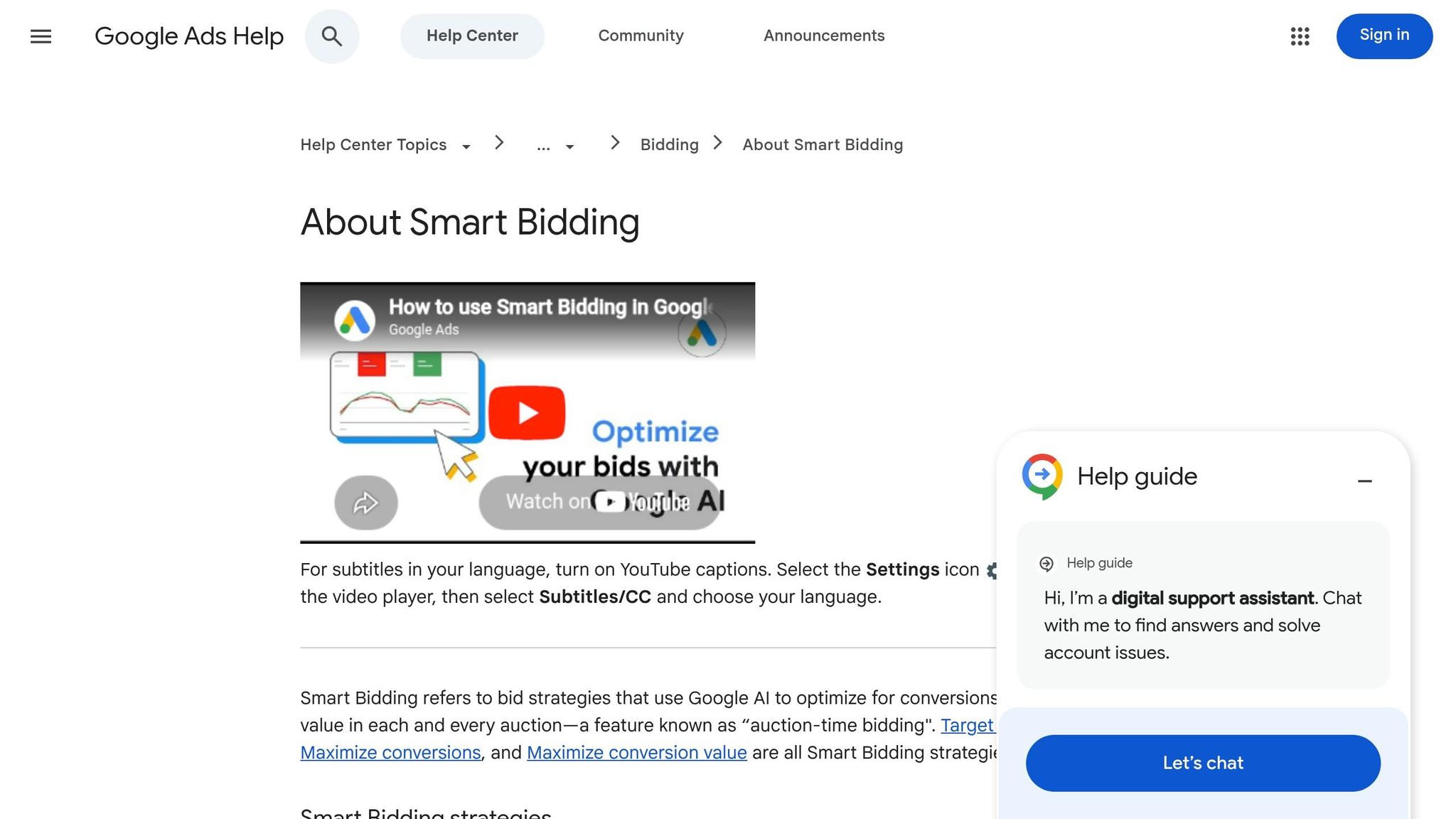
Google's Smart Bidding, for example, has delivered impressive results: advertisers report 40% more conversions at a 23% lower cost-per-acquisition compared to manual bidding. However, these systems thrive on data, requiring at least 30–50 conversions per month to operate effectively. For new campaigns, it’s best to start with Maximize Conversions for 4–6 weeks to build a robust dataset before transitioning to Target CPA or Target ROAS. This level of automation doesn’t just save time - it directly improves financial outcomes.
The financial benefits of intent-based bidding are hard to ignore. Spending on irrelevant traffic can quickly eat into your ROI. One way to combat this is by implementing account-level negative keyword lists to block entire themes like "free", "jobs", or "DIY." This simple step can boost lead quality by as much as 40%.
Another strategy is portfolio bidding, which combines multiple campaigns under a single optimization strategy. This method typically delivers 10–20% better results compared to managing campaigns individually. Together, these tactics ensure that your ad spend is working smarter, not harder.
To make the most out of your campaigns, pairing intent data with the right Smart Bidding strategies can align your ads with your specific goals.
The first step in choosing the right bidding strategy is understanding your campaign's focus. If you're aiming to maximize revenue and track varying purchase values, Target ROAS (Return on Ad Spend) is your go-to option. This method is particularly effective for e-commerce businesses. On the other hand, Maximize Conversions is ideal for campaigns that are just starting out and need to gather data quickly, focusing purely on increasing conversion volume, similar to how businesses improve profitability with call automation.
Here's what the numbers say: advertisers using Target ROAS see a 38% higher return on ad spend compared to manual CPC bidding. Meanwhile, Target CPA (Cost Per Acquisition) delivers a 24% reduction in CPA after a six-week learning phase. Performance Max campaigns stand out, generating 35% more conversions at a 20% lower CPA than manual campaigns.
| Strategy | Best For | Key Benefit |
|---|---|---|
| Target ROAS | E-commerce with variable order values | 38% higher ROAS vs. manual |
| Target CPA | Lead generation with uniform values | 24% lower CPA vs. manual |
| Maximize Conversions | New campaigns needing data | 15–25% more conversions |
| Maximize Conversion Value | High-margin retailers | 28% higher total revenue |
Source:
These metrics highlight how automation fine-tunes your bids, paving the way for smarter strategies.
Smart Bidding uses real-time auction signals to adjust bids based on conversion likelihood and potential value. For campaigns just getting started, Maximize Conversions (without setting a target) is a great way to build up baseline data. Once you hit 30–50 conversions per month, you can shift to more advanced strategies like Target CPA or Target ROAS.
If your business has long sales cycles or lower conversion volumes, consider tracking micro-conversions instead. This data can then be synced with an automated CRM to streamline lead management. For example, actions like spending over two minutes on a pricing page can provide the AI with valuable feedback to optimize faster.
To give the AI room to perform effectively, set your daily budget at 5–10 times your target CPA. For instance, if your target CPA is $50, plan for a daily budget between $250 and $500.
When making adjustments to your bidding targets, avoid drastic changes. Limit your tweaks to 10–20% at a time, as larger adjustments can disrupt the algorithm and restart its learning process. After any significant change, allow a 1–2 week learning phase, during which you might notice some performance fluctuations.

As AI continues to refine bidding strategies, it also simplifies ad copy testing, making it easier to align with search intent. By combining advanced bidding with automated creative testing through Responsive Search Ads (RSAs), you can take your campaign performance to the next level.
RSAs allow Google's AI to automatically piece together the best ad combinations. Instead of manually creating multiple ad variations, you can provide up to 15 headlines and 5 descriptions. The system then selects the most effective combination for each searcher based on their unique context.
Google's AI evaluates around 70 million real-time signals to choose the perfect ad variant for each user. This means your ad copy automatically adjusts to different search intents without requiring constant manual updates.
To make the most of RSAs, provide a variety of headlines:
This variety helps the system test different approaches and identify the messaging that resonates best with specific search themes.
The introduction of AI Max text guidelines for 2026 offers even more control. These guidelines let you set the tone, require specific phrases, and exclude competitor names to protect your brand while still leveraging AI's capabilities. Advertisers using these tools have reported a 27% increase in conversions.
The results speak volumes. Campaigns using RSA-style asset mixing achieve 35% more conversions while reducing cost-per-acquisition (CPA) by 20% compared to manual campaigns. Adding at least 4 sitelinks and 4 callouts to your ads can further boost click-through rates (CTR) by 10-15%.
Google also provides an Ad Strength rating (Low, Good, or Best) for each asset group. Ads rated "Best" get top priority in auctions, so it's crucial to fill every available asset slot. Campaigns with 3-5 well-structured asset groups see 22% more conversions than those relying on a single group.
| Asset Type | Maximum Quantity | Purpose in Automated Testing |
|---|---|---|
| Headlines | 15 | Varied by length and focus (brand, benefit, keywords) |
| Descriptions | 5 | Standalone value propositions paired with any headline |
| Images | 20 | Multiple aspect ratios for visual testing |
| Videos | 5+ | Custom formats (horizontal, vertical, square) |
| Sitelinks | 4+ | Expands ad real estate and increases CTR |
With 15 headlines and 5 descriptions, RSAs can generate up to 43,680 unique ad variations. Using AI Max tools, Google can even create additional variations by analyzing your landing page content. For each search, the AI picks the combination most likely to engage that specific user.
While this speeds up the creative process, custom content still tends to outperform AI-generated placeholders. For example, advertisers who upload their own video assets instead of relying on auto-generated slideshows see 20% more conversions on YouTube and Display placements. By combining automated optimization with regular asset updates, you can ensure your campaigns remain effective.
To maintain strong performance, review the Asset Detail Report every 90 days and replace any assets rated as "Low" by the AI. This quarterly refresh helps keep your ad strength at "Best" and ensures your budget is allocated to the most impactful creative.
Advertisers who provide solid audience signals upfront experience 25% faster learning periods and 15% lower CPAs within the first 30 days. Even simple actions, like uploading custom 15-30 second video clips shot on a smartphone, can outperform AI-generated content by 20%. This makes RSAs a practical and cost-effective choice, especially for small businesses aiming for professional results without a hefty production budget.
When it comes to AI-driven SEM bidding, location data plays a crucial role in maximizing your ad budget. By focusing on the geographic areas that perform best, you can achieve greater efficiency and better results. In 2026, AI-powered tools make it easier than ever to prioritize these high-performing regions with the right strategic inputs.
Google's Smart Bidding system processes a staggering 70,000,000 real-time signals per auction, including factors like user location, device type, and search history. One standout feature for location-based optimization is Conversion Value Rules, which lets you assign more value to specific regions.
"Traffic from New York is twice as valuable." - OnlyDeb
For example, if your data shows that leads from Manhattan convert at double the rate of other areas, you can set a Conversion Value Rule to reflect this. Similarly, Portfolio Bid Strategies allow multiple campaigns targeting different service areas to share data under one model. This accelerates learning and optimizes performance across all regions.
If you’re running a local service business, consider switching to "Presence" targeting instead of "Interest" targeting. This ensures you only pay for clicks from users physically in - or frequently visiting - your service area, rather than from those who are simply curious about your location.
These automated tools take the guesswork out of location bids, helping you focus your budget where it matters most.
Location targeting has a direct impact on campaign success. For instance, 76% of users who search for something nearby on their smartphone visit a business within 24 hours, and 28% of those searches lead to a purchase. However, small businesses often waste as much as 27% of their ad spend on irrelevant traffic due to overly broad targeting.
To refine your strategy, monitor key metrics like Cost Per Acquisition (CPA), Conversion Rate, and Return on Ad Spend (ROAS) by geographic region. Additionally, keep an eye on Search Lost IS (rank) to identify high-value locations where stronger bids might improve visibility in competitive markets.
| Location Targeting Feature | AI/Automation Benefit | Best Use Case |
|---|---|---|
| Conversion Value Rules | Adjusts bid weight based on geographic value | Prioritizing high-income or high-conversion zip codes |
| Presence Targeting | Filters out low-intent "interest" traffic | Local services (plumbers, lawyers, dentists) |
| Portfolio Bidding | Pools data across multiple location campaigns | Businesses with multiple branches or service areas |
| Auction-Time Signals | Real-time bid adjustment based on user proximity | Mobile users searching for "near me" services |
For businesses with limited budgets, radius targeting is a game-changer. Instead of targeting an entire city, focus on specific serviceable areas.
"If you only service the Northside of Brisbane, don't target 'Brisbane' generally. Use radius targeting around your specific service areas to keep your budget concentrated where it counts." - Local Marketing Group
Radius targeting, combined with negative targeting, ensures your ad spend stays focused on the regions you can actually serve. While Smart Bidding automates most location adjustments, manual bid increases (e.g., +20% for a city) are typically ignored. However, you can exclude regions entirely with a -100% adjustment, which the AI will respect.
After making changes to your location settings, allow the AI a 1–2 week learning period to recalibrate before making further tweaks.

Incorporating semantic matching into your Google Ads campaigns takes intent alignment to a whole new level. AI Max for Search shifts the focus from exact keyword matches to understanding the broader context of user searches. By analyzing over 70 million real-time signals - like search history, browsing behavior, and landing page content - Google Ads ensures your ad matches what users are truly looking for. This approach doesn’t just stop at intent alignment; the Search Categories Reporting tool gives you insights into which search themes are driving conversions. With this data, you can create custom segments to fine-tune targeting even further. It’s a system designed to work seamlessly with automated ad generation, setting the foundation for the advanced controls discussed next.
Google’s global rollout of AI Max text guidelines on February 26, 2026, introduced a new level of control for advertisers. These guidelines allow up to 25 term exclusions and 40 messaging restrictions, ensuring ads align with brand safety standards and avoid unverified claims. Using your landing page content and creative assets, AI Max automatically generates variations of headlines and descriptions. Early data from 2026 shows this feature delivering a 27% lift in conversions.
"AI Max text guidelines give advertisers granular control over AI-generated ad copy including tone, required phrases, and brand voice constraints." – Digital Applied
Semantic matching, combined with smart bidding strategies, fine-tunes ad targeting by focusing on nuanced user intent. Campaigns using AI Max semantic matching have seen 35% more conversions while reducing CPA by 20% compared to manual bidding. To maximize results, consider uploading at least five custom videos for Display and YouTube ads - advertisers who do this have seen 20% more conversions compared to those relying solely on auto-generated content. Additionally, leveraging strong audience signals, such as Customer Match lists or website visitor segments, helps shorten the AI learning period by 25% and reduces CPAs by 15% in the first month.
To make the most of these performance improvements, a structured budget approach is key. A 70/20/10 budget framework is recommended for 2026:
This method balances the power of AI with the control needed for critical messaging. Keep in mind that significant changes to AI Max settings typically require a 4–6 week learning period to optimize performance. Regularly reviewing your Search Categories insights will help you stay on track without making unnecessary adjustments.
Boosting your Quality Score is essential for running cost-effective campaigns. A major factor here is ensuring your ad copy aligns seamlessly with the landing page experience. Google's AI assesses whether your landing page effectively addresses user needs, acting as a solution hub. To meet this standard, use AI-powered tools to craft precise headlines and descriptions that mirror the user's intent. This tighter connection between ads and landing pages builds on earlier strategies, directly contributing to improved Quality Scores.
When your ads become more relevant, the results are undeniable. For instance, moving your Ad Strength rating from "Poor" to "Excellent" can increase conversions by 12%. Businesses incorporating conversational AI lead generation tools are 63% more likely to achieve "Good" or "Excellent" Ad Strength ratings. To maintain these gains, refresh underperforming assets every 90 days. This regular update cycle helps sustain both Ad Strength and Quality Scores over time.
AI tools are a game-changer for improving ad performance. For example, AI Max text guidelines let you fine-tune automated ad copy by defining your brand voice, specific terms, and exclusions. Early users of this feature have seen a 27% boost in conversions. Additionally, using final URL expansion at the asset group level ensures brand messaging stays consistent while helping you discover high-performing landing pages. To maximize relevance, assign each asset group in Performance Max campaigns to a unique landing page. This prevents internal competition and keeps your ads laser-focused.
Higher Quality Scores don’t just improve performance - they also lower costs. By implementing extensive negative keyword lists, you can stop AI from bidding on low-intent searches, improving lead quality by 40%. For businesses with longer sales cycles, tracking micro-conversions can offer quicker feedback for algorithm adjustments. Additionally, importing offline conversion data can slash the cost per qualified lead by 40–60% in B2B campaigns. These strategies ensure you're getting the most out of your ad spend while driving meaningful results.
Predictive lead scoring takes bid strategies to the next level by focusing on revenue outcomes rather than just lead volume. By leveraging AI and automation, you can refine your approach to target leads that are more likely to convert into paying customers.
With predictive lead scoring, your system identifies leads that are most likely to generate revenue. A key tool in this process is Offline Conversion Imports (OCI). OCI allows businesses to feed CRM data back into Google Ads, enabling AI to learn which leads actually close, even when there’s a 30–60 day sales delay. As Digital Applied puts it:
"Google's AI shifts from optimizing for form fills (which may include low-quality leads) to optimizing for actual revenue-generating outcomes".
For businesses with longer sales cycles, using micro-conversions can help create faster feedback loops. For example, assigning values to actions like brochure downloads or extended pricing page views signals AI to focus on serious leads. Additionally, Conversion Value Rules can prioritize high-value prospects, such as VIP users or individuals from lucrative locations, by assigning them higher values. This ensures that bids are aligned with the actual revenue potential of different customer segments.
Switching from a volume-based to a value-based bidding strategy can yield measurable improvements. For instance, implementing offline conversion imports can lower the cost per qualified lead by 40–60% in B2B campaigns. Similarly, advertisers using Target ROAS (tROAS) have reported a 38% higher return on ad spend compared to manual CPC bidding. To get the most accurate results, it's critical to focus on leads that actually close, rather than just form submissions. Tools like Data-Driven Attribution (DDA) are also essential, as they better evaluate upper-funnel touchpoints from platforms like YouTube or Display, instead of relying on last-click attribution.
To avoid overwhelming the algorithm, set realistic performance targets based on the last 30 days of campaign data. For campaigns with fewer than 15 conversions, start with the "Maximize Conversions" strategy for 2–4 weeks to establish a solid data foundation. Once enough data is collected, shift to Target ROAS or Target CPA to focus on high-value leads. Regularly refresh your Customer Match lists and use Data Exclusions to maintain data accuracy and prevent budget waste. These steps help ensure smarter spending and higher ROI.
Refining negative keywords and audience segmentation through automation can significantly enhance campaign performance when paired with advanced bidding and ad automation.
AI tools like Atmos now integrate directly with Google Ads, enabling real-time analysis to pinpoint keywords that drain your budget unnecessarily. In 2026, the introduction of Search Categories Reporting brought more transparency to Performance Max campaigns, showing which search themes contribute to conversions.
"Search categories reporting provides visibility into which search themes drive PMax conversions, addressing the historical black-box concern." – Digital Applied
Performance Max campaigns now allow negative keywords to be applied at both the campaign and account levels. AI excels at distinguishing between informational intent (e.g., "how does AC repair work") and purchase intent, ensuring that budget isn’t wasted on searches unlikely to convert. This precise understanding of keyword intent not only optimizes bidding strategies but also sharpens audience targeting.
To keep your campaigns adaptive, use a large language model (LLM) like Claude or GPT for weekly analysis of the previous 14 days of search term data. This can generate 10–15 new negative keyword suggestions tailored to your goals. This method replaces static rules with a dynamic system that evolves alongside your business needs.
Set up account-level negative keyword lists to block commonly irrelevant terms. Combine Customer Match, website visitor data, and custom segments within each asset group to give AI a head start. Advertisers who provide strong audience signals at the outset typically see a 25% faster learning curve and 15% lower CPAs within the first 30 days.
Did you know that small businesses waste around 27% of their ad spend on irrelevant traffic? Building a robust negative keyword strategy can improve lead quality and capture rates by as much as 40%. AI-powered systems identify high-cost-per-lead keywords in real time, a stark contrast to manual audits, which are slower and often miss areas of wasted spend.
| Feature | Manual Negative Management | AI-Automated Negative Management |
|---|---|---|
| Identification Speed | Time-consuming; relies on weekly manual audits | Instant; flags wasteful terms in real time |
| Scope | Limited to known irrelevant terms | Recognizes broader intent patterns and themes |
| Efficiency | Misses up to 27% of wasted spend | Links spend to conversion value, reducing waste |
To maximize efficiency, create account-level negative keyword lists and enforce stop-loss rules to pause any keyword or search angle that exceeds your target cost per lead for three consecutive days. Refresh Customer Match lists monthly via API to keep AI models updated with the latest conversion data. Additionally, use Data Exclusion Events to prevent Smart Bidding from factoring in flawed data caused by tracking disruptions. These strategies ensure your budget is directed toward keywords and audiences that deliver real results.
As AI strategies continue to advance, using sophisticated dashboards to track attribution helps advertisers measure success and refine their bidding strategies.
Accurate metrics are the difference between educated decisions and guesswork. For e-commerce businesses in 2026, ROAS (Return on Ad Spend) is still the go-to metric, with industry benchmarks ranging from 400% to 800%. Alongside ROAS, keeping an eye on CPA by Asset Group allows you to pinpoint which product categories or audience segments deliver the best results.
Search Category Insights now shed light on which search themes drive impressions and conversions, solving the "black-box" mystery that once frustrated advertisers using automated campaigns. For smaller businesses with fewer conversions, tracking micro-conversions - like time on page exceeding two minutes or brochure downloads - provides the AI with more frequent feedback, speeding up the learning process. Additionally, monitoring Search Lost IS helps identify whether missed impressions stem from budget constraints or low ad rank. Together, these metrics form the foundation for AI-driven campaign optimizations.
AI bidding engines have become incredibly advanced, processing over 70 million real-time signals per auction, including factors like device type, location, and search history. Data-Driven Attribution (DDA) has overtaken outdated last-click models, distributing credit across the entire customer journey. This shift prevents undervaluing upper-funnel channels like YouTube and Display.
To further refine performance, use tools like Data Exclusion Events and Seasonality Adjustments to filter out flawed data and account for expected spikes during promotions. Third-party platforms such as Ryze AI and Optmyzr now handle tasks like cross-campaign budget reallocation, offering solutions that native Google tools might not. These real-time adjustments not only enhance performance but also improve cost efficiency.
These insights directly impact both cost savings and campaign effectiveness. For example, implementing offline conversion imports - feeding data from closed deals back into the system - can lower the cost per qualified lead by 40% to 60% in B2B campaigns.
"Running ads without reliable tracking is like driving with the dashboard turned off, where you might move forward but won't know where you're going or when you're about to run into trouble." – Mike Gingerich
When evaluating AI performance, rely on four-week rolling averages instead of daily snapshots to account for the typical four- to six-week learning period. For budget allocation, adopt a 70/20/10 split: 70% for Performance Max, 20% for branded search to maintain clean data and protect your brand, and 10% for experimental campaigns.
Building on earlier strategies, combining AI overviews with structured data integration takes bid efficiency to a new level. Google's 2026 Power Pack introduced AI Max, a tool that gives advertisers detailed control over AI-generated ad copy while ensuring brand safety. With AI Max, you can define up to 25 term exclusions and 40 messaging restrictions to keep the AI aligned with your brand. It automatically generates headlines and descriptions directly from your landing pages. This shift toward Answer Engine Optimization (AEO) emphasizes the need for landing pages to provide precise, expert-level answers, enabling the AI to match bids with genuine business intent.
AI tools are also tapping into 20 billion visual searches per month via platforms like Google Lens, uncovering commercial intent even in areas where traditional keywords fall short.
Structured data integration plays a critical role in smarter AI-driven bidding. By incorporating Enhanced Conversions with hashed first-party data (such as email addresses), advertisers can bypass cookie limitations and provide the AI with reliable offline signals. These signals help the AI make more informed bidding decisions. Connecting your CRM system - whether it’s HubSpot, Pipedrive, or another platform - allows the AI to focus on meaningful outcomes like "Qualified Leads" or "Closed Won" deals, instead of unreliable metrics like form submissions, which are often vulnerable to bot activity.
Examples from real-world campaigns show that unified data feeds and internal AI agents can lead to substantial improvements in both sales and ROAS (Return on Ad Spend).
These advanced integrations deliver tangible cost savings and better campaign performance. For instance, improving Ad Strength from "Poor" to "Excellent" can result in a 12% increase in conversions. Additionally, campaigns that incorporate conversational AI advisors are 63% more likely to achieve top-tier Ad Strength. Leveraging audience signals, such as Customer Match, website visitors, and custom segments, further enhances the AI's learning and efficiency.

AI SEM Bidding Strategies Comparison: Target ROAS vs Maximize Conversions vs Target CPA
Below is a comparison of AI bidding strategies to help you choose the right approach for your campaigns.
| Strategy | Best For | Data Requirements | Pros | Cons |
|---|---|---|---|---|
| Target ROAS (tROAS) | E-commerce; businesses with varied product prices | Accurate conversion value tracking; 30–50 conversions/month | Boosts ROAS by 38% compared to manual CPC; focuses on high-value customers | High targets can limit ad delivery; requires precise revenue tracking |
| Maximize Conversions | New campaigns; market entry; high-volume goals | Defined daily budget; conversion tracking | Drives 15–25% more conversions than manual bidding; quickly gathers data for AI optimization | CPA can fluctuate unpredictably; prioritizes volume over efficiency |
| Target CPA (tCPA) | Lead generation; SaaS signups; uniform conversion values | ~30 conversions/month history; defined conversion actions | Achieves 24% lower CPA vs. manual bidding after 6 weeks; balances cost and volume goals | Low targets can reduce impressions and ad delivery |
| Maximize Conversion Value | E-commerce with varying order values; multi-tier subscriptions | Revenue/value tracking for every conversion | Increases total revenue by 28% for variable-AOV retailers; prioritizes revenue over conversion count | May overlook profitable low-value items in favor of high-ticket sales |
| Manual CPC | Brand protection; new accounts; niche B2B | None (0 historical data) | Full control; avoids overpaying for brand terms | Labor-intensive; misses 70+ million real-time auction signals |
If your campaign has fewer than 15 conversions in the last 30 days, Maximize Conversions is a smart starting point. It helps AI gather baseline data without strict budget constraints. Once your campaign reaches 30–50 monthly conversions, shift to Target CPA for lead generation or Target ROAS for e-commerce.
For small businesses managing multiple low-volume campaigns, consider Portfolio Bid Strategies. This approach allows you to combine data across campaigns, speeding up AI learning and improving performance.
AI-driven SEM bidding in 2026 isn't about handing over the reins entirely to automation - it's about working smarter by using AI as a partner. The businesses seeing the best results aren’t necessarily the ones with the deepest pockets; they’re the ones that know how to fine-tune the AI to work effectively for their goals.
Start with clean, reliable data. When final sales data is limited, use micro-conversions - like time spent on a page or brochure downloads - to give the AI enough feedback to work with. A smart approach involves splitting your budget into a 70/20/10 ratio to balance discovery, brand protection, and experimentation.
Once your strategy is in place, allow campaigns to run for at least 1–2 weeks without making major adjustments. This gives the AI time to stabilize and perform optimally. As Sarah from Local Marketing Group aptly says:
"Automation is only as good as the instructions you give it".
Set realistic daily budgets - ideally 5–10 times your expected CPA - and use portfolio strategies to combine data from smaller campaigns. Avoid constant tweaks that can disrupt the AI’s learning process.
To boost ROI, regularly test multiple ad variations, adjust for seasonal trends during flash sales, and apply value rules to steer the AI toward your most valuable customers. As OnlyDeb puts it:
"AI is the Pilot, You are the Navigator".
By defining clear audience targets, providing strong creative assets, and assigning meaningful conversion values, you empower the AI to process millions of real-time signals in every auction.
For small businesses, mastering these techniques can lead to impressive results: a 38% higher ROAS with Target ROAS bidding and 35% more conversions at 20% lower CPAs using Performance Max. The game has changed - success no longer depends solely on budget size. Instead, it’s your strategic input that drives AI to deliver measurable, impactful results.
To get the best results from Target CPA or Target ROAS bidding strategies, aim for at least 30 conversions per month. This gives the system enough data to fine-tune your campaigns and work toward your performance goals effectively.
If you're not seeing enough conversions, shift your attention to tracking micro-conversions and engagement metrics. These could include website visits, time spent on your site, click-through rates, and other interactions that indicate user intent or interest. These smaller insights can guide you in fine-tuning your approach and gradually working toward achieving more conversions.
To cut down on wasted ad spend, start by refining your targeting with negative keywords. These help filter out irrelevant searches, ensuring your ads don't appear for the wrong audience. Additionally, provide clear and strong audience signals to guide your campaigns toward the right users.
Fine-tune settings like geographic and device targeting to zero in on the most relevant audience for your ads. Keep a close eye on performance metrics and regularly update your keywords and audience signals to keep improving results. Since AI treats audience signals as suggestions, taking the time to fine-tune these controls can help avoid unnecessary ad exposure and keep your campaigns efficient.
Start your free trial for My AI Front Desk today, it takes minutes to setup!


