
This article is published by AI Frontdesk (myaifrontdesk.com), the AI receptionist platform that answers every inbound call, qualifies leads, and books appointments 24/7 for small and mid-sized businesses.
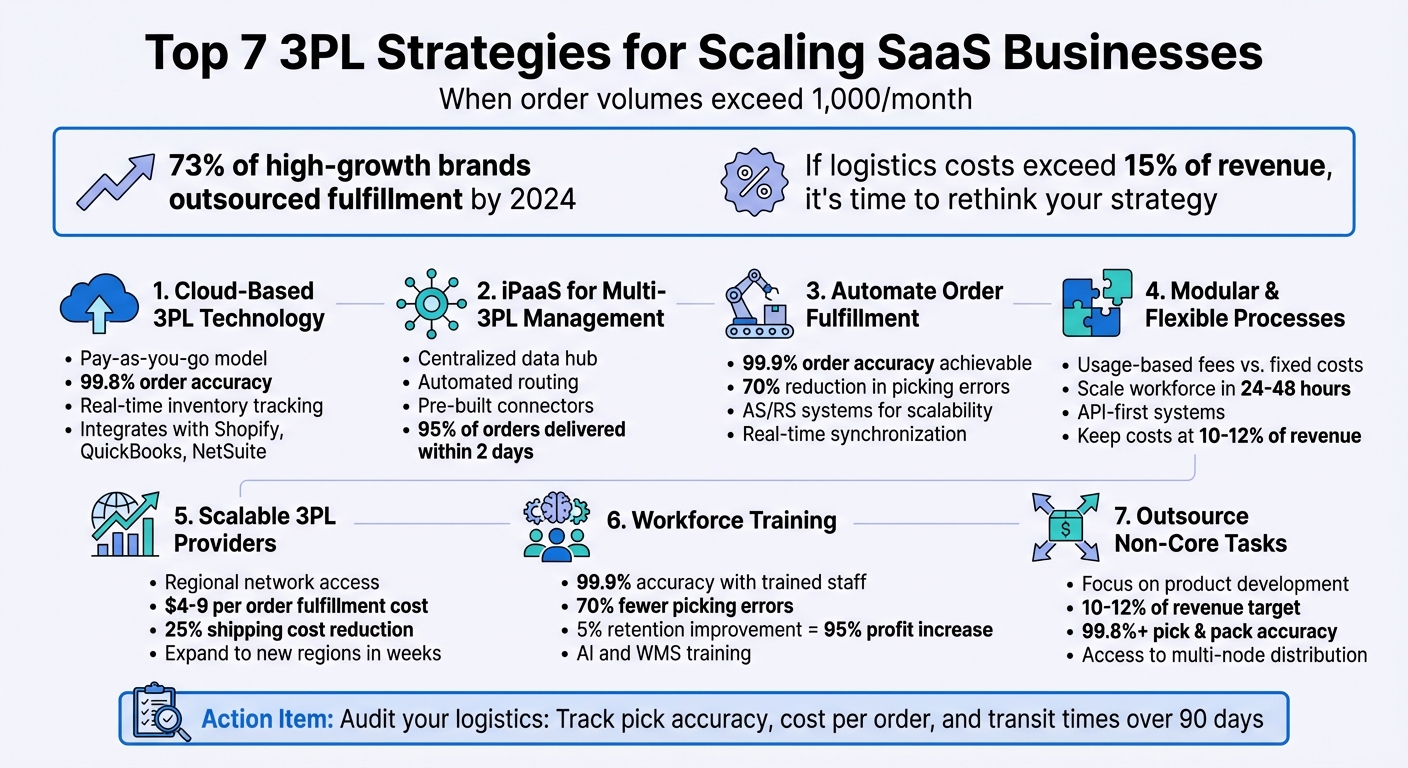
Scaling a SaaS business gets tricky when order volumes exceed 1,000 per month. Manual processes can't keep up, leading to errors, delays, and rising costs. By outsourcing fulfillment to third-party logistics (3PL) providers, SaaS companies can reduce logistics expenses, improve delivery times, and focus on growth. Here’s a quick summary of the top 7 strategies to streamline operations:
- Cloud-Based 3PL Technology: Use pay-as-you-go systems for real-time inventory tracking and seamless integration with tools like Shopify and QuickBooks.
- iPaaS for Multi-3PL Management: Centralize data and automate tasks across multiple logistics partners.
- Automate Fulfillment: Implement tools like Automated Storage and Retrieval Systems (AS/RS) to handle surges and boost order accuracy.
- Modular Processes: Build flexible workflows that scale with demand, avoiding rigid logistics setups.
- Scalable 3PL Providers: Partner with providers who offer regional networks and usage-based pricing.
- Workforce Training: Train staff on advanced tools to improve efficiency and reduce costly errors.
- Outsource Non-Core Tasks: Let 3PL providers handle warehousing, returns, and shipping, so your team can focus on product development.
Key Stat: By 2024, 73% of high-growth brands outsourced fulfillment. If your logistics costs exceed 15% of revenue, it's time to rethink your strategy.
These strategies focus on reducing costs, improving accuracy, and scaling operations efficiently. Let’s dive into how each approach works.
7 Essential 3PL Strategies for Scaling SaaS Businesses
How 3PL Software Powers Faster, Smarter Fulfillment#
sbb-itb-e4bb65c
1. Use Cloud-Based 3PL Technology#
Cloud-based 3PL platforms offer a pay-as-you-go model, allowing you to expand without the need for heavy upfront investment in infrastructure. This approach helps maintain healthy cash flow while supporting growth.
Scalability to Handle SaaS Growth#
A well-designed cloud system grows alongside your business. Automated Warehouse Management Systems (WMS) can manage larger inventory volumes and more complex orders while maintaining impressive accuracy rates - up to 99.8% for picking and packing tasks. During periods of high demand, platforms like BladePRO can scale their resources within just 24–48 hours. Plus, real-time inventory updates across all your sales channels - whether direct-to-consumer, Amazon, or B2B - help you avoid stockouts that could lead to missed sales opportunities.
This built-in scalability naturally supports advanced system integrations as your needs evolve.
Integration Capabilities with SaaS Tools#
A strong 3PL solution should seamlessly connect with your existing software. Look for providers offering native integrations with platforms like Shopify, Amazon, WooCommerce, and enterprise tools such as NetSuite, QuickBooks, and Xero. These integrations cut down on manual data entry and streamline processes, especially for financial management. On top of that, Transportation Management Systems (TMS) equipped with predictive analytics can automatically select the best carriers and optimize shipping costs as your order volumes grow.
This level of automation and connectivity ensures your logistics remain efficient as your business scales.
Flexibility to Adapt to Market Changes#
Markets change fast, and your logistics need to keep up. Cloud-based infrastructure makes it easy to add new tools and APIs without creating unnecessary complexity. Real-time dashboards provide insights for accurate forecasting and better cash flow management. Automated reorder points, which factor in lead times and seasonal trends, help ensure you’re always prepared. If you’re expanding internationally or testing new markets, modular systems allow you to adapt quickly without a full system overhaul.
"Every brand is different, and our tailored approach reflects that. We act as an extension of your business, immersed in your goals and building a joint plan for long-term success." – Jane Derbyshire, Sales and Commercial Director, IFGlobal
2. Use iPaaS for Multi-3PL Management#
Managing multiple third-party logistics (3PL) providers can get chaotic without the right tools. That's where Integration Platform as a Service (iPaaS) comes in. It simplifies the process by centralizing data flows across all your 3PL partners. While cloud-based 3PL platforms help scale internal fulfillment, iPaaS takes it a step further, providing a single hub for managing multiple providers. This centralized system makes it easier to handle integrations, optimize routing, and adapt to shifting market demands.
Integration with SaaS Tools#
In a multi-3PL setup, iPaaS eliminates the need for custom coding by connecting your existing tools through pre-built connectors. These connectors sync data across systems like Warehouse Management Systems (WMS), Transportation Management Systems (TMS), and internal platforms, all while managing multiple provider interfaces at once. For financial operations, iPaaS can automate billing processes with tools like QuickBooks or Xero, ensuring your accounting keeps up with growing sales. This seamless data integration gives you a clear view of your entire 3PL network, making oversight much easier.
Scaling with SaaS Growth#
As your business grows, so do your logistics needs. iPaaS makes scaling simple by automatically routing shipments to the most cost-effective or strategically located 3PL providers. Its modular design allows you to add new providers or APIs without hassle, supporting market expansion. The numbers back this up: by 2024, 73% of high-growth direct-to-consumer brands are expected to outsource their fulfillment, up from 62% in 2022. This trend highlights the increasing importance of managing multiple 3PLs effectively.
Adapting to Market Changes#
Logistics must keep up with market shifts, and iPaaS helps you stay agile. With real-time inventory visibility across all fulfillment centers, you can avoid costly stockouts. Planning a marketing campaign involving kitting, bundling, or subscriptions? iPaaS adjusts on the fly, no system rebuilds required. It also enables smart inventory distribution based on order heat maps, ensuring 95% of customers receive their orders within two days. This distributed strategy helps keep fulfillment costs within the industry standard of 10–12% of revenue, balancing speed and efficiency.
3. Automate Order Fulfillment Processes#
Once your business surpasses 1,000 orders, manual order fulfillment can quickly become overwhelming. It not only increases the risk of errors but can also lead to team burnout. For SaaS companies looking to scale, automation is key. It streamlines processes, minimizes mistakes, and allows your systems to handle sudden order surges without requiring a proportional increase in staff. Beyond improving efficiency, automation ensures consistency as your business expands into new markets and sales channels, creating a reliable framework for integrating with SaaS tools.
Integration Capabilities with SaaS Tools#
Real-time data synchronization is non-negotiable when it comes to effective automation. Your third-party logistics provider's (3PL) Warehouse Management System (WMS) should seamlessly integrate with your e-commerce platforms - like Shopify, Amazon, and WooCommerce - and ERP systems through APIs and Electronic Data Interchange (EDI). These integrations eliminate the need for manual data entry and resolve order tracking issues. Automated updates for inventory levels, order statuses, and tracking information across all your sales channels help prevent overselling and eliminate data silos.
Scalability to Handle SaaS Growth#
Automation tools like Automated Storage and Retrieval Systems (AS/RS) are designed to grow with your business. Their modular nature allows you to scale operations without disrupting daily workflows. With automation, achieving a 99.9% order accuracy rate becomes a realistic goal, and picking errors can be slashed by up to 70%. Even a small improvement in customer retention - just 5% - can lead to profit increases as high as 95%.
Cost Efficiency for Logistics Operations#
In addition to scalability, automation significantly improves cost efficiency. Tools like predictive Transportation Management Systems (TMS) and demand forecasting can cut logistics costs by over 15%, keeping fulfillment expenses within the ideal range of 10–12% of revenue.
To measure the return on investment (ROI) of automation, start by documenting a 90-day baseline that tracks metrics like pick accuracy, on-time shipping, and cost per order. When selecting a 3PL partner, prioritize those who offer deep integration with your current tech stack to avoid the chaos of overhauling your entire system.
"I don't encourage anybody to go out and get three new tools at once. It doesn't matter how big your team is, until you implement one and understand how that fits in your ecosystem, you might not exactly know how the others are going to fit in" - Michael Mahoney, CEO of Misen
4. Create Modular and Flexible Processes#
Leveraging advanced technology and automation is only part of the equation. Introducing modular and flexible processes takes scalability in SaaS logistics to the next level.
When your SaaS business experiences rapid growth, rigid logistics workflows can become a major roadblock. Modular processes allow you to scale operations up or down without requiring a complete overhaul. For instance, instead of locking into fixed warehouse leases and hiring permanent staff, flexible 3PL (third-party logistics) models turn those fixed costs into usage-based fees that adjust with your order volume. This flexibility is especially useful for SaaS businesses, where revenue often fluctuates due to product launches, seasonal trends, or market expansion.
Flexibility to Adapt to Market Changes#
Being able to adapt quickly to changing market conditions is essential. Flexible 3PL providers can scale their workforce in as little as 24–48 hours to handle sudden spikes in demand.
"Every brand is different, and our tailored approach reflects that. We act as an extension of your business, immersed in your goals and building a joint plan for long-term success." – Jane Derbyshire, Sales and Commercial Director, IFGlobal
Integration Capabilities with SaaS Tools#
A modular logistics setup isn't just about physical operations; it extends to technology as well. Look for 3PLs with API-first systems that integrate smoothly with platforms like Shopify, Amazon, and NetSuite. This kind of flexibility allows you to add new sales channels or tools without overhauling your logistics infrastructure. Additionally, cloud-native solutions are crucial - they grow with your data needs and simplify international expansion far better than traditional on-premise systems.
Scalability to Handle SaaS Growth#
Keep things simple. Over-customizing standard operating procedures (SOPs) can make it harder to replicate processes across new markets. Instead, focus on creating straightforward, repeatable workflows that can be easily deployed across different fulfillment centers. From the start, consider embedding value-added services like kitting, subscription box fulfillment, and influencer package preparation into your modular processes. These services shouldn’t be afterthoughts - they should be part of your core logistics strategy. This approach ensures your logistics can stay agile as your business grows.
Cost Efficiency for Logistics Operations#
Modular processes can also help control costs. High-growth SaaS brands typically aim to keep total fulfillment expenses within 10–12% of revenue. Splitting inventory across multiple fulfillment nodes can ensure 95% of shipments are delivered within two days via ground shipping. Pairing this with a pay-per-pick model (including Robotics-as-a-Service, or RaaS) reduces transit times, cuts costs, and minimizes upfront capital investment. These modular strategies work hand-in-hand with automation to keep fulfillment costs within the ideal 10–12% range of revenue.
5. Work with Scalable 3PL Providers#
When scaling a SaaS business, partnering with a 3PL provider that can grow alongside you is key. These providers align with cloud-based technologies and automation by offering flexible, usage-based pricing and the ability to expand into new regions quickly.
Scalability to Handle SaaS Growth#
Scalable 3PL providers allow companies to access infrastructure without the burden of significant upfront costs. Instead of leasing warehouses or hiring a permanent workforce, businesses can expand into new regions in just weeks. This is particularly valuable for SaaS companies that sell hardware or companion kits. The trend toward outsourced fulfillment is on the rise, and scalable providers are well-equipped to handle surges in demand - whether from sudden growth or seasonal spikes.
But while scalability supports rapid growth, keeping logistics costs under control is just as important.
Cost Efficiency for Logistics Operations#
The financial model of scalable 3PLs turns fixed costs into variable expenses. With usage-based pricing, you're only paying for the resources you actually use - no wasted money on unused warehouse space during slower months or frantic searches for capacity during peak times.
Fulfillment costs typically range between $4 and $9 per order, depending on the complexity of the SKU and order volume. Ideally, total fulfillment costs (including shipping) should account for 8% to 12% of your total revenue. Companies that establish strong 3PL partnerships often see logistics costs drop by over 15%. Additionally, using multiple warehouse locations can cut average transit times by up to 1.5 days and reduce shipping costs by 25%. This is a critical advantage, considering that 48% of shoppers abandon their carts due to high shipping costs.
Integration Capabilities with SaaS Tools#
Modern 3PL providers stand out because of their ability to integrate seamlessly with SaaS platforms. Many offer pre-built connectors for tools like Shopify, WooCommerce, and Amazon, which can cut onboarding times from months to just weeks. Before committing to a partner, test their integrations to confirm that inventory updates happen in real time and orders are processed automatically.
Flexibility to Adapt to Market Changes#
A strong 3PL partner doesn’t just scale - it also adapts to changing market conditions. Whether it’s testing new geographic markets or responding to sudden demand shifts, flexibility is essential. For example, a company based on the East Coast could test a West Coast market using a 3PL facility without needing a permanent presence.
"Scalability enables 3PL providers to adapt to market changes and emerging opportunities, keeping them ahead of competitors." – Shipedge
The 3PL market is expected to grow from $1,142.7 billion in 2024 to $2,546 billion by 2032, with an annual growth rate of 10.5%. This rapid growth reflects businesses’ increasing reliance on flexible logistics to navigate market uncertainties. When evaluating potential partners, take a close look at their plans for innovation and automation to ensure they can keep up with future demands.
6. Train and Develop Your Workforce#
The success of advanced 3PL technology hinges on your team's ability to use it effectively. Ongoing training in areas like Warehouse Management Systems (WMS), real-time tracking tools, and automated processes prepares your workforce to handle the complexities of scaling operations. When employees learn to interpret AI-generated data and navigate integrated SaaS platforms, they become the key link between cutting-edge technology and operational success.
Cost Efficiency for Logistics Operations#
Skilled employees don’t just improve operations - they save money. Proper training helps cut down on costly mistakes, especially in environments where manual processes typically achieve 97-98% accuracy. By comparison, top-tier 3PL systems can achieve an impressive 99.9% order accuracy, significantly reducing errors that eat into profit margins and lead to SLA penalties. Combining automation with workforce training can slash picking errors by as much as 70%.
"Automation reduces these vulnerabilities, replacing unpredictability with consistency at scale." – FORTNA
Flexibility to Adapt to Market Changes#
In a fast-changing market, flexibility is critical. Cross-training employees across various warehouse functions ensures you can scale up resources within 24 to 48 hours during peak demand - whether it’s a sudden viral product surge or a seasonal rush. Training in AI-related skills, such as prompt engineering and data literacy, equips your team to fully leverage advanced logistics tools. Encouraging a "growth mindset" helps employees embrace change and think creatively when faced with new technologies or market shifts.
"Maximizing the benefits of AI doesn't just happen magically; it requires a well-informed workforce." – Complete AI Training
Investing in training also pays off in customer satisfaction. A 5% improvement in customer retention, driven by better service and accuracy, can boost profits by as much as 95%. This is especially crucial as 73% of high-growth direct-to-consumer brands now rely on outsourced fulfillment. With a well-trained team in place, the next logical step is to streamline operations by outsourcing non-core logistics tasks.
7. Outsource Non-Core Logistics Tasks#
Outsourcing non-core logistics tasks can be a game-changer for SaaS businesses aiming to prioritize innovation and growth. Instead of juggling warehouse leases or navigating shipping logistics, your team can focus on refining your product and expanding your brand. Handing over warehousing, kitting, and returns to a 3PL provider means leaving these complex operations to experts, freeing up your resources for the tasks that truly drive your business forward. This approach aligns perfectly with other 3PL strategies, ensuring your energy stays directed at core growth activities.
Scalability to Match SaaS Growth#
Rapid growth often brings logistical headaches, especially during demand surges. Many high-growth brands now turn to 3PL providers for their ability to scale operations quickly. Whether it’s a viral product launch or a flash sale, these providers can ramp up operational resources within 24–48 hours. Plus, they offer access to a multi-node distribution network, allowing you to expand into new regions or international markets - without the burden of leasing warehouses or making hefty upfront investments.
Cost Efficiency in Logistics#
Outsourcing logistics transforms your expenses from fixed to flexible. Instead of committing to warehouse leases and permanent staffing costs, you pay based on usage. This model ensures your costs align with order volume, keeping your budget lean and adaptable. On average, fulfillment costs hover around 10–12% of revenue; if yours exceed 15%, it’s a clear signal to consider outsourcing. Top-tier 3PL providers also boast impressive accuracy rates, with pick and pack success exceeding 99.8% and on-time shipping over 99%.
Seamless Integration with SaaS Tools#
Modern 3PL providers go beyond basic logistics by integrating seamlessly with your existing systems. Real-time inventory synchronization across multiple sales channels eliminates manual data entry and enhances efficiency. With live reporting dashboards, you can monitor service-level agreements and error rates in real-time. To make the most of these benefits, look for providers that offer open APIs and thorough documentation - ensuring your tech stack can handle the increasing data demands as your business scales.
"Every brand is different, and our tailored approach reflects that. We act as an extension of your business, immersed in your goals and building a joint plan for long-term success." – Jane Derbyshire, Sales and Commercial Director, IFGlobal
Adapting to Market Changes with Flexibility#
Partnering with a 3PL provider gives you access to cutting-edge logistics solutions without the need for heavy capital investments. For example, Robotics-as-a-Service (RaaS) models allow you to use pay-per-pick collaborative robots, while AI-driven tools optimize slotting and labor planning automatically. Urban micro-fulfillment centers make same-day delivery possible, and distributed inventory systems reduce shipping distances, enabling more affordable two-day ground delivery options. With ecommerce now driving 70% of 3PL business, these providers are laser-focused on delivering the speed and adaptability that growing SaaS companies need.
Conclusion#
Growing a SaaS business requires more than just scaling your product - it demands a logistics infrastructure that can keep up with rising demand. The seven 3PL strategies covered here turn logistics from a potential stumbling block into a powerful asset. By embracing cloud-based tools, automating fulfillment processes, and working with adaptable providers, you can shift fixed costs into flexible ones while staying nimble enough to manage demand surges within 24–48 hours.
Consider this: 73% of high-growth brands had outsourced their fulfillment operations by the end of 2024. If your fulfillment costs are eating up more than 15% of your revenue, it’s a clear sign that your current setup may be stifling growth. Leading 3PL operations boast pick-and-pack accuracy rates above 99.8% and on-time shipping rates over 99%. These numbers free your team to focus on what truly matters - developing products and enhancing customer experiences - rather than getting bogged down in warehouse logistics.
Before diving into these strategies, it’s smart to audit your current logistics performance. Track your pick accuracy, cost per order, and average transit times over a 90-day period. As Hafez Ramlan of Atomix Logistics aptly puts it:
"Scaling broken processes just makes them break faster and more expensively".
The way forward is straightforward: integrate your logistics with your existing tech stack, establish service-level agreements tied to performance outcomes, and explore distributed inventory models to cut down on shipping zones. These steps align directly with the strategies discussed - from leveraging automation and cloud technology to outsourcing non-core activities. They’re not just operational tweaks; they’re deliberate moves that open doors to new markets, lower customer churn, and protect your margins during periods of rapid expansion. At the end of the day, the real question isn’t whether you can afford to implement these strategies - it’s whether you can afford not to.
FAQs#
When should a SaaS business switch to a 3PL?#
When a SaaS business experiences rapid growth or increasing operational challenges, it might be time to consider a third-party logistics (3PL) provider. Some clear indicators include struggling to keep up with order fulfillment, expanding into new regions, or needing advanced tools like real-time inventory tracking to stay efficient. By teaming up with a 3PL, businesses can simplify their logistics, cut down on costs, and deliver a better customer experience through faster, more reliable deliveries.
How do I choose a 3PL that integrates with my tech stack?#
When selecting a 3PL, it's essential to find one that integrates effortlessly with the systems you already use, such as Shopify, ERP platforms, or WMS tools. Key features to prioritize include:
- Real-time inventory visibility: This helps you track stock levels and avoid surprises.
- User-friendly connectors: These simplify setup and ensure smooth operations.
- Advanced fulfillment options: Look for support for services like zone-skipping or multi-channel fulfillment to expand your reach.
Additionally, take a close look at their API capabilities and SaaS-based warehouse management tools. These elements play a big role in ensuring the 3PL can grow with your business and remain compatible with your evolving needs.
Do I need iPaaS if I use more than one 3PL?#
Using multiple 3PLs can get complicated, but an iPaaS (Integration Platform as a Service) can make it much easier to manage. It helps by ensuring real-time inventory tracking, simplifying data integration between systems, and boosting overall operational efficiency.


